My shopping cart
Your cart is currently empty.
Continue ShoppingWhat if the most soulful resonance you've ever heard isn't found in a factory-fresh instrument, but in the seasoned wood of a guitar that's been played for decades? The global guitar market is surging toward a projected $10.78 billion in 2026, yet the most discerning players know the real treasures are often found when buying used acoustic guitars. It's a strategic pursuit of matured tone that requires a sharp eye and a genuine reverence for high-end craftsmanship.
A professional setup is a wise investment that ensures your pre-owned instrument matches your specific playing style. While costs vary based on your geographic location and the complexity of the work, you should check with a local luthier for their current rates. A standard setup typically involves adjusting the nut slots, saddle height, and truss rod. This service transforms a used find into a highly playable masterpiece tailored to your unique touch. If you are looking for professional guidance to accompany your new instrument, you can find out more about Per-session music instruction fees at Grace Music Academy.
You're likely looking for that perfect balance of value and character, but it's completely normal to feel a bit of trepidation. The fear of a warped neck or a hidden crack can make the pre-owned market feel like a minefield. This guide empowers you to master the technical nuances of evaluating instruments so you can spot a masterpiece while avoiding costly liabilities. We'll explore how to identify structural integrity, why specific brands hold their prestige, and where to find expertly vetted instruments that offer that coveted, matured resonance.
The global market for the Acoustic guitar is projected to reach $10.78 billion this year. While many enthusiasts look toward new inventory, the most seasoned players focus on buying used acoustic guitars to find instruments that have already begun their sonic evolution. Choosing a pre-owned instrument offers a distinct "Value Gap." This allows you to hold a boutique or Custom Shop build that might otherwise remain financially out of reach. Beyond the financial advantage, these instruments carry a heritage and character that factory-fresh models often lack. Every minor mark and played-in fret tells a story of artistry and dedication.
Sustainability is another powerful driver for the modern collector. By choosing a pre-owned instrument, you make an eco-conscious choice that honors the existing harvest of rare tonewoods. You aren't just buying a tool; you're becoming the next steward of a musical legacy. It's a way to appreciate premium craftsmanship while respecting the natural resources that make these instruments possible.
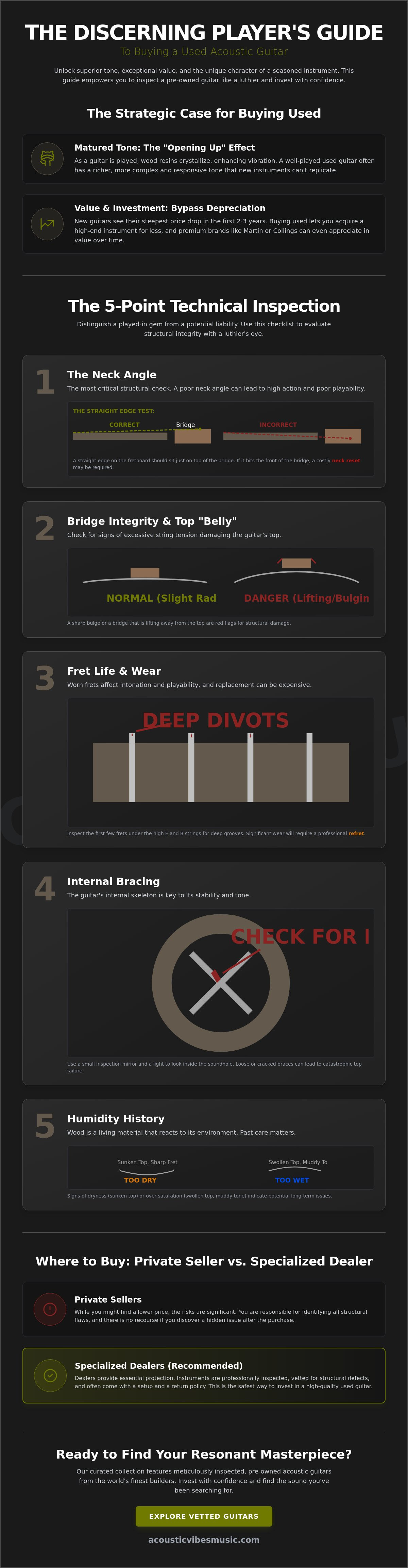
High-end tonewoods like Spruce and Cedar don't remain static; they evolve through play. As a guitar is played, the constant vibration causes the cellular structure of the wood to shift and settle. Opening up is the process where resin within wood crystallizes over time to enhance vibration. This maturation means a well-loved 10-year-old instrument often possesses a sweeter, more complex harmonic profile than a brand-new counterpart. The wood effectively learns how to vibrate. This results in a more responsive and resonant masterpiece that feels alive in your hands.
Understanding market fluctuations is key to a smart acquisition. Typically, the first 2-3 years of a guitar’s life see the steepest price drop. This creates a prime window for savvy buyers to secure professional-grade gear. However, certain brands like Martin and Collings are known for their remarkable ability to hold or even increase in value. While "used" refers to any pre-owned piece, "vintage" status brings investment potential that transcends mere utility. Buying used acoustic guitars allows you to bypass that initial depreciation hit while securing a high-performance instrument that may appreciate as it ages.
Securing a masterpiece requires more than just an ear for tone; it demands a luthier's eye for structural integrity. When buying used acoustic guitars, your goal is to distinguish between a "played-in" gem and a financial liability. A beautiful finish can hide significant structural fatigue. Use this professional checklist to evaluate any potential acquisition with the confidence of a seasoned curator.
If you prefer an instrument that has already passed these rigorous tests, explore our curated selection of vetted acoustic guitars. Every piece in our collection undergoes a meticulous evaluation to ensure it meets our standards for craftsmanship and playability.
The "Straight Edge Test" is your best diagnostic tool. Lay a long straight edge along the fretboard toward the bridge. Ideally, the end of the ruler should rest exactly on top of the wooden bridge. If it falls significantly below the bridge, the neck angle is failing. Check the saddle height as well. If the action is high but the saddle is already shaved down to the bridge wood, there's no "meat" left for future adjustments. For a deeper dive into the nuances of professional appraisal, industry experts at Acoustic Guitar Magazine offer an excellent primer on How to Shop for a Used Guitar.
Run your hand along the edge of the neck. If the fret ends feel sharp or "sprouted," the guitar has been dangerously dry. This often leads to center-seam cracks on the top or back. Use a bright LED light inside the body in a dark room. If light leaks through the wood, you've found a hairline fracture. These issues are fixable, but they should be identified before you commit to buying used acoustic guitars.
Finding your next masterpiece requires a choice between the wild frontier of peer-to-peer marketplaces and the refined security of a curated gallery. The "Marketplace Gamble" often lures enthusiasts with the promise of a basement bargain. Platforms like eBay and Reverb are popular, but they come with inherent risks. While Reverb's 5% selling fee or eBay’s 6.7% final value fee might influence a seller's price, these platforms offer zero protection against hidden structural defects or poor humidity management. Buying used acoustic guitars from a private individual means you are the sole inspector, often with no recourse if a "mint" instrument arrives with a lifting bridge or a compromised neck.
Specialized boutique dealers offer a starkly different experience. Instead of a transaction, you enter a partnership with a passionate curator. Dealers treat their inventory with reverence, maintaining strict humidity-controlled environments that protect delicate tonewoods from the stresses of seasonal change. When you choose a reputable dealer, you're paying for the peace of mind that comes with a luthier-vetted instrument. The excitement of discovery is never dampened by the fear of an expensive, unforeseen repair. It's a more methodical, appreciative way to build a collection.
Every instrument in a high-end shop should arrive ready for the stage. Professional setups are often included with your purchase, ensuring the action and intonation match your specific playing style. This isn't just a convenience; it's a significant financial saving. A reliable dealer will also provide an "Approval Period." This allows you to experience the guitar's voice in your own space before making a final commitment. Shipping is handled with extreme care, utilizing specialized packing techniques and climate-controlled logistics to safeguard premium acoustics during transit.
Consignment offers a unique gateway to rare and boutique builds. These instruments are often owned by collectors who treat their gear with professional-level care. Curated shops act as a safe middleman, providing a transparent history report that a private seller simply cannot match. Exploring Used and Consignment Instruments provides a safer entry point for those seeking elite craftsmanship without the "new" price tag. It's an opportunity to acquire a guitar with a documented lineage and a guaranteed stamp of structural health.
Every legendary builder has a unique structural DNA. Understanding these nuances is vital when buying used acoustic guitars, as it allows you to anticipate maintenance needs and long-term value retention. While a vintage Martin might offer unparalleled harmonic complexity, a modern Taylor provides revolutionary serviceability. You aren't just buying wood and wire; you're investing in a specific era of luthier engineering. It's a journey into the heritage of the craft. Let's look at what makes these iconic names stand out in the pre-owned market.
Martin instruments from the "Golden Era" reissues and the Custom Shop are highly coveted for their traditional construction and rich, bass-forward resonance. When inspecting these models, keep an eye out for "binding squeeze" at the waist or pickguard shrinkage. These are common quirks where materials age at different rates, occasionally pulling on the top wood. Keep in mind that since November 26, 2019, finished instruments containing most rosewood species are exempt from CITES permit requirements, though Brazilian rosewood remains strictly regulated. Conversely, Taylor Guitars revolutionized the industry with the NT neck. Because this is a bolt-on design, a neck reset that would be a major surgery on other brands is a simple shim adjustment on a Taylor. Explore our Martin Custom Shop and Taylor Guitars collections to see these distinct engineering philosophies in person.
Boutique builders operate with a level of precision that mass-production factories rarely match. Names like Lowden and Collings hold their value exceptionally well because of their limited production and elite material selection. Boutique guitars often feature higher-grade tonewoods that age more predictably. These builders frequently use hand-rubbed oil or thin nitrocellulose finishes. These finishes allow the wood to breathe and vibrate more freely than thick modern coatings. When buying used acoustic guitars from these makers, you're often securing a luthier-grade instrument that has been meticulously voiced for maximum resonance and tonal balance.
Ready to experience the pinnacle of acoustic craftsmanship? Browse our full selection of premium used and consignment guitars to find an instrument that speaks to your soul.
Securing your instrument is only the first chapter of the journey. Once you've navigated the strategic nuances of buying used acoustic guitars, your role evolves from seeker to steward. You now hold a piece of musical history with a voice that has matured over years of dedicated play. Protecting this investment requires a methodical, appreciative approach to care. The transition from a professional gallery to your personal space is a delicate time for aged tonewoods, and your attention to detail here ensures the instrument's value remains intact for decades.
Respect the "First 48 Hours" rule above all else. If your guitar was shipped, the internal environment of the case may differ significantly from your home's climate. Resisting the urge to immediately unbox the instrument is a test of patience, but it prevents finish checking and structural shock. Allow the case to reach room temperature naturally before opening it. This slow acclimatization ensures the wood cells settle without the stress of sudden expansion or contraction, preserving the artisanal finish you've worked hard to find.
Aged guitars often boast superior stability compared to factory-fresh models. Their resins have crystallized; their fibers have settled. Yet, they're not invincible. Maintaining a consistent humidity level between 40% and 50% is the most effective way to safeguard the instrument's structural integrity. Use a digital hygrometer to monitor your space. While in-case humidifiers are convenient for travel, a dedicated room-based system offers the most reliable protection for a high-end collection. Watch for warning signs like a sunken top or a change in action. These are the wood's ways of signaling a need for environmental adjustment.
A professional setup is the final step in making a pre-owned masterpiece truly yours. Every player has a unique touch, and a skilled luthier can adjust the nut and saddle to match your preferred string gauge and attack. This precision work optimizes intonation and maximizes the instrument's harmonic resonance. Beyond mechanical adjustments, take the time to restore the guitar's aesthetic glory. Conditioning a dark Ebony or Rosewood fretboard restores its deep luster and tactile smoothness. This process isn't just about maintenance; it's a ritual of appreciation for the craftsmanship that created the instrument. Ready to find a masterpiece? Explore our curated collection of premium acoustic guitars.
Your search for a masterpiece shouldn't be a game of chance. We've uncovered how the cellular maturation of aged tonewoods yields a resonance that factory-fresh models simply can't match. By applying a luthier's eye to structural integrity and understanding brand-specific engineering, you've transformed the act of buying used acoustic guitars into a strategic pursuit of quality. Proper post-purchase care and humidity management ensure that this matured voice continues to flourish in your hands for a lifetime.
Acoustic Vibes Music serves as your trusted advisor in this journey. As a Martin Custom Shop Expert Dealer, we provide a level of specialized knowledge that protects your investment from the first glance to the final chord. Every instrument we offer is refined through professional in-house luthier services and delivered with nationwide shipping featuring specialized climate-controlled packing. We handle the technical vetting so you can focus on the artistry. Browse our curated collection of luthier-vetted used acoustic guitars today. Your next great musical chapter is ready to begin.
Choosing between new and used depends on your desire for pristine condition versus tonal maturity. A used instrument often provides access to higher-tier craftsmanship at a more accessible price point. While new guitars offer a blank slate, pre-owned pieces have already begun the "opening up" process. This allows you to secure a professional-grade instrument that has already bypassed the initial depreciation phase common in the first few years of ownership.
Structural integrity is the most vital factor when buying used acoustic guitars. Specifically, you must evaluate the neck angle to ensure the instrument doesn't require an expensive reset. A guitar with a failing neck angle or a lifting bridge can quickly become a financial liability. Always prioritize the health of the wood and the stability of the internal bracing over minor cosmetic imperfections or surface-level wear.
You can identify a potential neck reset by performing the "Straight Edge Test" along the fretboard toward the bridge. If the straight edge falls significantly below the top of the wooden bridge, the neck angle is likely compromised. Another warning sign is high string action combined with a very low saddle. If there is no room left to lower the saddle further, a professional neck reset is often the only remaining solution.
Many enthusiasts believe used guitars possess a sweeter and more resonant voice due to the crystallization of resins within the wood. This process occurs as the instrument is played over several years, allowing the cellular structure of the top to vibrate with greater efficiency. While a new guitar offers crisp and modern clarity, a seasoned instrument often displays a more complex harmonic profile that only comes with age and dedicated play.
Finish cracks, often called "checking," are typically cosmetic and result from rapid temperature changes rather than structural failure. These fine lines in the nitrocellulose lacquer are common on vintage instruments and rarely affect the tone. However, you must distinguish these from actual wood cracks. A crack that penetrates the grain of the top or back requires professional attention to prevent further separation and a loss of resonance.
The primary risks of online acquisitions include hidden structural defects and inadequate climate control during shipping. Buying used acoustic guitars from private marketplaces often lacks a rigorous vetting process, leaving you vulnerable to instruments with warped necks or loose internal bracing. To mitigate these risks, prioritize sellers who provide detailed internal photos and offer an approval period. Selecting a specialized dealer ensures the instrument has been professionally inspected and packed securely.
A professional setup is a wise investment that ensures your pre-owned instrument matches your specific playing style. While costs vary based on your geographic location and the complexity of the work, you should check with a local luthier for their current rates. A standard setup typically involves adjusting the nut slots, saddle height, and truss rod. This service transforms a used find into a highly playable masterpiece tailored to your unique touch.
Heritage brands and boutique builders consistently hold their value best due to their reputation for elite craftsmanship. Names like Martin, Collings, and Lowden are particularly sought after by collectors for their historical significance and superior material selection. Taylor instruments also maintain strong resale value, partly due to their innovative NT neck design which simplifies long-term maintenance. Investing in these brands often provides a more stable financial return than mass-market alternatives.