My shopping cart
Your cart is currently empty.
Continue ShoppingA foam label alone doesn’t guarantee compatibility. SFF foam cannot be assumed safe for every nitrocellulose finish: manufacturers use different formulations with varying proportions of chemical agents. Choosing a guitar stand safe for a nitro finish means considering the instrument’s finish as well as the padding it touches.
Caution is sensible. Even well-padded stands concentrate contact pressure in a small area, and dye transfer or prolonged contact can leave marks that are difficult to reverse. Heat and sunlight can increase the risk.
This guide explains what SFF foam is and why its name alone can’t establish compatibility. You’ll learn how padding, pressure, dye transfer, and storage conditions affect finish marking, and what to consider when choosing how to support a guitar between playing sessions. The goal is practical: understand the risks, protect the finish, and make an informed choice.
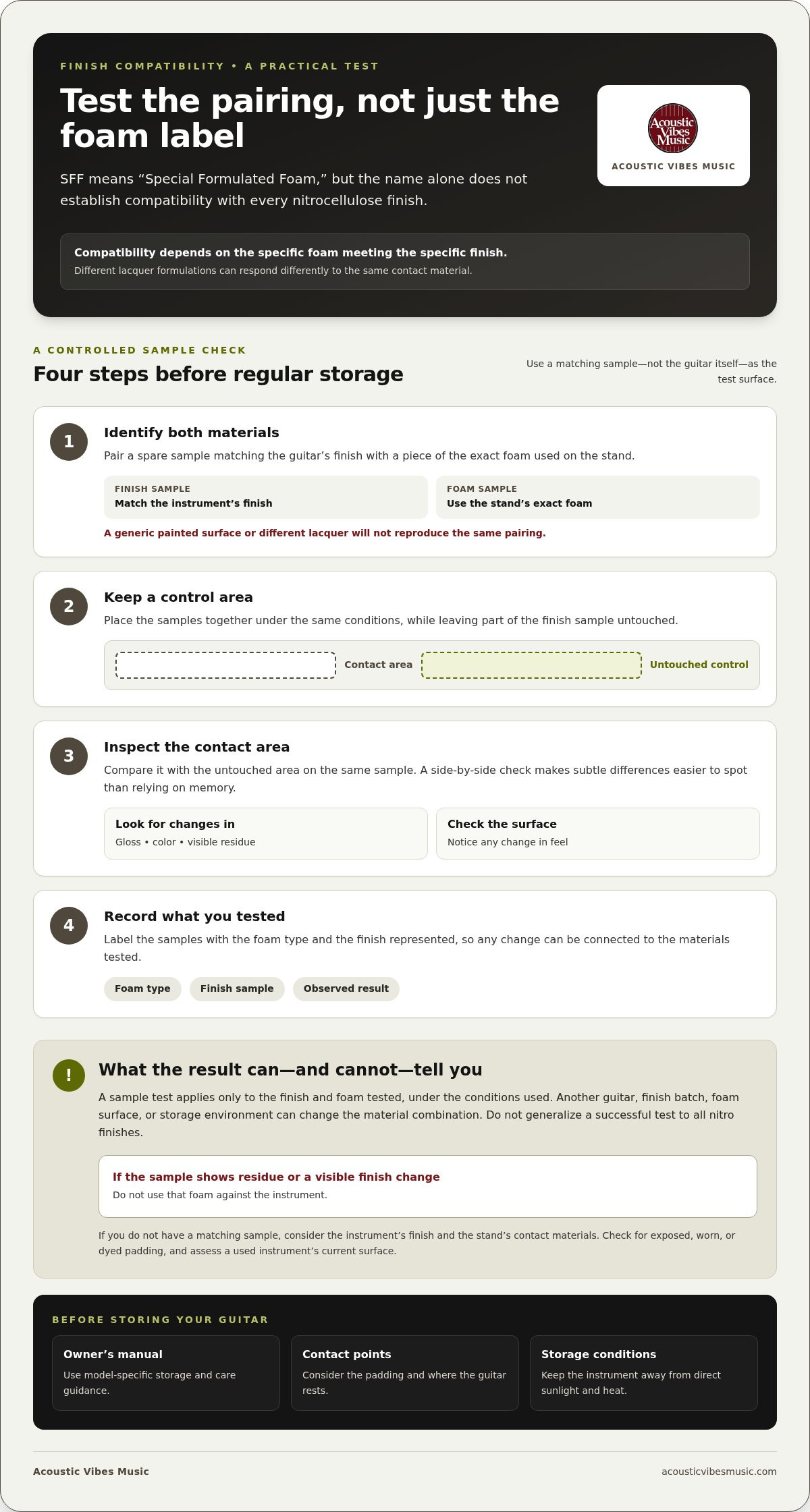
SFF means “Special Formulated Foam,” but the name alone doesn’t establish compatibility with every guitar finish. Instrument manufacturers use many lacquer formulations, which can respond differently to the same contact material. Foam that leaves one finish unchanged may mark another, so assess compatibility as a pairing between specific foam and a specific finish.
Test a sample before placing a valuable instrument on unfamiliar padding. The most useful comparison pairs a spare sample matching the guitar’s finish with a piece of the exact foam used on the stand. A generic painted surface or different lacquer won’t reproduce the same material pairing. Don’t use the guitar itself as a test surface.
Keep the test controlled. Note which foam and finish samples you’re comparing, then place them together under the same conditions. Inspect the contact area for changes in gloss, color, surface feel, or visible residue, and compare it with an untouched area on the same sample. A side-by-side check makes subtle differences easier to spot than relying on memory.
A sample test has limits: it represents only the finish and foam tested, not every guitar made with nitrocellulose lacquer. Manufacturers use different nitrocellulose formulations with varying proportions of chemical agents. Another guitar, finish batch, foam surface, or storage environment can change the material combination. Don’t generalize a successful test to all nitro finishes.
When choosing a guitar stand safe for a nitro finish, prioritize specific evidence over a broad foam label. If you don’t have a matching sample, base your decision on the instrument’s finish and the stand’s contact materials. Check for exposed, worn, or dyed padding, which changes what touches the lacquer. A used instrument’s finish may differ from its original specification, so assess its current surface rather than relying on a general label.
Testing is most useful before regular storage, while the guitar can stay off unfamiliar padding. If a sample shows residue or a visible finish change, don’t use that foam against the instrument. If it remains unchanged, the result applies only to the tested pairing and conditions. Keep the sample with your notes for a useful reference when comparing stand padding later.
Finish marks can have causes beyond stand padding. Contact pressure, heat, sunlight, and material transfer affect an instrument in different ways. A guitar resting on one narrow support point, for example, experiences concentrated pressure rather than contact across a broad surface. If its lacquer is vulnerable or still curing, prolonged contact can leave a visible impression.
Heat changes conditions at the contact point. Direct sunlight can warm the finish, worsen pressure marks, cause sagging, or change the color. A stand beside a sunny window may leave one section of the guitar warm while the rest stays shaded. That uneven exposure matters: the area touching the stand may also be under pressure, making a mark more pronounced.
Curing is another factor. Reports have noted an increase in undercured guitars built in 2020 and 2021, while the cause remains uncertain. An undercured finish may be more susceptible to impressions from contact than a fully cured surface. Those build years don’t establish the condition of every instrument made then. Finish history and present condition still matter.
Material transfer can cause a different kind of marking. Dye or residue on a support may discolor the lacquer where the surfaces meet. For example, a dark mark shaped like the stand’s neck cradle may indicate transfer rather than a pressure impression. Don’t assume a mark will wipe away: rubbing a delicate finish can cause abrasion or spread residue.
Look for clues before changing the instrument’s storage position:
These clues can help distinguish possible causes, but several factors may contribute to one mark. A guitar stored in direct sunlight against dyed padding, for instance, faces both heat exposure and material contact. Consider the stand, room, and instrument together. Move the guitar out of direct sun, inspect the contact surfaces, and compare the affected area with an untouched section under consistent lighting. Don’t press, scrape, or use household cleaners to investigate, as these actions can cause further damage.
Finish marking isn’t determined by foam alone. Contact pressure, sunlight, heat, dye, and curing condition can combine. Consider a guitar stand safe for a nitro finish alongside where the instrument rests and how it’s stored.
Storage choice matters because a guitar’s finish meets different surfaces on a floor stand and a wall hanger. Start with the model-specific guidance in the owner’s manual, then consider the room and contact points.
A guitar stand supports the instrument from below, while a wall hanger suspends it near the neck or headstock. That difference changes where the finish may touch padding and how the guitar sits in the room. A floor stand can be moved away from a sunny window; a wall hanger can keep the instrument clear of floor traffic. Neither design is automatically safer for every nitro finish.
Compare the exact contact surfaces, not just the storage format. A stand may touch the body and neck, while a hanger typically contacts the neck area. Check each padded point for dye, residue, exposed material, or wear. Then consider the instrument’s manual and storage location: sunlight and heat can affect the finish, while movement around a floor stand can disturb the guitar’s position.
There’s no single safe time limit for every nitro-finished guitar on every stand. Duration depends on the finish’s condition, the stand’s contact material, and the storage environment, including heat and direct sunlight. A guitar in a cool, shaded room faces different conditions from one in a sunny spot.
For daily storage, start with the manual and pay attention to the stand’s actual contact points. A guitar kept on a stand between practice sessions remains in contact with its supports, so inspect those areas during routine care. If the manual recommends a case or another storage method, follow its guidance for that instrument.
Choose the storage place as carefully as the support. Keep the guitar away from direct sun, heaters, and places where doors or foot traffic could bump the stand. A stable, shaded location reduces avoidable environmental exposure and accidental movement. After repositioning the stand, make sure the guitar rests properly rather than leaning against an unintended surface.
Storage guidance can differ between instruments, even when both have nitrocellulose lacquer. Manufacturers use different formulations, and the guitar’s finish condition matters too. Read the owner’s manual for the specific instrument, especially for instructions about stands, hangers, or cases. Follow those directions rather than applying a general rule based on another guitar.
The practical choice isn’t simply “stand or wall hanger.” Match the support and location to the instrument’s guidance, finish condition, and likely contact points. A shaded, stable setup helps you store the guitar thoughtfully between playing sessions.
Compatibility depends on the specific contact material and the guitar’s particular lacquer, not a broad “nitro-safe” label. Each manufacturer uses its own nitrocellulose formulation, so assess the materials as a pairing.
Stand padding is the surface between a guitar’s finish and the stand. Its composition matters because the surfaces remain in contact during storage. No material can be called safe for every nitrocellulose finish based on its name alone. Even similarly described lacquers may use different proportions of chemical agents, so compatibility can vary between instruments.
Look beyond the padding’s name. Check what covers the contact points, whether the surface is dyed, and whether it shows wear or residue. A label describing foam as specially formulated doesn’t establish that it suits every guitar. Treat the exact padding and finish as a combination rather than assuming a category-wide match.
A stand’s brand name alone doesn’t identify a universally safe option for nitro finishes. Useful evidence includes a clear description of the actual contact material and its intended compatibility, considered alongside the guitar’s finish. The same brand may use different padding across models, so evaluate the stand itself rather than relying on its logo.
For example, a stand advertised as suitable for lacquer still needs to be assessed against the instrument’s particular finish and storage conditions. Look for information specifically addressing nitrocellulose lacquer and identify the material touching the guitar. A general “safe for guitars” description doesn’t establish compatibility with every nitro-finished instrument.
Long-term storage of a nitro-finished guitar on a stand depends on its finish, contact surfaces, and environment, not a universal time allowance. The owner’s manual provides model-specific storage guidance. During extended contact, the support material and placement matter because the finish stays against the same points.
Stand prices vary with construction, adjustment features, and padding design, so there’s no single price for all stands described as nitro-compatible. Compare the material information and how the stand supports the instrument, not just its price or brand. Cost alone can’t establish whether the padding suits a particular lacquer.
For ongoing storage, follow the manual and choose a shaded location away from direct sunlight and heat. Heat, especially direct sunlight, can worsen pressure marks, cause finishes to sag, or change color. Reassess contact points if the padding becomes worn or contaminated. The practical takeaway is simple: “nitro-safe” isn’t a universal guarantee; compatibility depends on the specific guitar, padding, and storage setup.
No stand material can be called universally safe for every nitrocellulose lacquer finish based only on its name. Consider the finish and every surface that touches it together.
A stand’s frame and contact padding are separate parts. Metal or wood in the frame may never touch the guitar, while a covering on the cradle or neck support makes direct contact. Focus on those contact points, including seams, exposed edges, and any added sleeves or wraps.
Material labels alone don’t settle compatibility. “Foam,” “rubber,” fabric, leather, and cork describe broad categories, not a proven match for every lacquer. Don’t infer safety from a soft feel, neutral color, or familiar name. A dark fabric cover, for example, still warrants attention because of possible dye transfer where it touches the instrument.
Use this practical comparison when evaluating a stand:
Each instrument manufacturer uses its own nitrocellulose formulation, with varying proportions of chemical agents. That variation means a material suitable for one guitar may not suit another. A stand description that says “nitro-safe” is useful only if it clearly addresses the actual contact material and relevant finish. Treat the phrase as a product claim to understand, not a substitute for checking the stand’s construction and the instrument’s guidance.
Keep the storage environment in view, too. String Swing warns that heat, especially direct sunlight, can worsen pressure marks, cause finishes to sag, or change color. A carefully chosen contact surface can’t offset a stand placed beside a sunny window or heat source. Put the setup in a shaded area and check that the guitar rests on its intended supports.
These factors alone don’t identify one stand material suitable for every nitro-finished guitar. The reliable approach is to assess the exact surfaces touching the instrument, the manufacturer’s storage guidance, and the stand’s location. For a valuable guitar, prioritize clear material information and avoid worn or dyed padding until you’ve assessed the specific combination.
Acoustic Vibes Music offers acoustic guitars, including classical and flamenco instruments, alongside banjos and mandolins. When comparing guitars, consider the finish and its care requirements alongside sound, feel, and construction. This guidance can help you think carefully about storage and stand contact after choosing an instrument.
Explore the available acoustic instruments, or include used and consignment instruments in your search. Contact Acoustic Vibes Music or visit acousticvibesmusic.com to discuss your instrument options.
Make finish care part of how you choose and live with an instrument, rather than an afterthought once a mark appears. A guitar stand safe for a nitro finish is only one part of the decision; storage habits and the instrument’s own care guidance matter too. Keep these factors in mind as you compare a guitar’s feel, sound, and craftsmanship, so it suits both your playing and your space.
Acoustic Vibes Music offers acoustic guitars, classical and flamenco guitars, and banjos for players exploring their next instrument. If finish care is part of your decision, keep that priority in mind as you consider what to play and how to care for it.
Contact Acoustic Vibes Music for help, and take your next step with confidence.
SFF foam isn’t automatically safe for every nitrocellulose lacquer finish. The term identifies a foam formulation, but compatibility depends on the foam’s contact surface and the instrument’s particular finish. Before choosing a guitar stand safe for a nitro finish, find out whether its padding is specifically described as compatible with nitrocellulose lacquer. Don’t treat “special formulated” as proof that every guitar finish will react the same way.
Those material names alone don’t establish whether padding will damage a nitro finish. Rubber, PVC, foam, and neoprene describe broad categories; products within each category can differ in formulation, coverings, and dyes. For example, a fabric-covered foam cradle also brings its fabric and color into contact with the guitar. Assess the actual padding and its compatibility information rather than judging by material name alone.
Look for product information that specifically addresses contact with nitrocellulose lacquer, not just general guitar compatibility. Identify the exact stand model and inspect its contact points, including sleeves, seams, and exposed edges. Compare that information with the instrument’s owner’s manual. A stand’s brand or broad material label doesn’t prove compatibility with every lacquer formulation, so keep the assessment specific to the guitar and stand.
Choose padding with explicit compatibility information for nitrocellulose lacquer, and follow the guitar’s care guidance. No material name establishes suitability for every instrument. Check the full contact surface, including any cloth covering or dye, rather than assessing only the foam beneath it. A protective sleeve changes the surface touching the finish, so its material matters as much as the stand’s underlying padding.
Place the stand in a stable spot away from direct sunlight and heat sources. Check that the guitar rests on its intended supports, not a bare edge or nearby surface. Follow the instrument’s owner’s manual and inspect contact points when moving or repositioning the stand. If conditions change, such as sunlight reaching the stand later in the day, move the instrument to a more suitable location.
Contact between incompatible padding and lacquer may leave a mark, discoloration, residue, or a change in surface feel. The interaction depends on the padding and the instrument’s finish formulation; manufacturers use different nitrocellulose formulations. Avoid scraping or applying household cleaners to investigate a mark, since that can cause additional surface damage. If the finish changes after contact, stop using that contact surface and follow the instrument’s care guidance.