My shopping cart
Your cart is currently empty.
Continue ShoppingWhy can a guitar’s open strings be in tune while fretted notes still sound sharp or flat? The tuner may not be the problem. Pressing a string to a fret changes its tension, and the saddle’s position and shape help account for that change. With guitar saddle compensation explained, an angled or notched saddle makes more sense as a way to improve intonation, not a one-shape-fits-all fix.
If tuning seems to drift as you move up the fretboard, look beyond the open strings. This guide explains how compensation affects fretted-note intonation, what string gauge, action, temperature, and humidity can change, and how common saddle designs approach the task. You’ll also learn what to observe, including which strings and frets sound off, before considering an adjustment. Saddle position, action, and other setup details work together, so changing the saddle without identifying the cause may not solve the problem. Start with clear observations, then decide whether the instrument needs a setup assessment.
You tune every open string carefully, yet a chord sounds unsettled or a note higher up the neck rings sharp. That mismatch can make a tuner seem unreliable. Often, the cause is that an open string and a fretted note have different vibrating lengths. The saddle helps the guitar account for that difference.
Saddle compensation adjusts where each string contacts the bridge saddle to improve intonation across fretted notes. It is not simply a matter of raising or lowering the saddle. Height changes the strings’ distance from the frets, known as action. Compensation changes the strings’ effective length. These adjustments can interact, but they address different setup concerns.
The saddle is the strings’ endpoint at the bridge. The point where each string rests on it helps determine the speaking length, or the part of the string that vibrates. Fretting changes string tension and pitch, so strings may need slightly different effective lengths to play more accurately across the fretboard. A compensated saddle shapes or offsets those contact points to help achieve that.
The principle is part of guitar design, alongside the instrument’s other components and their roles in producing sound. For an overview, see Guitar Saddle Compensation. In practice, compensation can improve intonation, but it does not promise identical pitch in every situation. String condition, tuning, fretwork, setup, and playing touch can all affect what the ear or tuner registers.
An open string is tuned without being pressed against a fret. When fretted, it bends slightly over the fret and stretches, increasing tension and potentially raising its pitch. High action can require more movement to fret cleanly, while firm finger pressure can push a note sharp. The saddle’s contact position helps offset this change, but it is not the only factor.
Open-string tuning and intonation checks answer different questions. Tuning sets the pitch of each unfretted string; an intonation check compares fretted notes with their expected pitches. One sharp note does not establish that the saddle needs work. Check several strings and fret positions, then repeat the comparison with a consistent touch. Note any recurring pattern, since it offers more useful information than a single reading.
String length, tension, action, fret placement, and playing pressure work together. A saddle adjustment that improves one string may not explain every pitch variation elsewhere on the neck. That’s why guitar saddle compensation explained is best understood as the relationship between contact points and fretted-note behavior, not as a universal angle or quick fix. Keep the distinction clear: height affects playability, while compensation targets effective string length and intonation.
Compensation follows a simple chain: fretting changes a string’s tension, that change can shift pitch, and moving the string’s contact point at the saddle alters its effective vibrating length. The goal is to bring fretted notes closer to their intended pitches. Strings do not all respond alike, so compensation is considered across individual strings and fret positions rather than applied as one generic angle.
String diameter, stiffness, and construction affect how a string bends and stretches when fretted. A wound string and a plain string may respond differently even when pressed at the same fret. Gauge matters too: changing to a heavier or lighter set can alter tension and how the strings behave against the frets.
For a basic comparison, tune a string open, fret a note, and compare its pitch with the expected note. Press only hard enough to produce a clean tone. Extra pressure can stretch the string and make the fretted pitch sharp. Repeat the check with a relaxed, consistent touch. A mismatch at one fret is a clue, not a measurement that determines a universal saddle offset.
Fret position provides another useful detail. A pitch discrepancy may become more noticeable as you move up the neck, and the pattern can differ from string to string. Action matters as well: higher strings require more movement to reach the fret, which can increase stretching. Note which strings and fret areas show a repeatable difference instead of assuming every string needs the same correction.
Compensation is evaluated string by string because each string’s construction and fretted behavior can call for a different effective length. Scale length is the nominal vibrating length from the nut to the bridge saddle. At the bridge, the precise point where a string rests on the saddle can shift that effective length slightly, helping account for pitch changes caused by fretting.
For example, tune a string open, sound its octave at the twelfth fret, and compare the pitches. If the fretted note consistently reads sharp, lengthening that string’s effective speaking length may help. If it reads flat, the opposite direction may be needed. This illustrates the principle, but it is not a universal adjustment recipe. The appropriate contact point depends on the guitar and the string’s behavior.
A shaped saddle can address compensation, but it cannot correct every cause of poor intonation. Action, string condition, fretwork, tuning consistency, and playing pressure may also affect the result. A careful setup assessment considers the whole instrument before changing saddle geometry. If your observations point to an instrument-specific concern, professional acoustic-guitar repair support can help identify the issue.
A quick look at the saddle can show how its contact points are arranged, but appearance alone cannot tell you whether the guitar intonates well. Straight saddles have a relatively uniform contact edge, angled saddles shift that edge across the strings, and individually shaped saddles create more tailored contact points. The right layout depends on the guitar’s design and setup, not on which shape looks most elaborate.
| Saddle layout | How it positions strings | What to keep in mind |
|---|---|---|
| Straight | Strings meet a mostly continuous, unoffset edge. | Simple geometry, but it may offer less variation between string contact points. |
| Angled | A diagonal edge shifts contact positions across the strings. | Can provide different effective lengths within one shared saddle. |
| Individually shaped or notched | Distinct contours or notches position each string’s contact point separately. | Allows more tailored placement and calls for accurate shaping and fit. |
These are broad categories, not measurements or prescriptions. Saddle geometry varies between guitars, and a design may combine a general angle with more specific shaping. The visible layout is only part of the picture: accurate contact, suitable fit, and the instrument’s overall setup matter too.
A straight saddle has a contact edge that appears broadly consistent across its width. An angled saddle has a diagonal contact line, often placing the bass-string contact points farther back than the treble-string points. This shared offset can account for differences in how strings respond when fretted, while keeping all strings supported by one saddle.
The diagonal is a design feature, not proof of correct compensation. A guitar can have an angled saddle and still show intonation issues, just as a straight-looking saddle does not by itself confirm poor intonation. What matters is how each string performs across the fretboard.
Notches or shaped sections give individual strings distinct resting points instead of relying only on one continuous edge. This can allow more precise differences in effective string length. The trade-off is that these contact points must be shaped and positioned carefully, and the saddle still needs to fit the bridge properly. A more intricate appearance does not automatically make a design a better match for every acoustic guitar.
Think of guitar saddle compensation explained as matching contact geometry to the instrument’s actual intonation behavior. No layout is automatically superior. Before changing a saddle, consider whether the current setup, fit, and string-by-string results support that choice. The best design is the one that works with the particular guitar, not simply the one with the most visible adjustments.
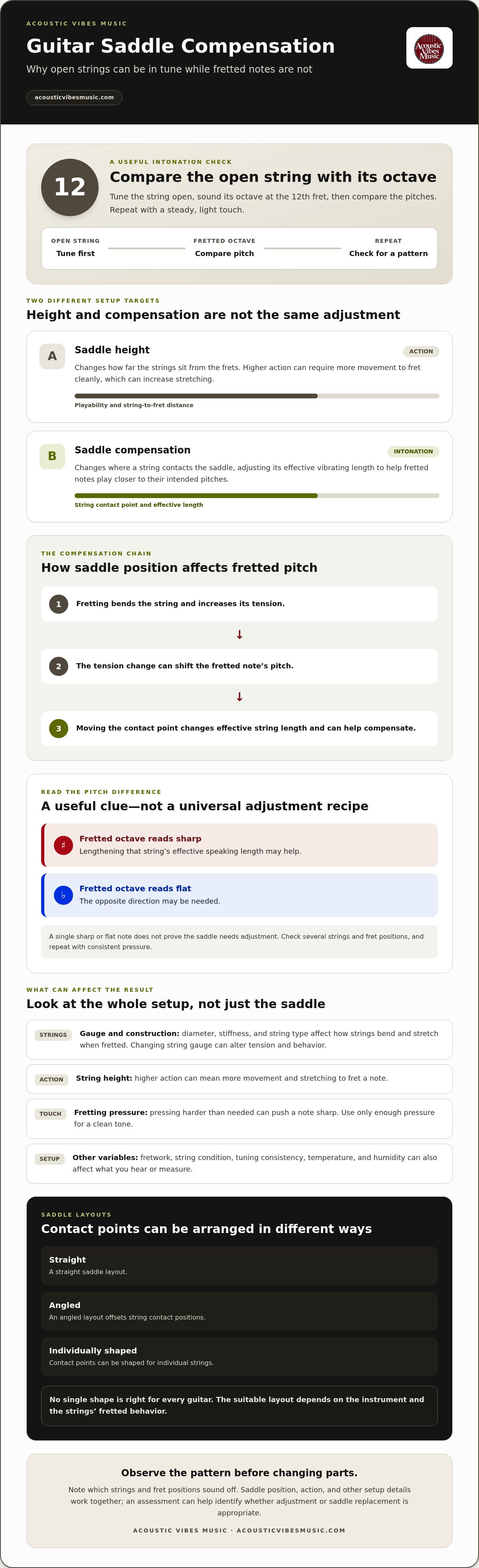
Before changing saddle geometry, gather observations you can repeat. A tuner reading can point to an intonation concern, but it cannot explain the cause on its own. Look for a pattern: which strings sound off, where on the fretboard the discrepancy appears, and whether it remains when you check again.
Start with fresh strings that have been stretched and settled, then tune each open string carefully with a reliable tuner. Compare each open string with that same string fretted at the twelfth fret. The fretted note should be an octave above the open string, so note whether the tuner consistently registers it sharp or flat.
Do not draw a conclusion from one reading. A change in pressure, a string that has not settled, or a slightly different tuning between checks can affect the result. If the twelfth-fret comparison is unclear, record that instead of forcing a diagnosis. These observations make it easier to describe what you hear and distinguish a recurring pattern from a one-off reading.
Intonation readings reflect the whole fretted string path, not just the saddle. High action can make a string stretch farther as you fret it, while neck relief affects the curve and playing feel along the neck. Worn or uneven frets may also contribute to inconsistent notes. Old or damaged strings can behave unpredictably, and firm fretting pressure can sharpen notes during a check.
Pay attention to where the problem appears. If one note is inconsistent but others are stable, repeat the check before deciding what it means. If discrepancies persist across several strings or fret positions, the pattern warrants a broader, instrument-specific setup assessment. In practical terms, guitar saddle compensation explained means considering the evidence before altering a carefully fitted part.
Also look at the bridge area for visible concerns such as lifting or damage. That is a separate structural issue, not a routine intonation adjustment. This acoustic guitar bridge repair guide discusses bridge condition specifically.
At-home checks are useful diagnostic clues, but they cannot replace an assessment of the instrument’s action, relief, frets, strings, and bridge. For a persistent intonation concern, book professional acoustic-guitar setup support before changing the saddle. A considered evaluation can help identify which part of the setup, if any, calls for adjustment.
A pitch mismatch does not automatically mean the saddle needs replacing. The right next step depends on repeatable checks, the condition of the existing saddle, and the rest of the setup. Think of the options as a progression: assess the setup first, adjust a suitable saddle if appropriate, or consider replacement if the current part is damaged or does not fit the instrument’s needs.
A correctly fitted saddle may have room for careful adjustment, while a damaged or poorly fitting saddle can change what makes sense. Modifying the existing part preserves it, but shaping removes material and cannot simply be undone. Replacement allows a fresh fit, but it also requires accurate work. Do not sand or cut based on one home test. A single reading may reflect technique or another setup factor rather than the saddle itself.
Compensation is only one part of a saddle’s job. Its height affects action, its radius should suit the string arrangement, and its fit needs to be secure so it sits properly in the bridge slot and maintains good contact. Changing the contact points without considering these details can create new playability or fit problems. A different material or a more visibly compensated shape is not guaranteed to improve tone or intonation on every guitar.
If repeatable checks still show inconsistent intonation, especially across several strings or fret positions, a luthier can assess the instrument as a whole. That assessment can help distinguish a saddle concern from issues involving action, relief, frets, strings, or the bridge. It can also protect the saddle’s fit and height while identifying a considered path forward.
Acoustic Vibes Music provides professional stringed-instrument repair and maintenance by appointment. The work addresses the specific instrument rather than applying a one-size-fits-all saddle solution. With guitar saddle compensation explained in context, your notes from careful checks can guide a useful setup conversation, while the instrument’s condition and response inform the work.
Explore Acoustic Vibes Music for professional support with your acoustic instrument.
Keep a brief setup note with your instrument: how it feels to play, where notes seem unsettled, and whether that changes after a restring or adjustment. Over time, this record gives you a clearer personal baseline and helps distinguish a passing variation from a concern worth investigating.
With guitar saddle compensation explained, you can approach intonation questions with curiosity rather than guesswork. Let your observations guide the next move, and leave delicate changes to a considered assessment when the cause is unclear. Acoustic Vibes Music offers professional repair and maintenance appointments for instrument-specific evaluation, with care grounded in acoustic-instrument expertise.
Book an appointment with Acoustic Vibes Music for professional repair and maintenance support. Bring your observations about the strings and fret positions that sound off so the setup can be assessed in context.
Saddle compensation is the arrangement of string contact positions to help fretted notes play closer to their intended pitches. For players searching “guitar saddle compensation explained,” the key point is that each string may need a slightly different speaking length rather than one identical bridge contact point. This is why the saddle’s shape can vary across its width. The exact arrangement depends on the guitar’s design and setup.
An angled saddle places strings’ contact points at different distances from the nut, helping account for how each string behaves when fretted. The bass-string side is often set farther back than the treble-string side, though the geometry varies by instrument. The diagonal is a design approach, not a tuning guarantee. Assess a guitar’s intonation by how its notes play, not by judging the saddle’s appearance alone.
No. Compensation can address pitch differences related to string length, but it will not correct every cause of inaccurate notes. A string that slips at the tuning machine can make readings seem inconsistent, while a damaged string may produce unreliable results. If notes remain out after tuning is stable, consider the full setup and the instrument’s condition before assuming a different saddle will solve the issue.
Use a reliable tuner and compare the open note with fretted notes at more than one position, keeping your fretting touch consistent. A capo can help you notice whether pitch changes are more apparent in a particular area of the neck, but it also changes how the string is pressed. Treat it as an observation tool, not a definitive test. Record repeatable patterns instead of judging by one chord.
If a string’s effective length is too short for its fretted behavior, notes may tend to sound sharp as you move up the neck. Familiar chord shapes can seem increasingly out of tune even though the open strings are correctly tuned. The symptom alone does not prove that compensation is insufficient, however. Check whether the pattern repeats and consider other setup factors before altering the saddle.
Yes. Changing gauge can alter string tension and the pressure needed to fret cleanly, so the guitar may respond differently. For example, heavier strings may make a stiff-feeling setup more noticeable, while lighter strings may feel easier to press. After changing gauge, tune the strings carefully and reassess playability and fretted-note accuracy before deciding that the saddle needs reshaping or replacement.
No. Action is the height of the strings above the frets, which affects comfort, clearance, and the effort needed to fret notes. Compensation concerns the strings’ effective lengths at the bridge. They are distinct adjustments, though they can influence one another: changing action may alter how much a string stretches when fretted. A setup assessment considers both rather than treating saddle height and contact position as interchangeable.