My shopping cart
Your cart is currently empty.
Continue ShoppingImagine opening your homeowners policy after a sudden loss only to find that your $15,000 custom-shop Martin or rare boutique Collings is capped at a generic $2,000 sub-limit. It's a heart-wrenching scenario that many collectors face because they assume a receipt is the same as real protection. You've spent years curating a collection that represents the pinnacle of acoustic artistry, and you deserve to know that its heritage is safe. It's completely natural to feel uneasy about whether a standard insurance adjuster can truly grasp the nuances of a hand-carved brace or a master-grade Adirondack top.
This guide teaches you how to secure a professional guitar appraisal for insurance purposes that protects the true financial and tactile value of your premium instruments. We'll help you bridge the gap between "what you paid" and the actual cost of replacement in today's shifting market. You'll learn how to obtain a legally defensible document that ensures your collection is covered under an Agreed Value policy. We will walk through the importance of luthier-led evaluations for structural integrity and how to document your heirloom pieces to satisfy the strictest 2026 industry standards.
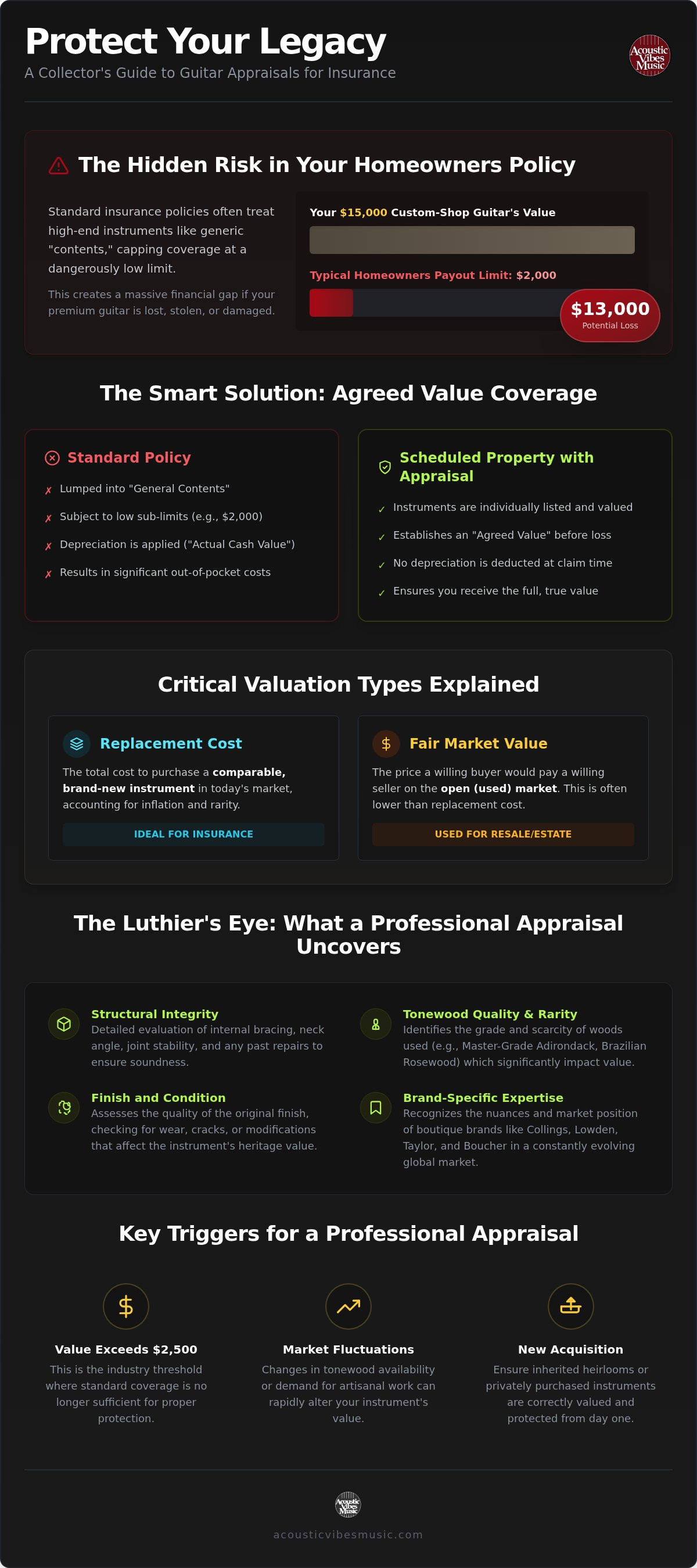
Owning a world-class acoustic instrument is a journey of sensory delight. From the first scent of a fresh spruce top to the tactile response of a hand-carved neck, these pieces are more than equipment; they're heritage. However, many collectors mistakenly believe their standard homeowners policy offers sufficient protection. In reality, most general policies lump musical instruments into a "general contents" category. This category often carries a restrictive sub-limit, sometimes as low as $2,000 or $2,500. If your $15,000 Martin or custom-shop masterpiece is lost, you're likely facing a massive financial gap that a standard policy simply won't bridge.
Insurance companies typically operate on the principle of depreciation. They assume that items lose value over time, much like a car or a television. High-end acoustic guitars from builders like Collings or Taylor often defy this logic, maintaining or even increasing in value as the tonewoods age and the market for artisanal craftsmanship grows. A sales receipt only tells the story of what you paid years ago. It doesn't account for the current scarcity of materials or the rising cost of replacement. This is why a formal guitar appraisal for insurance purposes is vital. It provides a contemporary, professional baseline that forces the insurer to recognize the instrument's true market position.
A professional luthier's eye is essential during this process. While a general appraiser might see a "wooden guitar," an expert guide identifies the nuances that drive value. They evaluate the structural integrity of the bracing, the quality of the finish, and the rarity of the grain. These hidden factors are what transform a standard instrument into a high-value asset. Without a luthier-backed document, you're essentially asking a claims adjuster to guess the value of your most prized possession.
To secure the best coverage, you should look into "Scheduled Personal Property" riders or floaters. This specifically lists each instrument on your policy, moving it out of the general contents pool. Most insurance providers require an independent guitar appraisal for insurance purposes to activate this coverage. The goal is to establish an "Agreed Value" policy. This means you and the insurer agree on the payout amount before a loss occurs. It eliminates claim-time disputes and ensures you receive the full financial value of your instrument without the sting of depreciation or "Actual Cash Value" deductions.
How do you know when it's time for a formal valuation? The $2,500 mark is the typical industry threshold where standard coverage becomes inadequate. If your instrument is worth more, you need professional documentation. Other triggers include significant shifts in the tonewood market. For example, the restricted availability of certain rosewoods or mahoganies can cause values to fluctuate rapidly. Finally, if you've recently inherited an heirloom or purchased a rare piece through a private secondary market, a professional evaluation ensures your new legacy is protected from day one.
Insurance terminology can feel like a different language. When you're seeking a guitar appraisal for insurance purposes, you'll encounter two primary figures: Replacement Cost and Fair Market Value. Understanding the distinction is the difference between a seamless recovery and a financial headache. Replacement Cost represents the total expense required to purchase a comparable, brand-new instrument in today’s market. In contrast, Fair Market Value is the price a willing buyer would pay a willing seller on the open market right now. For high-end collectors, these numbers rarely align. When insuring your instrument, choosing the wrong valuation type can leave you under-protected.
The impact of inflation and rising artisanal labor costs in 2026 has made these definitions even more critical. A guitar purchased five years ago may have a market value lower than what you paid, yet its replacement cost could be significantly higher due to the increased price of materials and specialized craftsmanship. Professional appraisals account for these shifts, ensuring your policy limits reflect the current reality of the high-end market rather than a dated sales receipt.
Modern masterpieces from builders like Boucher or Collings often see their replacement costs outpace their original MSRP. This happens because premium tonewoods have surged in price and limited-run availability has tightened. A custom shop model, such as a Martin Custom Shop or Taylor BTO, isn't just a product; it’s a specific configuration of artistry. If that instrument is lost, you aren't just buying a guitar. You're locating a specific tier of tonal excellence. Replacement Cost acts as the financial bridge to maintaining your current playing standard. It factors in current wait times and the reality that sourcing an equivalent build today may require a higher premium than your original investment.
For vintage treasures and discontinued models, Fair Market Value takes center stage. This figure is highly sensitive to market trends and the "Provenance Factor." Documentation of an instrument's history, previous owners, and original parts can drastically elevate its worth. Condition ratings also play a pivotal role. A "Mint" rating versus an "Excellent" rating can result in a valuation swing of thousands of dollars. You might wonder, is my old guitar worth anything? Our expert evaluation process looks beyond the surface to find the true heritage value. We analyze historical sales data and collector demand to ensure your appraisal reflects the real-world secondary market. If you're unsure which valuation fits your heirloom, our team is here to act as your expert guide through the selection process.
Many collectors take their instruments to the nearest local music store for a quick valuation. While these shops are great for strings and picks, they often lack the technical depth to conduct a precise guitar appraisal for insurance purposes on boutique builds. A generalist might miss the subtle distinctions that separate a standard production model from a master-grade commission. This oversight can lead to significant undervaluation, leaving your assets exposed if you ever need to file a claim. You need an expert guide who lives and breathes high-end acoustics.
Working with authorized dealers for Martin and Taylor ensures the appraiser has direct access to current MSRP data and factory-specific build sheets. It's about reputation and years of immersion in the industry. A specialist understands the heritage of these brands and can spot the "Custom Shop Expert" features that a generalist would overlook. Reliability is built on this level of specialized knowledge.
A truly professional valuation includes a structural assessment by a skilled luthier. Factors like bridge lifting or the impending need for a neck reset aren't just maintenance issues; they're critical value modifiers. An appraiser who doesn't check the internal bracing or the geometry of the instrument isn't giving you a complete picture. This technical scrutiny ensures your appraisal document is legally defensible and reflects the actual physical condition of the wood and hardware.
High-end tonewoods require a specialized eye for accurate valuation. In the 2026 market, the price gap between Adirondack Spruce and Sitka Spruce continues to widen as old-growth supplies dwindle. Understanding the nuances of Rosewood vs. Mahogany Back and Sides is just the beginning of a professional evaluation. Appraisals must also account for CITES regulations and wood rarity. Rare materials like Brazilian Rosewood or specific species of Ebony require precise documentation to maintain their legal and financial standing in a global market.
Vague reports are a collector's nightmare and are often rejected by specialty insurers. Look for these warning signs in your documentation:
Securing a precise guitar appraisal for insurance purposes requires more than just a few casual snapshots. For rare and heirloom instruments, national shipping to a specialized curator is the gold standard. It ensures your piece is evaluated by an expert who understands the shifting market for boutique brands. While it might seem daunting to ship a high-value asset, the depth of a professional, national-level report far outweighs the convenience of a local generalist's estimate. You're building a legal shield for your collection.
Documentation begins with a rigorous photography checklist. You must capture the headstock from both the front and back to verify the logo and tuner authenticity. The internal label is your instrument's birth certificate; ensure the serial number and model name are legible. Don't forget the bridge and any areas of play wear. High-resolution images of these details prove the instrument's condition at the time of the appraisal, which is vital for any future "Agreed Value" claims.
Beyond the wood and wire, you need to document the "Case and Candy." Original hangtags, certificates of authenticity, and even the original hardshell case add tangible value to a collector-grade instrument. Prepare a technical spec sheet that lists the model year, serial number, and any known modifications. Even a high-quality nut replacement or a professional refret should be noted. This level of detail shows the appraiser and the insurer that you are a meticulous steward of your collection.
Lighting is your best tool for showing the true artistry of the grain. Use natural, diffused light to avoid harsh glares on nitrocellulose finishes. Capture macro shots of the bridge and nut to provide evidence of proper maintenance and structural health. Place your instrument against a clean, neutral background to ensure the guitar remains the singular focus of every frame. These images serve as the primary evidence for your guitar appraisal for insurance purposes, leaving no room for adjuster doubt.
Safe transport is a skill every collector should master. Use a heavy-duty, double-walled box and plenty of archival-quality packing material to suspend the case within the carton. Loosen the strings slightly to reduce tension on the neck during transit. Before you seal the box, verify your shipping insurance covers the full replacement value. Our High End Acoustic Guitars for Sale: The Collector’s Guide offers deeper insights into the logistics of moving world-class instruments safely. If you're ready to secure your legacy, contact Acoustic Vibes Music to coordinate your professional evaluation today.
At Acoustic Vibes Music, we view every instrument as a masterpiece of engineering and emotion. Our "Passionate Curator" approach means we look far beyond the price tag. We analyze the specific resonance, the rarity of the grain, and the artisanal skill that went into every build. As an authorized dealer for Lowden and Yamaha L-Series, we have direct access to factory specifications and current market data that generic auction sites simply can't provide. This specialized data is the foundation of a rock-solid guitar appraisal for insurance purposes.
Every valuation we perform is backed by professional luthier expertise. We look deep. We inspect the internal bracing, the bridge stability, and the neck geometry to ensure the instrument is structurally sound. Once your appraisal is complete, the final step is presenting it to your insurance agent. We recommend requesting an "Agreed Value" policy. This ensures that the number on your appraisal is the exact amount you'll receive in the event of a total loss, bypassing the standard depreciation traps of Actual Cash Value policies. It's the ultimate safeguard for your investment.
Our expertise spans the entire spectrum of high-end acoustics. Whether you own a standard production Taylor Guitars model or a one-off custom build from a boutique shop, our team provides the same level of meticulous detail. Because we serve a national audience, our reports are recognized and respected by major insurance providers across the country. It's important to understand that an insurance appraisal is different from a consignment evaluation. While a consignment estimate focuses on what a buyer might pay today, a guitar appraisal for insurance purposes focuses on the cost to replace that instrument's exact quality and heritage in tomorrow's market.
Protecting your musical heritage shouldn't be a source of stress. We've streamlined our process to accommodate collectors nationwide through our secure mail-in appraisal service. You can also schedule an in-person appointment to walk through your collection with one of our expert guides. There is a profound peace of mind that comes with knowing your heirloom pieces are documented with a professional, legally defensible report. Don't leave your collection's future to chance or DIY estimates. Reach out to us today to secure the professional valuation your instruments deserve.
Your collection is a vibrant testament to your passion for artisanal excellence. It's more than just wood and wire; it's a curated gallery of history and tone. Don't let a generic homeowners policy or a lack of documentation leave your heritage pieces vulnerable. By understanding the critical gap between "what you paid" and current replacement costs, you've taken the first step toward true financial security. A comprehensive guitar appraisal for insurance purposes is the only way to guarantee that your instruments are protected at their full, defensible value.
As an authorized dealer for Martin, Taylor, and Collings, we bring a curator's eye to every evaluation. Our expert luthier on staff ensures that every structural nuance is documented, while our national shipping expertise makes professional valuation accessible no matter where you reside. You've spent years finding the perfect voice. Now, make sure that voice is never silenced by inadequate coverage.
Protect your investment-Contact Acoustic Vibes Music for a professional appraisal today. We're eager to help you document and preserve the artistry you love. Your collection's future starts with a single professional step.
You should update your valuation every two to three years to stay ahead of the shifting market. Values for rare tonewoods and boutique brands like Lowden or Collings can fluctuate significantly over a short period. Regular updates ensure your coverage reflects current replacement costs rather than an outdated figure. If you add a custom shop piece to your collection, update your insurance schedule immediately. This proactive approach keeps your policy accurate and defensible.
Most specialty insurers accept remote valuations if they are conducted by a recognized authorized dealer using a strict documentation protocol. A guitar appraisal for insurance purposes requires high-resolution photos of the headstock, label, and bridge to verify authenticity and condition. While some general carriers might be hesitant, specialty providers value the expertise of a national specialist over a local generalist who lacks deep knowledge of high-end acoustic brands.
An appraisal establishes a specific financial value based on current market data, while a certificate of authenticity only proves the instrument's origin. A certificate is a static document issued at the time of creation. An appraisal is a dynamic report that accounts for condition, provenance, and the 2026 market climate. You need both for a high-value Martin or Taylor to satisfy the rigorous requirements of a specialty insurance provider.
Professional fees vary depending on the depth of the report and the rarity of the instrument being evaluated. A formal insurance appraisal from a certified specialist involves a detailed structural evaluation and a thorough market analysis. While some shops offer quick verbal estimates for sales, a legally defensible document for your insurance carrier requires more specialized labor. It's best to contact your appraiser for a specific quote based on your collection's complexity.
A high-quality, professional repair often maintains or even stabilizes the value of a premium acoustic instrument. For example, a necessary neck reset performed by a master luthier ensures the guitar remains playable and structurally sound. While non-original parts can impact vintage values, essential maintenance is viewed positively by insurers. It proves the instrument is well-cared for. Poorly executed DIY repairs are what truly trigger a significant drop in your instrument's appraised worth.
Insurance companies won't accept a DIY valuation based on asking prices from public marketplaces. These sites show what sellers hope to get, not the actual value a specialist insurer requires. A professional guitar appraisal for insurance purposes involves analyzing private sales data and dealer benchmarks that aren't visible to the public. You need a trusted third-party expert to provide a document that stands up during a potential claims dispute.
Without a formal appraisal, your insurance carrier will likely settle based on Actual Cash Value, which includes heavy depreciation. This often results in a payout that is thousands of dollars below the actual cost of a replacement. You'll be left trying to prove the value of a missing item using old photos or receipts. An appraisal acts as a pre-negotiated settlement. It ensures you can return to your playing standard without a financial loss.
High-value vintage cases or specialized flight cases should be included as part of the instrument's total valuation in your report. If you own a rare 1930s hardshell case or a custom Calton, ensure your appraiser notes this specifically. Some collectors choose to list expensive cases as separate line items on their insurance rider. This ensures the case is covered if it's damaged while the guitar remains safe. It's all about protecting the complete asset.