My shopping cart
Your cart is currently empty.
Continue ShoppingYes, Gold Tone banjos offer options for different playing preferences, from the beginner-focused AC-1 open-back to resonator models such as the OB-150, which has a 20-hole bell brass tone ring. The range makes it worth comparing the model, construction, and price together rather than judging the brand by one instrument.
Choosing a banjo is personal: its weight, your playing style, and whether you prefer an open-back or resonator design all affect the fit. Gold Tone banjos span a range of models and price points, so understanding their differences can help you narrow your options.
This guide covers what to look for in Gold Tone banjos, how selected models compare, and how their listed prices differ. You’ll also find practical advice on cases and accessories, including what to check when a package includes them. By the end, you’ll have a clearer idea of which features matter for your playing and which listing details to review before choosing.
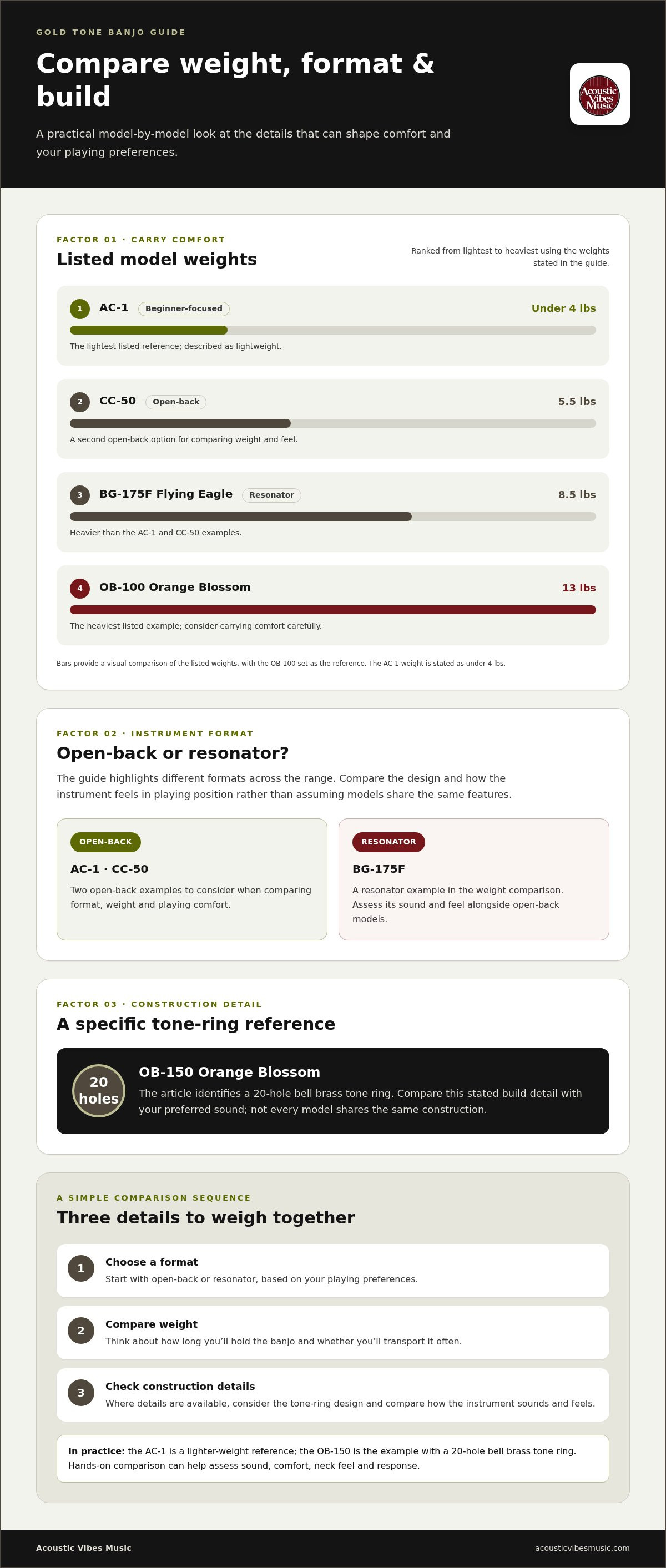
Gold Tone banjos span light, portable builds and heavier instruments. The Gold Tone AC-1 weighs under 4 lbs, while the OB-100 Orange Blossom weighs 13 lbs. That contrast matters if you carry a banjo regularly or prefer a more substantial instrument. Comparing construction and handling gives a clearer answer than judging the brand by one model.
Weight can shape everyday comfort, but it doesn’t tell you everything about sound. The CC-50 open-back weighs 5.5 lbs, and the BG-175F Flying Eagle weighs 8.5 lbs. Those examples show why the model name and design matter. Before choosing, think about where you’ll play, how long you’ll hold the instrument, and whether you’ll transport it often.
Tone-ring construction is another useful comparison point. The OB-150 Orange Blossom has a 20-hole bell brass tone ring. A tone ring is part of the banjo’s pot assembly, and its material and construction can influence the instrument’s response and tonal character. Compare the OB-150’s stated ring design with your preferred sound, rather than assuming every model shares the same build.
Open-back and resonator designs also give players different formats to consider. The AC-1 and CC-50 are open-back examples, while the BG-175F is a resonator banjo. Listen for the qualities you want, then compare how each instrument feels in playing position. A brief hands-on comparison can reveal whether weight, neck feel, and response work together for you.
The featured Bela Fleck signature banjo deserves a place in the comparison. Treat its signature status as a reason to explore its design, not as a substitute for assessing your own needs. Try the instrument alongside models such as the OB-150 and BG-175F. Focus on sound, comfort, and construction, then decide which details matter most for your playing.
Use a simple three-step evaluation: choose open-back or resonator, compare instrument weight, then assess tone-ring details where available. For example, a player prioritizing a lighter carry can start with the AC-1’s listed weight. Someone interested in a bell brass ring can examine the OB-150. These concrete comparisons make it easier to judge which Gold Tone model fits your preferences.
Case details can affect a banjo package’s value. The Gold Tone Mastertone OB-Standard resonator banjo is listed with a case, making it a specific example of an included case. Don’t assume every model comes with one.
A hard case and a gig bag suit different carrying needs. A hard case has a firm outer shell, while a gig bag is made of flexible fabric. Consider how you’ll transport and store the instrument. Frequent car travel may favor a fitted case; a lighter carry may favor a bag.
Match the case to the banjo’s shape and configuration. Resonator and open-back banjos have different body profiles, so check that the case fits the instrument’s body and neck. The Mastertone OB-Standard is listed with a case, but that doesn’t confirm a fit for other models.
Accessories may be bundled, sold separately, or offered through a promotion. One current offer applies to banjo purchases of $999.99 or more: a free Pro Banjo Accessory Kit through OCT 31ST. Treat that promotion separately from a model’s standard package. It has a purchase threshold and a stated end date.
Before comparing two listings, sort each detail into these three groups:
This quick comparison helps prevent you from mistaking a package feature for a standard inclusion. The Mastertone OB-Standard listing, for example, names a case. The accessory-kit offer, by contrast, depends on meeting its stated purchase threshold. Keep those differences in mind as you compare instruments.
Useful banjo accessories depend on your playing routine. A strap can support standing practice, a tuner helps with tuning, and picks suit players who use them. Spare strings are useful for routine replacements. Treat these as general accessory examples, not as items included with a particular Gold Tone model.
Make a short checklist before choosing: case type, fit, included accessories, and any applicable offer. Then compare the exact package details for the model you’re considering. For another look at model options, explore Gold Tone banjo models and weigh their listed inclusions against your needs.
The lineup includes beginner, open-back, resonator, convertible, and specialty models. The AC-1 is described as lightweight and beginner-focused. The AC-12 is a 12-inch acoustic composite, five-string open-back banjo. The AC-5 is an acoustic composite, five-string resonator model. Compare those descriptions first. They quickly distinguish several options by construction and format.
Cripple Creek models offer another way to compare configurations. The CC-50 is an open-back banjo. The CC-100R is a convertible resonator model. That distinction gives shoppers a practical starting point: decide whether an open-back design or convertible format better suits their preferences. Then compare the model details rather than assuming two instruments with related names share identical features.
Orange Blossom models cover several named options. The OB-100, OB-150, and OB-300 are all listed in the range. The OB-12 adds a top-tension format. Each model name helps identify a distinct instrument, but the names alone don’t describe every construction detail. Compare individual specifications when narrowing your choices. For instance, the OB-150 has a 20-hole bell brass tone ring, a concrete detail that sets it apart.
The Mastertone offerings add more named choices. The Mastertone OB-Standard is a resonator banjo listed with a case. The Mastertone OB-2 is identified as a Bowtie banjo. Those descriptions provide a useful first comparison: one listing explicitly calls out resonator construction and a case, while the other highlights its Bowtie designation.
The BG-175F Flying Eagle broadens the resonator selection. The OB-300 Orange Blossom and OB-12 Top Tension expand the named range beyond entry-focused examples. Rather than treating these names as a simple quality ladder, identify what matters most. Choose the format, construction detail, and playing priorities that shape your decision.
Use a short comparison process. First, sort models by open-back, resonator, or convertible format. Next, note construction details such as the AC-12’s 12-inch composite design or the OB-150’s tone ring. Finally, compare the exact model descriptions side by side. This approach turns a long list into clear options without assuming every banjo serves the same role.
Gold Tone’s range includes beginner, open-back, resonator, and specialty models. Start with the model descriptions, then compare their features with your priorities.
The AC-1 is a lightweight, beginner-focused open-back banjo. The AC-12 is a 12-inch acoustic composite, five-string open-back model. For resonator options, compare the AC-5 and BG-175F Flying Eagle. The CC-100R Cripple Creek adds a convertible resonator format, while the OB-12 offers a top-tension design.
Other named choices include the CC-50, OB-100, OB-150, and OB-300. The Mastertone OB-Standard is a resonator banjo listed with a case. The Mastertone OB-2 is identified as a Bowtie model. Compare these individual descriptions, rather than treating model names as interchangeable.
Compare each model’s listed price alongside its design and package details. For example, the AC-1 and Mastertone OB-Standard differ in model category, and the OB-Standard listing includes a case. Those distinctions help explain why a single price comparison cannot capture every buying consideration.
Build a shortlist by matching each model to how you plan to use it. Then review the exact listing for the instrument you’re considering, including any case or accessories. Keep package details separate from promotional offers, which may have different conditions.
These model groups make a practical first pass:
For a focused comparison, choose two models with contrasting formats. The AC-12’s open-back design and the AC-5’s resonator design provide one clear pairing. Compare that distinction with the package information for the Mastertone OB-Standard. This keeps the decision grounded in model details, not names alone.
Next, note the features that matter most: format, construction, and included items. The OB-150 has a 20-hole bell brass tone ring, while the Mastertone OB-Standard listing includes a case. Use those specifics when comparing models and their listings. A short written shortlist can make the final choice clearer.
The listed prices place these models at distinct points in the range. These prices offer useful reference points for comparing beginner, convertible, and Orange Blossom options, but model descriptions and included items also matter.
Compare each listing’s package details and instrument format rather than choosing by price alone. Consider whether an included case matters to you, alongside the model’s features and design. A shortlist based on price and intended use can help narrow your options.
Start with the way you’ll hold and play the instrument. A seated player may prioritize comfortable positioning, while standing players should consider strap balance. The AC-12 gives a concrete size reference: it has a 12-inch body and five strings. Consider whether that format feels manageable against your body and suits your playing style.
Next, test reach and hand comfort. Hold the banjo in playing position, then move across the fingerboard. Notice whether your fretting hand reaches comfortably and whether your picking hand rests naturally. For example, compare the AC-12 with another model in person, rather than choosing by its name alone. Comfort is easier to judge through playing than through a model description.
Distinguish body size from setup. Size describes the instrument’s physical format; setup affects how it plays. Check string height, tuning stability, and response as you fret notes. Listen for buzzing and notice whether notes are hard to press. These checks can help you decide whether the current setup suits your touch.
Use a consistent comparison routine for each banjo. Play the same passage on every model, including open strings and notes across the neck. Try a soft touch, then a firmer attack. The AC-12’s five-string format gives you a specific example to evaluate. Focus on comfort, response, and sound, rather than changing several variables between comparisons.
Keep your playing style in mind. A player exploring old-time music may prefer an open-back banjo, while someone seeking a resonator design should compare resonator models directly. Don’t assume body size alone determines sound or comfort. Assess format, reach, and response together by playing the same short passage on each instrument.
Record your impressions as you compare. Note which banjo feels comfortable, which notes sound clear, and whether the setup suits your touch. If a model feels awkward, try another configuration before ruling out the category. This can help you tell a setup issue from a mismatch in size or design.
Once your priorities are clear, compare the available Gold Tone banjo models against your notes. A deliberate test of position, reach, and response can turn a crowded lineup into a practical shortlist. Let your playing habits guide the final choice.
Acoustic Vibes Music offers banjos alongside other acoustic instruments. If your search has also sparked an interest in acoustic guitars, classical and flamenco guitars, or mandolins, you can explore these related instrument families in one place.
Use this guide to identify your priorities, such as playing format, comfort, and whether a case is included. Then explore banjos with those details in mind. Acoustic Vibes Music can help you compare options as you consider an instrument purchase.
Contact Acoustic Vibes Music to continue your instrument search.
The right instrument should make you want to play, not leave you second-guessing your choice. As you compare Gold Tone banjos, use your own playing goals as the final measure. Consider the sound you want, how the instrument feels in your hands, and whether its setup encourages regular practice. Those impressions can matter more than the model name alone.
Take time to choose deliberately. Revisit the details that matter to your routine, then narrow your options to instruments that feel like a natural fit. A considered choice can make practice more rewarding and give you a clearer direction as your playing develops.
Ready to take the next step? Explore Gold Tone banjo options and see which instrument inspires your next tune.
Gold Tone’s range includes AC, CC, BG, OB, and Mastertone models. Examples include the AC-1, AC-5, AC-12, CC-50, CC-100R, BG-175F Flying Eagle, OB-100, OB-150, OB-300, OB-12 Top Tension, Mastertone OB-Standard, and Mastertone OB-2 Bowtie. To narrow the choices, first decide whether you want an open-back, resonator, or convertible format. Then compare the individual model descriptions.
Prices vary by model, design, construction, and package details. Start by comparing models with similar formats, then note what each listing includes, such as a case. Treat an accessory promotion separately from the listed price, since promotional conditions may apply. Comparing the exact models side by side helps show how their features and included items relate to price.
Specifications differ by model, so compare details that affect your needs. The AC-12 is a five-string acoustic composite with a 12-inch body. The AC-5 is a five-string acoustic composite resonator banjo. The OB-150 features a 20-hole bell brass tone ring. These examples show why model-specific details matter: string count, body size, format, and tone-ring construction help distinguish instruments.
Players’ impressions vary by model, setup, and personal preference, so one person’s opinion may not apply to everyone. To form your own view, play the same short passage on each candidate. Notice how it feels, responds to your picking, and sounds in the musical setting you use. When comparing remotely, focus on the listed specifications and choose based on your priorities.