My shopping cart
Your cart is currently empty.
Continue ShoppingWhat if fret buzz near guitar nut isn’t coming from the nut at all? A low slot is one possibility, but a high first fret, too little neck relief, or a poorly shaped slot can create similar sounds. The place you hear the buzz is a clue, not a diagnosis.
If you’re unsure whether the noise happens on an open string or a fretted note, you’re not alone. And it’s sensible to pause before filing or adjusting anything: nut work is precise, and removing too much material can affect playability.
This guide will help you narrow down the likely cause with simple, low-risk checks. You’ll compare open strings with notes fretted near the first fret, look for patterns across strings, and learn what each result may suggest. We’ll also explain how nut height, neck relief, and saddle height interact, which checks are reversible, and when a professional luthier assessment is the safer next step. Start with the sound, follow the evidence, and avoid making an irreversible adjustment until you know what you’re correcting.
A fret buzz is an unwanted rattling or vibrating sound, often caused when a string contacts a fret as it vibrates. A loose component can also rattle in sympathy with a note. Either way, hearing the sound near the headstock doesn’t prove the nut is responsible. Vibration travels through the strings, neck, and body, making its apparent location an unreliable guide on its own.
The nut supports the strings, sets their spacing, and helps define the vibrating length. For a quick overview of what a guitar nut does, see this reference. A slot that’s too low can contribute to an open-string buzz, but a high first fret or insufficient neck relief may produce a similar impression. One symptom alone can’t confirm which part needs attention.
Start by comparing the suspect string played open with the same string fretted near the nut. The pattern is more useful than where the noise seems to come from, and it can help you decide what to check next without making an adjustment prematurely.
Play each suspect string open using a comfortable, repeatable attack. Listen for the buzz, then fret successive notes across the first few frets and play them with your normal pressure. Avoid striking harder than usual; the test should reflect how you actually play.
Write down which string and notes buzz. If the open string rattles but the sound changes when you fret a note, that’s a useful clue, not a diagnosis. Buzz on one fretted note, or across several nearby notes, creates a different pattern worth documenting.
String vibration can travel along the neck and into the body, so your ear may place a rattle near the nut even if its source is elsewhere. Loose hardware or another part vibrating sympathetically can also imitate fret buzz. Treat these as possibilities to inspect, not conclusions based on sound alone.
Before considering nut-slot work, note whether the noise occurs open, fretted, or both, and whether it affects one string or several. Don’t file or reshape a slot based only on where you hear the buzz. These observations give a technician or luthier a clearer starting point if the cause remains uncertain.
The nut, frets, and neck relief all affect the space between a vibrating string and the fretboard. Their symptoms can overlap, so treat a buzz pattern as a clue rather than a verdict. A low nut slot may let an open string vibrate against a fret close to the nut, while a fret-height or neck-relief issue can create buzz at other points along the neck.
An open-string buzz can suggest a low nut slot, but it doesn’t prove the nut is defective. Confirming the cause takes a closer look at the string’s clearance and the guitar’s overall setup.
If an open string buzzes but the sound changes or stops when you fret it near the first fret, a low slot is one possibility. The string may be sitting too close to a fret while open. But the same symptom can have other causes, so don’t file the slot based on sound alone.
A slot that’s too high tends to create a different problem: first-position notes can take more effort to press down, and the extra stretch as you fret may affect intonation. Each slot must suit its string, so accurate measurement matters before any material is removed. Removing too much can leave the string sitting too low.
A high or uneven fret can make a fretted note buzz when the vibrating string contacts a fret beyond the one being played. The issue may affect selected notes rather than every open string. If several neighboring notes buzz, or the pattern changes as you move up the neck, fret height deserves consideration alongside the nut.
Neck relief is the slight forward curvature that provides clearance for a vibrating string. Too little relief, including a neck that bows backward, can reduce clearance across multiple frets, especially in the lower positions. This can resemble a nut-slot problem even when the slot isn’t the source.
Don’t turn the truss rod based on a guess. Relief needs to be checked with the guitar tuned and measured appropriately, and adjustment guidance can vary by instrument. A change to one part of the setup can affect how the others behave, so diagnose the pattern before changing anything.
If your checks point to overlapping causes, or the fret buzz near guitar nut persists, a luthier can assess the slots, fret condition, neck relief, and overall setup together. Professional luthier repair and maintenance by appointment can be a practical next step when you’re unsure which adjustment is safe.
Use the pattern to choose what to inspect next, not to name a repair from sound alone. An open string that buzzes while the same string sounds cleaner when fretted may point toward the nut area. Buzz on fretted notes, across several strings, or in a run of nearby frets can suggest other setup or fret issues. Causes overlap, and an instrument’s condition matters.
The buzzing pattern narrows the investigation, but it doesn’t replace a hands-on inspection.
| Symptom pattern | Possible cause | Safe check | Recommended next step |
|---|---|---|---|
| Open string buzzes; fretted notes on that string are cleaner | Possibly a low or poorly shaped nut slot, or another source of open-string vibration | Repeat the open-versus-fretted comparison at a consistent playing force | Have the slot and nearby fret condition inspected before considering nut work |
| One fretted note buzzes | Possibly an uneven or high fret, or a localized setup issue | Play the note, then compare the notes immediately before and after it | Record the affected note and ask for fret and setup assessment if it persists |
| Several adjacent frets buzz | Possibly fret-height irregularity or neck relief affecting clearance | Note where the buzz begins and ends along the neck | Request a broader neck and fret check rather than assuming the nut is at fault |
| Multiple strings buzz | Possibly a broader setup issue, fret condition, or sympathetic vibration | Check each string separately and listen for a loose external component | Consider a full setup assessment, especially if the buzz is widespread |
Pay attention to whether the open string buzzes and whether fretting that same string near the nut changes the sound. If only one string shows this pattern, its slot may warrant closer inspection. If several strings buzz, a single low slot is less likely to explain the whole picture, though more than one issue can coexist.
Don’t file the slot as a first test. Slot depth and shape are precise, and removing material is difficult to reverse. Keep a note of the string and playing conditions, then use that evidence to guide inspection.
A buzz confined to particular fretted notes can justify checking the fret level and neck setup. If several strings or a wider stretch of the neck are affected, a nut-only fix may miss the cause. Gently check accessible external hardware for obvious looseness, but don’t overtighten anything or adjust components by guesswork.
If the pattern remains unclear, a professional assessment can check the nut, frets, neck relief, and overall setup together. For persistent fret buzz near guitar nut, Acoustic Vibes Music offers professional luthier repair and maintenance by appointment; review its repair services as a possible next step.
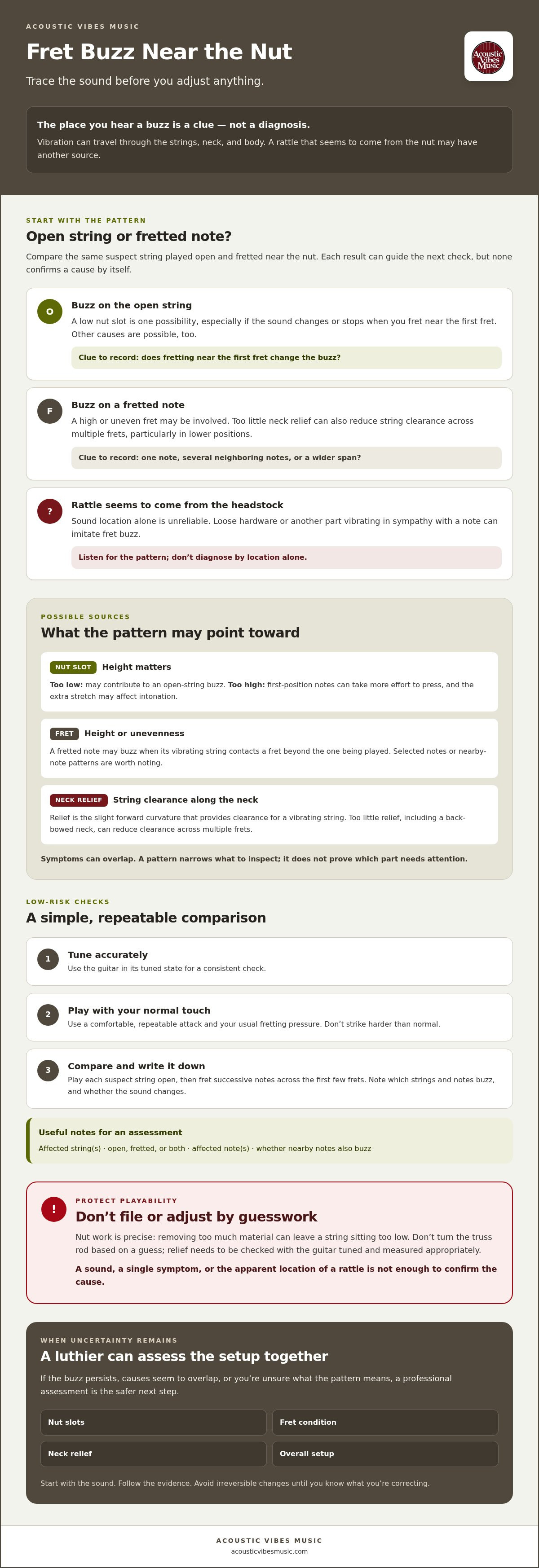
A careful listening test can give you useful clues without changing the instrument. The goal is to isolate where and when the noise occurs, not to repair a suspected cause on the spot. Keep the guitar in its usual playing position and use the same picking hand and attack throughout so the comparisons are meaningful.
These observations can help distinguish a repeatable pattern from a sound that only appears under an unusually hard attack. They won’t confirm the cause on their own, but they give you a clear record to refer to if the fret buzz near guitar nut persists or needs professional assessment.
Don’t deepen a nut slot just because the buzz seems loud near the headstock. The sound’s apparent location isn’t enough to identify the source, and an open-string buzz can have more than one explanation. Avoid improvised files, abrasive materials, or attempts to level frets at home; these can remove material unevenly and create new playability problems.
Nut filing permanently removes material, so it should only follow accurate measurement and a clear diagnosis.
Don’t turn the truss rod as a first test, either. Neck relief should be assessed for the specific instrument, and an adjustment made without the right measurement or manufacturer guidance can make the setup worse. Stop if an adjustment feels uncertain, the guitar is especially valuable to you, or the buzzing becomes more pronounced.
If your notes don’t point to a clear, safe next step, leave the setup unchanged and seek an expert assessment. Ask Acoustic Vibes Music about a luthier assessment for persistent buzz or a cause you can’t confidently identify.
A persistent buzz deserves a closer look, especially if it affects several frets or strings, changes unpredictably, or comes with visible nut damage. The same sound can come from a low or poorly shaped slot, fret irregularities, neck relief, or another setup concern. If safe listening checks haven’t narrowed it down, stop experimenting and have the instrument assessed.
A luthier can consider the nut-slot height and shape alongside fret condition, neck relief, and the overall setup. These parts interact, so filing one slot without checking the surrounding geometry may mask the symptom or make playability worse. For fret buzz near guitar nut, an instrument-specific inspection is safer than guessing from where the sound seems loudest.
Bring a clear description of the pattern. These details can help guide the inspection:
These details don’t prove what caused the buzz, but they give the repair professional a useful starting point. If possible, demonstrate the symptom with your usual playing touch rather than striking harder to make it easier to hear.
Nut, fret, and neck conditions work together to determine string clearance. A slot that seems suspect may not be the only issue, and fret work or a neck adjustment may need to be considered as part of the same assessment. Measurements and inspection help identify the source before any irreversible material is removed.
Repair diagnosis depends on the instrument and the fault. For example, this guide to acoustic guitar bridge repair illustrates why a repair begins with understanding the specific problem, not applying a one-size-fits-all fix.
Acoustic Vibes Music offers professional luthier repair and maintenance by appointment. If you’d like to discuss an assessment, explore Acoustic Vibes Music and confirm the current repair intake details before arranging an appointment.
The sound of fret buzz near guitar nut can point toward a nut-slot issue, but it may also come from fret irregularities, neck relief, or another setup concern. Compare the open string with nearby fretted notes, and keep track of which strings and positions buzz. Those patterns help narrow the next check, but they can’t confirm the cause by themselves.
Hold off on filing the nut or making other irreversible adjustments until the problem is properly identified. If the buzz persists, affects several notes, or you’re unsure what’s safe, a luthier can assess the nut, frets, neck, and setup together.
Acoustic Vibes Music specializes in acoustic instruments and related stringed instruments, with professional luthier repair and maintenance available by appointment. Explore Acoustic Vibes Music and ask about arranging a repair appointment. With a careful diagnosis and the right next step, you can work toward clean notes and a guitar that feels right in your hands.
An open-string buzz near the nut can happen if a nut slot is too low or poorly shaped, but that isn’t the only possibility. A high first fret, insufficient neck relief, or a loose part vibrating sympathetically may create a similar sound. Fret buzz near guitar nut is best investigated by comparing the open string with the same string fretted near the first few frets, then checking whether other strings show the pattern.
A nut slot that’s too high more often makes first-position notes harder to fret and can affect their intonation. It isn’t the usual explanation for an open-string buzz. A slot that’s too low may let an open string contact a fret, though a fret or neck issue can produce similar symptoms. Since each string’s slot is individual, have its height and shape checked before removing material or changing the setup.
Compare the suspect string played open with notes fretted successively near the nut. If it buzzes open but sounds cleaner when fretted, a low or poorly shaped nut slot is one possibility, not proof. If a particular fretted note or a run of nearby notes buzzes, fret height or neck relief may be involved. Record which strings and notes are affected; a professional inspection can confirm the source.
Don’t file the nut based only on a buzz that seems loud near the headstock. Nut filing permanently removes material, and a slot that’s too deep can create a new buzz or compromise playability. First compare open and fretted notes and check which strings are affected. If measurement indicates a slot problem, a luthier can determine whether it needs careful correction or another repair.
New strings don’t automatically cause a nut problem, but a string change can reveal a setup issue or coincide with a change in string gauge or tuning. Different strings may respond differently to the instrument’s existing setup. Check that each string is seated correctly at the nut and bridge, tune accurately, and compare the buzz with your usual playing touch. If it persists, note what changed and have the setup assessed.
Not necessarily. A light buzz may be a setup concern, but persistent noise, buzzing across several frets or strings, visible nut damage, or notes that won’t ring clearly deserve attention. Avoid forcing adjustments to see if the sound goes away. Track the affected strings and notes, then seek an instrument assessment if the issue continues or affects playability. The cause, rather than the sound alone, determines what repair may be needed.
You can safely do basic checks at home: tune the guitar, isolate the suspect string, compare open and fretted notes, and document the results. Avoid filing the nut, sanding frets, or turning the truss rod as a first test. Those adjustments can remove material or alter the setup, and mistakes may be difficult to reverse. If the cause remains unclear, professional luthier repair and maintenance by appointment is a safer next step.