My shopping cart
Your cart is currently empty.
Continue ShoppingA dreadnought may seem like the obvious choice for a full, powerful acoustic sound, but an OM can feel more responsive and articulate for fingerstyle. In the dreadnought vs OM for fingerstyle comparison, the OM’s balanced response and less dominant bass often help individual notes stand out, while the larger dreadnought adds low-end weight and projection. Both can work beautifully; the right fit depends on the sound and playing feel you want.
That difference matters when bass, melody, and inner voices need to ring clearly together. This guide compares how body size affects tone, responsiveness, note separation, and comfort, and explains why an OM can offer a middle ground between a dreadnought’s breadth and a smaller guitar’s intimacy. You’ll get practical criteria for choosing a body shape that suits your playing, whether you favor delicate fingerpicking, a stronger low end, or a balanced sound.
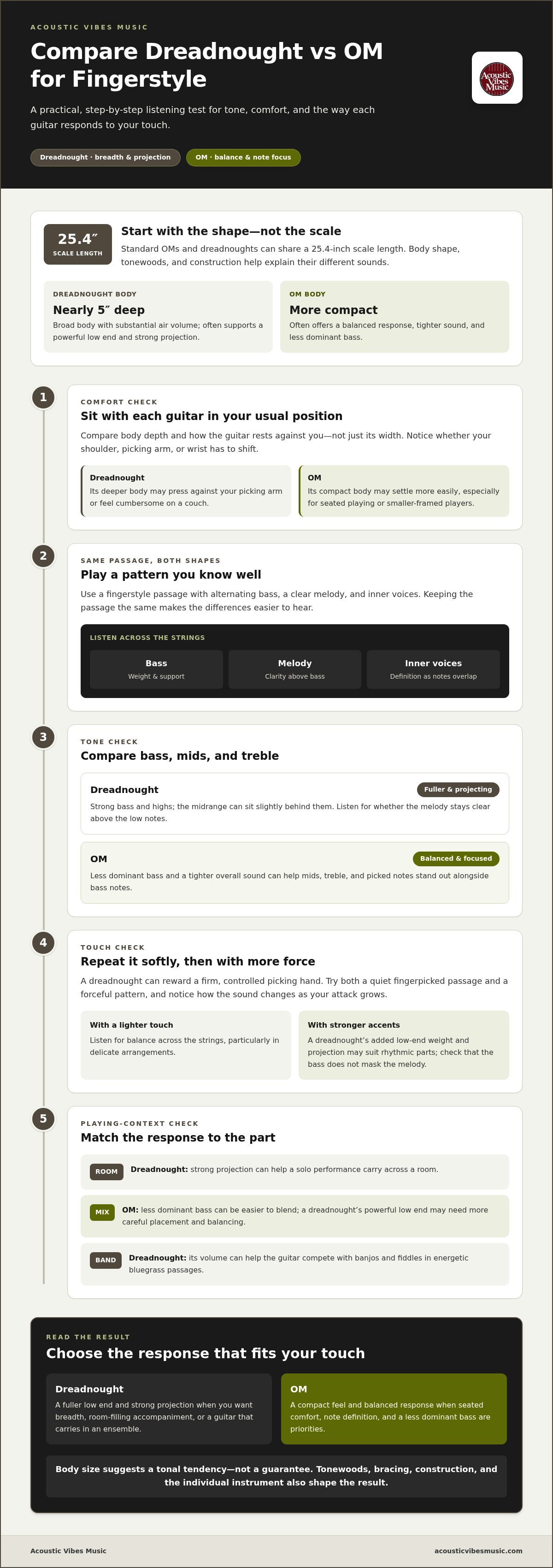
A dreadnought’s larger body typically delivers stronger bass and projection, while an OM offers a more compact feel and balanced response. Both can share a 25.4-inch scale length, so body shape, tonewoods, and construction help explain their different sounds.
A dreadnought has a broad body, typically nearly 5 inches deep, with substantial air volume. That design supports a powerful low end and strong projection. Its highs are emphasized, while the midrange can sit slightly behind the bass and treble. The result often suits vocal accompaniment and full-bodied playing.
The dreadnought’s history reflects its projecting voice: Martin builders conceived the shape more than a century ago to carry sound in an orchestra. Spruce and rosewood are a familiar tonewood pairing, but wood species, bracing, and construction all influence a guitar’s response. Body size suggests a tonal tendency, not a guaranteed result.
An OM has a smaller, more compact body than a dreadnought. Its response is often balanced, with less dominant bass and a tighter overall sound. That balance can make the mids and trebles easier to hear alongside bass notes. Standard OMs typically share the dreadnought’s 25.4-inch scale length.
Martin designed the OM in the late 1920s, and it was the first Martin design with 14 frets clear of the body. Tonewoods still matter: a spruce top paired with rosewood can sound different from other wood combinations, even within the same body shape. Compare the whole instrument, not its outline alone.
An OM’s smaller body is generally more comfortable for smaller-framed players and seated playing. A dreadnought’s deeper body can feel demanding depending on your posture, particularly if it presses against your picking arm. Its larger outline may also feel cumbersome on a couch. Body width alone, however, doesn’t determine comfort.
Try a practical test: sit with each guitar in your usual position and play a passage you know. Notice whether your shoulder, picking arm, or wrist has to shift. An OM may settle more easily against your body, while a dreadnought’s depth may call for a more deliberate position.
| Option | Body and feel | Bass, mids, and treble | Typical fit |
|---|---|---|---|
| Dreadnought | Larger body, typically nearly 5 inches deep | Strong bass and highs, slightly recessed mids | Players seeking projection and a broad sound |
| OM | More compact body; standard scale is 25.4 inches | Balanced response, tighter sound, less dominant bass | Players prioritizing seated comfort and tonal balance |
Compare comfort and tone together: play both shapes seated, then listen to how the bass, mids, and treble balance in the same passage.
A dreadnought can suit fingerstyle when you want bass weight, projection, and room-filling accompaniment. A Martin HD-28 is a recognizable dreadnought example; OM guitars offer a more compact alternative with balanced response. Their costs vary with model, tonewoods, construction, and condition, so body shape alone doesn’t determine price.
Yes, a dreadnought can be set up for more comfortable fingerstyle playing. A technician can assess the action, neck relief, and strings, then adjust the setup to suit your touch without changing the guitar’s body.
Fingerstyle doesn’t require a small-bodied guitar. Consider how a dreadnought responds to your attack and arrangement. Alternating bass notes, for example, can gain depth, while strong projection helps a solo performance carry across a room. Those same qualities may make dense passages sound fuller, so listen for whether the melody remains clear above the bass.
A dreadnought’s response can reward a firm, controlled picking hand. Try a familiar pattern with alternating bass and treble melody, then vary your touch. If the low notes support the melody without masking it, the larger body may suit your style. For delicate arrangements, use a lighter attack and listen for balance across the strings.
Recording can affect your choice, too. A powerful low end can add warmth to a solo guitar, but may require more careful placement and balancing in a mix. An OM’s less dominant bass can be easier to blend. The best match depends on the part, arrangement, and tone you want to capture.
An OM often feels at home under a fingerstyle pattern because its balanced response brings picked notes into focus. Try a piece with moving bass, inner voices, and a clear melody. Notice whether each line stays distinct as the notes overlap. Its compact body can also make seated practice feel less cumbersome.
OM guitars aren’t limited to fingerpicking. Their balanced response can also suit flatpicking, making the shape appealing if you switch techniques. Compare the same passage on an OM and a dreadnought. The contrast in bass weight and note definition may matter more than the style label.
Bluegrass is a natural setting for dreadnought projection. Its volume helps the guitar compete with banjos and fiddles, especially in energetic ensemble passages. If your fingerstyle playing includes strong rhythmic accents, or you also play in a bluegrass group, that reach can be useful.
For a practical comparison, play one quiet fingerpicked passage and one forceful pattern on each body. Listen for bass balance, melody clarity, and how the instrument responds as your attack grows. Explore acoustic guitar shapes as you narrow your preferences.
For fingerpicking, a dreadnought typically offers more volume and projection than an OM, with other factors equal. An OM’s balanced response and less dominant bass can make it easier to record, especially when distinct notes need room in a mix.
A dreadnought can give alternating bass notes real weight, while its projection helps a solo arrangement carry across a room. Its stronger low end may make melody notes less distinct when several strings ring together, so note separation also depends on your touch and arrangement. Play a bass-and-melody pattern, then soften the bass attack to hear the difference.
In a recording, that substantial low end can add warmth, but careful balancing may be needed when bass notes compete with the melody. A sparse arrangement can make the dreadnought’s broad response an asset; with a dense part, pay closer attention to how overlapping notes register. The shape doesn’t prevent clear fingerstyle playing, but it changes the balance you work with.
An OM’s balanced response gives picked notes clarity and articulation, helping melody, inner voices, and bass remain distinct. Its bass is generally less dominant than a dreadnought’s, creating a tighter sound that can feel immediate under the fingers. Try a phrase with sustained treble notes over alternating bass and listen for whether each line remains easy to follow.
That balance can make an OM easier to place in a recording than a dreadnought. With less bass energy in the sound, it may blend more readily into an arrangement. That doesn’t guarantee a perfect mix: microphone position, room sound, playing dynamics, and the part itself also shape the result.
To compare projection fairly, play the same passage on both guitars from the same distance and with a similar touch. A dreadnought will generally sound louder when factors such as bracing are equal, though construction and setup also affect each instrument. Listen from across the room, then up close. The louder guitar isn’t automatically the clearer one.
For a note-separation test, pick a low bass note, add a treble melody, and let both ring. Repeat with a lighter bass touch, then reverse the emphasis. On a dreadnought, notice whether the bass fullness supports or masks the melody. On an OM, listen for clarity and consider whether its lighter low-end weight suits the musical part.
Recording can clarify the choice. Capture the same phrase with each guitar, keeping the room, microphone position, and performance consistent. Compare the bass, melody definition, and how much adjustment the mix needs. An OM often offers a simpler starting balance, while a dreadnought can provide a more powerful foundation for a sparse fingerstyle arrangement.
An OM can bridge the broad, powerful dreadnought and the more compact parlor guitar. It offers a balanced, articulate voice with more body than a small parlor shape. For fingerstyle players, that middle-ground appeal means weighing comfort and note clarity against the fuller sound of a larger instrument.
The OM’s appeal comes from combining a manageable body with a full-size feel. Standard OMs typically have a 25.4-inch scale, the same scale length as standard dreadnoughts. That shared measurement separates scale from body size: choosing a smaller body doesn’t automatically mean choosing a shorter scale.
A parlor guitar sits at the more compact end of this comparison. Its smaller outline can feel less imposing, while an OM offers a broader platform and a more substantial voice. That difference matters for fingerstyle arrangements that need distinct notes and enough body to support bass lines.
Some players also consider a 000 body as a step between OM and dreadnought territory. A rosewood-and-spruce 12-fret 000 has been described as the closest smaller guitar to a dreadnought. Many 000 guitars use a shorter 24.9-inch scale, so compare that specification with the typical 25.4-inch OM before deciding.
Play the same short passage on a parlor, OM, and dreadnought. Include alternating bass, a sustained melody, and a chord change. Listen to how each body carries the bass beneath the melody, then notice whether the notes remain distinct as they overlap.
Next, play seated and standing. A parlor’s compact outline, an OM’s intermediate body, and a dreadnought’s larger frame each sit differently against your picking arm. Check whether the guitar stays comfortable through the full passage, not just the first chord. Your posture and arm position affect how each body feels.
Finally, compare tonewoods within the same body category where possible. Spruce and rosewood appear together in the 12-fret 000 example, but wood pairing alone doesn’t define the guitar’s complete response. Body shape, bracing, and construction also contribute. Keep the passage and your picking touch consistent so the body-size comparison stays useful.
An OM makes sense if you want more body than a parlor without the dreadnought’s larger outline. It can also suit players who alternate between fingerpicking and flatpicking, since OMs work well for both. Treat the label as a starting point, then compare scale, seated comfort, and the sound of your own passage across all three shapes.
The dreadnought vs OM for fingerstyle decision comes down to the sound you want and how each guitar feels through a complete passage. An OM often suits players seeking a balanced response and distinct notes, while a dreadnought can serve arrangements that benefit from a stronger bass foundation and projection.
Start with the part you play most. If your fingerstyle includes steady alternating bass beneath a melody, listen for how clearly each guitar lets those lines coexist. A dreadnought’s powerful low end can add weight, while an OM’s more balanced response can bring melody notes forward. Neither body shape dictates your technique.
Now compare dynamics. Play the passage softly, then increase your picking force without changing the rhythm. Notice whether the bass stays controlled and the treble melody remains present. If you also flatpick, include a short flatpicked phrase. OMs can work well for both fingerpicking and flatpicking, so this comparison is especially useful if you switch styles.
Dimensions help explain feel, but they don’t tell the whole story. Standard OMs typically have a 25.4-inch scale and a 1 3/4-inch nut width. Try familiar chord changes, then play a passage that uses open strings and moving bass notes. Pay attention to your fretting hand as well as the body against your picking arm.
Repeat the test seated and standing. Keep your posture natural, then notice whether either guitar makes you shift your shoulder or arm. Comfort matters through an entire practice session, not just the first few chords. The dreadnought vs OM for fingerstyle comparison becomes more personal when you try your own repertoire in both positions.
For a final comparison, use the same passage and picking touch on each instrument. Listen for bass balance, melody definition, and the feel of your arm and fretting hand. Dreadnoughts are generally louder than OMs when factors such as bracing are equal, but the individual guitar matters too. Explore acoustic guitars in different body shapes as you consider which sound and feel suit your playing.
Acoustic Vibes Music offers acoustic guitars for players comparing dreadnought and OM tone, response, and feel. Use this guide to narrow your preferences: fuller bass and projection, balanced note separation, or a body that feels comfortable for seated fingerstyle. Comparing guitars with your playing priorities in mind is more useful than choosing by body label alone.
If your musical interests extend beyond steel-string acoustics, Acoustic Vibes Music also offers classical and flamenco guitars, banjos, and mandolins. Explore the acoustic guitar selection as you consider which shape and sound best support your playing.
Visit acousticvibesmusic.com to explore the guitars.
Your next guitar should invite you to play more, not simply match a familiar label. Before deciding, choose a fingerstyle passage you love and notice which instrument makes you want to explore it further. That personal response can guide your choice better than expectations about body shape alone.
As you consider the dreadnought vs OM for fingerstyle, think about the music you want to make next. Acoustic Vibes Music offers acoustic guitars alongside classical and flamenco guitars, and also carries banjos and mandolins for players drawn to other acoustic sounds. Let your musical curiosity lead the way.
Contact Acoustic Vibes Music for advice as you consider your next instrument. Keep listening, keep playing, and trust the guitar that makes you eager to pick up the next song.
Yes. A 000 guitar can offer a useful middle ground, and some players describe a rosewood-and-spruce 12-fret 000 as the closest smaller guitar to a dreadnought. Compare it with an OM and a parlor using the same fingerpicked passage. Listen for how the bass supports your melody, then consider body comfort. The label matters less than the sound and feel that serve your playing.
No. Dreadnoughts generally emphasize bass more, but tonewoods, bracing, and construction also affect an individual guitar’s response. A particular OM can sound fuller than a particular dreadnought. Compare two instruments by playing the same low-note pattern with the same picking intensity, then listen for warmth, definition, and how quickly each note fades. This helps distinguish body-shape tendencies from the character of an individual guitar.
A useful comparison tracks four things: seated comfort, low-note weight, melody clarity, and projection. Play the same alternating-bass phrase on each guitar, then repeat it with a softer touch. Note which instrument keeps the melody easy to follow and which supports a stronger rhythmic attack. This simple side-by-side test reveals more than comparing body names or specifications alone.
Standard dreadnoughts and OMs typically share a 25.4-inch scale length, so the body shape doesn’t necessarily mean a different scale. A 000 guitar often has a shorter 24.9-inch scale. Scale affects string feel and the spacing between frets, so test familiar chord changes and stretches. Compare the specific instruments, since body style alone doesn’t identify every guitar’s scale.
Tonewoods and body shape influence different parts of an acoustic guitar’s voice. Shape affects how the instrument tends to balance bass, mids, and treble, while wood choice and bracing contribute to its response and character. For example, compare spruce-and-rosewood instruments in different body shapes. Keep your playing passage consistent so you can hear how the complete guitar responds, rather than judging by a wood name alone.
A dreadnought has a larger body and is typically nearly 5 inches deep. An OM is more compact, with a shape often favored for seated playing. These outlines affect how the guitar rests against your body and how its sound projects. Check depth as well as width: two guitars with similar-looking outlines can still feel different against your picking arm.
A larger body can push your picking arm outward, while a more compact guitar may sit closer to your torso. Try both shapes in your usual seated position, with your feet and shoulders relaxed. Play a full fingerstyle passage, not just a chord, and notice whether your arm shifts or your wrist feels restricted. Posture and the way you hold the guitar affect comfort alongside body size.
An OM’s balanced response and less dominant bass often help picked notes sound distinct, especially in a passage with melody over alternating bass. A dreadnought can deliver a fuller low end, which may suit arrangements that need weight and projection. Test clarity with overlapping notes: play a bass note, add a treble melody, and listen for whether each musical line remains audible.