My shopping cart
Your cart is currently empty.
Continue ShoppingWhat if the "bigger is better" rule for acoustic volume is actually holding your performance back? Most players assume a massive body is the only way to survive a heavy right hand, but the reality of dreadnought vs grand auditorium for strumming is far more nuanced than simple air displacement. You've likely felt that frustration when a guitar "chokes" or loses clarity just as you're finally digging into a chorus. It's a common worry that a more comfortable, smaller waist means sacrificing the low-end authority your music needs to truly resonate.
We believe choosing a premium instrument is about finding a partner that responds to your specific touch. This guide will help you identify the exact point where a guitar's headroom meets your strumming intensity. You'll gain a clear understanding of how high-end bracing and materials, such as Boucher's torrefied tops, allow smaller shapes to punch well above their weight class. We'll compare these iconic silhouettes so you can choose a guitar that offers both physical ease and the sophisticated sonic power your music demands.
Strumming is a high-energy exchange between your pick and the soundboard. When you strike the strings, you're initiating a complex chain reaction where mechanical energy transforms into acoustic projection. The guitar body acts as a resonant air cavity, serving as a natural amplifier for the vibrations moving through the bridge. Understanding the physics behind the dreadnought vs grand auditorium for strumming helps you predict how an instrument will behave when you really dig in during a performance. Acoustic headroom is the point where increased force on the strings no longer yields a corresponding increase in volume. Beyond this threshold, the sound simply compresses or "breaks up," losing the clarity and nuance of your playing.
The "waist" of the guitar plays a critical role in this sonic architecture. It acts as a frequency filter; a wider waist allows energy to bloom across the entire top, while a pinched waist restricts certain frequencies to create a more controlled output. Every curve of the instrument is a deliberate choice in balancing power against precision.
The Dreadnought body shape is defined by its massive soundboard and deep ribs. This expansive surface area allows the top to move a significant volume of air, producing the signature low-end "thump" that strummers crave. It's a design built for authority and sustain, making it the ideal partner for long, ringing chords that need to fill a room. Conversely, the Grand Auditorium utilizes a narrower waist to focus the energy toward the midrange. This creates a balanced EQ where every note in a complex chord remains distinct. While the Dreadnought wins on raw power, the Grand Auditorium offers a more articulate response that prevents your sound from becoming muddy under heavy use.
Performance excellence relies heavily on physical comfort. A guitar's lower bout height determines the angle of your strumming arm, which directly impacts shoulder health during long sessions. The Dreadnought's boxy frame can feel cumbersome, potentially leading to fatigue if you're playing for hours on end. Many enthusiasts prefer the "tucked-in" feel of a Grand Auditorium, especially when playing in a seated position. This shape allows the guitar to sit lower on the leg, bringing your arm into a more relaxed, natural alignment. When deciding between the dreadnought vs grand auditorium for strumming, you must weigh the desire for maximum acoustic volume against the practical reality of your own anatomy. A comfortable guitar is one you'll pick up more often, leading to better technique and a deeper connection with your music.
The dreadnought is the undisputed heavyweight champion of the acoustic world. Its massive body isn't just for show; it’s a tool for authority and projection. The Martin D-28 serves as the timeless benchmark for this shape, setting a standard that has defined recorded music for nearly a century. When you compare the dreadnought vs grand auditorium for strumming, you'll notice the dreadnought offers a "scooped" EQ profile. This leaves a sonic pocket in the midrange where a singer's voice can sit comfortably without fighting the guitar. It’s why this shape dominates bluegrass, traditional folk, and high-energy rock.
Aggressive players often find the dreadnought vs grand auditorium for strumming debate settled by the need for raw headroom. A smaller guitar might "choke" or compress when you strike with maximum force. The dreadnought’s larger soundboard prevents this sonic bottleneck. It allows the instrument to grow louder as you play harder without losing clarity. Listen for the "Bluegrass Growl" on the low-E string; it’s a guttural, percussive response that only a large body can produce. Collings Dreadnoughts take this further, utilizing hand-tuned tops to offer projection that often dwarfs standard factory models. They provide a level of immediate response that rewards a confident right hand.
Power requires control. Without proper internal architecture, a dreadnought can sound "muddy" or overbearing in a recording booth. The secret lies in how tonewoods and bracing influence strumming and low-end management. Scalloped bracing, for instance, lightens the top to allow for more bass dominance while maintaining structural integrity. For those seeking a slightly more focused low-end that still packs a punch, the Gibson J-45 is often called the "Workhorse" for its ability to balance power with a punchy, mid-forward character. It provides the rumble you want without the overtones that can clutter a mix. Explore our curated selection of boutique dreadnoughts to find your own sonic powerhouse.
The Grand Auditorium is often hailed as the "Swiss Army Knife" of the acoustic world. It’s a shape designed to bridge the gap between the intimate response of a small body and the projection of a full-sized instrument. When exploring the dreadnought vs grand auditorium for strumming, the GA stands out for its immediate responsiveness. While a dreadnought often requires a certain amount of energy to "wake up" the massive soundboard, the Taylor 814ce responds to a lighter touch with instant, shimmering clarity. It offers a balanced EQ profile where the bass, mids, and trebles occupy equal space in the sonic landscape.
To understand how these shapes compare for active performers, consider these strumming-specific metrics:
Singer-songwriters frequently gravitate toward the Grand Auditorium because its midrange focus cuts through a live mix without overpowering a vocal performance. It provides a sophisticated "sparkle" in the upper harmonics that dreadnoughts can sometimes lose in their own low-end resonance. This clarity ensures that complex chord voicings remain distinct even during spirited strumming sessions. You can further tailor this response by selecting specific tonewoods; check our guide on Rosewood vs. Mahogany Back and Sides to see how these materials influence the GA's natural balance.
Every guitar has a threshold where increased force no longer produces better tone. In the dreadnought vs grand auditorium for strumming debate, the GA typically reaches this "break up" point sooner than its larger cousin. Under a very heavy pick, a standard GA can begin to sound thin or compressed. However, modern innovations have pushed these boundaries. Taylor’s V-Class bracing and the unique internal architecture of Lowden Guitars significantly extend this headroom, allowing the smaller body to handle aggressive play with surprising composure. If you find your GA lacks "oomph," switching to a slightly heavier string gauge on the bottom three strings can provide the added tension needed to drive the top harder without losing that signature midrange focus.
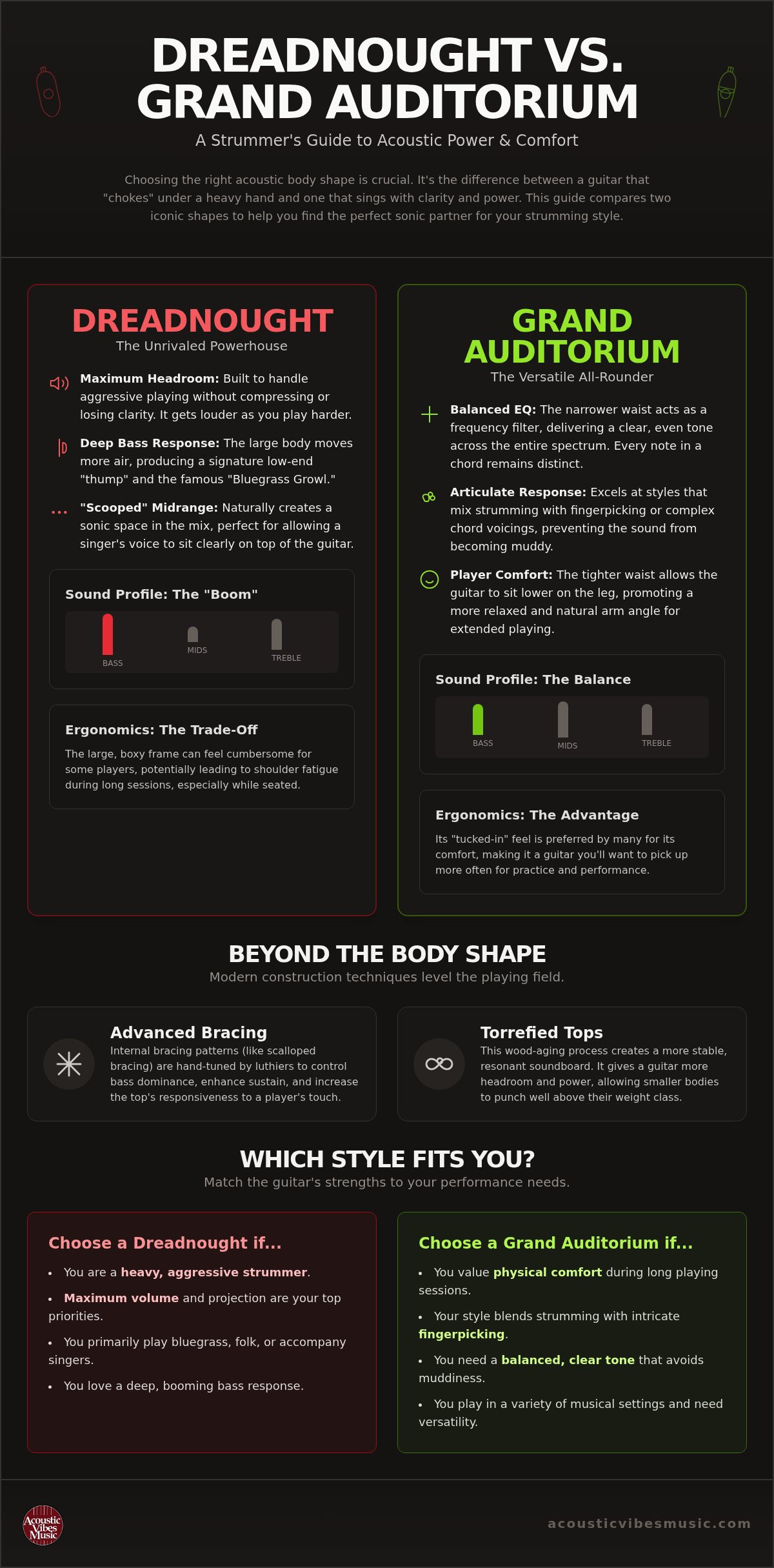
While body dimensions provide the blueprint, the internal architecture and material selection act as the engine of your instrument. In the debate of dreadnought vs grand auditorium for strumming, these factors can completely upend traditional expectations. For example, Boucher Guitars specializes in torrefied tops. By thermally treating the wood to mimic decades of aging, they significantly increase the soundboard's stiffness and resonance. This process allows a smaller-bodied guitar to achieve the massive headroom typically reserved for larger instruments. It’s a game-changer for players who want power without the bulk.
Choosing between Rosewood and Mahogany also allows you to fine-tune your strumming response. Rosewood provides deep lows and sparkling highs, which can add needed "air" and depth to a focused Grand Auditorium. Mahogany offers a punchy, mid-forward growl that can help a Dreadnought's bass-heavy profile cut through a mix with more precision. A masterfully built boutique Grand Auditorium will often out-project and out-perform a mass-produced factory Dreadnought in both volume and complexity. The quality of the build often speaks louder than the size of the box.
High-velocity strumming demands a top that won't distort under pressure. Adirondack (Red) Spruce is the gold standard here. It possesses a superior stiffness-to-weight ratio compared to Sitka Spruce, allowing it to handle an incredibly aggressive attack without losing clarity. The Boucher Studio Goose is a prime example of this engineering. It provides a ceiling of volume that feels almost limitless, rewarding players who have a heavy right hand with crystalline projection and rich harmonic overtones.
Elite luthiers use hand-scalloping and tap-tuning to maximize a guitar's potential. Brands like Collings are masters of this craft. They manage to build Dreadnoughts that offer immense power without the muddy "boom" that plagues lesser instruments. By thinning the braces in specific areas, they ensure the entire top vibrates in harmony, creating a balanced and responsive soundboard. Finally, remember that even the finest instrument requires a professional setup to truly shine. At Acoustic Vibes Music, our in-house luthier services ensure your guitar is optimized for your specific strumming style. Explore our curated collection of high-headroom boutique instruments today.
The decision between a dreadnought vs grand auditorium for strumming isn't just about physical size. It's about how the instrument translates your musical intent into the air. If your style demands a thunderous low-end and the sheer volume to anchor a bluegrass ensemble, the dreadnought remains your primary tool. If you prioritize a balanced frequency response and a body that stays comfortable through hours of songwriting, the grand auditorium is a versatile partner. At Acoustic Vibes Music, we understand that these nuances are what separate a good guitar from a lifelong companion.
We view our shop as a curated gallery where every instrument has earned its place through superior craftsmanship. We hand-select pieces from legendary builders like Yamaha and boutique innovators like Atkin. This rigorous selection process ensures that whether you choose a traditional powerhouse or a modern versatile shape, the build quality is beyond reproach. Every guitar in our collection undergoes a meticulous professional setup in our in-house luthier shop before it finds a home. We believe every player deserves an instrument that is performance-ready the moment it leaves the case. For those looking to invest in a legacy instrument, our guide to High End Acoustic Guitars for Sale offers deeper insight into the characteristics of heirloom-quality builds.
You don't need to be in our neighborhood to experience our specialized service. We safely ship these exceptional instruments to collectors across the country every day. Our packing process is as refined as our curation, ensuring your new guitar arrives in pristine condition regardless of your location. If you're still undecided on the dreadnought vs grand auditorium for strumming debate, we invite you to call us for a personalized tone consultation. We'll discuss your attack, your preferred string tension, and your sonic goals to help you find the perfect match from our inventory.
Finding the right guitar is a journey of discovery. It’s about that visceral moment when the first chord rings out and perfectly matches the sound you’ve heard in your head. We're here to act as your expert guide through the technical nuances of bracing, wood choice, and body physics. Explore our full Acoustic Guitar Collection today and take the first step toward owning an instrument that truly inspires your best playing.
Choosing between a dreadnought vs grand auditorium for strumming isn't just a technical decision; it's a personal one that defines your musical identity. You've seen how the massive air cavity of a dreadnought provides unrivaled bass and projection, while the refined waist of a grand auditorium offers a balanced midrange clarity that sits perfectly in any mix. It's important to remember that premium bracing and specialized tonewoods can push these shapes beyond their traditional limits, offering the sophisticated headroom your performance demands.
As an authorized dealer for Martin, Taylor, and Collings, Acoustic Vibes Music is dedicated to pairing collectors with heirloom-quality instruments. Every guitar in our gallery receives an expert luthier setup and is eligible for secure national shipping. We're here to share our passion and technical knowledge to ensure you feel confident in your choice. Explore Our Curated Collection of Premium Acoustic Guitars and discover the instrument that will elevate your music for years to come. Your next great discovery is just a chord away.
A Grand Auditorium is a remarkably versatile shape, though it reaches a sonic ceiling sooner than a larger body. While it handles moderate to spirited play with ease, extremely aggressive strummers might notice the tone becoming thin or compressed. High end models with specialized bracing are designed to mitigate this effect. This shape is perfect for players who value a balanced response over raw, percussive power.
The dreadnought is the undisputed leader when it comes to low end authority and bass response. Its wide waist and deep body cavity allow for significant air displacement, creating a powerful "thump" that anchors your sound. This makes the dreadnought vs grand auditorium for strumming choice easy for those who want a rich, room-filling low end. The grand auditorium offers a tighter, more controlled bass.
While dreadnoughts typically offer more raw volume due to their size, build quality often upends this rule. A boutique grand auditorium from a builder like Boucher or Collings can out-project a standard factory-made dreadnought. The efficiency of the soundboard and the quality of the internal bracing determine how much volume the instrument can actually produce. Volume is as much about engineering as it is about physical displacement.
Many singer-songwriters prefer the grand auditorium for its balanced EQ and midrange clarity. This profile ensures the guitar doesn't fight the human voice for space in a mix. However, if your voice is particularly mid-forward, a dreadnought's "scooped" sound provides a natural pocket for your vocals to sit. Your choice should depend on how your specific vocal range interacts with the guitar's frequency response and natural resonance.
You can use medium gauge strings on many modern grand auditoriums, but you should always verify the manufacturer's recommendations first. Heavier strings provide more tension to drive the top, which can increase volume and headroom for heavy strumming. This adjustment can help bridge the gap in the dreadnought vs grand auditorium for strumming comparison. Our professional luthier services can help you optimize your setup for higher tension strings safely.
Bluegrass players rely on the dreadnought for its immense projection and the signature "low-E growl." In an acoustic ensemble with loud banjos and fiddles, a guitar needs significant volume to be heard during rhythm and lead breaks. The dreadnought’s bass-heavy response provides the necessary percussive foundation for the genre. Its ability to cut through a dense acoustic mix is unmatched by smaller, more balanced body shapes.
Most players find the grand auditorium significantly more comfortable, especially during long seated sessions. Its narrow waist allows the instrument to sit lower on your leg, which brings your strumming arm into a more natural and relaxed position. Dreadnoughts have a wider waist and deeper bouts, which can cause shoulder fatigue for smaller players or those with existing joint issues. Comfort is a vital factor in your long-term performance.
Bracing acts as the skeletal support and the acoustic engine of the guitar. It dictates how much energy the top can handle before the sound distorts or compresses. Advanced techniques like hand-scalloping or specialized boutique bracing allow the soundboard to vibrate more freely while maintaining structural integrity. This engineering increases the headroom, allowing a smaller body to handle aggressive strumming with the sophisticated composure of a much larger instrument.