My shopping cart
Your cart is currently empty.
Continue ShoppingThe bigger ukulele isn’t automatically the more comfortable choice. Choosing a concert vs tenor ukulele for adults means weighing the roomier fret spacing of a tenor against the lighter, more compact feel of a concert. The difference can seem small on a size chart, but it becomes clear when you reach for a chord or play a fingerstyle passage.
It’s natural to wonder whether a tenor’s extra fret space will make playing easier, or whether its larger body might feel awkward. Body size can influence tone and projection, but the best fit also depends on your hands, posture, and the music you want to play.
This guide compares concert and tenor ukuleles by sound, scale, comfort, and playing style. You’ll learn what typical size differences mean in practice and how to judge an instrument by feel rather than its label alone. A consistent comparison can reveal details no measurement can settle.
Both concert and tenor ukuleles can suit adult players. The practical differences are their overall dimensions, the space your fretting hand gets, and how each instrument rests against your body. A concert is typically more compact, while a tenor gives you a longer playing surface. Neither size is automatically better. Use the measurements below as a starting point, then let your hands and ears guide you.
| Feature | Concert | Tenor |
|---|---|---|
| Overall length | About 23 inches (58 cm) | About 26 inches (66 cm) |
| Scale length | About 15 inches (38 cm) | About 17 inches (43 cm) |
| Fret spacing | Typically closer together | Typically more spread out |
| Typical feel | Compact, easy to hold close | Roomier across the neck, with a larger body |
These are approximate dimensions, not a template every instrument follows. Body shape, neck design, and construction vary, so two ukuleles with the same size label may still feel noticeably different. For a broader overview of the instrument’s common forms and construction, see Ukulele sizes and characteristics.
Scale length is the vibrating string length between the nut and the saddle. A longer scale generally creates more distance between frets, which becomes more noticeable as your hand moves up the neck. That extra room can help some players separate notes, while others prefer the shorter reaches on a concert. Fret count and exact spacing vary by model, so a size label doesn’t tell the whole story.
Overall length offers a clue about how the instrument may sit in your lap or against your torso, but body depth and outline matter, too. A tenor’s larger frame may feel substantial; a concert’s smaller profile may feel easier to position and carry. These are tendencies, not rules.
Concert and tenor ukuleles commonly use G-C-E-A tuning. Since the strings are tuned to the same notes, familiar chord shapes generally transfer between the two sizes. A C chord, for instance, uses the same fingering pattern on either instrument. You don’t need to relearn your music or chord vocabulary when you change size.
The hand feel can change, though. On the tenor, a chord may require a slightly wider reach; on the concert, your fingers may feel more closely grouped. Try familiar shapes on both and give your hand a moment to adjust before deciding which feels easier.
The fundamentals remain familiar: tuning, chord relationships, strumming patterns, and picking approach. The instrument’s response is a separate matter. Body and string differences can influence resonance and projection, while the neck and fret layout shape the physical experience. That’s the useful distinction in the concert vs tenor ukulele for adults decision: the musical language transfers, but the instrument’s feel and voice may not.
Size is a useful starting point, not a guarantee of sound or comfort. Concert ukuleles often have a bright, focused voice, where individual notes feel clear and distinct. Tenors often sound fuller and more resonant, with more depth and potentially longer sustain. These are common tendencies, not rules: instruments of the same size can respond differently under the same player’s hands.
A concert’s compact body can deliver a lively, direct sound that suits crisp strumming and clear chord changes. A tenor’s larger body often adds warmth and resonance, which may appeal when you want single notes to ring out. Listen to each size with both a brisk strum and a slowly picked melody. The difference may be more apparent in one playing style than the other.
Construction shapes the result. Body design and materials affect resonance, while strings influence brightness, tension, and response. Setup matters, too: an instrument that feels easy to fret and responds evenly may be more satisfying than one whose size seems ideal on paper. A tenor won’t always sound richer than every concert, and a concert isn’t automatically brighter than every tenor.
As a general tendency, a concert often sounds brighter and more focused, while a tenor often offers a fuller, more resonant voice. Treat that as a listening guide, not a promise. In the concert vs tenor ukulele for adults choice, the individual instrument matters as much as its category.
A longer scale usually means more room between frets. That may help if your fingers feel crowded when forming chords or moving between notes, but the added spacing can also require a wider reach, especially across several frets. A concert’s closer fret spacing may make compact chord shapes and shorter reaches feel more natural. Neither advantage applies to every adult player.
Comfort depends on more than hand size. Notice whether your wrist stays relaxed, whether your thumb rests comfortably behind the neck, and whether your fingers land cleanly without pressing harder than necessary. Technique matters as well: a player who favors compact chord shapes may prefer a different neck feel from someone who often stretches across the fretboard for melodies. Give each instrument time to settle in your hands.
Specifications can narrow the field, but they can’t capture the feel of a particular neck or the character of its voice. At the Acoustic Vibes Music showroom, compare instruments in person and let your playing reveal the differences.
Start with what you want the instrument to do. A size may lean toward a particular sound or feel, but it doesn’t determine your genre, experience level, or musical potential. Both concert and tenor ukuleles can work for strumming, fingerpicking, singing accompaniment, and performance. Use these tendencies to narrow your search, then listen to and handle individual instruments.
| Your priority | Size tendency to explore | Why it may suit |
|---|---|---|
| Crisp, rhythmic strumming | Concert | Its often bright, focused character can help chord rhythms sound clear. |
| Sustained notes or melodic picking | Tenor | Its often fuller, resonant voice may appeal when you want notes to ring. |
| Compact feel for carrying and holding | Concert | The smaller overall frame may feel easier to position or bring along. |
| A roomier playing surface | Tenor | Its longer scale typically gives the fretting hand more space between frets. |
| Singing or playing with others | Either | Choose the response and feel that best support your part in the music. |
If you enjoy a crisp rhythmic strum and want chord changes to stay clearly articulated, try a concert and listen to how it sits beneath your voice. If you play melodies note by note or want a more sustained quality, compare a tenor. These are starting points, not genre rules. A tenor can be a lively strummer, and a concert can serve melodic playing beautifully. Construction, strings, and setup influence an instrument’s voice, so judge what you hear rather than choosing by musical stereotype.
For solo practice, notice which sound you enjoy hearing up close and whether the neck feels natural through the passages you play most. For singing accompaniment, consider whether the ukulele’s tone supports your voice without feeling too prominent or too delicate. With other players, you may value projection and note clarity, but body size alone can’t guarantee how well an instrument will carry in a group.
Portability may tip the balance if you regularly take your ukulele along, while a larger playing feel may be more appealing if the instrument mostly stays at home. If you perform, treat amplification as a separate consideration: the right setup depends on the performance situation, not simply whether the body is concert or tenor. The concert vs tenor ukulele for adults decision is about matching your priorities, not meeting a rule about age, skill, or repertoire.
Once you’ve narrowed your preferences, explore the ukulele selection at Acoustic Vibes Music and compare instruments with your own playing in mind.
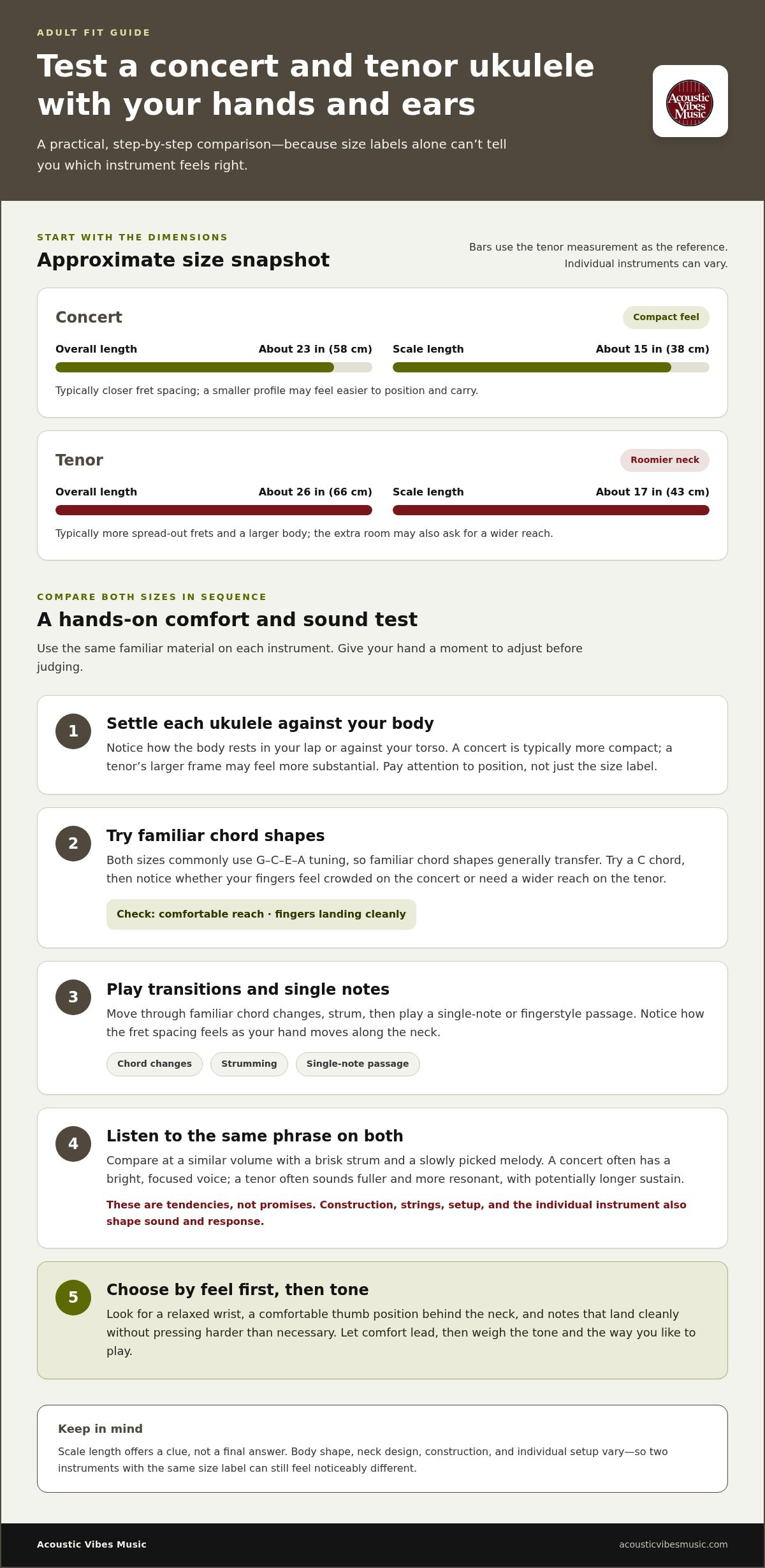
A consistent comparison tells you more than picking up one instrument and guessing from its size. Use the same posture and familiar music on both ukuleles. Pay attention to how your body responds as well as how cleanly you can play. This routine turns the concert vs tenor ukulele for adults decision into a practical comparison.
Keep the test simple and repeatable. When comparing instruments in person, use the same sequence on each before deciding which feels more natural.
Spend several minutes with each instrument if you can. A first impression matters, but it may change once your hands settle in and you repeat the same movements. Keep the comparison fair by using the same passage, tempo, and playing position on both.
Look for relaxed posture and repeatable fretting, not a perfect first attempt. A small adjustment in hand position is normal; persistent shoulder tension, a strained wrist, or having to squeeze hard to make notes ring deserves attention. Ask yourself whether the instrument lets your usual playing motion flow or makes you repeatedly compensate.
Adult players don’t have to choose tenor, and smaller hands don’t automatically require a concert. Comfort depends on your reach, technique, posture, and the individual instrument. A brief tryout shows which one feels more inviting now, not what you’ll be capable of playing in the future. Skills develop with practice, and preferences can evolve.
Use the test as a guide, not an exam. Bring a short list of familiar chords and a melody you enjoy when comparing ukuleles in person. That gives you a reliable way to judge each instrument on your own terms. Explore the ukulele selection and find a size that feels right in your hands.
Make the decision in this order: comfort first, then tone, then how and where you’ll play. If one size lets you fret, strum, and move between chords with less effort, that’s a strong reason to choose it. If both feel comfortable, compare their voices and consider which better suits your usual playing. The best choice in the concert vs tenor ukulele for adults debate isn’t a universal winner. It’s the instrument that makes you want to pick it up and play.
Use these tendencies as a final guide, not as rules. Individual instruments vary, and a particular ukulele may feel or sound different from what its size suggests.
Remember that size is only one part of an instrument’s character. Neck shape, setup, strings, and construction all contribute to how a particular ukulele feels and responds. If a concert feels easier than expected or a tenor sounds brighter than you imagined, trust what you experience rather than forcing the instrument to match a broad description. Your comparison is about finding a good fit, not proving a size label right.
Acoustic Vibes Music offers a curated ukulele selection online and an in-person showroom where you can experience instruments in your hands. Comparing options in person lets you listen, play familiar passages, and notice the small differences that specifications can’t convey. Take your time. A comfortable instrument with a sound you enjoy is a more personal guide than choosing by size alone.
Once you’ve chosen, Acoustic Vibes Music provides professional repair and maintenance for stringed instruments by appointment. Explore the selection online or visit the showroom to make the comparison tangible. Browse the ukulele selection and discover which size feels right for you.
Your decision doesn’t have to define the kind of player you’ll become. Think of it as choosing the instrument that feels inviting for the music you want to play now, with room to explore as your interests grow. The best answer to concert vs tenor ukulele for adults is the one that makes practice feel natural and leaves you eager to play another song.
Take the next step at your own pace. Browse Acoustic Vibes Music’s curated ukulele selection online, or visit the showroom to experience instruments in person. As your ukulele becomes part of your musical routine, professional repair and maintenance are available by appointment.
Explore the curated ukulele selection, then trust your hands and ears to lead the way. Your next favorite sound is waiting to be discovered.
Usually, choose a string set designed for your ukulele’s scale and size. A set made for a different instrument may change tension, feel, or tuning, so follow the string maker’s guidance before trying it. Material matters, too: switching string types can alter the instrument’s response. Match the set to the instrument’s specifications rather than relying on a general “ukulele strings” label.
Yes, a tenor can commonly use low-G tuning with a suitable low-G string. This replaces the high-G string with a lower-pitched one, extending the notes available below the usual range. The result changes the sound and feel compared with standard re-entrant tuning, where the G string is higher. Choose a string intended for your instrument and follow the maker’s fitting guidance.
Tune before each playing session, then check again if you’ve played for a while or the room conditions have changed. Fresh strings may need more frequent attention as they settle. A reliable tuner helps you target the correct pitch, especially if you’re still developing your ear. Confirm the intended tuning for your string set, too, since an alternate setup such as low G won’t match standard re-entrant tuning.
It may fit, but extra space can let the concert move around rather than stay secure. Check the case’s interior measurements against your ukulele’s body and neck dimensions, and consider how it sits inside rather than comparing overall length alone. Case shapes and padding vary. A close, supportive fit helps limit unnecessary movement during storage or transport, while a loose fit may call for a case sized more closely to the instrument.
Not necessarily. Whether a setup is useful depends on the instrument’s condition and how it feels to play. Check whether notes fret cleanly, tuning holds, and the strings feel comfortable under your fingers. In the concert vs tenor ukulele for adults decision, a well-adjusted instrument may feel better than another instrument of the same size. If notes sound inconsistent or playing feels unusually difficult, Acoustic Vibes Music provides professional repair and maintenance by appointment.
Retune carefully first, especially if the strings are new and still settling. Temperature changes, string condition, and tuning technique can also affect tuning stability. If it continues, look for obvious issues such as a string that isn’t seated properly, but don’t force the tuning pegs. Persistent problems are a reason to arrange a professional assessment. Acoustic Vibes Music provides instrument repair and maintenance by appointment.