My shopping cart
Your cart is currently empty.
Continue ShoppingYour first mandolin was a gateway, but your second must be a voice. It's a common frustration to feel limited by a starter instrument's thin, "tinny" tone or the stubborn tuning stability of entry-level hardware. You're ready for more. Searching for the best intermediate mandolin is a pursuit of genuine artistry and hand-carved excellence. It's about finding that perfect balance between a professional-grade tool and a piece of functional art that inspires every time you open the case.
We know the excitement of searching for that rich, woody "chop" and the tactile response required for lightning-fast melodic runs. You deserve an instrument that doesn't just play well but also holds its resale value through superior construction. This guide explores the essential criteria for selecting an intermediate mandolin with heirloom-quality tone and professional playability. We'll look at the 2026 market landscape, from refined pre-war designs to the modern precision that defines today's most sought-after mid-tier instruments.
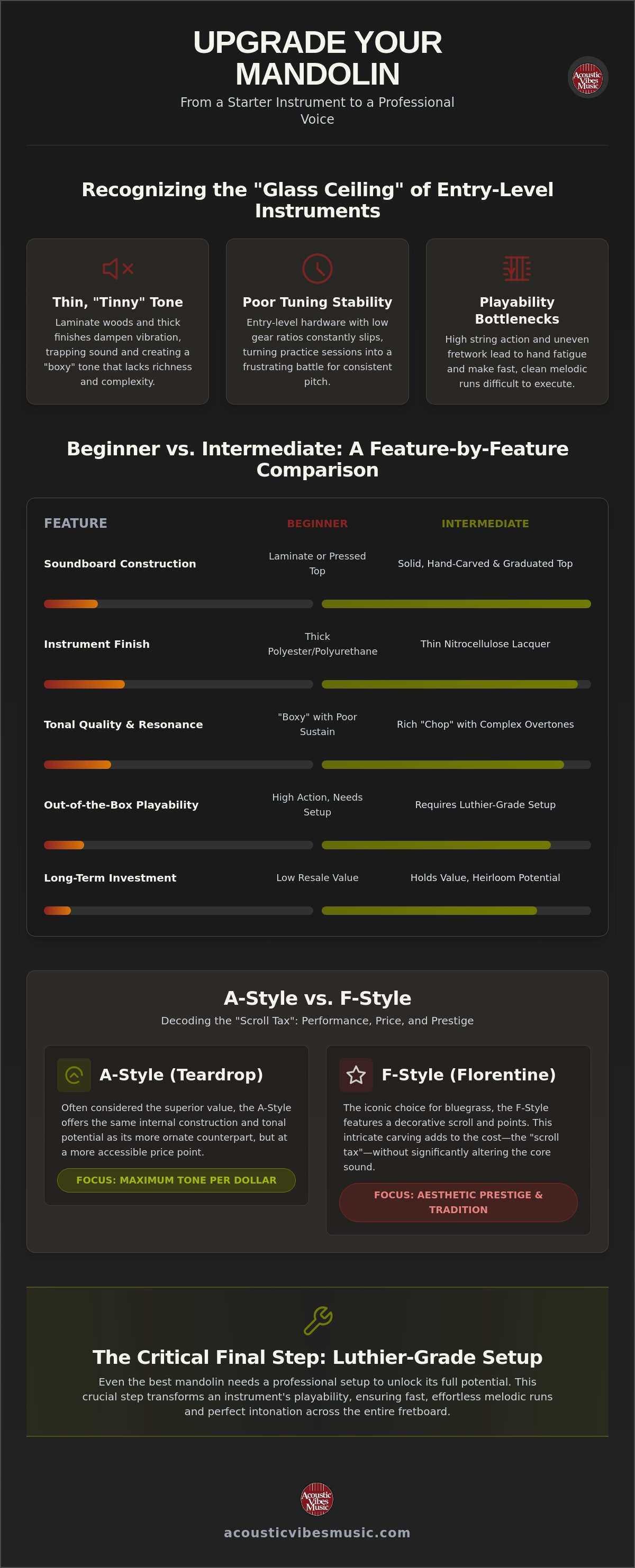
Every musician eventually encounters a plateau that has nothing to do with practice hours and everything to do with their gear. It’s the "Glass Ceiling" of entry-level instruments. While your first mandolin was a vital tool for learning chords, its laminate wood construction and heavy polyester finish now act like a sonic straightjacket. These materials are stiff and unresponsive, preventing the instrument from vibrating freely. Finding the best intermediate mandolin requires moving beyond these factory limitations to find an instrument that breathes and reacts to your touch.
The transition to a mid-tier instrument is about moving from a simple fundamental note to a world of rich overtones. Understanding the nuances of Mandolin history and construction reveals why solid, hand-carved tops are the gold standard for resonance. Unlike pressed tops found on budget models, hand-carved plates are graduated to specific thicknesses, allowing for a complex "chop" that carries across a crowded jam session. Brands like Collings Guitars apply this same level of obsessive precision to their mandolin line, ensuring that every chop and tremolo passage rings with professional authority.
Listen closely to your current mandolin. Does the sound feel "thin" or "boxy," as if the music is trapped inside the body? Beginner instruments often suffer from a lack of sustain, especially in the higher registers where notes tend to die out prematurely. You might also notice poor note separation. When you play complex double-stops or four-finger chords, the individual notes should be distinct and clear, not a muddy wash of sound. If your mandolin disappears the moment a banjo or fiddle joins the mix, you've officially outgrown its tonal capacity.
Playability bottlenecks are often the most frustrating part of a starter mandolin. Many entry-level models feature high action that cannot be lowered without causing significant fret buzz, largely due to uneven fretwork or unstable necks. Narrow nut widths can also cramp adult hands, making complex jazz chords or fast melodic runs feel impossible. A professional luthier setup reduces string tension and optimizes bridge height, allowing your fingers to glide through rapid-fire fiddle tunes without the fatigue caused by high action. Furthermore, budget tuners with poor gear ratios often slip, turning a ten-minute practice session into a constant battle for pitch. Upgrading to the best intermediate mandolin ensures you have the hardware reliability and ergonomic comfort needed to reach the next level of your musical journey.
When you step into the world of high-quality instruments, you leave behind the world of "good enough" factory specs. The most significant differentiator in a mid-tier instrument isn't just the materials, but how they are shaped. Budget models often use pressed solid wood tops, which are essentially flat pieces of spruce steamed and bent into a curve. This process stresses the wood fibers and limits vibration. In contrast, the best intermediate mandolin features a hand-carved top where a luthier sculpts the arch from a thick slab of wood. This allows for graduated thickness, where the soundboard is thinner at the edges and thicker under the bridge, creating a responsive "pump" that projects sound with clarity and depth.
Scholarly research on the Structure and Performance of the Mandolin highlights how the physical architecture of the instrument dictates its acoustic potential. Beyond the carve, the finish plays a critical role. Many entry-level instruments are encased in thick polyester or polyurethane. It's durable but acts like a layer of plastic wrap that stifles the wood's natural voice. A professional-grade instrument typically uses nitrocellulose lacquer. This finish is much thinner and more porous, allowing the wood to age and "open up" over time. If you want to experience this difference firsthand, you can explore our curated selection of precision-built instruments that prioritize these artisanal construction methods.
The choice of spruce defines the instrument's headroom. Adirondack (Red) Spruce is the traditional choice for bluegrass players who need a powerful, percussive "chop" that won't distort when played hard. It's stiff and offers incredible volume. Sitka Spruce, however, is often preferred by folk and Celtic players for its immediate responsiveness and warmer, more intimate character. While maple is the traditional choice for the body, understanding the broader world of tonewoods, such as Rosewood vs. Mahogany Back and Sides, provides helpful context for how wood density shapes your overall sound profile.
Maple provides the "snap" and "zing" that defines the mandolin's frequency range. While flamed or quilted figuring is visually stunning, it also indicates a level of wood density that contributes to a brighter, more focused tone. When hunting for the best intermediate mandolin, look for quarter-sawn maple rather than slab-cut. Quarter-sawn wood is cut perpendicular to the growth rings, resulting in a more stable neck and back that resists warping while offering superior energy transfer from the strings to the body.
Choosing the silhouette of your next instrument is a pivotal moment in your musical journey. For many, the iconic scroll and points of the F-style represent the pinnacle of mandolin design. However, seasoned players often point to the "Scroll Tax" as a reason to look closer at A-style models. Because the ornate scroll of an F-style is incredibly labor-intensive to carve and bind, these instruments typically cost 30 to 50 percent more than an A-style of equivalent tonal quality. If your goal is to find the best intermediate mandolin based strictly on sound per dollar, the A-style is an unbeatable value. It offers a symmetrical resonance that some purists argue provides a more balanced tone across the strings.
Despite the cost, the F-style remains the undisputed king of the bluegrass stage. Its prestige is rooted in tradition, but it also offers practical benefits like the convenient scroll for hanging a strap. For a deeper dive into these nuances, explore our guide on A-Style vs. F-Style Mandolins: Tone and Style Explained. Ultimately, the decision rests on whether you prioritize the "bluegrass look" or the raw acoustic power that a high-end A-style can deliver at a lower price point. Both styles have their place in a curated collection, and the choice often comes down to the specific musical environment you inhabit.
The shape of the soundholes dictates how the air moves inside the body. F-holes provide the percussive "bark" and rapid decay required for ensemble playing, making them the standard for bluegrass "chop." Oval holes, conversely, offer a sustained, tubular warmth that excels in solo Celtic or folk performances. To maximize these characteristics, F-hole models usually pair best with an adjustable ebony bridge to focus the energy; meanwhile, oval holes benefit from a bridge design that emphasizes resonance and sustain. Your choice here should align with whether you need to cut through a loud band or fill a quiet room with rich, melodic textures.
Market trends consistently show that F-style mandolins hold their resale value better than A-styles, largely due to their high demand among bluegrass enthusiasts. However, boutique A-styles from master builders are starting to defy the "budget" stereotype, gaining traction as serious professional tools. It is also true that your aesthetic preference significantly influences practice consistency; you are far more likely to pick up an instrument that you find visually inspiring every single day. When searching for the best intermediate mandolin, balance your financial investment with the emotional connection you feel when you open the case.
The transition from a $1,000 starter to the $2,500 to $4,500 "pro-intermediate" range is where the true magic happens. This is the sweet spot for finding the best intermediate mandolin that offers professional-grade performance without the five-figure price tag of a vintage heirloom. While many buyers get stuck in analysis paralysis looking at hundreds of obscure builders, a few names consistently rise to the top for their reliability and tonal depth. Eastman’s 500 and 800 series remain the essential entry point for those demanding hand-carved solid woods. Yet, for the player who wants to truly cut through the mix, Northfield’s "Big Mon" and NF5S models provide an aggressive, woody "chop" that has earned them a place on professional stages worldwide.
Pava mandolins represent another tier of boutique excellence. Built in the same workshop as legendary Ellis mandolins, they offer a pedigree of elite craftsmanship with a focus on pure, ringing tone and understated elegance. These instruments don't just sound better; they feel more alive in your hands. If you're ready to hear the difference that master-grade carving makes, view our current inventory of hand-selected mandolins today.
In the world of modern mandolins, Collings sets the benchmark for crystalline clarity and engineering precision. Their MT and MT2 models are often the last mandolin a player ever needs to buy. When you explore the Collings Guitars heritage, you see a commitment to detail that translates perfectly to the mandolin's high-tension environment. These instruments are famously consistent. You can buy a Collings with total confidence that the fretwork will be flawless and the tone will be balanced across every string. It is a level of industrial artistry that few other workshops can match.
Choosing between a small-shop luthier and a larger workshop involves understanding the "tap-tuning" process. In boutique shops like Pava, every top is hand-voiced to maximize its specific resonance. This level of individual attention ensures an incredible tonal pedigree. Larger workshops still offer hand-carving, but they might rely more on standardized graduations. When evaluating used or consignment instruments, always inspect the structural integrity carefully:
A well-maintained boutique instrument often carries a story and a soul that mass-produced models lack. Finding the best intermediate mandolin is ultimately about finding an instrument that responds to your unique touch and pushes you to play longer every single day.
Mandolins are high-tension machines. With eight steel strings exerting hundreds of pounds of pressure on a small spruce soundboard, the margin for error is razor-thin. While a guitar might be forgiving of a slightly high nut or a poorly seated bridge, a mandolin is not. A fraction of a millimeter can be the difference between a joy to play and a chore that causes finger fatigue. Even the best intermediate mandolin will only reach its full potential when it has been optimized by a specialist. This final stage of luthier-led refinement is what transforms a factory instrument into a professional-grade tool.
The bridge is the heart of energy transfer. Because mandolin bridges are floating, they must be perfectly "chalk-fit" to the specific arch of the top. If there are gaps beneath the bridge feet, your tone will suffer from a lack of volume and clarity. Similarly, nut slot depth is the secret to effortless first-fret playing. If the slots are too high, those tricky F and Bb chords become a battle. Proper compensation at the bridge ensures that your intonation remains perfect all the way up the neck, allowing your high-register tremolo passages to ring true and clear.
Our approach to mandolin optimization is obsessive. We don't believe in "factory-ready" standards. Every instrument that passes through our gallery undergoes a custom, national-level setup by our expert luthier team. We adjust the truss rod, level the frets if necessary, and meticulously seat the bridge to maximize resonance. This level of care is essential for maintaining the value of your investment. For those who already own a prized instrument and are finding the right luthier for repairs, our shop offers specialized services to restore and enhance the voice of your mandolin.
Solid wood is a living material that reacts to its environment. Humidity management is your most important task as an owner. Aim to keep your instrument in a climate-controlled environment between 40 and 50 percent humidity to prevent top cracks or seam separations. You should also be prepared for seasonal shifts; a slight truss rod adjustment is often needed when the weather turns dry. Beyond environmental care, the right accessories can significantly enhance your experience. Consider these essentials for your best intermediate mandolin:
By prioritizing professional setup and consistent maintenance, you ensure that your mandolin remains a responsive, reliable partner for years to come. The pursuit of quality doesn't end at the purchase; it's a commitment to the artistry of the instrument itself.
Upgrading to the best intermediate mandolin is a transformative step that bridges the gap between learning the craft and mastering the music. By prioritizing hand-carved tonewoods and understanding the subtle nuances of bridge seating and soundhole design, you ensure your next instrument is more than just a tool. It becomes a partner in your creative discovery. Whether you choose the percussive power of a Northfield F-style or the balanced resonance of a boutique A-style, the right choice will inspire you to reach for new heights in your playing.
At Acoustic Vibes Music, we curate every instrument with the eye of a collector and the ear of a player. As an authorized dealer for premier builders like Collings and Northfield, we provide access to the finest craftsmanship in the industry today. Every purchase includes a comprehensive expert luthier setup to ensure your new mandolin arrives ready for the stage. We offer secure national shipping with professional packing to protect your investment during transit. Explore our curated collection of professional mandolins and discover the instrument that speaks to you. Your next musical chapter starts here.
The ideal investment for a high-quality upgrade typically sits in the $2,500 to $4,500 range. This bracket allows for the hand-carved construction and premium tonewoods that define the best intermediate mandolin. While you can find solid-wood instruments for less, this price point is where you begin to see the artisanal details and tonal complexity required for professional-level performance.
F-style mandolins are the cultural standard for bluegrass, but they are not strictly superior in terms of raw tone. The scroll and points provide the iconic look and a convenient strap hanger, yet an A-style with f-holes can deliver the same percussive bark. if your budget is a primary concern, an A-style often provides superior sound quality for the same financial investment.
A professional setup is absolutely non-negotiable for achieving peak performance. Mandolins are sensitive instruments with high string tension, meaning even tiny adjustments to the nut slots or bridge seating can radically improve playability. A luthier-led setup ensures your instrument is easy to play and perfectly intonated, which factory settings rarely guarantee.
The primary difference lies in the size and the tuning of the strings. A mandola is the tenor of the mandolin family, tuned a perfect fifth lower to C-G-D-A. It features a larger body and a longer scale length, producing a rich, throaty resonance that complements the higher, soprano range of the standard mandolin.
Spruce is the gold standard for mandolin soundboards due to its incredible strength-to-weight ratio. Adirondack spruce is prized for its high headroom and percussive power, making it a favorite for bluegrass players. Sitka spruce is another excellent choice, offering a warmer and more balanced tonal profile that excels in folk and Celtic music.
You should change your strings every one to two months depending on how often you play. Mandolin strings lose their "zing" and develop intonation issues faster than guitar strings because of the high tension and double-course configuration. Fresh strings restore the crisp, bright high end and ensure your tremolo passages remain clear and focused.
Buying a used instrument can provide incredible value, but purchasing a new best intermediate mandolin offers the benefit of a manufacturer warranty. New instruments from an authorized dealer also ensure the instrument hasn't suffered from poor humidity control. If you choose used, ensure you inspect the structural integrity of the top arch and the neck joint carefully.
Most modern mandolins feature a standard nut width of 1 1/8 inches. This width is comfortable for the majority of players, though "wide nut" models at 1 3/16 inches are increasingly popular for those with larger hands or those transitioning from guitar. The right width prevents your fingers from feeling cramped during complex four-finger chords.