My shopping cart
Your cart is currently empty.
Continue ShoppingCould the wrong bottle of polish actually be devaluing your heirloom Martin or Gibson every time you buff the top? For many players, the thin, breathable layer of nitrocellulose is what gives an acoustic its soul and resonance; yet, it is also incredibly sensitive to the harsh chemicals found in standard retail cleaners. You likely want that deep, glass-like reflection to last a lifetime, but the fear of finish checking or that dreaded cloudy residue often keeps you from cleaning it at all. Finding the best guitar polish for nitrocellulose finish is about more than just aesthetics. It is about preservation.
We understand that your instrument is a legacy piece, and we've seen firsthand how the right care routine maintains both beauty and resale value. In this 2026 guide, we reveal which professional-grade polishes safely restore your guitar's luster without softening the lacquer or dampening its natural vibration. You'll discover the specific silicone-free formulas our own luthiers use on premium Collings and Bourgeois builds. We will compare boutique options like LORE® with industry staples like Virtuoso to help you achieve a mirror-like shine that protects against sweat and oils for years to come.
Nitrocellulose is a solvent-based lacquer that remains chemically active long after it leaves the spray booth. Unlike modern polyester or polyurethane finishes that form a hard, static plastic shell, nitro is porous and continues to cure and shrink over time. What is a nitrocellulose finish? Scientifically, it is a compound derived from cellulose treated with nitric acid; in the guitar world, it is the hallmark of premium craftsmanship. This finish is the gold standard for resonance because it can be applied in incredibly thin layers. This allows the tonewood to vibrate more freely, providing the harmonic complexity and open sound that collectors and enthusiasts crave.
However, this artisan beauty comes with significant vulnerability. Nitro is susceptible to several environmental and chemical enemies:
Using a generic furniture spray or a polish designed for thick polyurethane can be disastrous. These often contain silicone or heavy oils that clog the pores of the lacquer and trap contaminants. Finding the best guitar polish for nitrocellulose finish is essential to avoid creating a sticky, permanent mess that ruins your instrument's tactile feel and long-term resale value.
Players often say nitro allows a guitar to breathe. While wood doesn't actually exchange oxygen, the finish is significantly thinner than modern industrial alternatives. This lack of mass directly impacts how a Boucher Guitars torrefied top behaves. A thin finish allows the soundboard to move with maximum efficiency and speed. Conversely, applying the wrong wax-heavy products creates a dampening build-up. This stifles the instrument's natural voice, effectively muting the very resonance you sought when choosing a high-end acoustic.
Watch for hazing or clouding in areas of high contact, such as where your forearm rests on the lower bout. This is often a sign of moisture and oils trapped within the top layer of the lacquer. You should also distinguish between natural checking, which are the fine, beautiful cracks that develop with age, and chemical damage caused by improper cleaners. If the finish feels tacky or shows deep scarring, it is time to stop polishing. In these cases, consult a specialist for acoustic guitar bridge repair or finish restoration to preserve the heirloom's integrity. Using the best guitar polish for nitrocellulose finish during your regular maintenance routine prevents these costly professional interventions.
Selecting the best guitar polish for nitrocellulose finish is a chemical decision that determines the longevity of your instrument. You aren't just looking for a shine; you're looking for a formula that respects the delicate, evolving nature of the lacquer. High-end finishes require a neutral pH balance to prevent premature yellowing or clouding. If a product is too acidic, it can eat into the top layer of the finish. If it's too alkaline, it leaves a hazy residue that is difficult to buff out. Our luthiers prioritize products that offer professional-grade purity over retail convenience.
Abrasive levels are another critical factor. Many off-the-shelf polishes contain "diminishing abrasives" designed to cut through heavy scratches. While useful for restoration, these shouldn't be part of your weekly routine. Daily polishes should be non-abrasive, focusing on lifting oils rather than removing material. Using a heavy buffing compound too frequently will eventually thin the nitrocellulose to the point where the wood grain is exposed, especially on the sharp edges of the guitar body.
Silicone is the ultimate deal-breaker for any serious collector. While it provides an instant, mirror-like gloss, it is a permanent contaminant. Once silicone finds its way into the fine cracks or "checking" of an older finish, it permeates the wood grain itself. This causes the "fish-eye" effect, where new finish or glue won't adhere to the surface, bubbling up instead. If your guitar ever requires a neck reset or a bridge reglue, silicone contamination can make these standard repairs nearly impossible. Always check the label for "dimethicone" or "polysiloxanes" before let a drop touch your instrument.
It is a common mistake to treat these three categories as interchangeable. They serve distinct roles in a curated care routine:
If you're unsure about the current state of your instrument's finish, our team can provide a professional evaluation to help you choose the safest path forward.
Selecting the best guitar polish for nitrocellulose finish requires looking past the marketing and into the chemistry of the bottle. In our workshop, we've tested dozens of formulas to ensure they meet the standards of the world's finest luthiers. The market in 2026 has seen a significant shift toward boutique, petroleum-free options that prioritize long-term lacquer health over a quick, artificial shine. Whether you're maintaining a brand-new instrument or a delicate vintage piece, the following products represent the pinnacle of modern finish care.
MusicNomad Guitar One has become a staple for many players because of its versatile, silicone-free formula. It functions as an all-in-one cleaner, polish, and wax that remains safely compatible with nitro for daily use. For those who prefer small-batch excellence, boutique blends like LORE® have gained traction among owners of Martin Custom Shop models. These luthier-grade polishes often use traditional, natural ingredients that nourish the finish without leaving behind the heavy synthetic buildup found in cheaper retail alternatives.
When dealing with "closet finds" or instruments that have endured decades of smoke and sweat, a standard spray isn't enough. The Virtuoso system utilizes a two-step process that is essential for deep restoration. The Premium Cleaner first lifts years of embedded grime and oxidation without the use of harsh abrasives. Once the surface is chemically clean, the Premium Polish is applied to restore the deep, three-dimensional gloss characteristic of aged lacquer. Virtuoso Premium Polish remains the definitive choice for pre-war Martin collectors who prioritize chemical stability and archival safety for their most valuable instruments.
Gibson Pump Polish is a reliable, low-abrasive choice that has been a favorite in the industry for years. It contains a trace amount of lacquer in its formula, which helps to subtly nourish and "re-flow" the top layer of the finish during application. This makes it an exceptionally safe no-brainer for Gibson Acoustic Guitars as well as the high-gloss Yamaha L-Series. To get the best results, use it sparingly. A single mist on a microfiber cloth is often enough to remove fingerprints and restore clarity without creating a gummy layer that could eventually stifle the guitar's resonance.
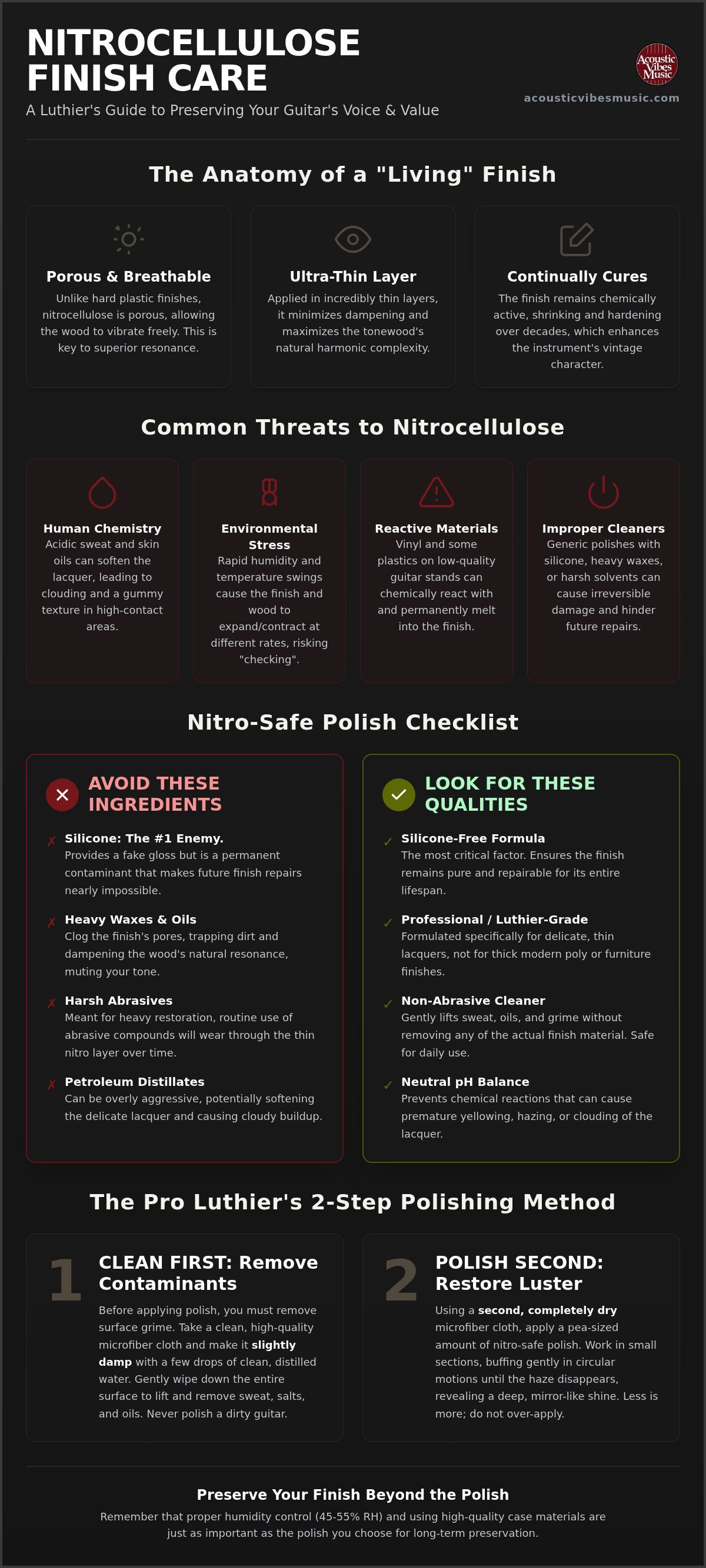
Mastering the art of maintenance is just as important as selecting the best guitar polish for nitrocellulose finish. While professional luthiers often use high-speed buffing wheels for restoration, hand-polishing is the safest and most intimate way to care for your heirloom instrument. This process allows you to feel the contours of the wood and identify any potential issues before they become costly repairs. Follow these steps to ensure a flawless, gallery-quality result every time.
High-quality microfiber is the undisputed champion for lifting oils. Its tiny fibers are designed to trap contaminants rather than just pushing them around. Avoid cheap, bulk-buy towels that may have rough edges or synthetic stitching that can scratch nitro. Always use a fresh section of the cloth for each part of the guitar. When your cloths get dirty, wash them separately without fabric softener. Softeners leave a waxy film on the fibers that will transfer directly to your instrument, creating a cloudy mess the next time you polish.
It is vital to understand that satin finishes require a different philosophy. Never use a high-gloss polish on a satin-finished Lowden. Doing so will slowly buff the finish into an uneven semi-gloss, ruining the original aesthetic. For these instruments, a damp, clean cloth is usually all you need. If you must use a product, ensure it is specifically labeled for matte or open-pore finishes. The goal is to clean the surface without adding a reflective sheen. If you are ever in doubt about the safest method for your specific build, consult our expert team for a personalized maintenance recommendation.
Maintenance is a holistic endeavor that extends far beyond the occasional buffing session. While applying the best guitar polish for nitrocellulose finish restores immediate luster, the long-term health of your lacquer depends on your daily habits and storage environment. Nitrocellulose remains chemically sensitive for decades. It is constantly reacting to the air, the temperature, and the materials it touches. Adopting a "prevention first" mindset reduces the friction on the finish and ensures that your instrument remains a pristine example of acoustic artistry.
The simplest way to protect your guitar is the "Clean Hands" protocol. Always wash your hands before you play. This removes the natural acids, salts, and oils that eventually lead to the gummy buildup discussed in previous sections. By minimizing the transfer of these contaminants, you significantly reduce how often you need to reach for a bottle of polish. Additionally, be mindful of your choice in cases. Lower-quality hardshell cases often use adhesives and plastics that "out-gas" chemical vapors. These fumes can soften the nitrocellulose, leading to a dull, tacky surface that no amount of polishing can fix. Investing in a high-quality, luthier-approved case is a fundamental step in heirloom preservation.
Even with the best home care, your instrument benefits from a periodic professional setup and maintenance appointment. Our luthiers don't just adjust the action; they perform a deep-level inspection of the finish to identify early signs of lifting or chemical distress before they become structural issues.
Humidity is perhaps the most influential factor in finish longevity. When the air becomes too dry, the tonewood shrinks faster than the lacquer can settle. This tension results in "checking," those fine, web-like cracks that are common on vintage instruments. For high-end Martin vs. Collings dreadnoughts, we recommend maintaining a consistent humidity level between 45% and 55%. In-case humidification systems are excellent for targeted care, but a room-wide solution is often safer for collectors with multiple instruments, as it prevents the localized "wet spots" that can occur with sponges or gel packs.
Many players are surprised to learn that their favorite guitar stand might be their finish's worst enemy. The surgical rubber or low-grade foam used on many retail stands contains plasticizers that cause a violent chemical reaction with nitrocellulose. This results in "stand rash," a permanent scarring or melting of the lacquer at the contact points. To nitro-proof your stands, cover the contact areas with clean, undyed cotton cloth. This simple barrier prevents the chemical migration that ruins so many beautiful instruments. Always check the neck and bottom of your guitar for any slight discoloration or softening, as catching stand rash early is the only way to prevent a total refinish job.
Your instrument's nitrocellulose finish is a living testament to premium craftsmanship. It requires more than just a quick wipe; it demands a curated approach to care. By strictly adhering to the silicone-free rule and selecting the best guitar polish for nitrocellulose finish, you ensure that your acoustic's resonance and visual depth remain uncompromised for decades. Remember that environmental stability and mindful storage are the true silent partners in maintaining that mirror-like shine. Whether you are buffing out fingerprints after a session or managing the humidity of a growing collection, every small action protects the long-term resale value of your investment.
As a family-owned authority and authorized dealer for legendary brands like Martin, Taylor, and Collings, we provide the expert guide you need to navigate high-end ownership. Our on-site luthier services are always available to help you maintain the tactile perfection of your favorite instrument. Ready to elevate your setup? Explore our curated collection of high-end acoustics and accessories to find the professional tools and heirloom-quality guitars you deserve. Keep playing, keep polishing, and enjoy the journey of discovery that only a world-class instrument can provide.
No, you should never use Windex or ammonia-based glass cleaners on a nitrocellulose finish. These harsh chemicals can chemically react with the lacquer, causing permanent hazing or even softening the finish to a gummy texture. For a safe clean, stick to products specifically labeled as the best guitar polish for nitrocellulose finish. These specialized formulas are designed to protect the delicate, porous nature of high-end acoustic instruments without risking chemical damage.
You should only polish your guitar sparingly, typically every three to six months. While it is tempting to buff your instrument after every session, over-polishing can eventually thin the lacquer. For daily maintenance, a simple wipe with a dry, clean microfiber cloth after you play is sufficient to remove skin oils and salts. Reserve deep polishing for when the finish looks dull or shows significant "gunk" buildup that a dry cloth cannot lift.
Most car waxes are unsuitable for nitrocellulose because they contain silicone or heavy petroleum distillates. While pure carnauba wax is technically safe, it often creates a thick, sacrificial layer that can stifle the guitar's natural resonance over time. We recommend using luthier-grade polishes that provide a high-gloss wet look without the heavy buildup. If you want to preserve the heirloom value of your instrument, avoid any automotive products not explicitly tested for musical instruments.
A high-quality, edge-less microfiber cloth is the gold standard for maintaining a premium acoustic. Microfiber is engineered to lift and trap oils and microscopic grit rather than simply pushing them across the surface. Avoid using old t-shirts or cotton rags, as the stitching or recycled fibers can contain abrasive materials that cause fine swirl marks. Always use a fresh, clean section of the cloth for each part of the body to prevent cross-contamination.
A sticky or tacky feeling usually indicates that the lacquer has been compromised by improper chemicals or environmental factors. This often happens when a silicone-based product is used or when sweat and skin oils react with the nitrocellulose. If the finish remains gummy after using the best guitar polish for nitrocellulose finish, it may require a professional luthier to chemically clean the surface. Do not keep adding more polish, as this will only exacerbate the buildup.
Light surface swirls and "spider-web" marks can often be minimized with a high-quality polish, but deep scratches require a different approach. Polishes work by filling in microscopic imperfections to restore a flat, reflective plane. However, if a scratch has penetrated through the lacquer into the wood, polishing will not fix it. In these cases, we recommend a professional setup and maintenance appointment to evaluate if a drop-fill or buffing compound is necessary.
No, lemon oil is intended exclusively for unfinished fretboards like rosewood or ebony. You should never apply it to the finished body of your guitar. The oils in these products can penetrate the porous nitrocellulose, leading to finish softening or permanent discoloration. While lemon oil is a staple for conditioning dry wood on the fingerboard, it is far too aggressive for the delicate lacquer used on high-end acoustic tops and sides.
Using a silicone-based polish on a vintage Martin is a critical mistake that can permanently devalue the instrument. Silicone creates a mirror-like shine, but it permeates the wood grain once the finish begins to check. This contamination causes the "fish-eye" effect, making it nearly impossible for a luthier to perform essential future repairs like bridge regluing or neck resets. New finish and glue simply will not adhere to a surface contaminated with silicone oils.