My shopping cart
Your cart is currently empty.
Continue ShoppingThe rarest tonewood isn’t automatically the right one for your hands or ears. In the african blackwood vs brazilian rosewood comparison, prestige can distract from the details that matter: how an individual guitar responds, how its design shapes the sound, and what its wood’s provenance records can show.
It’s easy to see why descriptions of these woods blur together. Both are prized, and familiar tone words can sound like promises, even though no wood guarantees a particular voice. This guide compares their commonly described tonal character without treating it as a verdict, then explains how construction and instrument design influence what you hear and feel. You’ll also learn why sourcing deserves attention: Brazilian rosewood’s trade restrictions make documented history especially important, while African blackwood follows a different regulatory path. Use the comparison as a listening guide, not a prestige ranking, and judge the whole instrument before deciding which tonewood fits you.
Both African blackwood (Dalbergia melanoxylon) and Brazilian rosewood (Dalbergia nigra) are valued guitar tonewoods, but neither guarantees a particular guitar voice. The african blackwood vs brazilian rosewood comparison is best used to set expectations, not predict exactly how an instrument will sound.
No. They belong to the same genus, Dalbergia, but are distinct species with their own characteristics and sourcing histories. A shared genus doesn’t mean identical appearance, wood behavior, or sound. The Brazilian Rosewood (Dalbergia nigra) reference offers more background on the species and its conservation status.
| Comparison | African blackwood | Brazilian rosewood |
|---|---|---|
| Identity | Dalbergia melanoxylon | Dalbergia nigra |
| Commonly described character | Players often describe its voice as focused, clear, or articulate. | Players often describe its voice as rich, complex, or overtone-rich. |
| Sourcing considerations | CITES Appendix II applies to the species; finished musical instruments are generally exempt from CITES permit requirements. | CITES Appendix I controls make international commercial trade highly restricted; documented provenance is especially important. |
These tonal words describe listening impressions, not fixed acoustic outcomes. One guitar may sound especially clear, while another seems harmonically rich, but the result also reflects the top, body dimensions, bracing, build, strings, and setup. Back-and-side wood contributes to an instrument’s response; it doesn’t work alone or determine volume by itself.
A tonewood’s reputation can suggest what to listen for, but the individual guitar’s voice is what matters. Compare instruments at a similar playing level using familiar music, then notice which response inspires you. Species descriptions are a useful starting point. Let your ears make the final call.
Tone descriptions can help you know what to listen for, but they aren’t reliable forecasts of what every guitar will deliver. In discussions of african blackwood vs brazilian rosewood, players may use terms such as “bright,” “warm,” “clear,” or “complex.” Those words capture personal impressions, not standardized measurements, and two listeners can describe the same sound differently.
There’s no dependable rule that one species is always brighter, warmer, louder, or more responsive. Those labels can describe a perceived balance of notes or overtones, but the result varies between instruments and listeners. Treat a tonewood description as a listening prompt: notice how individual notes, chords, and strummed passages sound to you instead of expecting a guaranteed character from the species name.
Back-and-side wood is only one part of a vibrating instrument. Body shape and size affect how a guitar feels and projects; the soundboard and bracing influence how the top moves. Build details and setup matter, too. String type and condition, action, and playing touch can all change the impression. The room also affects what you hear, especially the sense of bass, resonance, and volume.
Tonewood can inform a guitar’s voice, but it can’t describe the whole instrument. A light fingerstyle passage may reveal different details than a firm strum, while a reflective room can make a sound seem fuller than a dry space. Volume is also distinct from tonal response: a guitar that sounds clear or harmonically rich to one player isn’t necessarily louder than another. Construction and setup contribute to projection.
For a useful comparison, play similar guitars with the same musical phrase, in the same space, and at a similar volume. Keep your pick or fingerstyle approach consistent. Listen to single notes as well as full chords, and notice which instrument feels balanced and satisfying under your hands. Then play freely. Comfort and inspiration matter as much as a controlled comparison.
Wood choice can raise practical questions beyond sound. For background on how trade rules affect musicians and instruments made with Dalbergia woods, see the International Clarinet Association’s guide to navigating CITES regulations. To compare guitars, explore the acoustic guitar collection with the whole instrument in mind, not just its tonewood label.
No. A species label doesn’t make every guitar built with that wood superior to another. Brazilian rosewood’s long-standing reputation and rarity can make it especially desirable to collectors, while African blackwood is also valued for fine instrument making. Those associations provide context, but they can’t tell you whether a guitar will suit your hands, musical style, or ear.
Keep the categories separate. Rarity and history describe a wood’s place in the instrument market. Playability, sound, and craftsmanship describe the guitar in front of you. A striking back-and-sides set may catch your eye, but construction, condition, setup, and response should carry more weight when you’re choosing a guitar to play.
Let reputation guide your curiosity, not make the choice for you. A wood’s history may be a meaningful part of owning an instrument. But rarity doesn’t establish that you’ll prefer its sound, and prestige can’t compensate for a guitar that feels uncomfortable or doesn’t support your playing. Think about the music you play and the response you enjoy, then assess the whole build against those priorities.
The rosewood and mahogany tonewood guide offers another perspective on back-and-side wood choices. Use comparisons as starting points, not rankings.
Whenever possible, compare instruments with similar body styles under similar playing conditions. A smaller-bodied guitar and a larger-bodied one may differ in feel and response for reasons beyond their back and sides. Changing several variables at once makes it harder to identify what you prefer.
As you play, focus on what matters in your own music:
Play familiar phrases on each instrument and listen for qualities you value, rather than trying to confirm a reputation. Consider condition, setup, and build quality alongside the sound. In the african blackwood vs brazilian rosewood comparison, either wood may be part of a compelling guitar. The better choice is the complete instrument that feels right to play.
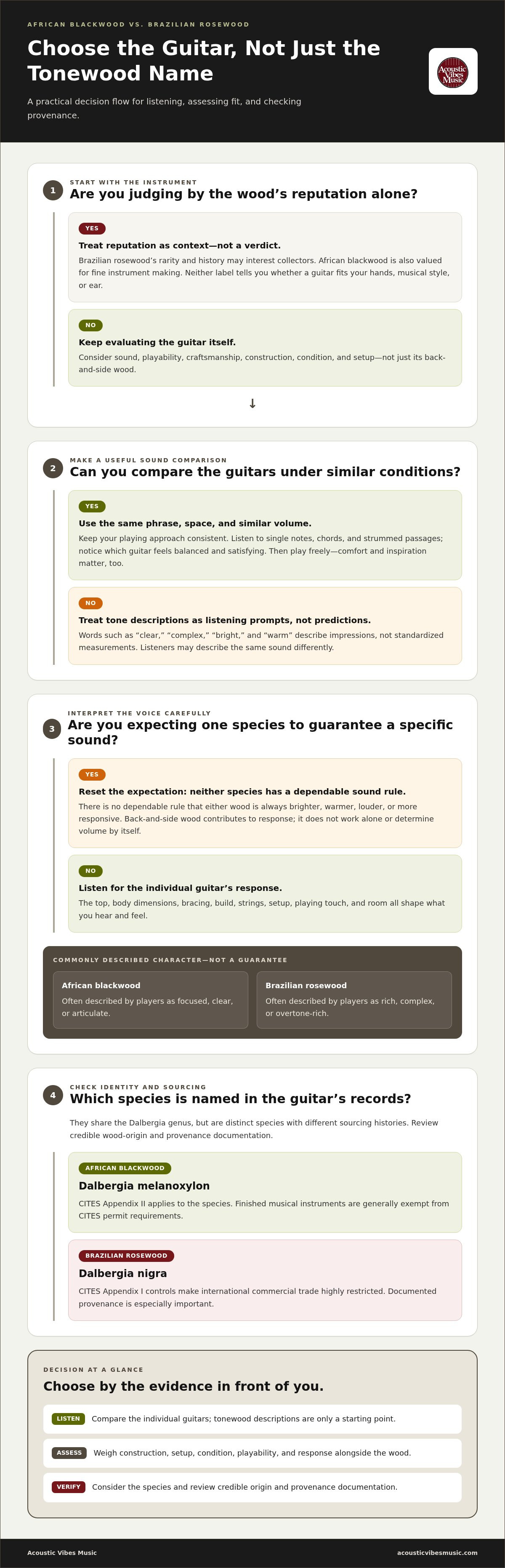
A sound preference can narrow your search, but it shouldn’t end the evaluation. When comparing african blackwood vs brazilian rosewood, take the guitar in stages: define the response you want, compare instruments, inspect condition and playability, then review the wood’s identity and provenance. This connects listening and sourcing questions without letting a prestigious species name decide for you.
Start with records that support what the instrument is made of and where its wood came from. Depending on the guitar and its history, useful records may include a detailed sales document, maker or build records, and applicable permits or certificates. Brazilian rosewood is listed under CITES Appendix I, but the requirements can depend on the specimen, transaction, destination, and current rules. Don’t assume every guitar or sale follows the same process.
Before buying, selling, or travelling internationally with an instrument, check current information from official CITES and relevant United States authorities. Keep records with the guitar’s identifying details, and treat unsupported species or origin claims as unverified. Documentation supports provenance; it doesn’t replace checking rules for the specific transaction.
Begin with the role the guitar will fill. Consider whether you mostly fingerpick or strum, the response you enjoy, and what feels comfortable for your music. Then compare real instruments under similar conditions. Make a few notes while you play so details don’t blur together.
Use the high-end acoustic guitar collector’s guide for a broader framework for weighing craftsmanship, condition, and history. Then put it to use: explore acoustic guitars by their sound and feel as well as their specifications.
African blackwood and Brazilian rosewood can help frame what you listen for, but neither species tells the whole story. A guitar’s sound emerges from its materials, design, construction, condition, and setup, then meets your technique and musical taste. Let tonewood knowledge inform your decision, not make it for you.
Use this checklist when comparing instruments:
Start with the instrument’s voice and how naturally it plays. A guitar that feels comfortable, responds well to your touch, and suits its intended role may be more rewarding than one chosen mainly for a celebrated species name. Pay attention to the setup, too. Even a beautifully made instrument can feel less inspiring if its action or condition doesn’t work for you.
For a fair comparison, play instruments in similar conditions and use music you know well. Notice whether the sound stays satisfying across the passages you actually play, and whether the neck and body feel comfortable over time. The african blackwood vs brazilian rosewood question can guide your research, but your ears and hands provide the most personal evidence.
You don’t need to choose by reputation alone. Explore the acoustic guitar collection to discover instruments with different voices and builds. Take your time, compare the craftsmanship, and look for the guitar that invites you to keep playing.
The african blackwood vs brazilian rosewood comparison can help you understand a guitar’s materials and provenance, but a wood’s reputation can’t guarantee a sound or playing experience. Descriptions like “bright” or “warm” are starting points. The individual guitar’s design, construction, setup, and condition all matter, as does how it feels and responds to you.
Compare instruments with your own playing in mind. Listen for the qualities you value, consider comfort and playability, and review credible provenance records where relevant. A guitar that inspires you to play is a better fit than one chosen for its tonewood name alone.
Ready to hear and feel the difference for yourself? Explore the acoustic guitar collection, with a curated selection of new and used instruments available through the online collection and physical showroom. Acoustic Vibes Music also provides professional repair and maintenance for stringed instruments by appointment. Take your time, follow your ear, and find the guitar that feels like yours.
No. African blackwood (Dalbergia melanoxylon) and Brazilian rosewood (Dalbergia nigra) are different species in the same Dalbergia genus. Their shared genus doesn’t make them interchangeable: they differ in characteristics, appearance, and sourcing considerations. When comparing guitars, treat each species as a separate material and assess the individual instrument rather than assuming one will look or sound like the other.
Neither sounds objectively better in every guitar. Players may describe one instrument as clearer or more overtone-rich, but those impressions aren’t guaranteed by the species name. The top wood, body shape, bracing, construction, strings, setup, and playing technique all affect the result. In the african blackwood vs brazilian rosewood comparison, play comparable instruments if possible and decide which voice and feel suit your music.
African blackwood is a very dense wood, with an average dried weight reported at about 79 pounds per cubic foot (1,270 kilograms per cubic metre). That figure alone doesn’t establish how it compares with every piece of Brazilian rosewood; density varies with the individual wood and its condition. For a reliable comparison, use verified species-level wood data and avoid treating density as a direct predictor of a guitar’s tone.
Yes, but its use depends on legally sourced wood and applicable trade requirements. Brazilian rosewood (Dalbergia nigra) is listed under CITES Appendix I, and international commercial trade is generally prohibited. In the United States, commercial trade in pre-convention wood requires CITES documentation supporting that it was acquired before June 11, 1992. Rules can depend on the instrument and transaction, so verify current official guidance before buying, selling, or travelling.
Yes, back-and-side wood can contribute to an acoustic guitar’s tonal response, but it’s only one part of the instrument. The soundboard, body dimensions, bracing, construction, setup, and strings also shape what you hear. Playing style and the room influence your impression, too. Treat tonewood descriptions as helpful listening clues, not promises about bass, volume, sustain, or projection from a particular guitar.
Appearance alone can’t reliably confirm a guitar’s species. Grain and color may offer clues, but they aren’t proof of identity or origin. Look for credible documentation, such as maker or build records and provenance records that identify the wood; for Brazilian rosewood, relevant trade documents may also matter. If a claim affects a purchase or international travel, verify the paperwork and current requirements rather than relying on a label or verbal description.
Use tonewood as one factor, but let the guitar’s sound and feel guide your choice. Consider whether its voice suits your playing, whether the neck and body are comfortable, and whether its setup and condition meet your needs. A species name can inform expectations and prompt useful questions, but it can’t capture the whole instrument. Compare guitars with familiar music, then choose the one that makes you want to play.