My shopping cart
Your cart is currently empty.
Continue ShoppingThe most coveted, premium soundboard in acoustic guitar history might actually feel stiff and unforgiving under your fingers. When weighing an adirondack spruce vs sitka spruce top, guitarists often assume that paying for vintage prestige guarantees instant sonic magic. You're likely wondering if red spruce is genuinely worth the buzz, or if you're risking a tight instrument that demands years of aggressive playing just to wake up.
Sorting through technical jargon like stiffness-to-weight ratios and dynamic headroom can feel overwhelming, especially when you can't test boutique models side by side in person. You deserve complete clarity before making an investment. In this guide, you'll discover the critical differences in dynamic response, volume ceiling, and natural aging between these two iconic tonewoods so you can choose with total confidence. Ahead, we break down their structural physics, how they open up over time, and exactly which spruce matches your touch.
Think of an acoustic guitar's soundboard as its mechanical speaker cone. While back and side woods reflect and color the sound, the top acts as the primary transducer, converting string vibrations into audible acoustic energy. Softwoods like spruce dominate luthiery because of their unmatched stiffness-to-weight ratio. Dense hardwoods like rosewood or maple can soak up energy before it blooms into sound. Spruce, by contrast, possesses a low average dried weight paired with incredible structural rigidity, allowing it to vibrate freely without buckling under high string tension. In evaluating an adirondack spruce vs sitka spruce top, this fundamental ratio dictates how efficiently that energy moves across the guitar.
The spruce top acts as a dynamic tonal filter. It shapes the attack, sustain, and fundamental clarity of every note before those frequencies ever bounce off the back and sides. While dozens of conifers exist globally, Adirondack (Picea rubens) and Sitka (Picea sitchensis) remain the undisputed champions of modern acoustic design due to their unique acoustic properties.
Wood is an anisotropic material, meaning its strength depends entirely on grain direction. Longitudinal stiffness runs parallel to the straight grain lines, bearing the 150 to 180 pounds of continuous pull exerted by steel strings. Lateral stiffness runs across the grain, dictating how vibrations disperse outward across the lower bout. When evaluating the acoustic properties of tonewoods, sound velocity plays a decisive role. In tonewood physics, velocity of sound measures how rapidly mechanical vibrations travel through the cellular structure of the spruce, directly determining note separation and dynamic immediacy. Higher longitudinal stiffness yields a faster sound velocity, giving notes an immediate, crystalline attack rather than a sluggish bloom.
No soundboard works alone; it lives in direct tension with its internal bracing. The debate surrounding an adirondack spruce vs sitka spruce top often comes down to how each species pairs with scalloped versus non-scalloped braces. Because Adirondack spruce is inherently stiffer across and along the grain, lutherie teams must carefully voice the bracing to prevent the guitar from sounding tight or choked. Master builders like Collings Guitars individually carve and tune their braces to match the specific flexibility of each spruce plate, ensuring the top achieves optimal resonance regardless of species density.
Harvested along the coastal rainforests of the Pacific Northwest and Southeast Alaska, Sitka spruce (Picea sitchensis) earned its status as acoustic luthiery's true workhorse for good reason. Some guitarists unfairly dismiss it as merely standard or baseline, but master luthiers know better. Sitka delivers an immediately rewarding tonal envelope right out of the case. Because it possesses slightly higher internal damping and mechanical compliance than red spruce, it doesn't demand decades of aggressive playing to sound sweet, open, and responsive.
As documented in the USDA Forest Products Laboratory Wood Handbook, Sitka balances an average dried specific gravity of roughly 0.42 with an impressive modulus of elasticity. This physical balance produces a soundboard that breathes easily under modest pressure. Tonal output remains warm and uniform across all registers, pairing rounded lows with shimmering overtones. When you evaluate an adirondack spruce vs sitka spruce top, Sitka consistently offers instant sonic gratification without requiring an exhausting break-in period.
Fingerstyle guitarists, vocal accompanists, and nuanced flatpickers gravitate toward Sitka because of its low initiation energy. You barely need to brush a string to coax a full, blooming fundamental out of the lower bout. When struck forcefully, Sitka produces a gentle acoustic compression. This natural compression rounds off harsh transient peaks, keeping your rhythm tracks smooth and sitting beautifully in a mix. Visionary builders like Taylor Guitars built an empire around Sitka's versatile dynamic response, pairing it with modern voicing systems for immediate articulation. If you appreciate immediate tonal depth, you can explore our curated acoustic guitar collection to find soundboards voiced for effortless nuance.
Giant old-growth logs allow luthiers to source clean, straight-grained soundboards with high consistency. Sitka ranges in appearance from a pale cream to a rich, warm honey-tan, frequently showing faint pinkish undertones. Exceptional soundboards exhibit prominent "silking." These radiant perpendicular ribbons, known as medullary rays, confirm a true quartersawn cut that delivers maximum lateral rigidity. In comparing an adirondack spruce vs sitka spruce top, Sitka tops generally display far tighter, more uniform grain spacing across the entire lower bout.
Adirondack spruce (Picea rubens), traditionally known as red spruce, holds mythical status among vintage enthusiasts. Found throughout the Appalachian mountains from Maine down to North Carolina, this tonewood defined the golden era of American luthiery. During the 1930s and early 1940s, icons like Martin and Gibson relied on red spruce for their dreadnoughts and advanced jumbos. Extensive overharvesting and wartime aircraft construction depleted these stands, forcing major builders to transition entirely to Sitka by 1946. As highlighted in a World Resources Institute analysis on guitar soundboard spruces, changing forest reserves continually reshape acoustic building traditions, sparking today's remarkable second-growth red spruce resurgence.
What makes Adirondack tone unmistakable is dynamic headroom. Unlike softer soundboards that compress under forceful strumming, red spruce doesn't choke out. Its exceptional modulus of elasticity creates a high dynamic ceiling. Strike the strings with sheer abandon, and the guitar simply rings louder, clearer, and more direct. The harmonic profile favors dry, fundamental power over lush overtone wash. Every note launches with punchy midrange separation, allowing complex runs to pierce through dense acoustic ensembles.
For aggressive rhythm players and bluegrass flatpickers, an adirondack spruce vs sitka spruce top is an easy contest. Heavy strummers require mechanical resistance so individual pick strokes don't blur into mud. Adirondack acts like an acoustic cannon, throwing pure sonic volume straight across an unamplified circle. Builders like Boucher Guitars have perfected this craft. Situated right in the heart of the Canadian Appalachian forest, Boucher hand-selects pristine, slow-grown red spruce, mastering the art of tapping its immense projection.
Do not expect cosmetic perfection when choosing red spruce. Because contemporary tops come from smaller, second-growth trees, an adirondack spruce vs sitka spruce top often reveals wide, pronounced grain lines, sometimes spacing ten or twelve rings per inch. Coloration skews pale, bone-white, or light cream, frequently marked by subtle color variations, grain swirl, or natural runout. Seasoned collectors celebrate these traits. They signal true Appalachian authenticity and high cross-grain stiffness, proving that cosmetic cleanliness never outranks raw acoustic authority.
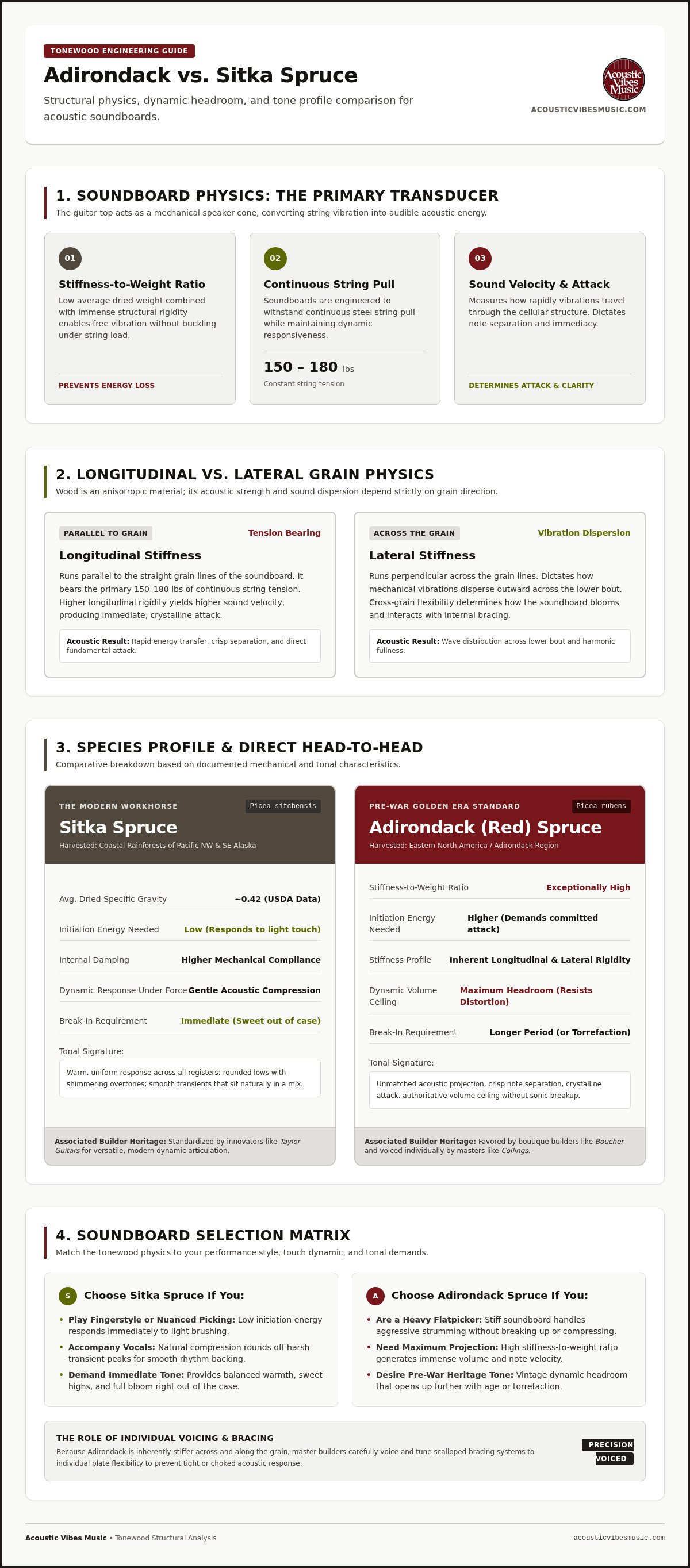
Every dynamic comparison of an adirondack spruce vs sitka spruce top centers on a fundamental trade-off: explosive headroom versus effortless touch sensitivity. Sitka yields easily to the lightest fingernail stroke, yet it compresses smoothly when pushed hard. Adirondack resists initial deflection. It demands deliberate picking attack before releasing its legendary, distortion-free dynamic range.
Fresh, non-torrefied Adirondack soundboards often feel tight and unforgiving. Green wood contains uncrystallized resins that restrict cellular vibration, meaning an unaged red spruce top can require years of heavy playing before it truly relaxes. Learn about the science behind wood maturation in our deep dive on whether acoustic guitars get better with age. Sitka, with its lower internal damping resistance, delivers its signature warmth and sweetness right out of the box.
Sitka envelops every fundamental note in a rich blanket of swirling harmonic overtones and lingering decay. Adirondack launches notes forward with dry, laser-like clarity, cutting through without sonic clutter.
| Tonewood Attribute | Sitka Spruce Top | Adirondack Spruce Top |
|---|---|---|
| Dynamic Headroom | Moderate; compresses pleasantly under heavy attack | Virtually unlimited; resists clipping and distortion |
| Touch Sensitivity | Exceptional; responds instantly to light fingerpicking | Requires stronger initiation energy to activate fully |
| Natural Break-In Time | Short (weeks to months) | Extended (several years of rigorous playing) |
| Best Playing Application | Fingerstyle, vocal backing, light-to-medium strumming | Aggressive flatpicking, bluegrass ensembles, heavy rhythm |
Modern torrefaction bridges the divide between both woods. By baking raw spruce in an oxygen-depleted kiln, luthiers burn off cellular moisture and crystallize internal resins. This thermo-curing process imparts decades of natural vintage aging in a single afternoon. Prestigious builders like Martin with their Vintage Tone System and Boucher have mastered this technique. Discover how thermal aging elevates red spruce in why choose a Boucher guitar and the torrefied top secret. If you crave vintage pre-war volume without the multi-year break-in delay, view our selection of Boucher Guitars to experience modern torrefied soundboards in person.
Deciding between an adirondack spruce vs sitka spruce top comes down to your attack strength and dynamic expectations. If you play primarily with bare fingers or a light nylon pick, a rigid red spruce soundboard will feel resistant and stifle your dynamic nuance. If you dig in hard with a heavy flatpick, a Sitka soundboard reaches its natural compression threshold quickly, rounding off your attack before you hit maximum volume.
Your soundboard also works in tandem with the guitar body. Pairing an Adirondack top with mahogany back and sides yields blistering punch, crisp note separation, and a dry, focused fundamental that cuts clean across any stage. Coupling Sitka spruce with rich East Indian rosewood delivers an orchestral voice with deep bass response and shimmering overtones. Explore how these combinations interact in our guide to Rosewood vs. Mahogany Back and Sides.
Sitka is the premier choice for singer-songwriters, studio multi-instrumentalists, and fingerstyle players. Its lower initiation energy yields instant harmonic bloom, wrapping vocal tracks in rich acoustic warmth. For guitars that deliver this effortless playability straight out of the case, look to the modern engineering of Taylor Guitars or the balanced craftsmanship found across Yamaha Guitars.
Adirondack stands supreme for bluegrass flatpickers, aggressive rhythm players, and artists who record unamplified acoustic instruments. It offers a massive dynamic ceiling that rewards firm technique with crystalline projection. When seeking pre-war Golden Era power, custom dreadnought configurations from Martin Guitars and hand-tuned acoustic builds from Collings Guitars reveal red spruce at its peak.
Spec sheets only tell part of the story. Because every spruce plate features subtle variations in ring density and deflection, listening to soundboards side by side is essential. Acoustic Vibes Music helps musicians nationwide compare high-end tonewood configurations through detailed video demonstrations and bespoke setup consultations. Whether you lean toward Sitka's sweet response or Adirondack's thunderous projection, expert guidance ensures you invest in an instrument tailored to your hands.
Your playing style dictates whether an adirondack spruce vs sitka spruce top belongs in your hands. Sitka remains the beloved, versatile choice for immediate harmonic warmth and delicate touch sensitivity. Adirondack provides the commanding headroom and vintage fundamental clarity required to drive an ensemble. Neither spruce is universally superior. The right soundboard simply reflects how you strike the strings.
Finding the right match shouldn't involve guesswork. As an authorized dealer for premier boutique builders, we inspect every soundboard for stiffness and resonance, ensuring each instrument receives an expert luthier setup. With our national shipping expertise and climate-controlled packing, your dream guitar arrives safe, settled, and tuned to perfection. Take the next step in your tone journey: explore our curated collection of high-end Adirondack and Sitka spruce guitars and discover an instrument that inspires your music for decades to come.
Yes, but only if your playing style demands superior dynamic headroom and punchy projection. Adirondack commands an upcharge due to its rarity and slow-growth harvesting. If you play aggressive flatpicking, bluegrass rhythm, or lead lines in acoustic ensembles, the investment pays off with crystalline volume. If you play quietly at home or prefer delicate fingerpicking, a standard spruce top often yields a warmer, more satisfying sound without the added premium.
For most fingerstyle guitarists, Sitka spruce sounds significantly better out of the box. Sitka requires less initiation energy to vibrate, responding immediately to bare flesh and light nail touches. It produces a broad, lush overtone envelope that flatters solo pieces and vocal accompaniment. Adirondack can feel stiff and sound somewhat dry or brittle under a light touch unless the soundboard has undergone extensive torrefaction or decades of break-in.
An untreated Adirondack soundboard typically takes two to five years of consistent, vigorous playing to loosen its cellular structure. Because red spruce has such high natural stiffness, its internal resins take substantial vibrational energy and time to crystallize. You can accelerate this timeline by choosing a torrefied top. Thermo-cured Adirondack sounds open, woody, and dynamically responsive from the very first strum, bypassing the traditional waiting period entirely.
There is zero botanical difference; they are two common names for the exact same species, Picea rubens. The term "Adirondack spruce" originally referred to trees harvested specifically from the Adirondack Mountains of New York. Today, luthiers use both names interchangeably for red spruce harvested throughout the broader Appalachian range, spanning from eastern Canada down through the mountains of North Carolina.
You can often tell them apart by looking closely at grain density and color tone. When examining an adirondack spruce vs sitka spruce top, Sitka typically shows tighter, highly uniform growth rings with a warm, pinkish-amber hue. Modern Adirondack tops usually display wider grain spacing, creamy bone-white coloration, and occasional natural color variations or runout that reflect their second-growth Appalachian harvest.
Torrefaction doesn't turn Adirondack into Sitka; rather, it makes Adirondack sound like a well-aged 1930s vintage instrument. The thermal process removes bound moisture and crystallizes resins, giving the wood immediate touch sensitivity without sacrificing its massive dynamic headroom. While it softens the initial stiffness, it retains the fundamental punch, direct attack, and note separation unique to red spruce rather than mimicking Sitka's lingering, overtone-heavy decay.
Both create iconic pairings, so your choice depends on the sonic balance you want. Pairing mahogany with an adirondack spruce vs sitka spruce top creates two distinct tonal profiles. Adirondack on mahogany yields the classic pre-war punch, known for dry fundamentals, rapid note attack, and biting midrange clarity. Sitka on mahogany softens the edges, introducing warm low-end bloom and smooth sustain that works beautifully for acoustic blues and folk accompaniment.
Major builders halted Adirondack production between 1944 and 1946 because old-growth stands were severely exhausted. During World War II, governments heavily commandeered lightweight red spruce for aircraft construction, including gliders and training planes. Combined with aggressive industrial logging, supply vanished rapidly. American guitar makers pivoted to the massive, plentiful old-growth Sitka spruce forests of the Pacific Northwest, establishing Sitka as the modern industry standard.