My shopping cart
Your cart is currently empty.
Continue ShoppingThe wood of your guitar never truly stops moving, even decades after it left the luthier's bench. That sharp, sickening "pop" heard in a quiet room is often the sound of a masterpiece under environmental stress. Most players assume a split in the wood marks the end of an instrument's prime, but the truth is that acoustic guitar crack repair is as much about restoring the climate as it is about the physical mend. We understand the anxiety that comes with spotting a fracture, especially the fear that the rich, woody resonance you love might be lost forever. It's a concern every serious enthusiast shares when their prized investment's integrity is at stake.
You can protect your instrument's voice and long-term value with the right approach to stabilization. This guide provides a clear path to identifying, managing, and professionally repairing cracks to ensure your guitar remains a legacy piece. We'll explore how to distinguish harmless finish checking from structural damage and why maintaining a precise relative humidity between 45% and 55% is your most vital tool. By understanding the artisanal repair process, you'll gain the confidence to keep your collection in peak playing condition for years to come.
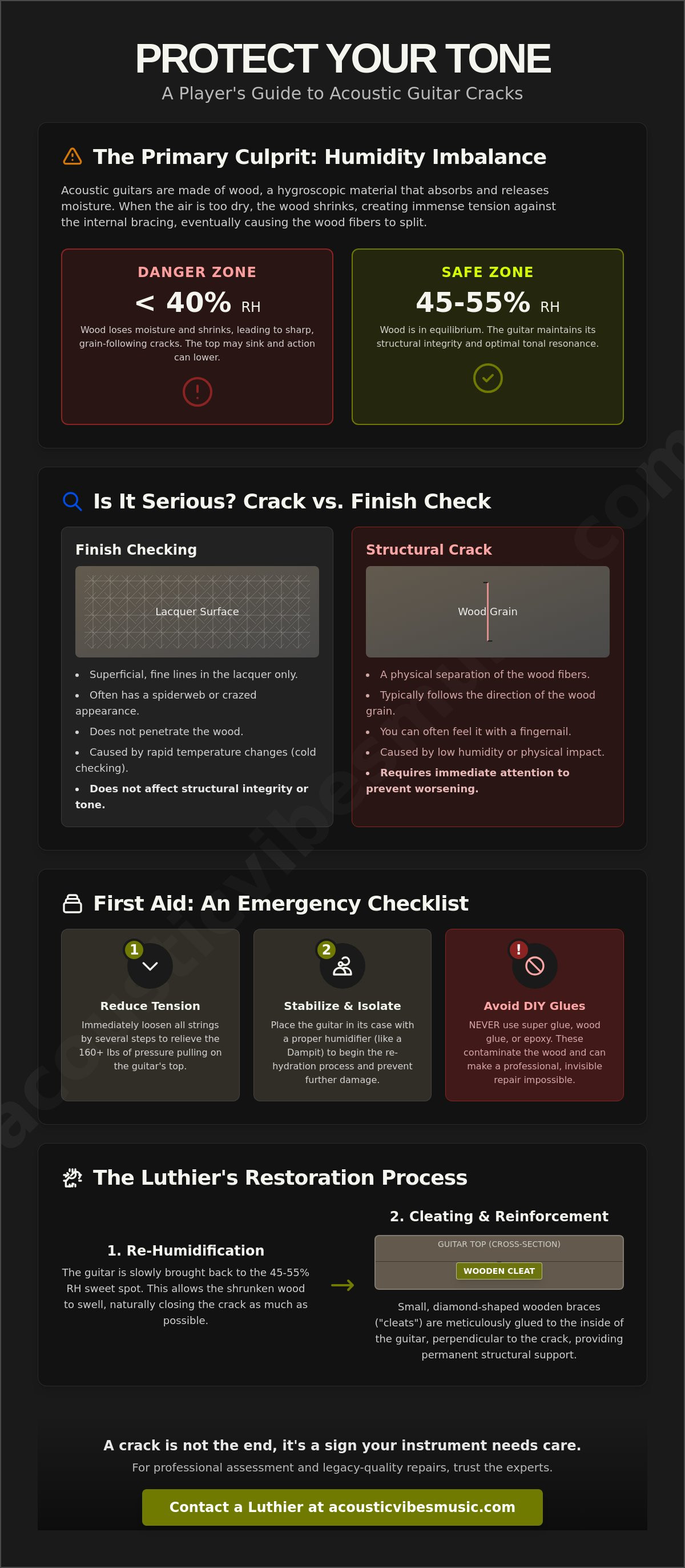
Wood is a living, breathing material. Even after it has been harvested, seasoned, and crafted into a world class instrument, it remains hygroscopic. This means the wood cells constantly absorb and release moisture to reach an equilibrium with the surrounding environment. When the air becomes excessively dry, those cells shrink. Because the guitar's top is anchored to internal braces and the rim, it cannot contract uniformly. This internal tug of war creates immense tension, eventually pulling the wood fibers apart. The resulting split is what makes acoustic guitar crack repair a necessary skill for any serious collector.
Distinguishing between a structural crack and finish checking is your first priority. Checking appears as a delicate web of fine lines across the surface lacquer. It's often the result of "cold checking," which happens when a chilled instrument is exposed to sudden warmth. While these lines might affect the vintage aesthetic, they don't penetrate the wood. A structural crack is different. It follows the grain lines and creates a physical separation in the timber itself, directly threatening the instrument's resonance and stability. Most cracks manifest in predictable patterns, such as along the center seam of the top or near the bridge, where string tension and bracing create natural stress points.
High end instruments from legendary makers like C.F. Martin & Co. or Collings utilize solid tonewoods to achieve their signature complexity and projection. This superior tone comes with a specific environmental vulnerability. Solid wood grain runs in a single direction, making it far more likely to split than laminate materials. Laminates use cross-grained layers that act as a mechanical deterrent to shrinking. While laminates are rugged, they lack the soul and evolving character of solid wood. Enthusiasts accept this sensitivity as part of the stewardship of a premium instrument.
The gold standard for proper guitar maintenance and storage is a consistent relative humidity between 45% and 55%. Relative humidity is the measure of water vapor currently in the air compared to the maximum amount the air can hold at that specific temperature. When levels dip below 40%, the wood begins to lose its structural integrity. Dry cracks are distinct from impact cracks; they look like clean, straight surgical incisions following the grain. Moving your guitar between extreme environments, like a heated home in winter and a cold car, accelerates this moisture loss. This rapid shift is the primary catalyst for the damage that eventually requires professional acoustic guitar crack repair.
Discovering a split in your tonewood is a heart-stopping moment for any player. Don't let panic lead to a hasty DIY decision. The seconds following the discovery are critical for a successful acoustic guitar crack repair. Your primary goal is to stop the damage from migrating. Wood fibers under tension act like a zipper; once a tear starts, the surrounding force wants to pull it wider. Acting quickly to stabilize the environment and reduce physical stress is the best way to ensure the mended instrument retains its original voice.
Start by loosening the strings. Most steel-string acoustics carry significant tension, often exceeding 160 pounds of pressure across the bridge. This force pulls the bridge toward the neck, which can widen a crack in the top or soundboard. Drop the pitch by at least a whole step or two. You don't need to remove the strings entirely, as some light tension keeps the internal components from shifting, but the "crush" on the wood must be neutralized immediately. This simple step prevents a minor hairline from becoming a major structural failure.
Next, evaluate the gap. A "tight" crack has fibers that still touch, while a "separated" crack shows a visible trough. Take high-resolution photos in natural, side-lit conditions to highlight the depth and length of the split. This documentation helps your luthier understand the starting point and track if the crack moves during transport. Avoid touching the crack with your fingers. Natural oils and dirt from your skin can contaminate the raw wood fibers, making it incredibly difficult for professional hide glue to bond during the restoration process.
The internet is full of "quick fix" advice that can ruin a vintage instrument. Never apply lemon oil, sunflower oil, or furniture polish to an open crack. These substances saturate the grain, creating a greasy barrier that prevents professional adhesives from ever achieving a structural bond. Similarly, stay away from hardware store superglues. Cyanoacrylate glue is brittle and incredibly difficult to control; it can melt the finish on a premium instrument. While you wait for professional help, consider how a comprehensive The Art of the Acoustic Guitar Setup can often identify environmental vulnerabilities before they turn into fractures. Protecting your investment requires patience and the right expert guidance. If you are looking to expand your collection with instruments built for resilience, exploring our curated acoustic guitars can help you find a piece that fits your playing environment perfectly.
Professional acoustic guitar crack repair begins long before the glue bottle is opened. Patience is the luthier's most valuable tool. When a guitar arrives at the bench with a "dry crack," the wood fibers are contracted and the gap is wide. Attempting to glue it in this state creates a permanent, unsightly scar. Instead, the instrument enters a controlled re-hydration phase. By slowly increasing the humidity within a specialized cabinet or case, the luthier coaxes the wood to swell. This natural expansion often closes the crack so tightly that the split becomes nearly invisible to the naked eye. Only once the wood has returned to its intended dimensions can the structural work begin.
Choice of adhesive is a mark of a true specialist. Many master luthiers prefer traditional hot hide glue for high end restorations. It's prized for its crystalline structure, which transfers vibration efficiently, and its historical accuracy. If a repair needs to be adjusted fifty years from now, hide glue allows for it because it's easily reversible with heat. For other structural needs, aliphatic resin glues like Titebond offer incredible shear strength and a slightly longer working time. Both are far superior to hardware store varieties because they don't "creep" or soften under normal temperature fluctuations. This technical precision ensures the repair doesn't just hold; it becomes part of the instrument's soul.
A cleat is a tiny, diamond shaped piece of tonewood that acts as a structural bridge across the fracture. Professional repair demands that the cleat material matches the instrument’s build. We use sitka spruce for soundboards and mahogany or rosewood for backs and sides to maintain tonal consistency. These reinforcements are glued with their grain running perpendicular to the crack. This cross grain orientation provides the mechanical strength needed to prevent the split from reopening under the stress of vibration. Cleating is the gold standard for high end repair because it provides permanent structural reinforcement with minimal impact on the instrument’s total mass or tonal response.
Once the structure is sound, the luthier focuses on the aesthetic. For tight cracks, we use a technique called "wicking," where low viscosity glue is drawn into the fibers via capillary action. If the finish was damaged during the initial split, the repair involves meticulous drop-filling. This requires layering nitrocellulose lacquer or specialized resins into the depression. After the fill has cured, it's leveled with precision scrapers and buffed to a high gloss. The goal is a repair that vanishes into the wood grain. This level of detail is essential for those who collect high end acoustic guitars for sale, as it preserves both the visual artistry and the investment value of an heirloom instrument.
A crack isn't always a solitary event. It's often the messenger of a larger mechanical shift within the instrument's architecture. When you're assessing the need for an acoustic guitar crack repair, you must first determine if the body is deforming under its own structural tension. Over decades, the constant 160-plus pounds of string pull can cause the "box" of the guitar to rotate. The top pulls up behind the bridge, the area in front of the bridge sinks, and the neck angle steepens. In these instances, a simple glue-and-cleat job is like patching a window on a shifting foundation. You have to address the core geometry.
Perform the neck angle test to see if your instrument is under distress. Lay a long straightedge along the frets toward the bridge. Ideally, the edge should sit right on top of the bridge wood, not the saddle. If the straightedge falls significantly below the bridge, the neck has pulled forward. This shift often creates enough internal stress to trigger cracks along the fingerboard extension or the center seam. In these cases, the repair involves a full neck reset to restore the original playability. It's a complex process, but for a vintage Gibson acoustic or an heirloom Martin, it's a necessary investment in the instrument's future.
Look for "bellying" behind the bridge. A slight dome is natural, but a sharp, localized bulge indicates the internal braces may be failing or unglued. If your action feels like a high-tension workout and the saddle has been shaved down to a nub to compensate, you're likely facing a reset. Watch for gaps at the neck heel or cracks in the binding. These aren't just cosmetic flaws. They're red flags that the joinery is no longer holding the tension of the strings. Identifying these symptoms early can prevent a minor split from becoming a catastrophic failure.
A neck reset is a major surgical procedure for a luthier. It involves using steam to soften the glue in the dovetail joint, removing the neck entirely, and recutting the heel to change the angle to perfection. While major body cracks often coincide with the need for a neck reset on older instruments, the two repairs serve different purposes. Crack stabilization preserves the wood, while a reset restores the mechanical integrity and "feel" of the guitar. On high-end instruments, this overhaul ensures the guitar remains a functional tool of expression rather than a silent wall-hanger. If your instrument is showing these complex signs, our team provides the expert Luthier Repair Services required to restore its original glory.
Stewardship of a fine instrument is an ongoing dialogue with the wood. While we have explored the intricate methods of acoustic guitar crack repair, the ultimate goal for any collector is to render those techniques unnecessary through proactive care. Your first line of defense is a high quality digital hygrometer. Don't rely on the analog dial built into a vintage case; these are often inaccurate. A modern sensor provides real time data, and many now sync with your smartphone to send alerts if your storage environment dips below the safe 45% threshold. This small investment prevents the silent stress that leads to structural failure.
The "Case-Only" rule is the simplest way to prevent structural heartbreak. While a row of instruments on wall hangers looks like a curated gallery, it exposes the wood to the fluctuating humidity of the entire room. Air currents from HVAC vents act like a slow motion kiln, pulling moisture from the soundboard. Keeping your guitar in its hardshell case creates a micro-climate that is much easier to regulate. Think of the case as a protective vault for your instrument's voice. This habit, combined with a bi-annual professional check-up, ensures that minor shifts in the wood are caught before they require major surgery.
Two-way humidification systems, such as Boveda, have revolutionized instrument care. Unlike traditional sponge-based humidifiers that only release moisture, these packets maintain a constant equilibrium by absorbing excess vapor when necessary. They eliminate the guesswork and the risk of over-humidifying, which can be just as damaging as dryness. For those with extensive collections, a dedicated guitar room with a localized HVAC humidifier offers the ultimate peace of mind. During your seasonal maintenance, ask your luthier to inspect the internal bracing. This is also the perfect time to refresh your tone with the Best Acoustic Guitar Strings 2026 to ensure your setup remains optimized for the coming season.
Choosing an authorized service center for brands like Martin and Taylor is vital for maintaining your instrument's pedigree. When an acoustic guitar crack repair is unavoidable, keep every receipt and detailed work order. A well-executed repair performed by a reputable luthier doesn't have to be a deterrent for future buyers. In fact, professional documentation proves that the instrument has been stabilized and cared for by an expert. This transparency protects the resale value of your C.F. Martin & Co. Guitars, turning a past repair into a testament to the instrument's enduring resilience and your commitment to quality craftsmanship.
A split in the wood is never the end of the story for a premium instrument; it's simply a chapter that requires expert intervention. We've explored how precise re-hydration and artisanal cleating can return a fractured soundboard to its peak stability. By acting quickly and avoiding the pitfalls of DIY fixes, you ensure your guitar remains a functional piece of art for the next generation. The path to a successful acoustic guitar crack repair relies on a deep respect for traditional lutherie and modern environmental science.
Don't let structural concerns silence your favorite instrument. As an Authorized Martin Custom Shop Expert Dealer, we bring a specialized focus to high end Lowden and Taylor repairs. We offer nationwide shipping for our expert service, making world class craftsmanship accessible no matter where you're located. Trust your heirloom to the guides who understand the soul of the wood. Schedule a Professional Luthier Consultation today and let's restore the stability and tone you've come to rely on. Your collection deserves the highest level of care.
Repairing a cracked acoustic guitar is almost always worth the investment for solid wood or vintage instruments. A professional mend stops the fracture from spreading and preserves the structural integrity of the soundboard. High end guitars are designed to be heirloom pieces, and addressing a split early ensures the instrument continues to project its signature voice for decades to other enthusiasts.
The total for an acoustic guitar crack repair depends on the severity of the split and the level of finish restoration required. Factors like the location of the crack, whether internal cleats are needed, and the type of wood involved all influence the complexity of the work. We suggest a professional assessment to understand the specific requirements for stabilizing your particular instrument's unique tonewoods.
A masterfully executed repair should have no discernible negative impact on your instrument’s tone. Luthiers use specialized adhesives and lightweight wooden cleats that allow the soundboard to vibrate naturally. In fact, many players find that stabilizing a structural split restores the clarity and resonance that was lost when the wood fibers were separated and under environmental stress.
You should never use standard hardware store glues on a premium instrument. These adhesives are often too thick and lack the specialized properties needed for acoustic resonance. Professional luthiers use traditional hot hide glue or high grade aliphatic resins because they are reversible and offer superior vibration transfer. DIY attempts with improper glue can permanently decrease your guitar’s resale value and tonal quality.
You can identify a finish crack by its appearance; surface checking often looks like a fine web of lines that don't necessarily follow the wood grain. A structural wood crack follows the grain lines exactly and often creates a visible separation in the timber. If you can feel a "step" or a physical gap with your fingernail, the damage likely penetrates the wood and requires stabilization.
Leaving a crack open allows it to act like a zipper, widening further every time the humidity fluctuates. Raw wood fibers inside the split can also become contaminated with dirt and skin oils, which prevents adhesives from bonding properly in the future. Eventually, an untreated crack can lead to internal brace failure or a catastrophic collapse of the instrument’s top under string tension.
The duration of a repair is often dictated by the necessary re-hydration period. A dry instrument may need to sit in a controlled humidity environment for several days or even weeks before the wood expands enough to close the gap naturally. Once the wood is stabilized, the actual gluing, cleating, and finish touch ups typically take several additional days to allow for proper curing and buffing.
A professional acoustic guitar crack repair that is well documented often preserves more value than leaving a vintage piece in a state of disrepair. Collectors and enthusiasts understand that wood movement is a natural part of an instrument's aging process over many decades. Using an authorized service center for the work proves that you have maintained the instrument to the highest standards of craftsmanship.