My shopping cart
Your cart is currently empty.
Continue ShoppingYour guitar's tonewood is only half the story. The real magic happens in the few millimeters of alloy vibrating above it. Finding the best acoustic guitar strings isn't just a maintenance chore; it's a sonic upgrade that can redefine your instrument's character. We've all felt the frustration of a once-vibrant instrument turning muddy and dull after just a few sessions. It's discouraging when your fingers fight against stiff, unforgiving wire that lacks the projection you need.
You deserve a setup that feels as good as it sounds. This guide will help you navigate the complex world of phosphor bronze, 80/20 alloys, and modern coating technologies to unlock your guitar's hidden voice. Discover how the right choice can extend your tone's life and improve playability without sacrificing volume. We'll examine the latest 2026 innovations, from advanced coatings used by 42 percent of players to hybrid gauges that balance comfort with power. It's time to stop settling for average and start curating your signature sound. Let's explore the artisanal craftsmanship and technical nuances that will elevate your playing experience.
The string is the catalyst. It's the physical bridge between your creative intent and the instrument's response. While enthusiasts often obsess over the choice of Adirondack spruce or Brazilian rosewood, the reality is that those woods remain silent without the kinetic energy of a vibrating wire. Finding the best acoustic guitar strings is about more than just grabbing a fresh pack from the shelf. It's about understanding the three pillars of string quality: material, gauge, and construction. These elements dictate how your instrument breathes and how it feels under your fingertips. Every nuance of your touch is filtered through these vibrating lengths of metal before the first note ever reaches the soundhole.
High-end instruments are notoriously sensitive to these choices. A masterfully voiced Collings guitar or a responsive, hand-crafted Lowden will reveal every flaw in a subpar string. This is where the concept of tonal synergy becomes vital. You aren't just looking for a "good" string; you're looking for the specific alloy and tension that complements your guitar's unique EQ profile. When the string and the tonewood work in harmony, the instrument feels alive. It responds to the lightest touch with a wealth of harmonic detail that inspires you to keep playing.
Strings translate finger energy into soundboard movement through a complex series of vibrations. Premium manufacturers focus on consistent winding tension to ensure that these vibrations are uniform across the entire length of the string. The nuances of acoustic string construction, such as the shape of the core wire and the precision of the outer wrap, determine how many overtones are produced. As strings age, they lose this harmonic richness. Dirt and oxidation dampen the vibration. This leads to a "thuddy" response that even the best acoustic guitar strings can't avoid if left on the instrument for too many hours of play. Fresh strings restore that lost energy, allowing the soundboard to move with its full intended range.
Your personal tonal goals should guide your selection process. Do you need more "sparkle" to cut through a mix, or are you seeking the chocolatey "warmth" of a vintage-voiced instrument? Strings act as a natural EQ for your setup. If your guitar is inherently dark, a bright 80/20 bronze can provide the necessary brilliance to balance the sound. Conversely, if your instrument is too "zingy" or modern, phosphor bronze can add much-needed depth and complexity. It's also vital to understand the difference between projection and volume. Volume is raw decibels, but projection is the string's ability to throw that sound across a room with clarity and definition. The right string choice ensures your voice is heard, regardless of the venue.
Material choice is the primary architect of your guitar's EQ. While many players treat strings as an afterthought, the specific alloy you choose acts as a filter for your instrument's natural resonance. Phosphor Bronze remains the industry standard for a reason. Composed of approximately 92 percent copper and 8 percent tin with a touch of phosphorous, these strings deliver a lush, harmonically complex warmth that suits almost any playing style. They offer a "broken-in" feel right out of the pack. If you want a balanced, reliable tone that emphasizes the richness of your guitar's overtones, this is your starting point.
For those seeking to inject life into a darker, bass-heavy instrument, 80/20 Bronze is the answer. Despite the name, this alloy is actually brass, consisting of 80 percent copper and 20 percent zinc. These strings provide a distinctive "zing" and brilliant high-end clarity that can help a muddy dreadnought cut through a room. Conversely, Monel and pure nickel strings offer a trip back in time. These alloys provide a "fundamental" tone, meaning you hear more of the wood and less of the string's own metallic shimmer. They are the vintage enthusiast's choice for a dry, woody, and punchy character that mimics the sounds of the early 20th century.
Delicate vintage instruments or players with sensitive fingertips often turn to Silk and Steel. By wrapping silver-plated copper over a silk or nylon core, these strings significantly reduce tension. They produce a soft, mellow voice that protects the structural integrity of lightly braced guitars while providing a tactile experience that is remarkably easy on the hands.
The chemical composition of these two giants dictates their lifespan. The phosphorous in Phosphor Bronze acts as an anti-corrosive agent, helping the strings retain their "new" sound longer than uncoated 80/20s. When considering a Martin Custom Shop build, the choice often depends on the player's attack. Fingerstylists frequently gravitate toward Phosphor Bronze because the enhanced overtones fill out the sonic space during delicate passages. Flatpickers might prefer 80/20s for the immediate, percussive snap they provide during fast lead lines.
Innovation hasn't stopped at traditional bronze. Nickel-Bronze strings are gaining traction for their transparent quality, designed to let the natural voice of the tonewood shine without coloration. Aluminum Bronze offers a unique combination of increased projection and natural corrosion resistance. For those seeking a more pronounced low-end, copper-heavy alloys provide a deeper bass response that can make a small-bodied guitar feel much larger. Finding the best acoustic guitar strings for your specific needs often involves experimenting with these niche materials. If you are currently exploring a vintage-inspired Gibson, matching it with the right alloy is the final step in your tonal journey.
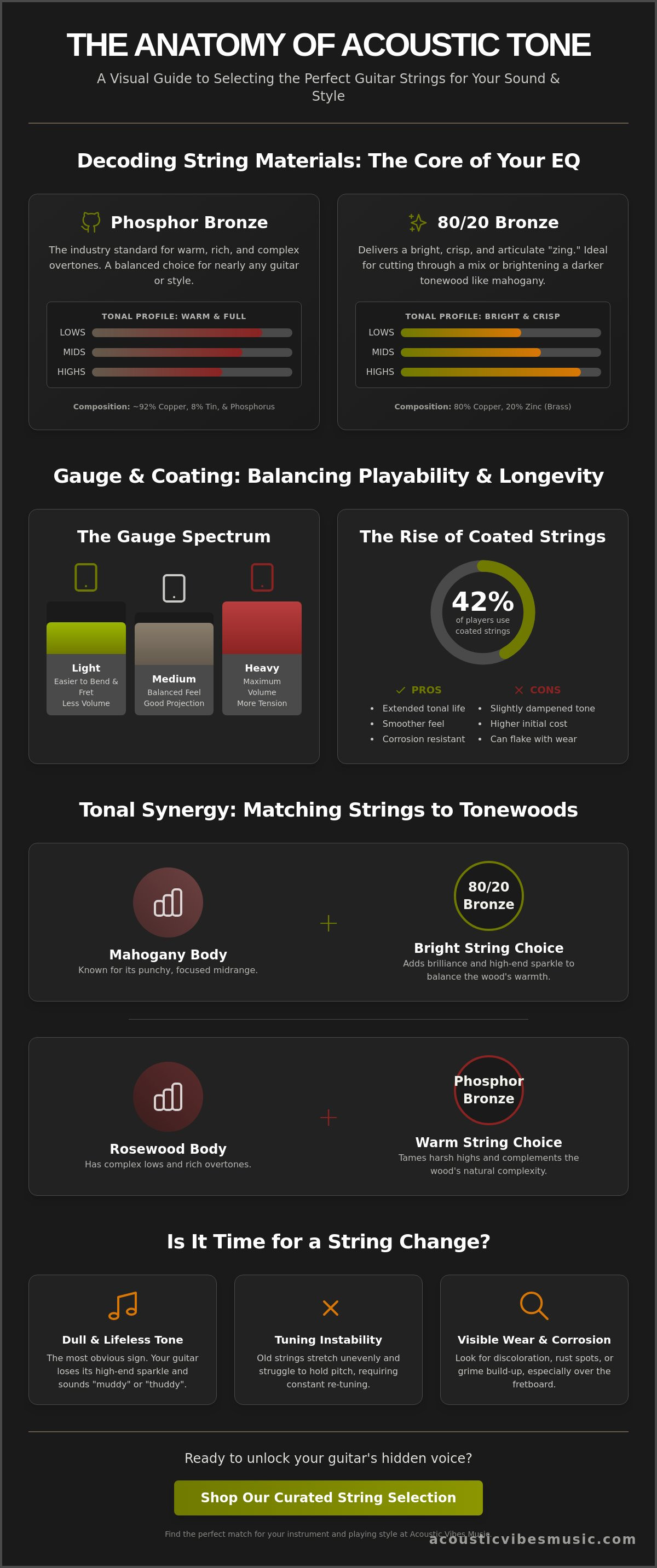
Gauge is more than a measurement of thickness. It is a measurement of potential energy. When you select the best acoustic guitar strings for your instrument, you are choosing how much tension will be applied to the bridge and the soundboard. This physical relationship is the foundation of your guitar's voice. A set of Mediums, typically 13-56, provides the necessary mass to drive the heavy spruce top of a large Dreadnought. If you drop down to Lights on a large-bodied guitar, you might find the tone lacks the "punch" and headroom you expect. The top simply isn't being pushed hard enough to reach its full resonant potential.
The year 2026 has seen a significant shift in how we view string longevity. We've moved beyond the thick, plastic-feeling coatings of the past. Modern "micro-coatings" and "treated" strings are now engineered at the molecular level. These advancements allow the string to vibrate with a freedom that was previously impossible for protected wires. It's a exciting time for collectors who want their instruments to sound "fresh" for weeks rather than hours. However, don't assume that a 12-54 set from one brand will feel identical to a 12-54 from another. Tension charts reveal that core-to-wrap ratios vary wildly between manufacturers. One brand's "Light" set might exert 160 pounds of pressure, while another hits 165, fundamentally changing the tactile response of your setup.
Small-bodied guitars, such as Parlor or OO models, are often built with delicate, light bracing to maximize their intimate response. Over-tensioning these boutique instruments with heavy strings is a genuine risk to their structural health. It can lead to bridge lift or unwanted "bellying" of the top. Conversely, a modern Taylor or a classic short-scale Gibson is typically voiced for a specific gauge. Using the manufacturer's recommended tension ensures the soundboard moves in its intended "sweet spot," providing the best balance of volume and clarity without stressing the woodwork.
The debate between coated and uncoated strings remains a centerpiece of the enthusiast community. Approximately 42 percent of players now opt for coated versions, drawn by the promise of extended tonal life. Modern polymers have nearly eliminated the "slick" or "slippery" feel that once deterred traditionalists. While these strings excel in longevity, many professional recording artists still prefer the raw "tonal bloom" of an uncoated string. There is a specific harmonic sparkle and a textured "grip" to uncoated bronze that some feel is essential for capturing a perfect take. For the casual collector, the cost-benefit analysis usually leans toward coated sets, ensuring your guitar is ready to sing the moment you pull it from the case.
Your guitar's tonewood acts as the acoustic foundation, but the strings you choose define the final frequency response. For a Rosewood instrument, the challenge is often managing the lush, complex low-end. Because Rosewood is naturally "scooped" in the mids with resonant bass, the best acoustic guitar strings for this wood often lean toward 80/20 bronze or bright coated sets. These help tame overwhelming lows while providing the high-end shimmer needed to cut through. Conversely, Mahogany is prized for its mid-range punch and "dry" character. To accentuate this focused voice, Phosphor Bronze is a standard recommendation. It adds a layer of harmonic warmth that complements Mahogany's fundamental-heavy response without masking its percussive nature.
High-end boutique instruments require even more specific pairings. When you are playing Lowden Guitars, you are likely seeking that signature "airy" Celtic chime. These instruments often respond beautifully to lower-tension strings or specialized alloys that allow the unique bracing to breathe. On the other hand, the meticulous engineering of Collings Guitars often thrives with high-tension premium sets. The rigidity and precision of a Collings build can handle the increased energy of a medium gauge, resulting in a piano-like clarity and massive headroom. The result is an instrument that feels incredibly stable and responsive.
Fingerstyle players demand exceptional note separation. When playing complex chord voicings, you don't want the frequencies to bleed together. Round-core strings are a fantastic choice here. Because the wrap wire has full contact with the core, they offer a more flexible feel and increased sustain. This flexibility is essential for expressive vibrato and nuanced fretting. For those exploring alternate tunings like DADGAD or Open G, consider "True Medium" sets. These provide extra tension on the strings you tune down, maintaining a consistent feel across the fretboard and preventing unwanted buzzing.
If your style involves aggressive strumming and fast lead lines, you need strings that won't "flop" under a heavy pick. Bluegrass sets are a game changer for this. By combining light-gauge trebles for easy bending with medium-gauge basses for a powerful low-end, they offer the best of both worlds. This pairing provides a percussive snap that is essential for rhythmic driving. You want the guitar to respond instantly to your attack. Ready to hear the difference for yourself? Explore our curated selection of premium acoustic guitars to find an instrument that perfectly matches your tonal aspirations.
The tone dies first. Then the feel. While visual oxidation is the most obvious sign of a string's demise, the true enthusiast listens for the loss of harmonic complexity. When your instrument begins to sound "thuddy" or lacks its usual sustain, the metal has likely reached its fatigue point. For a high-end acoustic, changing your strings every 20 to 30 hours of active play is a standard benchmark to maintain peak performance. Waiting until you see rust means you've already spent weeks playing a compromised instrument. Fresh wire restores the "bloom" and touch sensitivity that makes premium tonewoods so rewarding to play.
Consistency is the secret to a stable instrument. If you decide to experiment with a different gauge to find the best acoustic guitar strings for your style, remember that your guitar's neck will react to the change in tension. Moving from a Light set to a Medium set adds approximately 20 to 30 pounds of additional pull on the bridge. This shift often necessitates a truss rod adjustment to maintain proper neck relief. Without this balance, you may experience buzzing or uncomfortably high action. Integrating string changes into a broader care plan, including our professional Luthier Repair Services, ensures your instrument remains a precision tool rather than a source of frustration.
Old strings are a primary cause of poor intonation. As a string wears, it loses mass unevenly due to fret contact and skin oils. This irregularity prevents the string from vibrating in a perfect mathematical arc, meaning your guitar won't stay in tune even with the finest high-end tuners. Use the moment when the strings are off to perform essential maintenance. Wipe down the fretboard with a specialized cleaner to remove acidic buildup. For a deeper look at how these small adjustments impact your sound, explore our guide on The Art of the Acoustic Guitar Setup.
Environmental control is your first line of defense. High humidity can accelerate string corrosion, while extreme dryness can shrink the wood and alter your action. Aim for a consistent relative humidity between 45 and 55 percent to keep both your strings and your guitar in optimal health. String wipes and cleaners do offer a benefit by removing oils after a session, but they are no substitute for a fresh set. There is no replacement for the high-end experience of a perfectly strung guitar. It's the final step in curating a playing experience that feels effortless and sounds extraordinary. Invest in the best acoustic guitar strings, maintain them with discipline, and let your instrument's true voice be heard.
The journey to your perfect tone is a deeply personal pursuit. By now, you understand that selecting the best acoustic guitar strings involves balancing the chemical brilliance of the alloy with the structural needs of your instrument's tonewood. Whether you are taming a resonant rosewood back or driving a stiff spruce top, your choice of gauge and coating defines the tactile connection between your hands and the music. Don't let a dull set of wires mute the artistry of a world-class build.
We invite you to take the next step in your tonal evolution. As an authorized dealer for the Martin Custom Shop, Lowden, and Collings, we curate only the finest instruments and accessories for the discerning player. Our expert luthier services are available by appointment to ensure your setup is as precise as your playing. With nationwide shipping on all premium instruments, your next discovery is just a click away.
Explore our curated selection of premium acoustic guitars and accessories
It's time to unlock the hidden voice of your guitar and experience the joy of a perfectly balanced instrument. Your best performance is waiting to be heard.
You should change your strings every 20 to 30 hours of active play to maintain a vibrant, harmonically rich tone. While visual rust is a clear indicator, the loss of sustain and a "muddy" response often happen much sooner. Professional musicians frequently change their sets before every performance to ensure the instrument's voice remains consistent and reliable under the spotlight.
Phosphor Bronze is an alloy of 92 percent copper and 8 percent tin that provides a warm, balanced sound with lush overtones. It's the standard for versatility. 80/20 Bronze, which is actually brass, offers a much brighter "zing" and high-end brilliance. This makes it an ideal choice for cutting through a dense mix or brightening a naturally dark, bass-heavy guitar.
Coated strings are an excellent investment for players who want to extend their tonal life by three to five times compared to uncoated sets. Approximately 42 percent of guitar players now choose coated options for their resistance to oils and corrosion. While they cost more upfront, the longevity they provide makes them a cost-effective choice for those who don't want to change strings every week. Finding the best acoustic guitar strings for your lifestyle often means weighing this durability against the raw tonal bloom of uncoated wire.
No, you should never put medium gauge strings on a guitar that isn't braced for the increased tension. A set of mediums can exert over 160 pounds of pressure on the bridge. While a large dreadnought needs this energy to drive the top, a delicate parlor or vintage instrument could suffer structural damage, such as bridge lift or top warping. Always check the manufacturer's recommendations before increasing your gauge.
Yes, the tactile experience varies significantly between brands due to different core-to-wrap ratios and winding tensions. One manufacturer might use a thicker hex-core with a thinner wrap, while another uses a round-core. These artisanal nuances change how "stiff" or "flexible" the string feels under your fingers, even if the overall diameter is identical. Experimenting with different brands is the only way to find your perfect match.
Fresh metal has a high level of harmonic content and hasn't yet been dampened by the natural oils from your fingers. This "metallic" shimmer is normal and usually settles into a more balanced, musical state after two or three hours of play. If the brightness persists, you might consider switching from 80/20 bronze to a warmer phosphor bronze or a nickel-based alloy for a more fundamental-focused sound.
You'll know your guitar needs a professional setup if you notice new buzzing, a change in string height, or intonation issues after switching brands. Even if the gauge is the same, a shift of just 10 or 20 pounds of total tension can alter the neck relief. If the instrument feels "harder" to play or won't stay in tune up the neck, it's time to visit a luthier for a precision adjustment.
The best acoustic guitar strings for amplified play are those that provide a balanced output across all six strings. If you use a magnetic soundhole pickup, monel or nickel-bronze strings are superior because they interact more effectively with the magnets. For piezo-based systems, phosphor bronze is often preferred because its balanced warmth helps to round out the "quack" or harshness sometimes associated with under-saddle transducers.