My shopping cart
Your cart is currently empty.
Continue ShoppingImagine your prized heirloom guitar finally reaching its sonic peak, only to become nearly unplayable due to rising action. It's a common misconception that a shifting neck angle represents a manufacturing defect or the end of an instrument's life. In reality, nearly 90% of vintage flat-top acoustics will eventually require professional intervention to combat the 180 pounds of constant string tension they endure. Recognizing the early signs your acoustic guitar needs a neck reset is the hallmark of a responsible collector. It's about stewardship and ensuring that your Martin, Taylor, or Collings continues to sing for the next generation.
We understand the hesitation you feel when your fingers ache and the saddle is already shaved down to the bridge. You want to know if a simple adjustment can fix the problem or if it's time for a more significant restoration. This guide will walk you through a definitive diagnostic checklist to evaluate your guitar's geometry with confidence. You'll learn exactly why these shifts happen, how to test your neck angle at home, and why a professional reset is actually a value-adding milestone for any premium instrument. Let's explore how to preserve the playability and artistry of your collection.
Every time you tune a steel-string acoustic to pitch, you're loading the body with approximately 180 pounds of tension. It's a relentless force. For a high-performance instrument, this pressure is the catalyst for a slow, inevitable metamorphosis. Over years of play, the "geometry of the box" begins to shift. The pull of the strings creates a slight dome behind the bridge, known as bellying, while simultaneously pulling the neck block toward the bridge. This rotation causes the neck to dive forward, raising the strings higher off the fretboard. It isn't just about the neck; the entire body of the guitar is essentially folding in on itself at a microscopic rate.
The artistry found in Collings Guitars or Martin instruments relies on building at the absolute limit of structural lightness. This allows the top to vibrate with maximum efficiency, producing that rich, complex tone collectors crave. However, even the most meticulously seasoned tonewoods are susceptible to long-term compression. While torrefied tops, such as those featured on Boucher guitars, offer enhanced stability and a vintage-dry response, they aren't immune to the laws of physics. Humidity plays a massive role here. Dry air makes wood brittle and prone to shrinking, while excessive moisture softens the fibers, making it easier for the string tension to pull the neck block out of alignment. This movement is often so slow you won't notice it until the playability suddenly feels "off."
It's vital to view this shift as a maintenance milestone rather than a structural failure. High-end acoustics are intentionally built with a traditional form of joining the neck, such as a dovetail or mortise-and-tenon joint, to ensure the instrument remains serviceable for centuries. This design allows a skilled luthier to remove the neck, re-carve the heel, and reset the angle without damaging the body. A neck reset preserves the heirloom status of your Lowden or vintage Gibson by returning it to its optimal playing state. The neck angle is the precise geometric relationship between the plane of the fretboard and the bridge height. When this relationship fails, you'll start noticing the unmistakable signs your acoustic guitar needs a neck reset.
Identifying the structural health of a premium instrument requires a keen eye and a bit of technical intuition. While high action is the most obvious symptom, it's often the culmination of several subtle shifts in the wood. Recognizing the common signs a neck reset is needed allows you to intervene before playability is permanently compromised. These indicators aren't just inconveniences; they are the voice of the wood telling you the geometry has reached its limit. If your strings feel like they're hovering miles above the frets and a truss rod adjustment hasn't helped, the neck angle is almost certainly failing.
Another red flag is the "14th fret hump." This occurs at the point where the neck joins the body. You might see the fretboard suddenly dive toward the soundhole or rise up like a ski jump. This distortion makes clean fretting nearly impossible in the upper registers. It's a clear signal that the neck block has rotated under the constant pressure we discussed earlier.
This is the most critical diagnostic point for collectors. We call it the Saddle Height Ceiling. When action gets too high, the initial instinct is to shave down the bridge saddle. However, if the saddle is nearly flush with the bridge wood, you've hit a dead end. This creates a shallow "break angle" where the strings pass over the saddle. Without a steep, healthy angle, the strings cannot effectively drive the soundboard. Your guitar loses its punch, volume, and sustain. It feels stiff and lifeless, regardless of the actual string height, because the downward pressure on the bridge has vanished.
Examine the top of your guitar from a side profile. A significant bulge or "belly" behind the bridge often accompanies a neck that has pulled forward. This shift also wreaks havoc on intonation. Because the geometry is warped, the notes won't ring true as you move up the neck; the scale length is effectively compromised. You may also experience persistent buzzing on the higher frets that a standard setup simply can't resolve. If your instrument is exhibiting these signs your acoustic guitar needs a neck reset, it might be time to consult our expert luthier services to restore its original glory and protect your investment.
Measuring action at the 12th fret is a helpful start, but it doesn't tell the whole story. To truly understand the geometry of your instrument, you need to look at bridge projection. This is the gold standard for identifying the signs your acoustic guitar needs a neck reset. By using a 24-inch straightedge, you can visualize the plane of the neck and see exactly where it intersects with the bridge. It's a simple, non-invasive test that provides immediate clarity. You'll know quickly if your guitar's structural health is holding steady or shifting under the pressure.
First, ensure your guitar is tuned to standard pitch. This is non-negotiable. Without that 180 pounds of tension, the wood relaxes and gives a false reading. Lay the straightedge flat down the center of the fretboard between the D and G strings. Slide it toward the bridge until the end rests over the wooden bridge body. Don't let it hit the saddle; you're measuring the relationship to the bridge wood itself.
Look closely at where the straightedge lands. In a healthy instrument, the bottom of the straightedge should rest exactly on the top edge of the wooden bridge. If the straightedge falls significantly below the top edge of the bridge wood, hitting the front face of the bridge instead, the neck angle is too shallow. This is a clear "fail" and a primary indicator of structural shift.
While the "on-top" landing is ideal, there's a small margin for error. Professionals generally look for the 3/64ths rule. If the straightedge is within 3/64ths of an inch of the bridge top, a standard setup can often compensate. However, once it dips lower, you've officially run out of room for adjustments. The geometry has shifted beyond the reach of a simple saddle shave.
Keep in mind that bridge thicknesses vary by manufacturer. For instance, the beefier bridges on many Gibson Acoustic Guitars might create a slightly different visual profile than a slim vintage Martin bridge. Regardless of the brand, the fundamental goal remains the same. The straightedge should ideally rest exactly on the top edge of the bridge, indicating a perfect geometry that allows for a full-height saddle. Finding your straightedge "buried" in the bridge face is one of the most definitive signs your acoustic guitar needs a neck reset to restore its voice and playability.
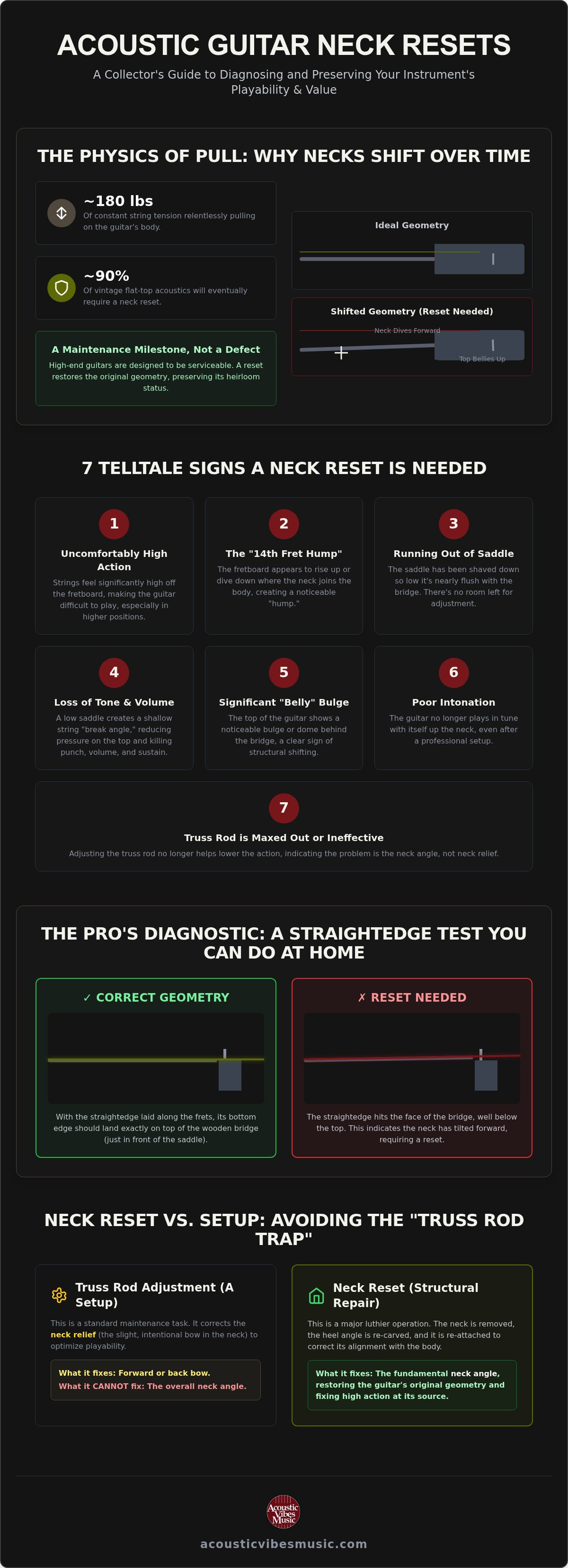
Distinguishing between a routine adjustment and a structural overhaul is critical for any collector. Many players mistakenly believe the truss rod is a dial for string height. It isn't. While a seasonal setup is essential maintenance, using it to mask deeper geometry issues is a recipe for disaster. If you find yourself fighting high action despite a straight neck, you are likely seeing the primary signs your acoustic guitar needs a neck reset. A setup addresses the surface; a reset addresses the foundation.
Understanding neck relief is the first step in proper maintenance. The truss rod exists solely to manage the slight concave bow required for strings to vibrate without buzzing against the frets. You can check this by placing a capo at the first fret and depressing the string where the neck meets the body. There should only be a microscopic gap, roughly the thickness of a business card, between the bottom of the string and the 7th fret. If your action remains painfully high after setting this proper relief, the issue lies in the neck angle. Attempting to lower action by "bottoming out" the truss rod can cause permanent structural damage or even snap the rod itself. For more on related maintenance costs, see our guide on Acoustic Guitar Bridge Repair Cost.
Shaving the wooden bridge is another common "quick fix" often suggested by less experienced shops. This involves physically removing material from the bridge to lower the overall profile. While this temporarily lowers action, it is a destructive process. Thinning the bridge reduces its mass and structural integrity, often leading to cracks or total bridge failure. On a premium Martin or Taylor guitar, this modification is a major red flag for collectors. According to industry experts, "cheap fixes" like this can devalue an instrument by 30% or more. It's a permanent alteration to an heirloom instrument that should have been addressed with a proper reset.
Occasionally, a lifting bridge can be mistaken for a neck angle issue. If the bridge is physically pulling away from the top, the action will rise, but the solution is a professional re-glue rather than a full reset. A expert diagnostic is the only way to be sure. Don't settle for temporary patches that compromise your instrument's voice. If your guitar is showing the signs your acoustic guitar needs a neck reset, schedule a luthier appointment today to ensure your investment receives the specialized care it deserves.
A neck reset is often described as major surgery for an acoustic instrument. It's a meticulous restoration that returns a guitar to its factory-spec geometry. When you've identified the signs your acoustic guitar needs a neck reset, the solution involves more than just a quick adjustment; it requires the steady hand of a master luthier. This process isn't a sign of failure but a testament to the instrument's longevity. High-end builds are specifically designed to be taken apart and put back together, ensuring they can be played for a century or more.
The difficulty and technique of a reset depend entirely on the joint construction. For traditional instruments like those from Lowden or Martin, the luthier must use a specialized steam-and-chisel technique. By injecting steam into the neck joint, the glue softens, allowing the neck to be carefully pressed out of the mortise. Once removed, the luthier precision-carves the heel to a steeper angle before re-gluing it. This is a high-stakes procedure where preserving the original finish is paramount.
In contrast, modern Taylor Guitars utilize the NT neck system. This bolt-on design is a marvel of serviceability. Instead of steam and carving, the luthier uses precision-milled shims to adjust the angle. It's a cleaner, faster process that offers incredible accuracy. Whether your collection favors the heritage of a dovetail or the innovation of a bolt-on, understanding these construction methods helps you plan for the long-term health of your heirloom pieces.
Entrusting a world-class instrument to a repair shop requires confidence. Ask your luthier about their experience with specific brands and their approach to finish touch-ups around the heel. A professional reset is never just about the neck; it's a comprehensive service. This should almost always include the fabrication of a new bone nut and saddle. Because the neck angle has changed, the old components will no longer provide the optimal break angle or string height.
Viewing a reset as a "rebirth" changes the collector's perspective. It's the moment your guitar regains its full tonal potential, offering the same snap and resonance it had the day it left the workshop. If you've noticed the signs your acoustic guitar needs a neck reset, don't wait for the wood to suffer further stress. Contact our expert luthier team for a structural evaluation of your premium acoustic.
Protecting a world-class instrument requires more than just climate control. It demands an understanding of the structural forces at play. By recognizing the early signs your acoustic guitar needs a neck reset, you transition from a player to a true steward of craftsmanship. Whether you're performing the straightedge test or evaluating saddle height, these diagnostics ensure your investment remains playable for decades. A professional reset isn't just a repair; it's a revitalization of the resonance and snap that made you fall in love with the instrument.
As an authorized dealer for the Martin Custom Shop, Taylor, and Collings, we provide the specialized expertise needed for these high-stakes restorations. Our on-site luthier services handle structural repairs with the reverence they deserve, and our national shipping expertise ensures your high-value instruments arrive safely. If you're ready to experience the peak performance of a perfectly set instrument, browse our collection of expertly maintained high-end acoustic guitars. Let's ensure your favorite acoustic continues to tell its story with clarity and power.
Industry data shows standard resets average between $600 and $750, while vintage instruments often exceed $1,000. These figures reflect the high level of skill and specialized tools required for the task. Additional work like refretting or carving a new saddle often accompanies the process. While we don't quote specific shop rates here, investing in professional luthier services ensures your premium instrument's structural integrity remains intact for another generation of play.
A professionally executed reset is considered essential stewardship for a vintage instrument. It often preserves or increases market value by restoring original playability. Conversely, quick fixes such as shaving the bridge can devalue a collector grade piece by 30% or more. Buyers of high end brands look for proper maintenance records. Seeing the signs your acoustic guitar needs a neck reset and addressing them correctly is the hallmark of a responsible owner.
A neck reset is a major milestone, not a seasonal adjustment. Most high quality flat top guitars will require this procedure every 25 to 50 years. The exact timing depends on string gauge, storage conditions, and environmental humidity. It's a natural result of the 180 pounds of constant tension exerted on the wood. While it's a significant event, it's a planned part of the instrument's lifecycle that ensures its longevity.
This is not a project for the home workbench. The process involves injecting high pressure steam into the joint and using specialized chisels to re-carve the heel. One mistake can lead to cracked wood or ruined finishes. Professional luthiers spend years mastering the geometry required for a perfect reset. Attempting this yourself on an investment grade instrument often results in costly damage that far exceeds the price of professional service.
It is the most permanent structural solution for high action caused by neck angle failure. While a setup or truss rod adjustment only treats symptoms, a reset addresses the fundamental geometry. You can expect the correction to last for several decades. However, because wood is an organic material, it will continue to move slowly under string tension. Proper humidity control is the best way to extend the life of your new neck angle.
Traditional Martin guitars use a dovetail joint and light bracing to achieve their legendary resonance. This construction is designed to be serviceable. While they may require resets more frequently than over-built factory guitars, it's because they are optimized for tone rather than rigid stiffness. Collectors value this serviceable design because it allows the instrument to be restored to factory specifications indefinitely. It's a sign of a high performance build.
Ignoring the signs your acoustic guitar needs a neck reset leads to more than just sore fingers. As the geometry continues to collapse, the top may develop permanent deformation or bellying that is much harder to correct. Intonation will consistently fail, making the guitar sound out of tune even when open strings are perfect. Eventually, the instrument becomes unplayable, and the cost of restoration increases as secondary structural issues begin to emerge.
The actual bench time for a reset is typically several days, as glue must dry and the wood needs time to settle under new tension. However, high end luthier shops often have a significant backlog. You should expect the entire process to take several weeks from drop off to final setup. This timeline ensures that every adjustment is stable and that the new nut and saddle are perfectly carved for the restored geometry.