My shopping cart
Your cart is currently empty.
Continue ShoppingThat thin, tinny ring on your high E string isn't always a lack of technique; often, it's simply the physical limit of entry-level hardware. You've likely felt the frustration of notes losing their luster past the seventh fret or the literal headache of wrestling with a flimsy tailpiece during a frantic string change. It's a common plateau where your developing ear and musicality begin to outpace the resonance of a mass-produced instrument. You're chasing that deep, woody chop and a tactile response that feels like an organic extension of your own hands.
We're here to help you bridge that gap. By upgrading your mandolin through strategic hardware swaps and professional luthier adjustments, you can unlock hidden potential in your current rig. This guide explores the essential path from basic modifications to the rewarding investment in boutique, heirloom-quality instruments. We'll examine how precision setups lower your action, how high-mass tailpieces stabilize your tuning, and why transitioning to a hand-carved mandolin from a master builder ensures your instrument holds its value while delivering superior tone. Discover how to transform your playing experience from a struggle for clarity into a celebration of artisanal craftsmanship and resonant power.
Every dedicated player eventually hits a physical plateau where their fingers can do things the instrument simply cannot translate. It is a frustrating moment of realization. You've practiced your scales, mastered your tremolo, and worked on your chop, yet the sound remains stubbornly one-dimensional. This is the performance ceiling. Upgrading your mandolin is not just about vanity or aesthetics; it is about finding a tool that matches the sophistication of your evolving ear. When your musicality begins to outpace the resonance of your gear, you are no longer playing an instrument; you are fighting one.
Identifying this ceiling requires an honest evaluation of your current rig. Is the sound "thin" on the high notes? Does the intonation sour as you move past the seventh fret? These aren't always technique flaws. Often, they are the result of entry-level manufacturing. Understanding the history and construction of the mandolin reveals why solid, hand-carved tonewoods are the gold standard for projection. Mass-produced models often rely on shortcuts that muffle the very vibrations you are trying to create.
Most beginner instruments utilize pressed laminate tops. While durable, these tops lack the graduation and flexibility required for true resonance. They produce a "tinny" quality that lacks the complex overtones found in professional builds. You might notice a distinct lack of sustain during slow, melodic passages, where notes die off before they can fully bloom. This lack of "pop" and "woody" depth is a clear sign that the wood has reached its vibration limit. A carved solid spruce top, by contrast, acts as a sensitive diaphragm, responding to the slightest touch with clarity and power.
Mechanical failure is the most tangible sign that it is time for a change. If you find yourself retuning after every single song, your tuning machines are likely failing to hold tension. Furthermore, many budget instruments suffer from the "intonation wall." This occurs when cheap hardware and poor bridge placement make it impossible to stay in tune across the entire fretboard. You may also encounter:
Recognizing these limitations is the first step toward a more rewarding musical experience. Transitioning to a professional-grade instrument ensures that every hour of practice is reflected in the tone you produce.
Sometimes the path to a superior sound doesn't require a new case. It starts with the components that bridge the gap between the strings and the tonewood. When you begin upgrading your mandolin, these tactile improvements often provide the most immediate gratification. Think of it as a precision tune-up for a high-performance engine. By focusing on the points of contact and vibration, you can coax a surprising amount of character out of a mid-range instrument.
The bridge is the primary conduit for sound, and upgrading your mandolin with a Cumberland Acoustic Bridge is often the single most effective change you can make. Most entry-level instruments come with generic bridges that lack proper density or fit. A bridge carved from high-grade ebony provides that coveted "woody" chop and clarifies the note separation across all four courses. A professional bridge fitting maximizes acoustic energy by ensuring the bridge feet match the top's unique arch perfectly, eliminating air gaps that muffle tone.
Pair this with a James Tailpiece for a significant mechanical advantage. Unlike flimsy stamped metal covers that rattle or bend, these cast tailpieces are robust and elegant. They streamline the often-infuriating process of string changes with a clever hinged design. More importantly, their increased mass enhances vibration transfer, adding a noticeable richness and sustain to every note you strike.
Your body is a natural dampener. When you hold a mandolin against your chest, you're unintentionally stifling the back plate's ability to vibrate. A Tone Guard solves this by decoupling the instrument from your body, allowing the wood to breathe and project with newfound volume. It's a simple, non-invasive addition that makes a world of difference in a loud jam or recording session.
Comfort is equally vital for technical progress. An arm rest keeps your forearm off the top plate, protecting the delicate nitrocellulose finish from oils while preventing your arm from "damping" the soundboard. These ergonomic refinements provide several key advantages:
If you aren't sure which hardware fits your specific model, our expert luthier services can guide you through the selection and installation process. Quality hardware isn't just an ornament; it's the foundation of a responsive, professional-sounding instrument.
When you have exhausted the potential of your starter instrument, the next logical step in upgrading your mandolin involves a deep dive into lutherie and design. This is where the "Scroll Tax" enters the conversation. While the iconic F-style scroll is a testament to artisanal carving, it's a common myth that it adds to the acoustic volume. The scroll is solid wood; it is a visual signature, not a sound chamber. Realizing this allows you to focus on what actually moves the air: the top plate, the internal bracing, and the quality of the timber.
The focused punch of an F-style is legendary in bluegrass circles, offering a percussive "chop" that cuts through a dense mix with authority. However, the open sweetness of an A-style is often preferred by Celtic and classical players for its balanced resonance and lyrical sustain. For the savvy collector, A-Style vs. F-Style Mandolins offer a fascinating choice in value. You often get a higher grade of wood and more meticulous hand-carving on an A-style at the same price point as a mid-tier F-model, simply because the builder isn't spending forty hours carving a decorative scroll.
Adirondack Spruce, often called "Red Spruce," remains the gold standard for mandolin tops due to its incredible stiffness-to-weight ratio. It offers massive headroom. This means the tone won't compress or distort when you play with a heavy hand during a loud jam. Sitka Spruce is warmer and more "played-in" out of the box, but Adirondack rewards the patient player with an explosive projection as the fibers break in over time. This is perfectly complemented by the choice of maple for the back and sides. While Big Leaf Maple is prized for its dramatic, cloud-like quilt, Sugar Maple is denser and stiffer, providing the bright, immediate response that characterizes professional instruments.
Your hands also deserve a say in the matter. While the traditional 1-1/8 inch nut width is the standard for fast, nimble fretwork, many modern players find that upgrading your mandolin to a "wide nut" 1-3/16 inch design offers better comfort and cleaner note articulation. Finally, consider the finish. A hand-rubbed varnish is thinner and more flexible than standard lacquer. It allows the wood to vibrate more freely, helping the instrument reach its full tonal potential much faster than a thick, glassy coat ever could.
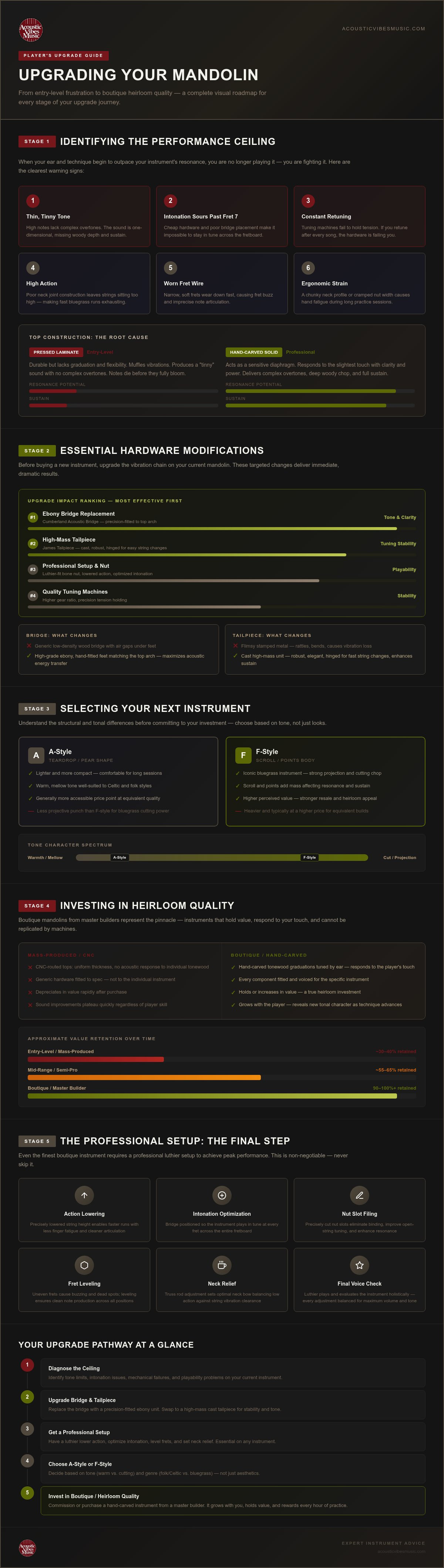
The transition from a mass-produced instrument to a boutique build is the ultimate milestone in upgrading your mandolin. It is the moment you stop playing a mere product and begin a partnership with a piece of functional art. While hardware swaps can bridge the gap, they cannot replicate the fundamental physics of a hand-carved instrument. High-end makers have set a benchmark for consistency and clarity that transforms the playing experience into something deeply personal. These instruments are built with a level of intentionality that ensures every note carries a specific weight and character.
A professional-grade mandolin is also a sound financial decision. Unlike entry-level gear that depreciates the moment it leaves the showroom, boutique instruments from respected builders hold their value remarkably well in the secondary market. In many cases, a well-maintained mandolin from a sought-after shop can even appreciate as the tonewoods "open up" and the builder's legacy grows. You aren't just buying a tool; you're acquiring an heirloom.
Makers like Collings Mandolins and Northfield specialize in a refined voicing that production lines cannot achieve. While modern CNC technology provides a consistent starting point, the true magic lies in the hand-carved graduations of the spruce top. An artisan luthier listens to the wood. They remove microscopic shavings until the plates reach their peak resonance, a process known as tap-tuning. This ensures that the instrument responds to the lightest touch while maintaining massive headroom for aggressive bluegrass picking. This level of detail is why upgrading your mandolin to a boutique build results in a more responsive, "alive" instrument that vibrates against your chest with every chop.
The difference is felt immediately in the hands. A radius fingerboard follows the natural curve of your palm, significantly reducing fatigue during long sessions or complex chord inversions. High-quality fretwire provides a glass-like surface for effortless slides and vibrato. Beyond the playability, the visual hallmarks of excellence are undeniable. From the elegant bound headstocks to the intricate purfling, every detail signals a commitment to craftsmanship. These aesthetic choices aren't just for show; they reflect the same precision found in the internal bracing and joinery. When an instrument is this beautiful and easy to play, it naturally inspires more frequent and productive practice sessions.
As a Passionate Curator, we hand-select every instrument in our gallery to ensure it possesses a unique sonic personality. If you are ready to find your forever instrument, browse our curated selection of professional mandolins and experience the peak of modern lutherie.
The journey of upgrading your mandolin does not end at the point of purchase. Even a master-built instrument from a premier workshop requires a final, personalized touch to align with your specific playing style. A professional luthier setup is the essential bridge between a beautiful object and a high-performance musical tool. It ensures that the physics of the instrument work in harmony with your hands, providing a level of responsiveness that inspires confidence during every session.
Precision intonation is perhaps the most critical element of this process. Because mandolins utilize a floating bridge held in place only by string tension, even a microscopic shift can cause your chords to sound sour as you move up the neck. An expert guide knows how to position the bridge with mathematical accuracy, ensuring that a fretted note at the 12th fret perfectly matches the open harmonic. This technical rigour is paired with action adjustment. Finding the "sweet spot" allows for effortless playability without sacrificing the percussive volume and "no-buzz" clarity required for a professional bluegrass chop.
Small adjustments often yield the most significant tactile rewards. Filing nut slots to the correct depth is a subtle art that dramatically reduces the pressure needed for first-position chords. If the slots are too high, your hand will fatigue quickly; if they are too low, the open strings will rattle. Fret dressing is equally vital. By leveling, crowning, and polishing the frets, a luthier creates a perfectly flat playing field, eliminating the "dead spots" that plague mass-produced instruments. For more insights on selecting and maintaining your gear, explore our Mandolin and Banjo Buying Guide.
Owning a high-end, solid-wood instrument comes with a responsibility to protect its structural integrity. A solid-wood mandolin thrives in a stable environment where the relative humidity remains consistently between 40% and 50%. National climate shifts can be brutal on a carved spruce top, leading to cracks or bridge sinking if the wood becomes too dry. Investing in a high-quality, thermally regulated case is mandatory for national travel or shipping. Schedule a professional maintenance check every six to twelve months to account for seasonal wood movement. These regular visits ensure your investment continues to open up and improve with age, maintaining its status as a reliable musical partner for decades to come.
Upgrading your mandolin is a rewarding journey that moves you from wrestling with entry-level limitations toward embracing the responsive power of a hand-carved instrument. You've learned that identifying the physical ceiling of your current gear is the first step in technical growth. Whether you refine your rig with high-mass hardware or transition to the legendary clarity of an Adirondack spruce top, each modification should serve your unique musical voice. It's a process of discovery that rewards patience and a keen ear for quality craftsmanship.
Don't forget that even the finest tonewoods only truly sing when they're perfectly adjusted. As an Authorized Collings Dealer, we ensure that expert luthier setups are included with our instruments, paired with secure national shipping to protect your investment. Explore our curated collection of professional mandolins to find a boutique partner that matches your ambition. Your next great performance shouldn't be held back by your hardware. Let's elevate your sound today.
A significant investment in upgrading your mandolin usually involves moving from factory-line production to a hand-carved instrument. While entry-level models serve as excellent starting points, they aren't designed for professional-grade projection. Serious players typically find that an intermediate upgrade provides a substantial jump in tonal complexity. You'll notice the difference when selecting instruments from boutique builders who prioritize individual voicing and material excellence.
A high-quality, fitted ebony bridge is often the most impactful physical modification for an entry-level instrument. Most factory bridges don't provide proper soundboard contact, which stifles vibration and muffles the "woody" character of the wood. Replacing a generic bridge with a precision-fitted model ensures maximum energy transfer from the strings to the top plate. This simple change can dramatically increase volume, clarify note separation, and improve the overall resonant "pop."
The choice between a radiused and a flat fingerboard comes down to ergonomic preference and traditional feel. A flat fingerboard is the historical standard, favored by many traditionalists for its consistent surface. However, it's the radiused fingerboard that features a slight curve following the natural arc of your fingers. This curvature makes barre chords and complex reaches significantly more comfortable, reducing hand fatigue during long performances without sacrificing the precision required for fast bluegrass leads.
Tonal superiority is a common myth when comparing F-style and A-style designs. While the F-style's scroll and points are iconic and highly prized by bluegrass collectors, they're largely decorative and don't contribute to the internal sound chamber. A-style mandolins often provide superior value. You pay for the quality of the wood and carving rather than labor-intensive aesthetics. Both styles produce world-class projection if they're hand-carved from premium spruce and maple.
Upgrading to a cast tailpiece is absolutely worthwhile for both mechanical reliability and tonal sustain. Stamped metal tailpieces are prone to bending and often rattle, which won't help your clarity during a performance. A solid, high-mass tailpiece increases the vibration transfer to the body and simplifies the often-frustrating process of string changes. It's a functional improvement that stabilizes tuning and adds a refined, professional look to the base of your instrument.
You'll know it's time for a professional setup if you notice poor intonation, high action, or persistent tuning instability. If the notes sound sharp or flat past the seventh fret, your bridge likely needs precision positioning. Additionally, if the strings feel "stiff" or are difficult to press down, a luthier can adjust the nut slots and bridge height to optimize playability. Regular maintenance ensures your instrument doesn't become a source of physical frustration.
Professional tone is often achieved through phosphor bronze strings, which are celebrated for their warmth and powerful projection. For players seeking a "dry" and "woody" vintage sound, Monel strings offer a unique alternative that emphasizes the natural character of the tonewoods. The right choice depends on your specific instrument's voicing. Experimenting with different gauges and materials is a vital part of the process when you're upgrading your mandolin and finding your personal signature sound.
The price disparity in the mandolin market is driven by the methods of construction and the rarity of materials. Mass-produced instruments rely on CNC machines and thick lacquer finishes, whereas premium models feature hand-carved graduations and thin, flexible varnish. This artisanal approach allows the luthier to tap-tune each piece of wood for maximum resonance. High-end builds also utilize aged Adirondack spruce and highly figured maple. They're increasingly rare and difficult to source.