My shopping cart
Your cart is currently empty.
Continue ShoppingThe most expensive Hawaiian Koa on the showroom floor might actually be the wrong choice for your specific playing style. While it's easy to equate a premium price tag with superior sound, a true ukulele wood comparison reveals that your ideal tone depends entirely on the physics of the grain. You likely feel the pressure of choosing between a safe mahogany build and an exotic spruce top, fearing you'll end up with an instrument that sounds thin or boxy. It's a common hurdle for enthusiasts who want their next purchase to be a lifelong companion rather than a temporary hobby.
This guide will help you master the subtle nuances of tonewoods to find an instrument that perfectly matches your sonic preference and technique. Whether you're chasing the legendary chime of a Martin 5K or the deep, traditional warmth of a handcrafted Kamaka, we've curated the essential knowledge you need. We'll explore the distinct personalities of Koa, Mahogany, and Spruce. You'll gain the confidence to select an heirloom-quality instrument and the expertise required to keep that solid wood resonant for decades to come.
When performing a detailed ukulele wood comparison, you quickly realize that the soundboard is the true engine of the instrument. While the back and sides provide structural integrity and a touch of color, the top is responsible for roughly 80% of the total tone. It's the heart of the build. A high-quality soundboard converts the vibration of the strings into the warm, resonant air that fills the room. If the wood is too heavy, the sound feels choked; if it's too thin, the instrument lacks the structural strength to handle string tension over time.
Small instruments like the ukulele face a unique acoustic challenge. Because the body has limited internal volume, you need higher-quality woods to achieve professional projection. In a large guitar, the sheer size can mask minor wood imperfections, but every fiber matters in a soprano or concert build. Tracing the history of the ukulele reveals a story of Portuguese influence and Hawaiian adaptation, but the secret to its iconic sound has always been the responsiveness of the timber. This responsiveness creates the "Jumping Flea" effect, where the wood recovers instantly from one strike to the next, facilitating the rapid Hawaiian-style fingerwork that defines the genre.
The difference between a boutique build and a factory model often comes down to "tap tone." Master luthiers spend hours tapping a piece of wood and listening to its natural resonance before they even begin to carve it. They hand-voice the top by thinning specific areas to maximize vibration. In contrast, factory-pressed tops are uniform and often thicker, which can lead to a "boxy" or compressed sound. When you invest in a professional instrument, you aren't just buying wood; you're buying a piece of timber that has been tuned to its highest potential.
Solid wood is the gold standard for serious players because it vibrates as a single, cohesive unit. This unity provides superior harmonic richness and a phenomenon known as "bloom," where the note seems to expand and grow after the initial pluck. Laminates and High-Pressure Laminates (HPL) offer excellent stability in changing climates, but they often lack this complex character. They don't "open up" with age. Most serious players eventually transition to solid-wood instruments for recording because the microphone picks up the subtle overtones that laminates simply cannot produce.
The internal bracing patterns of a ukulele interact deeply with wood density. A denser wood like Koa requires delicate bracing to avoid becoming overly stiff, while a lighter wood like Spruce allows for more robust support. This stiffness-to-weight ratio is why certain spruces are highly prized for tenor sizes; they provide the power needed for a larger body without sacrificing clarity. In the context of a soprano ukulele, projection is the measure of how effectively the instrument transmits its acoustic energy into a space, allowing the notes to remain distinct and audible at a distance without losing their tonal integrity.
Selecting the right material for your instrument is a deeply personal journey. In any ukulele wood comparison, three specific timbers emerge as the pillars of modern design. Hawaiian Koa, Mahogany, and Sitka Spruce each offer a distinct sonic fingerprint that dictates how your music will eventually reach the listener's ear. While Koa provides the traditional island chime, Mahogany offers a grounded, punchy warmth, and Spruce delivers the crystalline clarity preferred by soloists. Understanding these profiles is the first step toward finding a voice that resonates with your soul.
Hawaiian Koa is the undisputed gold standard for the ukulele. It's a wood that demands reverence, both for its rarity and its complex acoustic properties of tonewoods. In premium models like the Martin 5K Soprano, you'll often see "flame" or "curl." These terms describe the mesmerizing, wavy grain patterns that seem to move under the light. Beyond its visual artistry, Koa is famous for its "sweetness." It starts its life with a bright, crisp attack but matures beautifully over years of play. As the wood fibers loosen, the instrument loses that initial bite and develops a much richer, more resonant low-end.
This maturation process is why vintage Koa instruments are so highly prized by collectors. If you enjoy the shimmering overtones and a balanced frequency response, Koa is unmatched. It's an investment in a sound that only gets better with every hour you spend practicing.
If Koa is the flamboyant soloist, Mahogany is the reliable, honest partner. It's known for a fundamental-heavy tone, meaning you hear the primary note clearly with fewer distracting overtones. This makes it a favorite for vocal accompaniment. The Martin Centennial Concert All Mahogany is a standout example, providing a mid-range punch that sits perfectly under a singer's voice. Many modern players prefer the "Streetmaster" finish, which is thin enough to allow the Mahogany to breathe and vibrate more freely than a heavy gloss coat.
When comparing Mahogany's directness to the more complex textures of other woods, it's helpful to look at how these materials perform across different body sizes. You can explore this further in our guide on Rosewood vs. Mahogany Back and Sides. For those seeking high-volume dynamics, Sitka Spruce remains the top choice for its crisp highs. Alternatively, Cedar offers a softer, "played-in" warmth that is ideal for delicate fingerstyle techniques.
Finding the perfect match requires a hands-on approach. We invite you to explore our curated collection of professional ukuleles to hear these tonal differences for yourself.
The search for the perfect sound often leads beyond the traditional pillars of the industry. While our ukulele wood comparison has focused on the classics, exotic timbers like Acacia and Mango are gaining significant traction among boutique builders and discerning players. Acacia is a botanical cousin to Hawaiian Koa, offering a strikingly similar golden hue and sweet mid-range at a more accessible price point. It's a fantastic entry point for those who crave that island aesthetic without the premium cost of rare Hawaiian timber. Mango wood, on the other hand, provides a completely different aesthetic and sonic experience. It's visually arresting with its unique spalting and varied colors, while producing a warm, mellow, and slightly dark tone that appeals to players seeking a moody, intimate sound.
Sustainability is also reshaping the market. Brands like Breedlove and Martin are leading the charge by utilizing eco-friendly timbers and responsibly harvested alternatives. This shift ensures the future of the craft while introducing new tonal palettes. These modern approaches prove that you don't always have to rely on century-old traditions to find an instrument with a soul. Whether it's the recycled beauty of a sustainable build or the visual drama of an exotic fruitwood, the options for 2026 are more diverse than ever.
High-end collectors often prioritize "Master Grade" tonewoods, where the grain displays intense flamed or quilted patterns. It's a common misconception that more figure automatically equals better sound. In reality, while intense figure adds immense value and rarity to an instrument, the tonal impact is often subtle compared to the wood's density and age. The Martin 2K Tenor All Koa represents a visual and auditory pinnacle, balancing a stunning flamed appearance with the classic Hawaiian chime that professionals demand. These instruments are built to be heirlooms, where the visual drama of the grain matches the sophisticated harmonic complexity of the build. You're paying for the rarity of the timber and the artisanal skill required to work with such figured material.
For the traveling musician, the fragility of solid wood can be a liability. This is where modern materials like High-Pressure Laminate (HPL) shine. The Martin 0X Sunburst Tenor is the ultimate "festival" instrument because it's nearly impervious to the elements. Understanding how climate affects your ukulele's tone is vital for anyone moving between different environments. Synthetic builds handle temperature swings and humidity shifts far better than solid timber, which can crack or warp when the air dries out. If you're looking to expand your collection with pieces that stand the test of time, you might also be interested in our guide to High End Acoustic Guitars for Sale. These modern alternatives ensure that your music stays consistent, regardless of where your journey takes you.
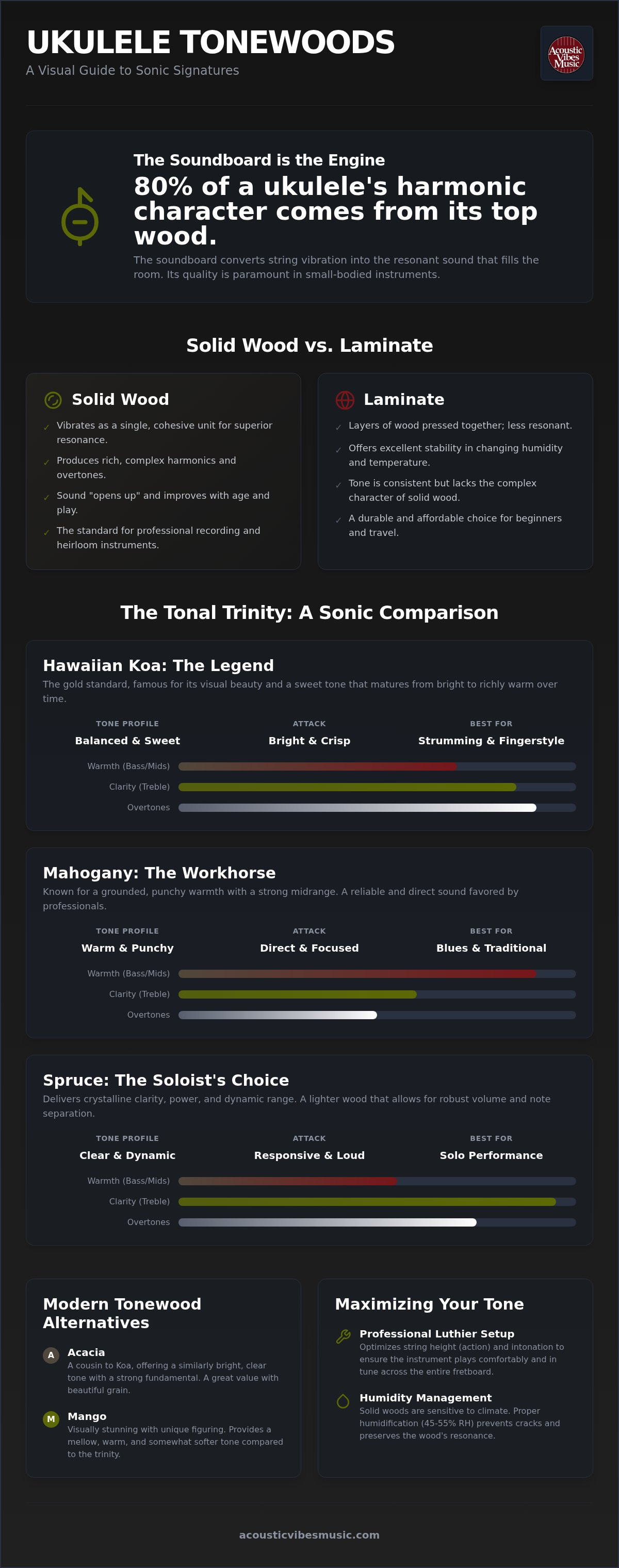
Owning a master-built instrument is a form of stewardship. Your detailed ukulele wood comparison only matters if the timber remains healthy, resonant, and properly tensioned. A professional luthier setup isn't a luxury; it's a necessity for high-end solid-wood instruments. Because woods like Koa and Mahogany are organic materials, they continue to breathe and move long after they leave the workshop. A specialist ensures that the relationship between wood density and string tension is perfectly balanced. Denser woods often require slightly higher tension strings to drive the top effectively, while lighter builds might benefit from lower tension to avoid over-stressing the soundboard.
Fine-tuning the natural voice of your wood also involves the materials used at the contact points. Switching from plastic components to Bone or TUSQ for the nut and saddle can dramatically improve sustain and clarity. Bone offers a traditional, slightly warmer response that complements the sweetness of Koa. TUSQ is a consistent, engineered material that provides a bright, modern chime. These small adjustments act as the final polish on an already exquisite tonal palette.
Every instrument we handle undergoes a rigorous inspection to ensure it performs at its peak. We focus heavily on adjusting the action height. On a delicate small-body top, the margin for error is razor-thin; too high and the playability suffers; too low and you'll encounter frustrating buzz. Checking intonation is equally vital. Small scale lengths are notoriously prone to tuning issues, especially as you move up the fretboard. While we focus on preventative care, understanding the acoustic guitar bridge repair cost can help you appreciate why maintaining proper bridge health is vital for any professional-grade stringed instrument.
Humidity is the primary enemy of your investment. You must maintain a consistent environment of 45-55% humidity to prevent the wood from shrinking or cracking. This is especially critical for solid Koa instruments, which can be more sensitive to dry air than their laminate counterparts. High-end hardshell cases are a non-negotiable accessory. They act as a climate-controlled sanctuary for your instrument when it's not in your hands. You can identify fret sprout by running your fingers along the edge of the neck; if the metal fret ends feel sharp or protrude past the wood, your instrument is dangerously dehydrated.
Ready to find an instrument that has been expertly prepared for a lifetime of play? Browse our collection of professionally setup ukuleles today and experience the difference that expert curation makes.
Choosing an instrument is the culmination of everything you've learned about grain density and resonance. While a ukulele wood comparison provides the technical foundation, the true test happens when you strike that first chord. For the ultimate collector, the Martin 5K Soprano Ukulele ($4,999.99) stands as the definitive heirloom choice. It's crafted from the most exquisite flamed Hawaiian Koa available, delivering a shimmering, crystalline chime that represents the absolute zenith of the luthier's art. This isn't just a purchase; it's a piece of history that will only grow more resonant for the next generation.
For the gigging professional, the Martin TKE Tenor Koa has become the 2026 performance standard. It offers the depth of a tenor body with the traditional sweetness of Koa, providing the projection needed for the stage. If you lean toward a vintage aesthetic, the Martin Centennial Concert All Mahogany ($599.00) offers an "honest," punchy mid-range that sits beautifully under a vocal. Meanwhile, the modern innovator might prefer the Martin 0X Tenor Black. Built with high-pressure laminate, it's a worry-free powerhouse that handles temperature swings with ease, making it the perfect companion for the traveling musician.
We take a "Passionate Curator" approach to every instrument in our gallery. We don't just move boxes; we hand-select pieces that meet our rigorous standards for craftsmanship and tonal complexity. Our expertise extends to national shipping, where we ensure your high-end ukulele is properly humidified and arrives in perfect tune. You'll find direct access to world-renowned brands like Martin and Gibson, alongside boutique builds you won't find at a standard retail outlet. Every sale is backed by our professional luthier services, ensuring your new voice is ready to sing the moment it arrives.
Finding the right wood profile is a sensory experience. We invite you to browse our curated selection of new and pre-owned models online, each documented with the detail a serious enthusiast deserves. If you're still undecided between the punch of Mahogany or the sweetness of Koa, consult with our experts. We're here to help you find the specific tonal signature that fits your unique ear and playing style. Don't settle for a boxy sound when an heirloom-quality instrument is within reach.
Explore our full collection of professional ukuleles and discover the instrument that will define your sound for years to come.
Mastering the nuances of tonewoods is the final step in finding an instrument that resonates with your personal style. You now understand that the soundboard is the engine of your music. This ukulele wood comparison has revealed why the traditional sweetness of Koa, the direct warmth of Mahogany, or the crystalline clarity of Spruce can transform your performance. Don't let the fear of a thin or boxy sound hold you back from investing in a professional grade instrument that will mature alongside your skills.
We invite you to shop our curated collection of professional ukuleles and experience the Acoustic Vibes difference. As an authorized dealer for elite brands like Martin, Kamaka, and Breedlove, we provide more than just a retail experience. Every purchase includes an expert luthier setup to ensure perfect playability right out of the box. We also offer national shipping with specialized instrument protection, so your new heirloom arrives in pristine condition. Your forever voice is waiting; find the wood profile that speaks to you and start your next musical chapter today.
Koa is considered the gold standard because of its traditional Hawaiian chime and balanced frequency response. It offers a unique "sweetness" that other timbers struggle to replicate perfectly. While it's highly prized for its heritage, the best wood ultimately depends on your personal ears. Perform a ukulele wood comparison by listening to different models to see if you prefer Koa's shimmer or the grounded punch of Mahogany.
Solid wood is a single piece of timber that vibrates freely, whereas laminate consists of thin layers of wood bonded together. Solid wood instruments provide superior harmonic richness and actually improve in sound as the fibers break down over time. Laminates are more durable and stable in harsh climates, but they generally lack the complex overtones and "bloom" found in professional solid builds.
Yes, a spruce top significantly increases the volume and projection of a ukulele due to its high stiffness-to-weight ratio. It creates a crisp, bright sound that cuts through a mix more effectively than denser hardwoods. This makes spruce a popular choice for tenor sizes or soloists who need their notes to carry across a room with crystalline clarity and dynamic range.
Mahogany is favored for its remarkable stability and its "honest," fundamental-heavy tone. It produces a warm, woody sound with a strong mid-range punch that sits perfectly under a human voice for accompaniment. Because it's more readily available than rare Hawaiian Koa, it serves as a high-quality, professional workhorse material for both entry-level instruments and elite boutique models.
High-quality solid wood ukuleles definitely mature and improve their sound with regular play. Over time, the cellular structure of the wood becomes more flexible, allowing the instrument to "open up" and vibrate more efficiently. This process results in a richer, more resonant tone with increased sustain, eventually turning a great instrument into a true heirloom-quality piece with a unique character.
Cedar and Spruce are often considered the premier choices for fingerstyle because of their immediate responsiveness to a light touch. Cedar provides a warm, intimate character that feels "played-in" from the very first day. Spruce offers more headroom and definition, ensuring that every individual note in a complex fingerpicking pattern remains distinct and articulate without becoming muddy or compressed.
Humidity is the most critical factor in preserving the health and resonance of your solid wood instrument. If the air becomes too dry, the wood will shrink, leading to structural cracks, bridge lift, or sharp fret ends. Maintaining a consistent environment of 45-55% humidity is essential to keep the timber stable and ensure the soundboard continues to vibrate as the luthier intended.
Acacia is an excellent, cost-effective substitute for Koa since the two trees are very closely related botanically. In a ukulele wood comparison, you'll find that Acacia offers a similar golden aesthetic and a sweet, balanced tonal profile. While it may lack some of the extreme harmonic complexity of high-grade Hawaiian Koa, it provides a professional island sound that satisfies most discerning players.