My shopping cart
Your cart is currently empty.
Continue ShoppingChoosing the wrong acoustic guitar isn't just a financial mistake; it's a missed connection with your own musical voice. This Taylor Guitars buying guide serves as your expert roadmap through the most innovative era in the company's history. We know that staring at the 100 to 900 series numbering can make you feel more like a mathematician than a musician. It's easy to feel overwhelmed by technical shifts like V-Class bracing or the revolutionary 2026 Action Control Neck. You want an instrument that responds to your touch, not a puzzle to solve.
We're here to strip away the confusion and help you find your perfect match. You'll learn how to navigate the 2026 Next Generation lineup, understand why premium tonewoods like Honduran Rosewood matter, and gain total confidence in choosing a body shape that fits your playing style. From the heritage-inspired warmth of the new Gold Label series to high-value alternatives from brands like Recording King, we'll explore the artistry and engineering that define today's premium acoustic market. Let's find the Taylor that finally feels like home.
Every great collection starts with a map. In this Taylor Guitars buying guide, that map is a three-digit code etched into the soul of every instrument. Since the early days of the Taylor Guitars company history, Bob Taylor and Andy Powers have used a logical numbering system to help players find their voice. It's a language of tonewoods and dimensions that allows you to "read" a guitar before you even strike a chord. This precision is what makes the brand a favorite for those who value both consistency and innovation.
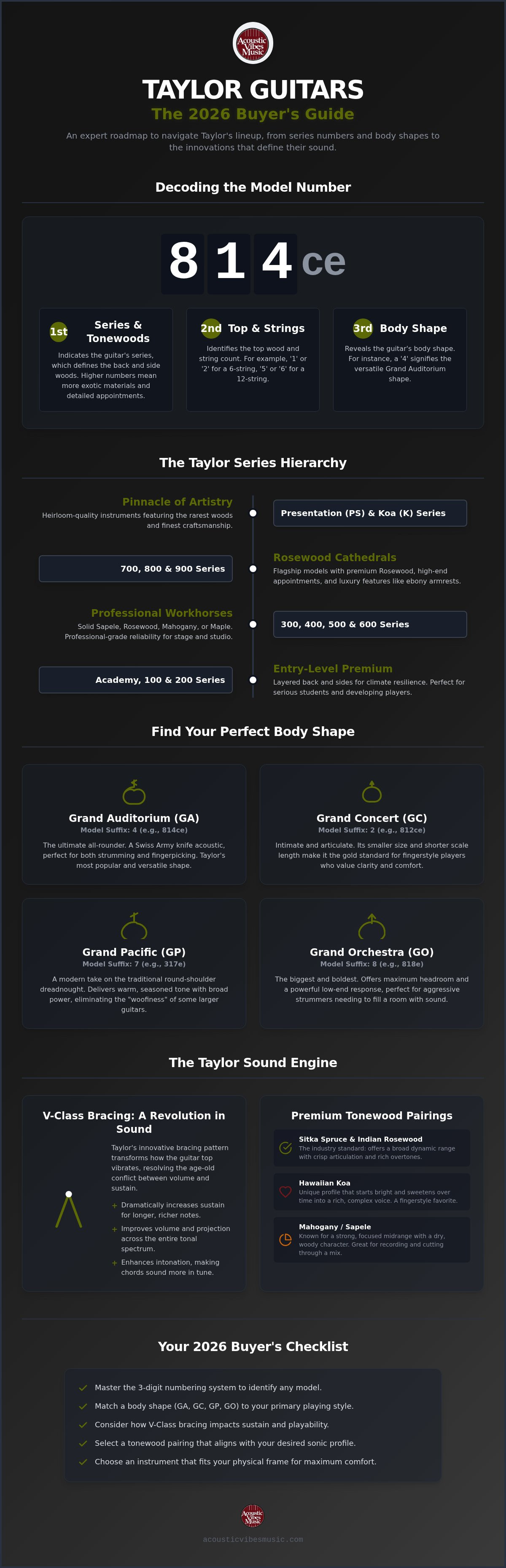
The Taylor code is simple but profound. The first digit identifies the series, which generally dictates the back and side woods. Higher numbers typically reflect more exotic materials and intricate appointments. The second digit acts as a toggle for the top wood and string count. A "1" or "2" represents a six-string model, while a "5" or "6" indicates a twelve-string version. Finally, the third digit reveals the body shape and cutaway status. A "4" at the end signifies a Grand Auditorium, while a "7" indicates the newer Grand Pacific shape. Understanding these numbers is the first step toward total confidence in your purchase.
The journey begins with the Academy and 100/200 series. These are entry-level premium instruments featuring layered back and sides. They're incredibly resilient to climate changes and perfect for serious students. Move into the 300 to 600 series to find the true workhorses of the industry. These guitars use solid Sapele, Rosewood, Mahogany, or Maple. They deliver professional-grade reliability for the touring musician. The 700, 800, and 900 series represent the Rosewood cathedrals of the lineup. The 800 series is the flagship, while the 900 series adds high-end appointments like ebony armrests and intricate abalone inlays for the ultimate luxury experience.
At the summit of the catalog, you'll find the PS (Presentation) and Koa series. These instruments are the pinnacle of artistry. The Presentation series represents the absolute limit of Taylor craftsmanship, often featuring the rarest sets of Macassar Ebony or Cocobolo. The Koa series is a celebration of Hawaiian heritage, offering a unique tonal profile that starts bright and sweetens into a rich, complex voice over years of play. It's a dream choice for fingerstyle players who want a guitar that grows with them. Explore our curated selection of Taylor Guitars to see these masterpieces in person. They aren't just tools; they're heirloom-quality investments in your musical future.
The physical relationship between a player and their instrument starts with the body shape. It's the foundation of comfort and the primary filter for your acoustic voice. In this Taylor Guitars buying guide, we look past the aesthetics to the engineering that dictates how a guitar feels against your ribs and how it projects into a room. Taylor has mastered the art of ergonomic design, ensuring that whether you're a heavy strummer or a delicate fingerstyle player, there's a silhouette sculpted specifically for your reach.
The Grand Auditorium (GA), recognized by the "14" in its model number, remains the most popular choice for a reason. It's the ultimate Swiss Army knife of acoustics. For 2026, Taylor refreshed the 300, 400, and 800 series Grand Auditoriums with "Next Generation" specifications, offering a refined waist that sits perfectly on the lap. If you prefer a more intimate experience, the Grand Concert (GC) or "12" models offer a shorter scale length and a smaller footprint. These are the gold standard for fingerstyle enthusiasts who prioritize tactile feedback and mid-range clarity over raw volume.
For those who crave the traditional "boom" of a larger instrument, the Grand Pacific (GP) offers a round-shoulder dreadnought feel with a more blended, seasoned tonal character. It removes the "woofiness" often associated with big guitars. If you need maximum headroom for aggressive strumming, the Grand Orchestra (GO) is the largest body in the lineup. It delivers a visceral low-end response that can fill a hall without an amplifier. You can find more detail on these specific comparisons in our guide on dreadnought vs grand auditorium for strumming.
Bracing is the engine of the guitar. While traditional X-bracing has defined the acoustic sound for a century, Taylor's V-Class bracing changed the physics of the soundboard. It allows the top to be both stiff and flexible, improving sustain and correcting the "sour" intonation often found high up the neck. The 2026 Next Generation series introduces "scalloped V-Class bracing" to the mid-tier 300 and 400 series. This update provides a more supple response, giving these workhorse models the harmonic complexity previously reserved for the 800 series and above. It's a massive leap forward for players who want boutique performance at a professional price point.
Taylor's NT Neck design has long been the industry benchmark for stability. Because the neck is bolted on with precision-milled shims, a luthier can adjust the angle in minutes rather than hours. The 2026 lineup takes this further with the "Action Control Neck" on select models. This allows for micro-adjustments to the string height without traditional filing, ensuring your setup remains perfect regardless of humidity shifts. Before you settle on a shape, explore our curated Taylor collection to feel how these modern innovations translate into effortless playability.
The soul of an acoustic instrument resides in its organic components. While the bracing provides the structure, the tonewoods act as the filter through which every vibration must pass. In this Taylor Guitars buying guide, we explore how different species of wood interact with Taylor's modern engineering to create distinct sonic signatures. Choosing the right pairing is a personal journey. It’s about finding the wood that resonates with your specific frequency as a player.
The soundboard, or top, is the engine of the guitar. Sitka Spruce remains the industry standard for its incredible strength-to-weight ratio and wide dynamic range. However, the 2026 lineup increasingly utilizes Lutz Spruce on premium models. Lutz is a natural hybrid of Sitka and White Spruce. it offers a higher volume ceiling and a more "broken-in" feel right out of the box. For those seeking a modern twist, Urban Ash provides a transparent tonal profile that lets the player's technique shine through without heavy coloration.
Deciding between these two legendary woods is the most common crossroads for buyers. Indian Rosewood is celebrated for its "scooped" midrange. It delivers thunderous lows and crystalline highs, making it an ideal companion for solo performers who need their guitar to fill a lot of sonic space. Conversely, Tropical Mahogany offers a focused, fundamental-heavy sound. It provides a punchy midrange that sits perfectly in a recording mix or a blues ensemble. For a deep dive into these characteristics, see our detailed guide on Rosewood vs. Mahogany Back and Sides.
If you're a singer-songwriter, consider your vocal range. Rosewood's scooped mids create a "pocket" for lower, richer voices to sit in. Mahogany’s midrange focus can help a lighter, breathier voice cut through the instrument's projection. The 2026 Gold Label series highlights this beautifully, offering the 510e in Mahogany for warmth and the 810e in Honduran Rosewood for those seeking ultimate harmonic complexity.
For the player who wants something beyond the traditional, exotic woods offer a unique aesthetic and tonal palette. Hawaiian Koa is a fan favorite. It starts its life with a bright, crisp response but matures over years of play into a sweet, rich midrange that fingerstyle players adore. Walnut sits somewhere between Mahogany and Rosewood, offering a dry, woody character that flatpickers find addictive. Taylor’s commitment to material excellence extends to the fretboard, where West African Crelicam Ebony is used across the board. This provides a dense, slick surface that ensures every note feels as premium as it sounds. These aren't just aesthetic choices; they're the building blocks of your unique musical identity.
Every musician's journey eventually leads to a choice between the cutting edge and the classic. While this Taylor Guitars buying guide highlights the peak of modern engineering, it's essential to understand how these high-tech instruments compare to vintage-spec alternatives. Taylor builds the future. Their 2026 Next Generation series utilizes Action Control necks and Claria electronics to solve age-old problems of playability and amplification. It's a philosophy of perfection and consistency. You know exactly how a Taylor will respond before you even pick it up.
Contrast this with the Recording King philosophy. While Taylor focuses on the evolution of the soundboard, Recording King looks back to the "Golden Era" of guitar building. They prioritize pre-war aesthetics and traditional construction methods. For the player who finds the modern Taylor voice a bit too "hi-fi" or bright, a vintage-inspired build offers a different kind of satisfaction. It’s the difference between a precision-engineered sports car and a meticulously restored classic muscle car. Both are exhilarating, but they offer entirely different tactile experiences.
If you're seeking that dry, woody growl of a pre-war dreadnought, the Recording King collection is a revelation. These instruments often feature solid Adirondack spruce tops, bone nuts, and nitrocellulose finishes. These specs are typically reserved for boutique builds costing thousands more. They use traditional V-neck profiles and forward-shifted X-bracing to produce a fundamental-heavy tone that honors the history of American roots music. It's a darker, more "seasoned" sound that complements the sparkling clarity of a Taylor 800 series perfectly.
Many Taylor owners keep a Recording King as a high-value "couch guitar" or a dedicated travel instrument. Their all-solid dreadnought and 000 models provide a massive price-to-performance ratio, giving you a professional-grade solid wood voice without the anxiety of taking a flagship Taylor to a campfire or a rowdy jam session. The Dirty 30s series offers a charming, lo-fi blues box vibe that's impossible to find in a modern precision instrument. We encourage you to browse Recording King models to see how they might fill a different niche in your collection. Find your next masterpiece by exploring our full selection of premium acoustics today. Whether you choose the precision of a Taylor or the grit of a Recording King, your perfect tone is waiting.
A premium instrument is a significant investment in your creative future. This Taylor Guitars buying guide concludes with the practical steps needed to turn your research into a lifelong partnership. You've explored the bracing and the woods; now it's time to look at the ergonomics of your daily practice. Finding the right guitar is about more than just a model number. It's about how the instrument disappears when you start to play, leaving only the music behind.
Before you finalize your decision, run through this essential checklist to ensure your choice meets every requirement of your lifestyle:
Every high-end guitar needs a custom touch before it leaves the gallery. Factory settings are a starting point, but a professional luthier setup tailors the instrument to your specific hands. We adjust the action and intonation to match your preferred string gauge and attack. This ensures the 2026 Action Control Neck performs at its peak. For ongoing maintenance or structural adjustments, our Acoustic Vibes Music repair shop stands ready to keep your instrument in showroom condition.
Once you've found "the one," check the details. Ensure your model includes the appropriate hardshell case or AeroCase for protection. Verify the warranty registration process to protect your investment. If you're buying from across the country, prioritize retailers with national shipping expertise. We use specialized packing techniques to ensure your guitar arrives safely, regardless of the distance. If you're still weighing your options between modern precision and traditional character, explore our curated Recording King collection for incredible value. Your perfect tone is out there. It's time to bring it home.
The 2026 landscape for acoustic players is filled with unprecedented choice. From the micro-adjustments of the Action Control Neck to the rich, complex overtones of the Gold Label series, finding your signature sound has never been more accessible. This Taylor Guitars buying guide has mapped out the essential terrain, but the final step is a personal one. Whether you're drawn to the modern precision of a 814ce or the vintage-inspired growl of a Recording King dreadnought, your instrument should be a catalyst for your creativity.
At Acoustic Vibes Music, we don't just move boxes. We act as your expert guide and passionate curator. Every instrument in our expertly curated high-end inventory receives a professional luthier setup before it leaves our shop. We take the anxiety out of the process with safe national shipping on all instruments, ensuring your new masterpiece arrives ready for the stage. Ready to explore a different side of the acoustic world? Shop the Curated Recording King Collection at Acoustic Vibes Music to find incredible value and pre-war character. Your next great song is waiting to be written. Pick up your guitar and play.
The Grand Auditorium (GA or "14" models) is the most popular silhouette in the catalog. Its medium dimensions offer a perfect balance between the volume of a dreadnought and the clarity of a smaller concert body. This versatility makes it the top recommendation in any Taylor Guitars buying guide for players who switch between aggressive strumming and delicate fingerstyle techniques.
Taylor has transitioned the vast majority of its US-made lineup to the innovative V-Class bracing system. However, refined X-bracing is still utilized in the Academy, 100, and 200 series, as well as select specialty models. While V-Class offers superior intonation and sustain, the traditional X-bracing remains a favorite for players seeking a familiar, vintage-inspired response and a softer low-end character.
Many Recording King models, particularly those in the higher series like the RD-318 or RD-328, feature all-solid tonewoods. This construction provides the resonance and complex overtones typically found in much more expensive instruments. It is a key reason why they are a standout value for players who want a professional-grade acoustic voice on a tighter budget without sacrificing material quality.
V-Class bracing is a revolutionary internal architecture that allows the guitar top to be simultaneously stiff and flexible. By directing vibrations along the grain of the wood, it increases sustain and ensures that notes remain in tune with one another all the way up the neck. This design effectively solves the "sour" notes often found in traditional builds. It represents a significant shift in how modern acoustics project sound.
The Academy Series and 100 Series are the premier choices for those just starting their musical journey. Taylor specifically designed the Academy Series with ergonomic features like built-in armrests to reduce physical fatigue during long practice sessions. These models provide the signature Taylor playability and reliable intonation at a price point that is accessible for serious students. They offer a professional feel that encourages beginners to play more often.
Most Taylor 200 series models and above include either a high-quality AeroCase or a deluxe hardshell case. The specific type of protection depends on the series and body shape. For example, the 300 series and higher typically ship with a custom-fitted hardshell case to safeguard the solid tonewoods during national shipping and travel. This ensures your investment stays protected from humidity and impact.
Recording King guitars are frequently used by touring professionals who need a reliable, "rootsy" tone for the stage. Their pre-war inspired builds offer a dry, woody character that cuts through a mix beautifully. They are an excellent choice for gigging musicians who want a vintage aesthetic and sound without the high cost or fragility of a true museum-piece instrument. They handle the rigors of the road with impressive durability.