My shopping cart
Your cart is currently empty.
Continue ShoppingWhat if the most evocative, room-filling tone you ever played came from a body shape small enough to tuck under your arm? It's a common misconception that parlor size guitars are merely shrunken versions of their larger siblings, destined to sound thin or boxy. You might worry that choosing a compact instrument means sacrificing the rich projection of a dreadnought, but the reality is far more exciting. These instruments are specialized tools of intimacy and mid-range clarity, designed for players who demand both physical comfort and professional-grade sonic depth.
We understand the hesitation that comes with choosing between a classic 12-fret heritage build and a modern 14-fret boutique configuration. This guide promises to demystify those tactile nuances, helping you find a parlor guitar that balances exquisite craftsmanship with a voice that punches well above its weight. We will explore the specialized builds from masters like Collings, Atkin, and Martin, focusing on how premium tonewoods and artisanal bracing create that sought-after focused response. From the dry, woody punch of an all-mahogany "Dust Bowl" build to the refined elegance of a 5-28 Terz, you're about to discover how to select an heirloom-quality instrument with total confidence.
Step away from the clinical dictionary definitions and look at the artistry. While some sources describe a "parlor" simply as a room for conversation, musicians know the history of parlor guitars tells a much richer story. These instruments were the original high-fidelity home audio systems, designed to deliver nuance and projection in the intimate social spaces of the 19th century. Today, parlor size guitars represent a return to that focused, intentional sound. They are defined by a distinct silhouette: a significantly narrower waist and an elongated upper bout that often shifts the bridge toward the center of the lower bout, maximizing the vibration of the soundboard.
This construction isn't about being "small"; it's about being efficient. The smaller air chamber creates a sonic signature characterized by immediate response and a robust mid-range. You won't find the cavernous, sometimes muddy bass of a dreadnought here. Instead, you get a transparent, woody tone where every note in a chord has its own space to breathe. It's this precision that draws modern collectors back to the vintage footprint, seeking an instrument that rewards a delicate touch with surprising sustain and harmonic complexity.
Don't let the "0" and "00" designations overwhelm you. While a Martin Size 0 is often the benchmark, a true parlor is generally the smallest full-sized instrument in a builder's catalog. Crucially, these are not travel guitars. In the boutique market, a parlor features the same premium bracing and master-grade woods as any flagship model. The shorter scale length, typically 24 to 24.75 inches, is the secret to their playability. It lowers string tension, making the guitar feel soft and responsive, which is a revelation for intricate fingerstyle work.
The fingerstyle specialist is the natural match for this body shape. The balance between registers ensures that melody lines don't get buried by the accompaniment. Beyond the sound, the ergonomics are life-changing for many. If you have a smaller frame or find yourself struggling with the bulk of a jumbo, the parlor offers a fatigue-free playing experience. It's also the songwriter's best friend. Because the frequency response is so focused, it leaves plenty of room for the human voice, making it a perfect companion for intimate vocal performances and studio recording sessions.
Listen closely to the resonance of a high-end small body. The restricted air chamber inside parlor size guitars acts as a natural compressor, focusing the energy of the vibrating top into a punchy, immediate response. This physics-driven intimacy is why tonewood selection is so critical. While a dreadnought can rely on sheer volume to hide imperfections, a parlor reveals everything. This transparency is why many elite builders favor Adirondack spruce for the soundboard. Adirondack provides significantly more headroom than Sitka, allowing you to dig in with a pick without the tone "breaking up" or becoming muddy. It gives a small instrument the authority of a much larger one.
Bridge placement is the secret engine of this design. In many traditional parlor builds, the bridge is positioned squarely in the "sweet spot" of the lower bout. This location maximizes the leverage the strings have over the top, coaxing out deep harmonics that you wouldn't expect from such a compact footprint. It's a delicate balance of tension and vibration that requires an artisanal touch to perfect. If you're curious about how these elements come together in a professional build, explore our hand-selected acoustics to see these features in action.
The choice between a 12-fret and 14-fret neck joint is more than just a matter of upper-fret access. It's a fundamental tonal decision. On a 12-fret model, the bridge is shifted further down the body into the widest part of the lower bout. This shift creates a warmer, rounder voice with a more pronounced bass response. Many players find the shorter reach of the 12-fret neck joint to be more ergonomic for long sessions. You can dive deeper into the mechanics of this in our guide on what is a 12-fret guitar and how it alters the instrument's personality.
Back and side woods act as the EQ for your guitar. Mahogany is a staple for parlor size guitars because it emphasizes the mid-range, providing a dry, "honky" blues character that cuts through a mix. If you prefer a more "piano-like" complexity, rosewood is the superior choice. It adds shimmering overtones and a sophisticated bass floor that fills out the small body's natural frequency gaps. For a side-by-side comparison of these two legends, check out our analysis of Rosewood vs. Mahogany Back and Sides to find your perfect sonic match.
Finding the right instrument is about matching your playing personality to a builder's specific philosophy. While some brands focus on historical accuracy, others push the boundaries of modern acoustic engineering to see what's possible in a compact frame. In the curated world of parlor size guitars, three names consistently rise to the top: Martin, Collings, and Atkin. Each offers a unique interpretation of the small-bodied voice, ranging from the warm, fundamental-focused heritage of Pennsylvania to the hyper-articulate clarity of Austin, Texas. Understanding these differences is the key to finding your forever guitar.
The "sweet spot" for each brand often lies in how they manage the relationship between the small body and the player's touch. A Martin might feel like a warm embrace, while a Collings feels like a precision tool. Atkin, meanwhile, occupies a space of pure character, offering a tactile experience that bridges the gap between past and present. We hand-select every piece in our collection to ensure these brand-specific traits are represented at their absolute best.
Martin essentially wrote the blueprint for this entire category. Their "0" and "00" sizes are the foundational designs that almost every other boutique builder references. Models like the 0-18 and 0-28 remain the gold standard for that dry, balanced "American" sound. When you Shop C.F. Martin & Co. Guitars, you're investing in a legacy of scalloped X-bracing and dovetail neck joints. These construction methods provide a sweet, singing high end and a woody mid-range that has defined folk and blues records for over a century. It's the classic choice for the traditionalist.
If you crave absolute transparency and flawless execution, Collings is your destination. Their Parlor 1 and Parlor 2 series take the vintage footprint and refine it with modern precision engineering. These instruments are incredibly responsive, offering a level of note separation that is rare in such a small air chamber. You can Explore Collings Guitars to find an instrument where every frequency is balanced and every detail is finished to perfection. It's a high-performance machine for the modern fingerstyle player.
For those who want the soul of a 1930s instrument without the structural risks of a vintage find, Atkin is the answer. Their parlor models are famous for their hand-aged finishes and a "broken-in" feel that usually takes decades to achieve. When you Discover Atkin Guitars, you'll hear a distinct, vintage-correct tone that feels warm and harmonically rich. Atkin uses a specialized torrefaction process and thin nitrocellulose lacquer to ensure the guitar breathes and vibrates like a true heirloom from day one.
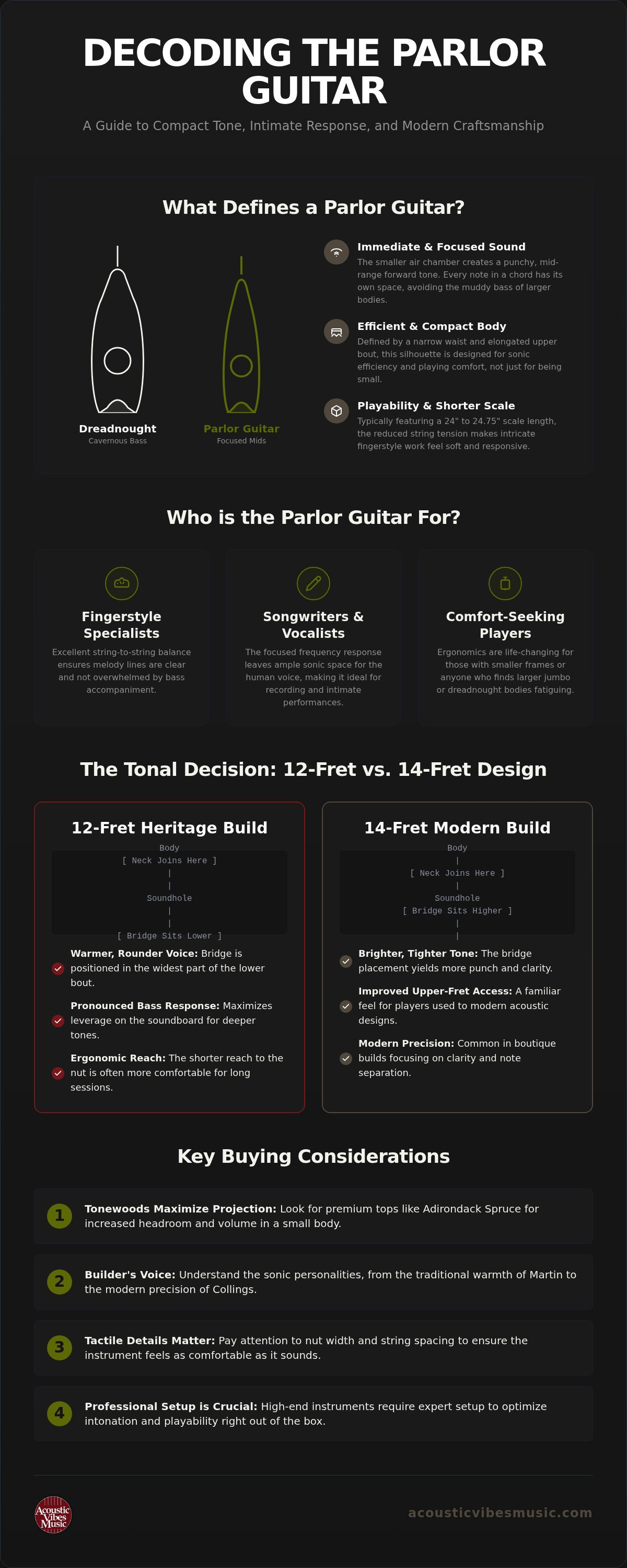
Your hands are the final judge of any instrument. While the visual allure of parlor size guitars is undeniable, the physical specifications determine whether it becomes a lifelong companion or a beautiful ornament. Nut width is arguably the most critical measurement here. While many mass-produced acoustics utilize a 1 11/16-inch nut, most premium parlor builds opt for a wider 1 3/4-inch (1.75 inch) nut. This extra space is vital. It prevents your fingers from crowding during complex fingerstyle passages, allowing each note to ring with absolute clarity. Pair this with generous string spacing at the saddle, and you have an instrument that feels expansive despite its compact frame.
Don't settle for a "boxy" or thin response. This common complaint usually stems from inferior bracing or stiff tops found in entry-level models. To avoid this, prioritize instruments with hand-scalloped bracing and master-grade tops. These features allow the soundboard to vibrate more freely, producing the rich, three-dimensional tone we explored in previous sections. Because of their unique dimensions, these guitars also require specialized storage. Standard cases are often too loose, which can lead to structural damage during transport. Always ensure your parlor comes with a custom-fitted hardshell case to protect the integrity of the build.
A parlor guitar is a precision instrument for the fingerstyle artist. Its immediate response captures the subtle nuances of your attack, making it ideal for folk, blues, and intricate solo work. While they can handle light strumming, they aren't designed to compete with a heavy-handed dreadnought in a loud ensemble. If your style leans more toward aggressive rhythmic work, you might want to see how a Dreadnought vs. Grand Auditorium for Strumming compares. In the studio, the parlor's focused frequency range is a secret weapon. It sits perfectly in a mix without requiring heavy EQ, providing clean, articulate tracks every time.
The biggest error is assuming small means quiet. A well-built parlor can project with startling authority and sustain. Another pitfall is ignoring the neck profile. A chunky "V" neck might feel great for thumb-over playing but could fatigue a player used to modern "C" shapes. Finally, never underestimate the power of a professional luthier setup. Even the finest boutique guitar needs a specialist’s touch to dial in the action for your specific touch. At Acoustic Vibes Music, we include this expert service with every instrument. Browse our premium parlor collection today to find a guitar that is perfectly calibrated for your hands from the moment it arrives.
Finding your perfect instrument shouldn't feel like a transaction. It should feel like a discovery. At Acoustic Vibes Music, we operate more like a curated gallery than a standard retail outlet. We hand-select every instrument in our collection, ensuring that each of our parlor size guitars meets a rigorous standard for tonal complexity and material excellence. You aren't just buying a small-bodied acoustic; you're acquiring a piece of artisanal skill that has been vetted by specialists who live and breathe high-end lutherie.
Playability is our obsession. Every guitar that leaves our shop undergoes an expert setup by our professional luthier team. We adjust the action, check the intonation, and ensure the nut slots are perfectly filed so your new parlor is ready for the stage or the studio the moment you open the case. If you're ordering from across the country, rest easy. We provide national shipping with professional, high-impact packing designed specifically for delicate, high-end acoustics. Your investment is protected from our door to yours.
Choosing between a vintage-voiced Atkin or a precision-engineered Collings can be a daunting task. That's why we offer personalized consultations. We act as your expert guide, providing detailed tonal descriptions and tactile feedback over the phone or via email. We want to help you find that "forever" guitar that responds to your unique touch.
Big-box retailers often treat instruments like boxed inventory, leaving them in warehouses where humidity and temperature aren't always monitored. We offer a different experience. You get direct access to world-class brands that demand specialized knowledge, such as Boucher Guitars and the ethereal builds from Northern Ireland. Browse Lowden Guitars to see how unconventional tonewoods and unique bracing can redefine the parlor sound. Buying from us means buying with the confidence that your instrument has been cared for by people who respect the heritage of the craft.
Explore our current inventory of 12 curated parlor models to find the one that speaks to you. Whether you're looking for the dry punch of mahogany or the piano-like shimmer of rosewood, our collection is constantly evolving with new arrivals from the world's finest builders. Take the next step in your musical journey today. Shop Our Curated Parlor Guitar Collection and connect with our experts for a deep dive into the specific sonic profile of any instrument in our care.
Choosing a parlor guitar is an exercise in intentionality. It’s about moving past the sheer volume of larger bodies to find a focused, articulate voice that responds to your most delicate touch. Whether you're drawn to the historical resonance of a traditional 12-fret build or the modern precision of a boutique masterpiece, these instruments offer a level of tactile intimacy that few other shapes can match. You've seen how the right nut width and premium bracing can transform a compact frame into a professional-grade tool with surprising projection and depth.
We know that selecting parlor size guitars online requires a high degree of trust. That's why our curated high-end inventory is backed by professional expertise at every step. Every instrument includes an expert luthier setup to ensure it plays perfectly from the first chord. With national insured shipping, your new heirloom arrives safely at your door, ready for the stage or the studio. Trust the artistry and the specialized knowledge that goes into every hand-selected piece in our collection.
Discover Your Perfect Parlor Guitar in Our Curated Collection
Your next great song is waiting in a smaller frame. Explore our collection today and find the instrument that speaks to your unique style.
A parlor guitar is significantly smaller than a 000, which is considered a mid-sized auditorium instrument. While the 000 offers a balanced, multi-purpose tone, the parlor features a narrower waist and a smaller lower bout that usually measures under 13.5 inches. This compact design results in a more focused, mid-range heavy sound compared to the broader frequency response of a 000 model.
Parlor size guitars are excellent for both beginners and seasoned professionals. For new players, the smaller body and shorter scale length reduce string tension, making it easier to fret notes without finger fatigue. Experienced collectors value them for their intimate response and specialized tonal clarity, making them a versatile choice for any skill level or hand size.
You can certainly strum a parlor guitar, though it responds best to a lighter touch. While they excel at fingerstyle due to their exceptional note separation, light strumming with a thin pick produces a charming, vintage character. They won't have the massive volume of a dreadnought, but they offer a unique, percussive energy that sits perfectly under a vocal track.
The 12-fret neck joint is a traditional design that shifts the bridge closer to the center of the lower bout. This specific placement allows the strings to drive the soundboard more efficiently, resulting in a warmer, fuller tone with increased sustain. It also brings the player's fretting hand closer to the body, creating a more ergonomic and comfortable playing position.
Premium parlor size guitars from boutique builders like Collings, Atkin, or Martin hold their value exceptionally well. While dreadnoughts have a larger general market, the demand for high-end small-bodied instruments is consistently high among studio musicians and collectors. A well-maintained parlor from a respected luthier often becomes a sought-after heirloom that maintains its worth over decades.
Most professional-grade parlor guitars feature a nut width of 1 3/4 inches (45mm). This wider spacing is preferred because it provides more room for the fingers, which is essential for the intricate movements required in fingerstyle playing. Some vintage-spec models may even utilize a 1 13/16-inch nut to accommodate traditional techniques and provide an even more expansive feel.
Choose mahogany if you want a dry, punchy sound with a strong emphasis on the mid-range and fundamental notes. It's the classic choice for blues and roots music. Opt for rosewood if you prefer a more "piano-like" complexity with rich overtones and a deeper bass floor. Your choice should depend on whether you want a raw, woody character or a sophisticated shimmer.
Most parlor guitars are designed for light or extra-light gauge acoustic strings to protect their delicate bracing. Because the scale length is often shorter, using heavier strings can put excessive tension on the bridge and top. Many players prefer phosphor bronze or silk and steel strings to enhance the instrument's natural warmth and provide a softer feel for complex fingerstyle work.