My shopping cart
Your cart is currently empty.
Continue ShoppingThe biggest, boldest sound in the room doesn't always require the biggest guitar body. Many players find that a massive dreadnought creates more shoulder fatigue than musical inspiration, leading them to explore the incredible versatility of 000 size guitars. It is a common struggle to feel stuck between a small parlor instrument that lacks projection and a larger model that feels like a piece of furniture. You deserve an instrument that feels like an extension of your body while delivering a balanced, professional tone that handles everything from delicate fingerstyle to spirited flatpicking.
Finding that perfect balance is easier than you think. This guide explores why the auditorium shape is the definitive choice for discerning players who refuse to compromise on playability or character. You'll learn how to select the right model based on critical specs like scale length and tonewood selection. We'll also preview exceptional instruments from world class builders like Martin, Collings, and Boucher. From understanding nut widths to identifying the best boutique models, you're about to discover how to find a guitar you'll never want to put down.
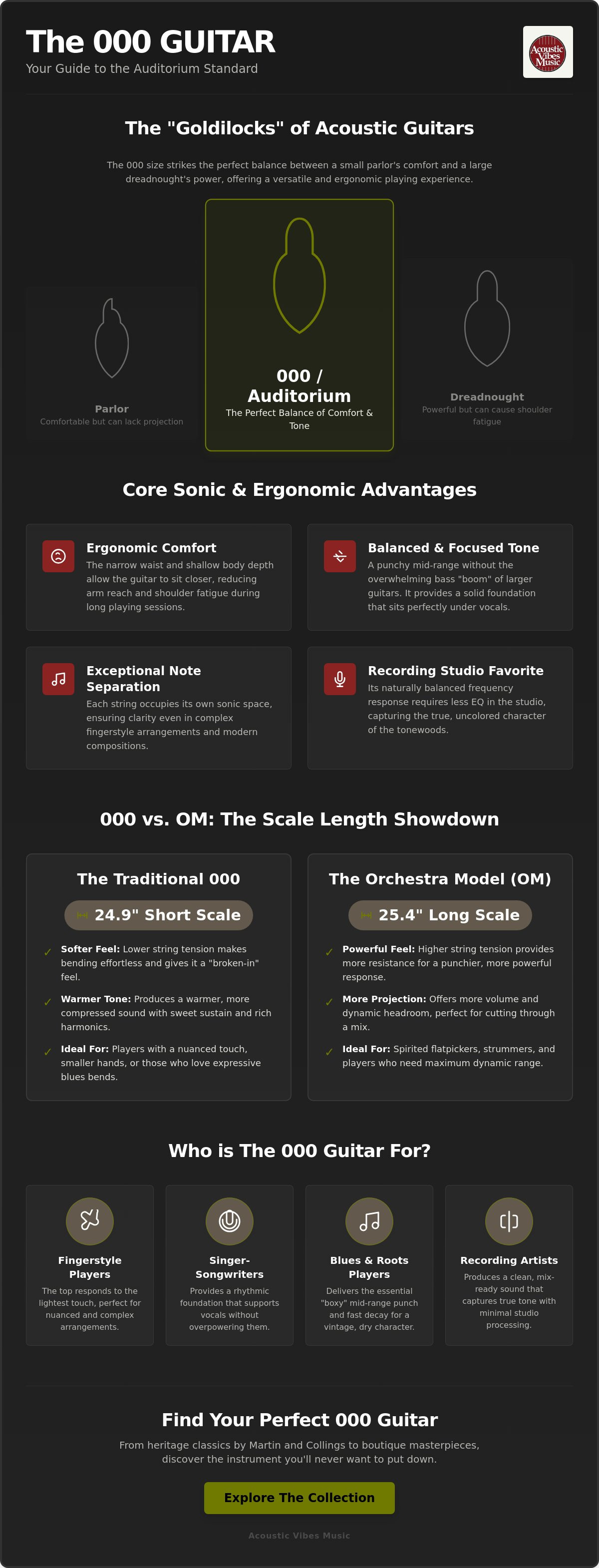
The 000 size guitar is often described as the "Goldilocks" of the acoustic world. It sits perfectly in the middle of the spectrum, offering more presence than a small parlor model while remaining far more manageable than a massive dreadnought. Known officially as the Auditorium body, this shape features a distinctive narrow waist and a shallower body depth. These physical traits aren't just for show; they allow the instrument to sit much closer to your body. If you spend hours practicing in a chair, you'll immediately appreciate how this design reduces the reach of your strumming arm, making it a dream for ergonomic comfort.
Historically, the 000 rose to prominence during the crucial transition from gut strings to steel strings. Looking back at Martin's 000 and Orchestra Model history, we see a design that was revolutionary in the 1920s and remains a benchmark for Martin guitars in 2026. The tonal profile is defined by a focused, punchy mid-range. Unlike larger guitars that can suffer from "woof" or low-end muddiness, 000 size guitars provide exceptional note separation. Every string has its own space in the sonic landscape, making it a sophisticated choice for complex arrangements and modern compositions.
Shoulder fatigue is a real concern for many enthusiasts. Dreadnoughts are deep and wide, often forcing your arm into an awkward angle that can lead to long-term discomfort during long sessions. Choosing a 000 body provides immediate ergonomic relief. While you might trade away some of the raw, room-shaking volume of a larger body, you gain immense clarity and balance. Recording engineers often call this their favorite body shape because its balanced frequency response requires less EQ work in the studio. It captures the true character of the wood without the overwhelming bass boom that can clutter a mix.
Fingerstyle players gravitate toward this shape because the thinner top and smaller air cavity respond to even the lightest touch. You don't have to "dig in" to get the soundboard moving. However, don't overlook its potential for vocal accompaniment. For singer-songwriters, 000 size guitars provide a rhythmic foundation that sits neatly under a voice rather than competing with it. If you have a penchant for Delta blues or ragtime, the fast decay and "boxy" mid-range punch of this model will feel like a homecoming. It delivers that vintage, dry character that is essential for traditional American roots music.
The 000 and the OM (Orchestra Model) often look identical at first glance. They share the same body dimensions within the spectrum of common acoustic guitar shapes and sizes. However, the secret to their distinct personalities lies in the scale length. While most 000 size guitars utilize a 24.9-inch short scale, the OM opts for a 25.4-inch long scale. This half-inch difference completely changes the mechanical feel and sonic response of the instrument. It is the primary reason why one guitar might feel stiff and powerful, while another feels soft and inviting.
Beyond scale, modern players prioritize the nut width and neck profile. The 1 3/4-inch nut has become the gold standard for fingerstyle enthusiasts, providing that extra fraction of space needed for clean, complex fretting. When paired with a "Modified Low Oval" neck profile, the guitar feels fast and contemporary. Conversely, many boutique builders lean into traditional V-shapes. These offer a more substantial grip for those who prefer vintage-inspired ergonomics and a deeper connection to the wood. Finding the right combination is a deeply personal journey that impacts how long you can play without discomfort.
Short scale lengths reduce the overall tension on the strings. This makes "bends" feel effortless and gives the guitar a "broken in" feel right out of the case. For players with smaller hands, the slightly shorter distance between frets makes high-register stretches much more manageable. Sonically, this setup produces a warmer, more compressed tone. It emphasizes sweet sustain and harmonic richness over raw, percussive power. It is a forgiving setup that rewards a nuanced touch.
Some modern builders create hybrids that defy traditional labels. By putting a long scale on a 000 body, you gain the projection and "snap" needed for alternate tunings like DADGAD. The increased string tension drives the soundboard harder, resulting in more volume and a quicker attack. For instance, comparing the immediate punch of Collings guitars in an OM configuration against the lush warmth of a traditional Martin 000 reveals how scale length dictates the instrument's voice. If you're ready to feel these differences for yourself, you can explore our full collection of high-end 000 and OM models to find your perfect match.
Choosing the right materials is where the soul of the instrument truly takes shape. While the 000 body provides the frame, it's the tonewoods that act as the engine for your sound. Most factory models rely on Sitka Spruce for its immediate responsiveness and versatile dynamic range. However, if you have a heavy attack or seek maximum headroom, Adirondack (Red) Spruce is the premium alternative. This wood was a staple in the early C.F. Martin & Co. history and remains the gold standard for players who want their 000 size guitars to bark with authority.
The back and sides dictate the color of the sound. Mahogany offers a dry, punchy mid-range that cuts through a mix with surgical precision. It is the quintessential sound of American folk and blues. On the other hand, East Indian Rosewood provides a lush, piano-like quality with complex overtones and deep lows. To let these woods sing, 2026 models often feature thin nitrocellulose lacquer finishes and traditional hide glue construction. These artisanal methods allow the wood to vibrate naturally, ensuring the guitar breathes and matures over decades of play. You'll find that 000 size guitars built with these specs age into a richness that factory finishes simply can't match.
Modern luthiery has introduced torrefied or thermally aged tops to the market. This process mimics the cellular breakdown of vintage wood, giving a brand-new instrument the dry, resonant snap of a pre-war classic. For collectors seeking rarity, Madagascar Rosewood offers a tonal profile strikingly similar to the legendary Brazilian species. Meanwhile, Koa has surged in popularity for custom builds, providing a stunning visual grain paired with a bright, sweet high-end that mellows beautifully over time. For a more technical breakdown, read our Tonewood Deep Dive: Adirondack vs. Sitka for more detail.
A master builder does more than assemble parts; they voice the instrument. By hand-voicing the top, a luthier adjusts the thickness of the soundboard to optimize its specific density. Even the choice of bridge material matters. Ebony provides a fast attack and clear note decay, while Rosewood offers a warmer, more rounded finish. Through the meticulous process of hand-scalloping braces to reduce mass while maintaining structural integrity, a skilled luthier allows a 000 to produce Dreadnought-level projection. This level of craftsmanship ensures that every note carries with intentionality and power.
While the history of the auditorium shape began over a century ago, the current market for 000 size guitars is more vibrant and diverse than ever. Every enthusiast recognizes the Martin 000-18 and 000-28 as the definitive blueprints for this category. The 000-18, with its mahogany back and sides, delivers a dry, woody punch that has defined countless folk recordings. Its sibling, the 000-28, utilizes East Indian Rosewood to provide a lush, harmonic complexity that remains the benchmark for professional players. These instruments represent the heritage of the craft, offering a timeless voice that continues to inspire new generations of collectors.
For those seeking a more specialized feel, the Atkin 000 Series has become a modern sensation. Based in the UK, Atkin builds instruments with a remarkable "broken-in" character right out of the case. Their proprietary "aged" finishes and relic'd aesthetics provide the tactile joy of a vintage instrument without the structural headaches of a hundred-year-old guitar. Meanwhile, Canadian builder Boucher has carved out a niche by utilizing high-altitude Adirondack spruce harvested from their own backyard. These masterpieces, such as the Boucher Grand Reserve 000, offer a level of headroom and crystalline clarity that is rarely found in mid-sized bodies.
Deciding between a heritage brand and a boutique builder often comes down to your preference for precision versus tradition. Comparing a Martin 000-28 to a Collings 0002H reveals two different philosophies. While Martin offers the classic, warm "thump" associated with their legacy, Collings guitars are precision-engineered for unmatched note-to-note consistency and a hi-fi frequency response. Similarly, the Atkin 000-37 is winning over vintage Martin collectors in 2026 because it captures that elusive "pre-war" snap and dry resonance with startling accuracy. You can explore these standout 000 guitars at Acoustic Vibes Music to find the one that speaks to your hands.
If you want to step outside the traditional American design school, several builders offer unique takes on the 000 size guitars framework.
Ready to experience these world-class instruments in person? We invite you to browse our curated selection of Atkin guitars and find your forever auditorium model today.
Selecting an heirloom instrument is a significant milestone for any player. It's not just about the wood and wire; it's about finding a partner for your musical journey. To ensure you land on the right model among the many 000 size guitars available, start by assessing your primary environment. Solo performers often require the nuanced response of a 000-18, while session players might prefer the balanced frequency spectrum of a rosewood 000-28 to avoid clashing with other instruments. If you're a home hobbyist, prioritize ergonomic comfort above all else. Your guitar should be an instrument you reach for every single day.
Decide on your scale length preference early in the process. As we discussed, the traditional 24.9-inch short scale on 000 size guitars offers a slinkier, more comfortable feel. If you play in drop tunings or need maximum percussive power, the 25.4-inch OM scale might be the better fit. Think about how the string tension impacts your specific technique. Don't overlook the importance of a professional setup. Even a masterpiece from the Martin Custom Shop or a precision-engineered Collings benefits from a luthier's touch. A specialized setup ensures the action height and neck relief are tailored exactly to your fretting pressure. It's the final step in turning a high-end purchase into a personal extension of your playing style.
Evaluating tone from a distance requires a discerning ear. Focus on high-quality audio demos that use minimal processing to hear the true character of the wood. Ask your dealer specific questions about the remaining saddle height and current neck relief. These technical details indicate the long-term health and adjustability of the instrument. When it's time to ship, ensure your dealer uses climate-controlled packaging and professional-grade materials. Shipping peace of mind is essential when investing in premium craftsmanship.
The auditorium shape is the ultimate Swiss Army knife of the acoustic world. It offers a level of versatility that few other body styles can match. Whether you are chasing the dry punch of mahogany or the lush overtones of rosewood, there is a perfect model waiting to be discovered. We invite you to contact our expert curators for a personalized recommendation tailored to your hands and ears. You can find your heirloom-quality 000 size guitar today and experience the peak of acoustic excellence.
The search for a "forever" guitar often ends the moment you cradle a 000 against your body. This shape represents the peak of acoustic design, offering a sophisticated balance between ergonomic ease and professional-grade projection. By understanding the nuances of scale length and the distinct personalities of premium tonewoods, you're no longer just buying an instrument; you're selecting a partner for a lifetime of music. 000 size guitars are the definitive choice for those who refuse to compromise on tonal clarity or physical comfort.
At Acoustic Vibes Music, we live for the pursuit of quality. Our gallery features an expert-level curation of the world’s finest builders, including Martin, Collings, and Atkin. Every instrument undergoes a rigorous professional luthier inspection before it ever reaches your hands, ensuring it plays perfectly from the first strum. Whether you're across the street or across the country, our nationwide shipping with climate-aware packaging brings these masterpieces safely to your door. Browse the Curated 000 Collection at Acoustic Vibes Music and discover the instrument that will inspire your next chapter. Your perfect auditorium model is waiting.
Yes, a 000 is significantly smaller and shallower than a dreadnought. While a dreadnought is built for raw volume and heavy bass, the 000 body focuses on ergonomic comfort and mid-range clarity. Its narrower waist allows the instrument to sit lower on your leg, which reduces the reach of your strumming arm. This makes 000 size guitars a favorite for seated practice and long recording sessions where physical fatigue is a concern.
The primary difference lies in the tonewoods used for the back and sides. A Martin 000-18 features solid mahogany, delivering a dry, woody punch with clear fundamental notes. In contrast, the 000-28 utilizes solid East Indian Rosewood, which provides a richer harmonic profile and deeper low-end resonance. Both models share the same body shape and 24.9-inch short scale, but their sonic colors are distinct choices for different musical styles.
Fingerstyle players prefer this shape because of its immediate responsiveness and exceptional note separation. The smaller air cavity and thinner soundboard react to a light touch, allowing delicate nuances to ring out clearly. Unlike larger bodies that can swallow high-end frequencies with overwhelming bass, the 000 provides a balanced voice across all six strings. It's the perfect platform for complex arrangements where every note needs to be heard with crystalline clarity.
You can absolutely strum a 000, though it offers a different experience than a larger model. It provides a focused, rhythmic punch that sits beautifully under a vocal without competing for the same frequencies. While it doesn't have the room-shaking volume of a dreadnought, its projection is surprisingly potent in intimate settings or through a microphone. Many singer-songwriters choose 000 size guitars precisely because they don't overpower their singing voice during live performances.
A standard 000 features a 24.9-inch short scale length. This specification is the defining characteristic that separates it from the long-scale Orchestra Model (OM). The shorter distance between the nut and the bridge reduces string tension, making the guitar feel softer under your fingers. It makes complex chords easier to fret and allows for more expressive string bending, providing a relaxed, inviting feel that many enthusiasts find addictive.
The Taylor Grand Auditorium is a larger instrument with a 16-inch lower bout and a 25.5-inch scale length. While the Taylor GA is a versatile modern hybrid, the 000 is more compact with its 15-inch width and shallower body depth. The 000 offers a more traditional, vintage-inspired mid-range focus, whereas the Taylor GA is designed for a bright, hi-fi sound with more modern projection and a larger physical footprint.
Boutique instruments from builders like Collings offer a level of hand-voiced precision that factory models can't replicate. Every top is thickness-sanded to its specific density, and braces are hand-scalloped to maximize vibration while maintaining structural integrity. For a serious player or collector, the investment pays off in unmatched note-to-note consistency and a sophisticated voice that matures beautifully. These instruments are hand-selected for their superior materials and artisanal construction.
Light gauge strings are the traditional choice for this body style. They pair perfectly with the short scale length to provide a comfortable, slinky feel that doesn't overstress the bridge or soundboard. While some modern builds can handle medium strings, light gauges allow the sensitive top to vibrate most freely. This setup preserves the sweet sustain and harmonic richness that define the classic auditorium sound, making the guitar feel responsive and alive.