My shopping cart
Your cart is currently empty.
Continue ShoppingBuying a premium guitar based solely on the logo on the headstock is the fastest way to miss out on the instrument that actually speaks to your soul. You've likely spent hours staring at the complex numbering system used for taylor acoustic guitars, wondering if an 814ce is truly the pinnacle or if you're simply paying for the prestige of a household name. It's natural to feel overwhelmed by the technical choice between Sitka and Adirondack spruce or the subtle shifts in resonance between different body shapes. We understand that hesitation because we've felt it too. Every player deserves an instrument that rewards their specific technique, whether you're a delicate fingerstyle artist or a heavy-hitting strummer.
This 2026 guide simplifies that journey by helping you decode the modern Taylor lineup with the precision of a master luthier. You'll discover how to navigate the proprietary bracing and tonewood combinations that define their signature clarity. We also provide a curated look at professional alternatives, such as the handcrafted Yamaha L-Series and the master-built FG9 models, which often challenge the high-end status quo in terms of both tone and value. We're here to ensure your next purchase is a true heirloom that inspires your playing for decades to come.
Step into any professional recording studio, and you'll likely find Taylor Acoustic Guitars ready for action. Known for a signature "shimmer," these instruments deliver a bright, articulate high-end that cuts through dense mixes without fighting the vocals. This modern tonal profile began with the history of Taylor Guitars, where Bob Taylor's focus on manufacturing precision changed the industry. Unlike vintage-voiced instruments that can sound muddy, a Taylor provides immediate clarity. It's a reliable choice for the working musician who needs every note to ring with definition.
Professional setups are effortless thanks to the patented NT neck design. This bolt-on system ensures perfect alignment and allows for easy neck angle adjustments decades down the road. You won't fear the dreaded neck reset that plagues many vintage acoustics. This engineering focus also results in incredible consistency. When you browse our curated selection of Taylor Acoustic Guitars, you can trust that the instrument arriving at your door will play with the same precision as the one you tested in a showroom. It's a level of quality control that builds immense confidence for players buying sight-unseen.
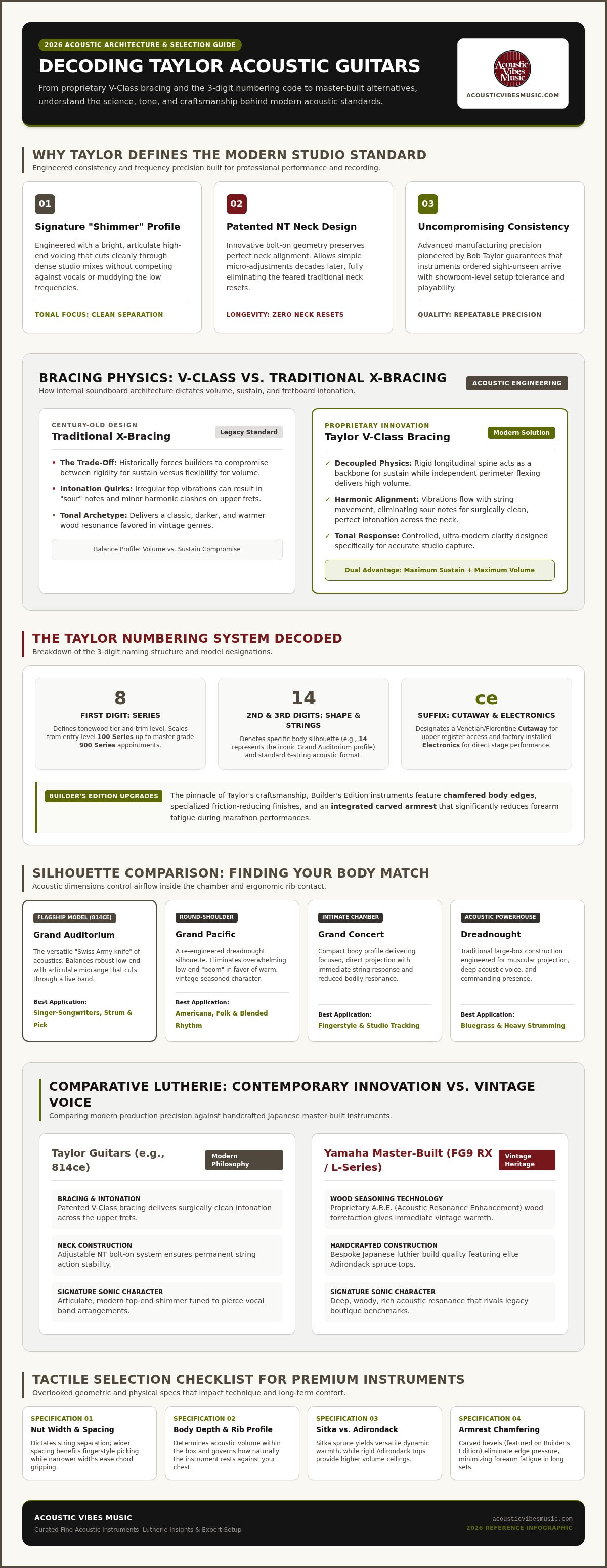
Traditional X-bracing has been the industry standard for a century, but it often forces a trade-off between volume and sustain. V-Class bracing changes the physics of the soundboard by acting as a rigid backbone while allowing the sides to vibrate freely. This results in a guitar that is both louder and rings out longer. V-Class bracing resolves "sour" notes on the upper frets by aligning the vibrations of the top with the strings to ensure perfect intonation across the entire fretboard. While some boutique builds focus on a darker, woodier resonance, the V-Class response is surgically clean and modern.
Understanding the lineup is simple once you unlock the three-digit code. The first digit represents the series, moving from the accessible 100 series up to the luxurious 900 series; each step indicates higher-grade tonewoods and more intricate appointments. The "ce" suffix stands for "Cutaway" and "Electronics," marking a guitar that's ready for the stage. For those seeking the absolute pinnacle of their craft, the Builder's Edition models offer premium upgrades like chamfered edges and specialized finishes that enhance comfort beyond standard production specs. These thoughtful touches make the instrument feel like a natural extension of your body.
Choosing the right silhouette is just as vital as selecting your tonewood. While bluegrass players often gravitate toward the muscular power of a Grand Pacific or a traditional Dreadnought, many musicians find their voice in a more intimate frame. Understanding these variations helps you identify taylor acoustic guitars that feel like a bespoke creation tailored to your body. The shape governs how air moves within the box and, more importantly, how the instrument rests against your ribs. For a detailed breakdown of how these dimensions impact your technique, see our guide on dreadnought vs grand auditorium for strumming.
For those who crave traditional volume, the Grand Pacific series reinvents the round-shoulder dreadnought with a warmer, more blended sonic profile. It eliminates the excessive "boom" often associated with large guitars, replacing it with a seasoned, vintage character that fits perfectly in Americana or folk settings. It is a bold departure from the ultra-bright Taylor archetype. It provides a rich low-end while maintaining the legendary note separation professionals expect.
The Grand Auditorium is the most versatile shape in the catalog. It is a true Swiss Army knife. The 814ce remains a professional benchmark because it balances a strong bass response with a clear midrange that won't get lost in a live band mix. It is the perfect choice for the modern singer-songwriter who needs one instrument to handle both aggressive strumming and delicate picking. If you choose a Builder’s Edition model, the integrated armrest significantly reduces shoulder fatigue during long sets. This ergonomic touch makes a standard performance feel fluid and effortless.
Not every musician needs massive projection. The Grand Concert series, including models like the Taylor 512ce, offers a surging 12-fret experience that emphasizes intimacy and tactile feedback. Shorter scale lengths reduce string tension, making complex fingerstyle passages much easier on your fretting hand. When compared to boutique alternatives, the Grand Concert stands out for its immediate response and focused projection. Pairing this shape with rosewood or mahogany creates a recording-ready sound that is sweet, punchy, and harmonically dense.
While Taylor shapes are industry icons, we also invite you to explore handcrafted Yamaha alternatives like the LJ series. These medium-jumbo guitars offer a unique take on comfort and resonance that provides a serious alternative to the standard GA profile.
Choosing between taylor acoustic guitars and high-end Yamaha models often feels like deciding between a sleek, modern electric car and a meticulously restored classic. Taylor represents the "Modern Shimmer," a bright, hi-fi sound that works perfectly in contemporary pop and worship music. Yamaha, particularly their Japanese-made L-Series, leans into "Timeless Resonance." These instruments offer a deeper, more traditional bloom that flatters folk and classical styles. While Taylor relies on incredible factory precision to ensure every guitar is identical, Yamaha’s Hamamatsu workshop utilizes master luthiers who hand-voice each top. This artisanal approach gives Yamaha a distinct edge for players who value unique character over standardized perfection. It creates a soulfulness that is felt the moment your pick hits the strings.
A.R.E. (Acoustic Resonance Enhancement) is Yamaha's secret weapon. It’s a chemical-free process that manipulates temperature, humidity, and pressure to age the wood at a cellular level. Taylor uses torrefied tops to achieve a similar "played-in" feel, but Yamaha’s hand-selected Sitka spruce undergoes a proprietary treatment that mimics the cellular structure of wood from a fifty-year-old instrument. This results in a richness that is hard to find in mass-produced models. To understand how these materials impact your sound, read our guide on rosewood vs mahogany back and sides. The use of solid Madagascan rosewood on the Yamaha GC42C ($4,799.99) is a rarity because the limited supply of this exotic timber is typically reserved for the world's most exclusive luthier-built instruments.
The Taylor ES2 is a stage workhorse. It uses behind-the-saddle sensors to capture a punchy, direct sound that has become the standard for taylor acoustic guitars on loud stages. However, the Yamaha Atmosfeel system takes a more holistic approach. It combines a piezo, a contact sensor, and an internal microphone to reproduce the guitar's natural air. For recording or quiet solo performances, Atmosfeel provides the most "mic-like" tone because it captures the low-frequency vibrations of the body alongside the string attack. If you're playing in a loud rock band, the ES2’s feedback resistance might be your best friend, but Atmosfeel wins for pure acoustic fidelity and warmth.
While taylor acoustic guitars like the 814ce set a high bar for modern playability, the 2026 market offers extraordinary handcrafted alternatives that demand your attention. If you're a singer-songwriter seeking the ultimate dreadnought, the Yamaha FG9 RX ($4,399.99) is a revelation. Featuring a premium Adirondack spruce top, it delivers a projection and touch sensitivity that rivals the most storied boutique builds. It's an instrument designed to respond to the subtlest nuances of your vocal performance while providing a rock-solid foundation for aggressive strumming. For those who want all-solid rosewood performance in a stage-ready package, the Yamaha AC5R Vintage Natural ($1,779.99) stands as a Japanese-built powerhouse that handles high-volume environments with ease.
The Yamaha LL56R ($4,769.99) stands as a testament to what happens when a master luthier in the Hamamatsu workshop is given total creative freedom. This flagship model rivals custom shop builds from any major manufacturer, featuring hand-selected woods and a level of detail that is palpable the moment you hold it. For those who need jumbo volume without sacrificing refined clarity, the Yamaha LJ56R Medium Jumbo ($4,769.99) offers a rich, warm resonance that fills a room. Its wide dynamic range makes it a versatile partner for both heavy-handed rhythm work and delicate melodic lines. These instruments aren't mass-produced; they're curated pieces of art designed for the most discerning collectors.
Digital innovation meets authentic dreadnought tone in the Yamaha TransAcoustic TAG3 SDB ($1,899.99). You can experience immersive reverb and chorus effects directly from the soundhole without ever plugging into an amp. It’s a game-changer for couch playing or intimate songwriting sessions. For electric players looking to dip their toes into nylon strings, the Yamaha NTX1NT ($579.99) provides a comfortable crossover neck that feels familiar to those used to the slim, fast necks of taylor acoustic guitars. Meanwhile, the Yamaha AC3R TBS ($1,179.99) proves you don't need to spend a fortune for professional solid-wood tone, offering incredible value for the gigging musician who needs a reliable, great-sounding workhorse.
Finding the right instrument is a personal journey that requires comparing the best the industry has to offer. We invite you to browse our full selection of Yamaha Professional Guitars to find the master-built instrument that perfectly complements your unique playing style.
Selecting a professional instrument is a deeply personal endeavor that extends far beyond aesthetics. You must first evaluate your primary playing environment. A studio-focused musician might prioritize the surgical precision of taylor acoustic guitars, while a couch player may seek the warm, enveloping hug of a handcrafted Yamaha. If you're performing on stage, the reliability of the electronics and the robustness of the build become the deciding factors. For those building a legacy collection, our guide to high end acoustic guitars for sale offers deeper insight into what makes an instrument a true heirloom.
Tactile comfort often comes down to fractions of an inch. The nut width is a critical spec that dictates string spacing and hand fatigue. Most modern Taylors feature a 1-3/4" nut, which provides ample room for intricate fingerstyle work. Conversely, a 1-11/16" nut offers a narrower feel that many players find superior for "thumb-over" chord shapes or those with smaller hands. Don't overlook this detail; it's the difference between a guitar that feels like home and one that feels like a struggle. Both Yamaha and Taylor hold their resale value exceptionally well in 2026, making either brand a safe harbor for your capital.
When your new instrument arrives, check the intonation and neck relief immediately. Solid-wood guitars are living things that react to their environment. A professional setup is non-negotiable for any instrument priced over $2,000. It ensures the action is dialed to your specific attack and playing style. We also urge you to invest in high-quality humidity control. Maintaining a consistent 45 to 55 percent humidity level is the only way to protect your investment from the cracks and warping that can ruin a master-built top. These small maintenance steps preserve the "newness" of the tone for decades.
Your choice ultimately reflects your tonal philosophy. Taylor’s bolt-on neck and V-Class bracing represent the cutting edge of manufacturing innovation. Yamaha’s dovetail joints and handcrafted L-Series represent a respect for luthier tradition that dates back generations. If you're just starting this professional journey, the Yamaha FG830 ($449.99) remains the gold standard for "entry-level professional" tone, offering solid-top resonance at an unbeatable price point. It provides a taste of premium craftsmanship without the flagship investment. Ready to upgrade? Shop our curated Yamaha collection today and find the instrument that speaks to your unique musical voice.
Choosing between the surgical precision of taylor acoustic guitars and the soulful resonance of a handcrafted Yamaha is a milestone for any serious player. You've explored how V-Class bracing and modern body shapes define the current professional standard, while technical details like nut width can transform your tactile experience. As an Authorized Dealer for both Taylor and Yamaha, we take pride in acting as your expert guide through this landscape of premium craftsmanship. Every instrument in our collection undergoes an expert luthier setup to ensure it arrives ready for the stage or studio. We provide nationwide insured shipping, so your next heirloom travels safely from our gallery to your hands. Whether you're drawn to Taylor's contemporary shimmer or the master-built depth of the Yamaha FG9, the right choice is the one that makes you never want to put the guitar down.
Explore our curated selection of Yamaha Guitars-from TransAcoustic to Master-Built to find your match. Your perfect tone is waiting; let's find it together.
Taylor's Grand Concert models are often preferred for fingerstyle because of their articulate high-end and shorter 24-7/8 inch scale length. This design reduces string tension and makes complex fretting easier. While taylor acoustic guitars excel in clarity, Yamaha’s LS series offers a wider, more traditional resonance. The choice depends on whether you want Taylor's modern shimmer or Yamaha's woody depth. Both brands provide exceptional note separation for delicate fingerpicking techniques.
The Yamaha FG9 is a master-built instrument handcrafted in Japan with premium Adirondack spruce, placing it in the same tier as Taylor's 800 or 900 series. In contrast, the Taylor 300 series is an entry-level professional line designed for high-volume production. The FG9 features labor-intensive construction and hand-voiced tops that the 300 series doesn't offer. You're paying for boutique-level craftsmanship and superior materials that rival world-class custom shop instruments.
Taylor's V-Class bracing acts as a rigid center spine to increase sustain and improve intonation across the fretboard. It specifically targets the "sour" notes found in traditional designs. Yamaha’s scalloped bracing follows a more classic approach by shaving wood away from the braces to allow the top to vibrate more freely. This creates a bass-heavy, powerful response. While V-Class prioritizes modern precision, scalloped bracing focuses on traditional volume and a "boomy" low end.
The Yamaha TransAcoustic system uses a small actuator on the interior back of the guitar to create effects, which adds a tiny amount of mass. Most players find that it doesn't noticeably dampen the unplugged resonance or volume. The guitar still functions as a high-quality solid-wood instrument. You get the benefit of built-in reverb and chorus without sacrificing the authentic acoustic character that defines the brand’s professional lineup for pure acoustic sessions.
The Taylor 812ce is the closest professional equivalent to the Yamaha AC5R. Both instruments feature a concert-sized body, a cutaway for upper-fret access, and the classic pairing of a Sitka spruce top with rosewood back and sides. While the taylor acoustic guitars version will offer more high-end "sparkle" and V-Class intonation, the AC5R provides a punchier midrange and the vintage-voiced benefits of Yamaha’s A.R.E. wood torrefaction process at a competitive price.
Yes, the Yamaha LL56R is a flagship model handcrafted in the elite Hamamatsu workshop in Japan. A small team of master luthiers manages the entire construction process, from hand-selecting the tonewoods to the final nitrocellulose finish. This isn't a factory-line instrument. The level of individual attention given to each LL56R ensures a complexity of tone and a level of detail that rivals the most expensive custom shop acoustics available on the market today.
Taylor guitars hold their resale value exceptionally well because they are one of the most recognized and trusted names in the industry. While boutique brands like Collings or Lowden also retain value, their market is much smaller. A Taylor is a highly liquid asset in the used market. Buyers trust the consistency of Taylor’s manufacturing, which makes them a safer long-term investment for many collectors and professional gigging musicians alike.
We don't recommend using medium gauge strings on a Taylor Grand Concert. These smaller-bodied instruments are specifically braced for light gauge strings to maximize resonance and protect the structural integrity of the top. Medium strings exert significantly more tension, which can lead to bridge lift or top deformation over time. If you need more volume, consider a Grand Auditorium or Dreadnought model that is designed to handle the extra tension of heavier strings.