My shopping cart
Your cart is currently empty.
Continue ShoppingA factory-standard setup is the fastest way to get buried in a crowded bluegrass jam. You have likely felt the frustration of a mandolin that sounds sweet in your living room but turns thin and tinny the moment the banjo starts rolling. It is exhausting to fight high action just to keep up with a blistering fiddle tune, especially when your chop chords lack that essential, percussive thump that drives the rhythm. We understand that your instrument is an investment in your craft, and its hardware should never hold your performance back.
Mastering the specific requirements of a mandolin setup for bluegrass is about more than just lowering the strings. It is a technical balancing act where volume and projection are prioritized to ensure you are heard clearly over the ensemble. This guide provides the professional secrets and technical adjustments required to transform your mandolin into a high-performance bluegrass machine. We will explore the critical role of bridge seating, the precision of nut slotting, and the luthier techniques used to achieve that coveted woody resonance. From choosing the right string tension to optimizing the break angle, you will learn how to unlock the full potential of your instrument's construction and protect its long-term value.
The legendary "bluegrass bark" isn't a happy accident. It's the result of intentional engineering. Most mandolins arrive from the factory with a generic configuration designed to feel acceptable for a wide range of styles. However, in a high-intensity jam, "acceptable" often means your sound gets buried. A specialized mandolin setup for bluegrass transforms the instrument from a delicate melodic tool into a rhythmic powerhouse capable of cutting through a wall of banjos and fiddles. It bridges the gap between a beautiful piece of woodwork and a high-performance performance tool.
Think of your mandolin as the snare drum of the bluegrass ensemble. While the guitar provides the low-end drive and the banjo offers the rolling drive, the mandolin anchors the timing with its percussive "off-beat." If your setup is too light or your action is too low, that percussive snap disappears. You're left with a thin tone that lacks the authority to lead a group. A professional setup ensures that every ounce of energy you put into the strings is translated directly into the top wood, maximizing the instrument's natural projection.
Understanding the mechanical side of Mandolin history and construction reveals why setup is so vital. The "chop" relies on the rapid transfer of energy from the strings through the bridge and into the soundboard. If the bridge isn't seated perfectly or the string tension is insufficient, the energy dissipates before it can resonate. Many players blame a "thin" tone on the quality of the wood, but it's frequently a symptom of poor downward pressure. The mandolin chop is the percussive backbeat of bluegrass music. Achieving that sound requires a setup that favors a stiff, responsive string feel over a soft, "easy" touch.
Every adjustment involves a trade-off. While folk or classical players might prefer ultra-low action for complex fingerings, bluegrass players often opt for a slightly higher string height. This extra clearance allows the strings to vibrate more freely without buzzing against the frets when you're playing with a heavy right-hand attack. It creates more "air" in the notes and significantly increases your total volume. If you're currently playing an entry-level instrument and struggling with these dynamics, it might be time to look at our guide to the Best Intermediate Mandolin to see how better construction supports a more aggressive setup. A proper mandolin setup for bluegrass finds the "Goldilocks" zone where the instrument remains playable for fast fiddle tunes while retaining the power to command the room during a solo.
Achieving a professional mandolin setup for bluegrass requires a shift in perspective. While many beginners chase the lowest possible action for comfort, bluegrass professionals seek "headroom." This is the physical space needed for the strings to vibrate widely under the force of a heavy pick attack without hitting the frets. If your geometry is out of alignment, you'll notice buzzing, poor intonation, or a "choking out" of notes during fast fiddle tunes. Proper geometry creates a foundation where the instrument feels responsive but retains its acoustic power.
Action height is measured at the 12th fret, the halfway point of the scale length. For a mandolin setup for bluegrass, the "Goldilocks" zone usually sits slightly higher than standard folk settings. Use a precision string action gauge for these measurements. Aim for approximately 4/64" to 5/64" on the G string and 3/64" to 4/64" on the E string. These heights provide enough clearance for a clean, percussive chop while remaining manageable for melodic work. To adjust this, use the thumbwheels on your traditional bridge. Turn them clockwise to raise the saddle or counter-clockwise to lower it. Always loosen your strings slightly before making these adjustments to avoid stripping the threads or damaging the bridge base.
The truss rod controls the "relief," or the slight concave bow in the neck. Without this curve, the strings would buzz against the middle frets. Most modern mandolins use a single-action rod, though some boutique builds feature double-action rods for more precise control. We recommend targeting a relief measurement between .005" and .010" at the 7th fret. To check this, hold a string down at the first and 15th frets and look for a tiny gap at the 7th. If the gap is too large, your action will feel stiff. If it's non-existent, you'll hear constant buzzing. Small adjustments are key; never turn the nut more than an eighth of a turn at a time. If the rod feels stuck or resists movement, stop immediately. For instruments of high pedigree, it's often best to seek professional luthier services to avoid permanent neck damage.
The nut is the final piece of the geometric puzzle. If the slots are too shallow, the strings sit too high, making the first few frets difficult to press. If they're too deep, the open strings will buzz. A perfectly slotted nut ensures that your mandolin plays effortlessly in the "money frets" where most bluegrass rhythm happens. When these three elements—action, relief, and nut depth—work in harmony, the instrument feels like a natural extension of your hands.
The bridge is the mechanical heart of your instrument. While the previous section focused on the neck and action, the bridge is where the vibrational energy of the strings actually meets the soundboard. For a proper mandolin setup for bluegrass, the relationship between the bridge foot and the mandolin top must be absolute. Any microscopic gap between these two surfaces acts as a tonal filter, robbing you of the volume and complex overtones you need to be heard. Professional luthiers spend significant time "fitting" or "chalk-fitting" the bridge to ensure the base follows the unique graduation of the carved spruce top perfectly. Instruments from elite makers like Collings mandolins often feature these meticulously fitted bridges right out of the workshop, setting a high standard for tonal transfer.
Traditional ebony remains the gold standard for bluegrass bridges. Its density provides a specific balance of mass, allowing for clear sustain without sacrificing the quick decay that defines a high-quality chop. A bridge with too much mass can dampen the top's vibrations, while one that's too light might sound thin and brittle. High-grade ebony offers the woody, organic response that bluegrass players demand. This material choice, combined with a perfect fit, creates the immediate, percussive snap required to drive a high-energy ensemble.
Intonation on a mandolin is notoriously finicky due to the short scale length and double-course strings. You can test yours by comparing the harmonic at the 12th fret with the fretted note. If the fretted note sounds sharp, the bridge needs to move toward the tailpiece. If it sounds flat, move it toward the neck. Because the bridge is "floating" and held only by string pressure, even a simple string change can accidentally shift its position. Meticulous placement is essential for playing in tune up the neck, especially during those high-register solos that define the genre.
The saddle slots define your string spacing and overall playability. For clean tremolo and precise picking, the spacing between the two strings in a course must be exact. Slots should only be deep enough to hold the string securely. A good rule of thumb is to seat the string between 1/3 and 1/2 of its diameter into the wood. If slots are too deep, they "bury" the string, dampening the sound and causing tuning instability. Smoothing these slots with specialized files prevents "string grab," ensuring the string slides freely and stays in tune through even the most aggressive rhythm playing. This level of detail is a hallmark of a professional mandolin setup for bluegrass.
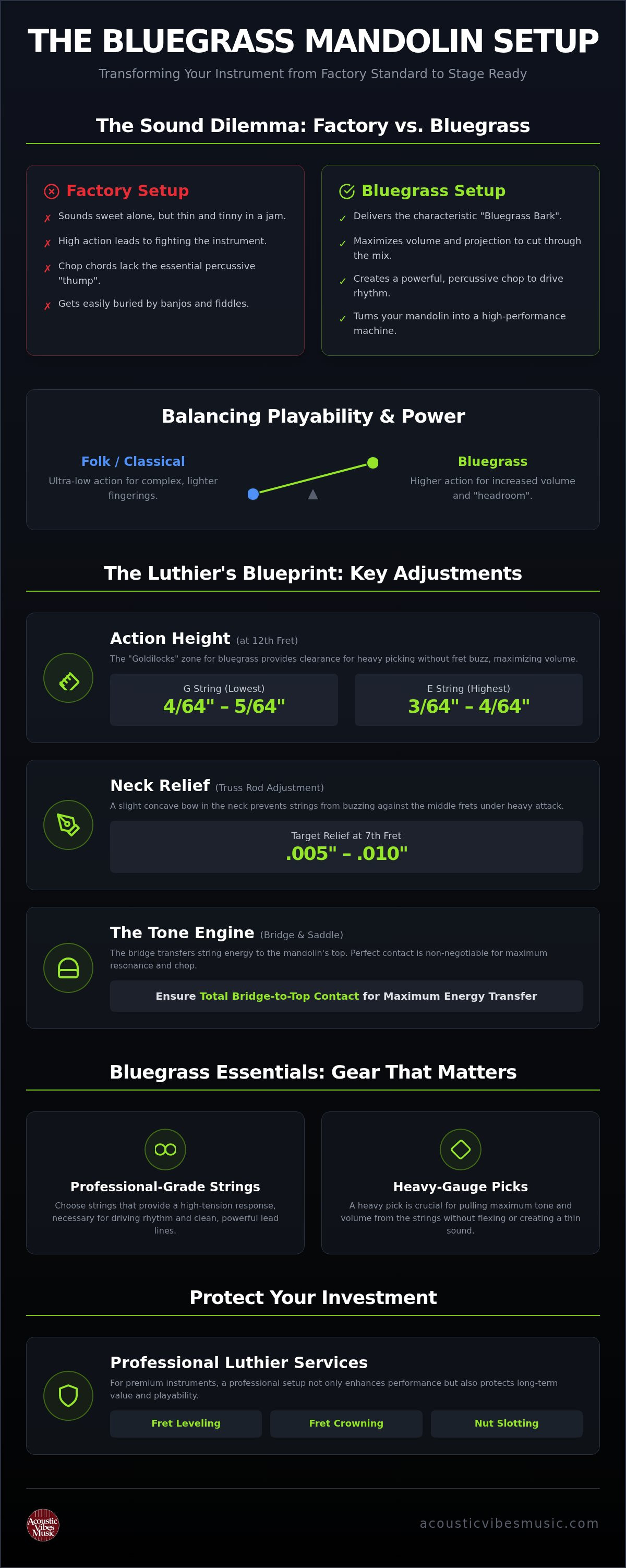
Hardware and accessories are the final variables in a professional mandolin setup for bluegrass. While the bridge and neck provide the structural architecture, your choice of strings and picks dictates how that architecture responds to your touch. These components act as the interface between your technique and the instrument's resonance. Choosing the wrong gauge or material can negate even the most precise luthier work, leaving your tone thin and your projection stifled.
Bluegrass players almost exclusively utilize medium or heavy gauge phosphor bronze strings. This isn't just tradition; it's physics. Light strings lack the necessary tension to move a thick, carved spruce top and will often "bottom out" or buzz when played with the force required in a loud jam. Phosphor bronze offers a rich, complex overtone profile that cuts through a dense acoustic mix. If you prefer a "drier," more vintage response, Monel strings are a fantastic alternative. They provide a fundamental-heavy tone reminiscent of the pre-war era. For those who play daily, coated strings offer impressive longevity, though some purists still prefer the immediate, metallic "snap" of uncoated sets. Exploring these tonal nuances is a journey similar to selecting High End Acoustic Guitars where every material choice affects the final heirloom voice.
Your pick is the most affordable performance upgrade available. In the world of bluegrass, anything thinner than 1.5mm is generally considered insufficient. Large, rounded triangle picks are the industry standard because they provide more surface area to grip during intense tremolo or fast lead lines. Using a heavy, rigid pick allows the player to effectively "drive" the mandolin top, transferring maximum kinetic energy into the soundboard for superior volume. Look for picks with hand-finished speed bevels. These pre-worn edges mimic the natural wear pattern of a seasoned professional, allowing the pick to glide off the double-course strings with minimal resistance. This small detail significantly increases both your speed and your dynamic range. Browse our curated selection of premium mandolins to find an instrument built to handle this level of professional play.
Don't overlook the tailpiece when considering a mandolin setup for bluegrass. Standard stamped metal tailpieces can sometimes rattle or flex under high tension. Upgrading to a cast tailpiece increases the mass at the base of the instrument, which often improves sustain and simplifies the string-changing process. Internally, most bluegrass mandolins feature parallel tone bars. These two braces run longitudinally and are tuned to maximize the "bark" and mid-range punch of the instrument. Understanding whether your mandolin utilizes tone bars or X-bracing helps you set realistic expectations for its natural projection and headroom.
High-end mandolins are precision-engineered marvels. While basic adjustments can be handled at home, a comprehensive mandolin setup for bluegrass on an heirloom-quality instrument requires a specialist's touch. Instruments crafted by world-renowned builders are designed to last for generations; however, they are also sensitive to tension and environmental shifts. Entrusting your instrument to a professional luthier ensures that every adjustment is made with a deep understanding of the specific graduations and bracing patterns unique to that build. It's about more than just playability. It's about preserving the structural integrity of a masterpiece.
The professional difference is most evident in the precision of the fretwork. Factory frets are rarely perfect, and even the most expensive instruments develop wear over time. A professional setup includes meticulous fret leveling, crowning, and polishing. This process eliminates dead spots and provides a smooth, frictionless surface for clean lead lines and effortless tremolo. Beyond playability, a luthier performs critical structural health checks. We inspect for loose braces or signs of top sinking, catching minor issues before they become catastrophic repairs. This proactive care maintains the resale value and tonal integrity of your boutique investment.
If you notice buzzing that persists despite adjusting your action, or if certain notes feel thuddy and lack sustain, your frets likely need expert attention. Environmental factors are also a primary concern for mandolin owners. In arid environments or regions with extreme seasonal shifts, low humidity can cause the wood to shrink. This leads to sharp fret ends, a sinking bridge height, or even structural cracks. These shifts require expert intervention to stabilize the instrument without causing permanent damage. Whether you are playing vintage treasures or modern Collings Mandolins, professional oversight is essential for long-term reliability.
We treat every instrument as a curated masterpiece. Our specialized approach to high-end mandolin setups focuses on maximizing the individual voice of each piece while tailoring the playability to your specific bluegrass style. We offer professional luthier repair services by appointment for those seeking the highest level of artisanal craftsmanship. For players across the country, we provide national luthier services with secure shipping protocols to ensure your instrument receives world-class care regardless of your location. Protect your instrument’s legacy. Schedule your maintenance appointment today to ensure your mandolin remains a high-performance machine for years to come.
Transforming your instrument from a quiet companion into a bluegrass powerhouse requires meticulous attention to technical detail. From the precision of neck relief to the absolute contact of a perfectly seated bridge, every adjustment serves the goal of maximum projection and that legendary percussive chop. We've explored how hardware choices like heavy-gauge phosphor bronze strings and rigid picks allow you to drive the top of your instrument with authority. A professional mandolin setup for bluegrass ensures your instrument isn't just comfortable to play; it becomes a reliable tool for high-performance music.
As an authorized dealer for world-renowned brands like Collings, Martin, and Taylor, we understand the artistry involved in every carved spruce top. Our expert luthier services are designed to protect your investment and optimize your tonal range. Whether you visit us in person or utilize our secure national shipping for premium maintenance, we provide the specialist care your instrument deserves. Explore Our Professional Mandolin Setup and Repair Services to experience the difference of artisanal craftsmanship. Your pursuit of quality and the joy of discovery start with an instrument that truly performs.
Standard bluegrass action at the 12th fret usually measures between 4/64" and 5/64" on the G string and 3/64" to 4/64" on the E string. While lower settings feel comfortable, these heights provide the necessary headroom for an aggressive pick attack. This prevents the strings from buzzing against the frets during a powerful mandolin setup for bluegrass. Precision is key. Use a dedicated string action gauge to ensure consistent results across both courses.
Most professional players schedule a setup twice a year to account for seasonal humidity changes. Wood is a living material that reacts to environmental shifts, which can alter your neck relief and bridge height. If you travel frequently for festivals or live in an arid climate with extreme weather shifts, more frequent checkups are advisable. Regular maintenance preserves the structural integrity and playability of heirloom instruments like those from Collings or Gibson.
Light gauge strings are rarely recommended for bluegrass because they lack the tension needed to drive a thick, carved spruce top. Under the force of a heavy pick, light strings often bottom out, resulting in a thin tone and excessive buzzing. Medium or heavy phosphor bronze sets are the industry standard. They provide the resistance and volume required to produce a clear, percussive chop that cuts through a loud ensemble during a mandolin setup for bluegrass.
Buzzing on an instrument with high action often points to uneven frets or a poorly seated bridge. If a single fret sits higher than its neighbors, it will catch the string even if the overall action is raised. Additionally, check the nut slots and the bridge base. If the bridge doesn't have total contact with the top, it can create sympathetic vibrations. A professional luthier can identify these structural issues through precise fret leveling and crowning.
Bridge material is critical for achieving the characteristic bluegrass bark. Traditional high-density ebony is favored for its ability to transfer energy rapidly while maintaining a woody, organic decay. Some modern alternatives exist, but ebony remains the benchmark for its specific mass and stiffness. A well-fitted ebony bridge ensures that the percussive snap of your chop chords is projected clearly without sounding brittle or losing the fundamental note's warmth and authority.
You likely need a truss rod adjustment if you notice buzzing in the middle of the neck or if the strings feel unusually stiff. Check your relief by holding a string at the first and 15th frets. There should be a tiny gap, roughly .005" to .010", at the 7th fret. If the neck is perfectly flat or back-bowed, it requires an adjustment to restore the necessary concave curve for clean vibration and optimal playability.
Upgrading to a cast tailpiece can subtly improve your mandolin's volume and sustain by increasing mass and reducing vibration loss. Standard stamped tailpieces are prone to flexing or rattling under the high tension of bluegrass strings. A solid cast version provides a more stable anchor point, which often results in better note separation and a clearer tonal response. It also simplifies string changes, which is a welcome benefit for any active performer or touring musician.
Use a clean, dry microfiber cloth to wipe down the body and neck whenever the strings are removed. For the fretboard, a tiny amount of specialized fretboard conditioner can be applied once a year to prevent the wood from drying out. Avoid household cleaners or excessive moisture, as these can damage the delicate nitrocellulose finish found on premium instruments. Keeping the hardware free of sweat and oils prevents premature corrosion and maintains the instrument's luster.