My shopping cart
Your cart is currently empty.
Continue ShoppingA humidity reading across the room may not reflect what your guitar experiences inside its case. Seasonal shifts, heating, and air conditioning can change conditions around an instrument, while a reading in another part of the room may miss those local differences. Maintaining consistent guitar humidity doesn’t mean chasing a perfect number. It means measuring near the instrument, tracking changes, and responding thoughtfully.
Both dry air and excess moisture are worth taking seriously. Acoustic guitars are built from wood that expands and contracts as it absorbs or releases moisture, and either extreme can affect playability and condition. A relative humidity reading of 45% to 55% is a commonly recommended target, with 40% to 60% often treated as a broader acceptable range. Your guitar maker’s care guidance is also an important reference.
This guide explains how to measure humidity where your guitar is stored, compare room and case-based control, and build a routine for seasonal changes. You’ll also learn which signs may point to a humidity issue and when a professional assessment can help protect your instrument’s feel, sound, and craftsmanship.
Stable conditions support predictable playability and careful long-term maintenance. A guitar kept in a reasonably steady environment is less likely to experience abrupt changes in how its wood responds, though a humidity reading alone can’t guarantee a particular outcome. The goal is to understand the conditions around your instrument, notice meaningful shifts, and follow care guidance suited to its construction.
Wood exchanges moisture with the surrounding air. As indoor conditions change, it may gradually take on or release moisture, which can affect how an acoustic guitar feels or plays. That doesn’t prove humidity is the cause of a change. Setup, construction, storage habits, and other factors also matter.
Relative humidity is the amount of moisture in the air compared with the maximum amount that air can hold at the same temperature. It’s expressed as a percentage and is separate from temperature. For a foundation on the term, see Understanding Humidity.
Indoor readings can shift with the seasons and with heating or air conditioning. Conditions may also differ near a window, vent, or guitar case. A room reading is useful context, but it doesn’t diagnose the wood’s moisture condition or the guitar’s health.
Wood responds gradually to changes in moisture. That movement may influence how an acoustic guitar feels under the hands or how its setup behaves, particularly when environmental conditions fluctuate. Instruments don’t all respond identically: construction, materials, storage, and the maker’s care recommendations all affect what’s appropriate.
That’s why maintaining consistent guitar humidity is a measured care habit, not a promise that one reading suits every instrument. Check the guidance for your guitar and monitor conditions where it’s stored. If the room reading looks steady but the guitar feels different, consider the local storage environment and other possible causes before drawing conclusions.
Consistency matters more than reacting to every small change. Track readings over time and use the pattern to guide sensible care. A hygrometer measures the air around it. It can’t tell you by itself whether the guitar needs adjustment or repair.
A change in how your guitar feels is worth noticing, but it doesn’t identify the cause. Wood may respond to environmental shifts, and changes in action, fret feel, or appearance can offer clues. Similar symptoms can also come from setup changes or structural concerns. Consider the instrument alongside its storage conditions rather than treating it as a humidity gauge.
A humidity clue is an observation; a luthier-confirmed diagnosis identifies what’s actually causing the change. A hygrometer measures the air where it sits, while a luthier can assess the guitar itself. Don’t treat one reading or symptom as proof that the instrument is too dry or too damp.
In drier conditions, some owners notice sharper-feeling fret ends, a change in string height or buzzing, or a top that looks less rounded. These are possible indicators, not definitive diagnoses. Setup, string choice, and other changes can also affect playability. Use the maker’s care guidance rather than applying a universal threshold.
Record what you notice and when. For example, note whether fret ends began to feel rough after the heating season started, whether the guitar was stored in its case, and what the humidity reading was near its usual storage place. A timeline helps distinguish a pattern from a one-off reading and gives a luthier useful context if you seek an assessment.
With increased moisture or a sharp change in conditions, an instrument may feel harder to play, its action may seem higher, or the top and back may look more pronounced. A muted tonal response may also prompt a closer look. None of these observations proves excess humidity. Setup, strings, and other structural factors can produce similar impressions.
Don’t add moisture just because the guitar feels different. Take a fresh reading near its storage place and compare it with the maker’s recommendations first. Adding moisture without evidence of dry conditions may move the environment further from what the guitar needs. Measured adjustments are more useful than reacting to a symptom in isolation.
Seasonal variation can coincide with a gradual change in feel. A persistent change, a sudden shift in playability, or a visible structural concern deserves attention, especially if it remains after you’ve reviewed the storage conditions. Don’t try to diagnose cracks, bridge movement, or other structural changes from humidity alone. A professional assessment can help distinguish an environmental influence from a setup or repair issue.
Careful observation is part of maintaining consistent guitar humidity, but it isn’t a substitute for examining the instrument. If a change persists or worries you, professional guitar assessment can help clarify the next step.
The right setup depends on where your guitar is stored. A guitar kept in its case may experience different conditions from one left out in a room, so a room reading alone may not represent the air around the instrument. For maintaining consistent guitar humidity, consider your storage habits, how conditions change, and how regularly you can monitor them.
Room humidification
May suit a regularly used room or a space where several instruments are stored. It can help manage the broader environment, but room size, heating or air conditioning, and open doors may affect consistency. Monitor conditions near the guitars, not only beside the humidifier.
Case-based control
May suit a guitar that’s usually stored in its case or when you want to focus care around one instrument. It creates a more contained environment than treating the whole room, but you’ll still need to monitor conditions near the guitar and follow the maker’s directions for any product used.
Room and case together
May suit a guitar stored in a room with seasonal swings when you also want to manage the environment around a cased instrument. This approach adds another layer to monitor. Follow maker guidance and avoid adjustments you can’t measure.
If you regularly play or store several instruments in one room, managing the room’s conditions may be a practical starting point. Consider the whole space: HVAC operation, room size, and doors opening to other areas can all affect consistency. Take readings where the guitars are kept and observe how conditions change during normal use.
A case can help create a more contained environment around one guitar, making this approach worth considering if you put the instrument away between playing sessions. It focuses care on that instrument rather than the whole room, but it doesn’t remove the need to monitor conditions. Follow the guitar maker’s instructions for any case-based humidity product.
Use this decision guide:
There’s no single setup for every guitar or storage routine. Use the maker’s care recommendations as your reference, then choose the method you can monitor consistently. For a related perspective on selecting an instrument to cherish, see High End Acoustic Guitars for Sale: The Collector’s Guide to Heirloom Quality.
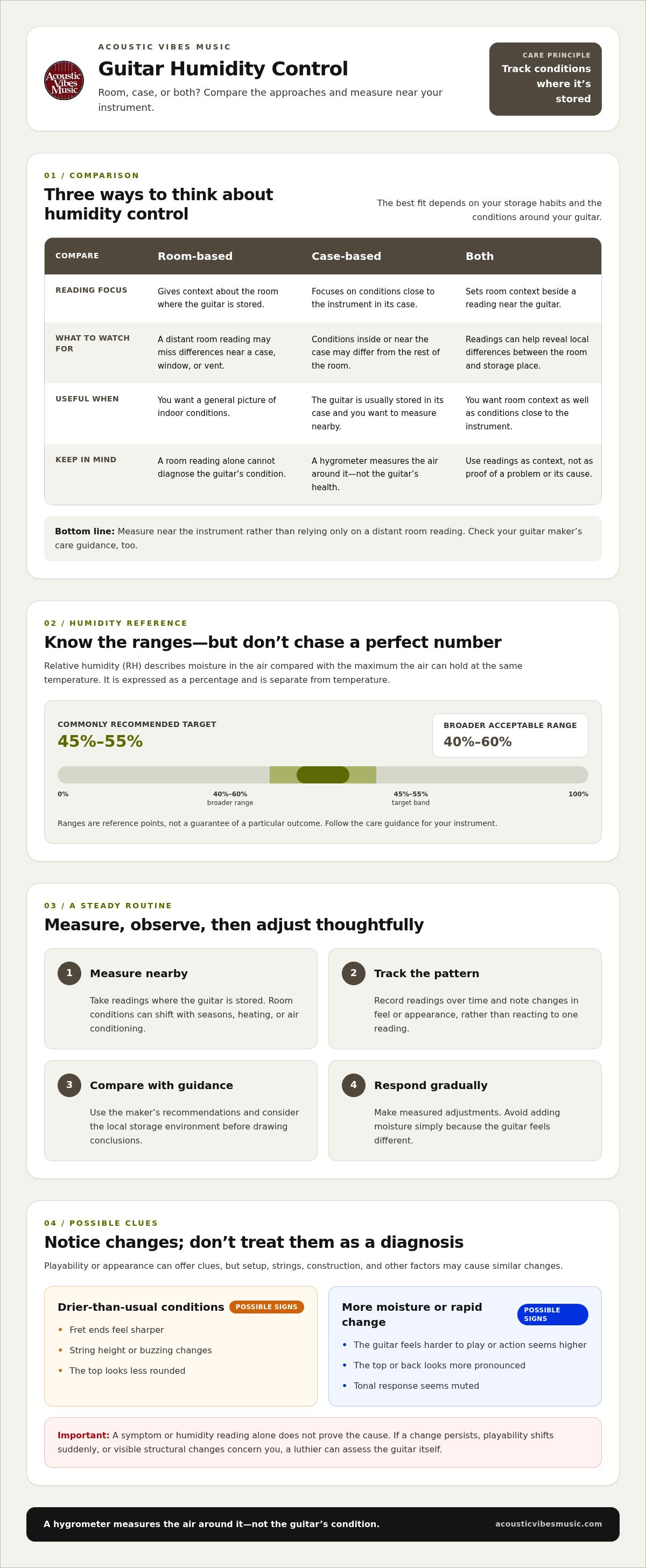
A dependable routine turns occasional readings into useful context. Measure near the guitar, record the result, compare the pattern with the maker’s care guidance, and make any needed adjustment gradually. Then reassess before changing course again. This helps you avoid reacting to one fluctuation or making an abrupt correction that may not suit the instrument.
Place a hygrometer by the guitar, record stabilized readings over time, compare them with maker guidance, adjust conditions gradually, and reassess.
Position the hygrometer near the guitar’s case or usual storage spot, following the device’s instructions for placement and use. A display across the room can provide context, but it may not reflect conditions inside a case or beside the instrument. Let the reading stabilize as directed, then record it consistently.
A simple log can include the date, reading, whether the guitar was cased, and any relevant change in room conditions, such as heating or air conditioning. Trends are more useful than one isolated number. If a reading seems implausible, review the hygrometer’s instructions and the guitar’s care guidance before acting on it.
Use your observations and the instrument maker’s recommendations to decide whether an adjustment is appropriate. If conditions call for a change, make it gradually rather than adding or removing moisture abruptly. Recheck the reading and observe the pattern and the guitar’s response over time. Avoid stacking control methods or making repeated changes before you understand their effect.
Follow the instructions for any humidity-control device you use. The right approach depends on whether the instrument is stored in a case or exposed in the room, and on how readings behave in that location. Keep the measurement point consistent so comparisons remain meaningful. A reading beside the guitar one day and across the room the next may not show a true change in its storage conditions.
Routine monitoring can guide environmental care, but it can’t confirm the cause of a structural concern. If you notice persistent or sudden changes around the bridge, body, or other structural areas, don’t keep adjusting humidity in an attempt to diagnose them. A luthier can assess the instrument directly. For context on repair considerations, see Acoustic Guitar Bridge Repair Cost: 2026 Guide to Finding the Right Luthier.
Building a repeatable habit is the practical heart of maintaining consistent guitar humidity. If a structural concern needs a closer look, arrange a professional guitar assessment with Acoustic Vibes Music.
Routine observation is useful when a guitar’s feel shifts gradually and there’s no visible structural concern. Note the change, review the conditions where the instrument is stored, and compare readings over time with the maker’s care guidance. If the change persists, appears suddenly, or involves a visible concern, a luthier’s assessment is a sensible next step.
A humidity reading describes the air at the measuring point. It can’t confirm why the action changed, whether a crack is active, or whether bridge movement indicates a repair issue. These observations need context, not a diagnosis based on one number. Don’t assume every playability change comes from humidity or that adjusting the environment will resolve a structural problem.
Before arranging an assessment, note what you’ve observed. Record when the guitar began to feel different, where it was stored, and whether its storage routine or room conditions changed. Add recent hygrometer readings and describe any visible concerns plainly. These details provide context, but they don’t replace an in-person examination.
Keep observations factual. “The strings began buzzing after the room’s conditions changed” is more useful than concluding that humidity caused the issue. A luthier can assess the instrument directly and consider these details alongside its construction and condition.
If you’re uncertain about the cause, pause aggressive humidity adjustments instead of making repeated changes in response to symptoms. Continue monitoring the storage environment and follow the maker’s recommendations, but don’t try to repair a crack, bridge, or other structural area yourself. Persistent or concerning changes call for hands-on evaluation.
Acoustic Vibes Music provides professional stringed-instrument repair and maintenance by appointment. An assessment can help clarify the instrument’s condition and what attention may be appropriate, without assuming the humidity reading tells the whole story. Thoughtful care includes knowing when observation is enough and when a skilled assessment can offer a clearer picture.
If your guitar still feels different or a visible change concerns you, Explore Acoustic Vibes Music and take the next step toward professional instrument care.
Good care doesn’t need to become complicated. Choose one habit you can keep, such as noting a reading when you check your guitar or observing how it feels each time you bring it out to play. Over time, these observations can help you make informed choices about maintaining consistent guitar humidity instead of reacting to every change.
If you’re considering a new instrument, the same attention to care can shape what you look for in a guitar. Acoustic Vibes Music offers a curated selection of new and used acoustic guitars, each with its own character, feel, and craftsmanship.
Explore the instruments and expertise at Acoustic Vibes Music. Keep learning your guitar’s needs, trust careful observation, and enjoy the music you make along the way.
Yes. A room humidifier isn’t the only option for maintaining consistent guitar humidity. If you usually keep one guitar in its case, case-based control may be more practical. Room control may suit a space where several instruments are stored. If you move your guitar between a case and a stand, take readings near both storage spots. Follow the guitar maker’s care instructions and don’t add moisture without checking conditions first.
A brief reading outside your usual range doesn’t, by itself, mean the guitar is damaged or unsafe. Check that the hygrometer is positioned near the instrument and follow its instructions before interpreting the result. Note whether the reading returns to its typical pattern or stays unusual, and consider recent changes such as moving the guitar or changing its storage location. If the instrument develops persistent or concerning symptoms, arrange a luthier’s assessment.
Check often enough to notice meaningful changes where the guitar is stored, particularly as heating, air conditioning, or seasonal weather shifts. A regular check during your usual instrument-care routine can be easier to maintain than reacting to every brief fluctuation. Keep a dated log so you can compare readings over time. Let the hygrometer’s instructions and the guitar maker’s care recommendations guide your routine.
A car can expose an acoustic guitar to conditions very different from a stable indoor space, so avoid leaving it there for extended periods. A humidity reading alone can’t tell you the full temperature-related risk. If your guitar has been exposed to extreme conditions, move it to a stable environment and allow it to return gradually rather than making abrupt changes. Watch for persistent changes in feel or appearance, and seek an assessment if you’re concerned.
They can coincide with a change in feel, but buzzing or altered action doesn’t identify humidity as the cause. A recent string change or setup issue may also affect playability. Note which strings buzz, when you first noticed it, and where the guitar has been stored. Avoid making structural adjustments based only on a humidity reading. If the problem continues or worsens, have a luthier assess the instrument.
Shipping can expose a guitar to changing conditions, so careful packing and gradual acclimation after arrival are sensible. Follow the maker’s shipping and care guidance, and avoid moving the instrument straight from one extreme environment into another. Once it has had time to adjust gradually, observe how it plays and looks. If structural or playability concerns persist, record what you notice and arrange a professional assessment rather than attempting a repair yourself.