My shopping cart
Your cart is currently empty.
Continue ShoppingIs your dream guitar hiding behind a shimmering wall of overtones, or is it the punchy, dry clarity of a focused midrange that truly moves you? When you're ready to invest in a legacy instrument from builders like Collings or Boucher, the choice between mahogany vs rosewood back and sides becomes the most critical decision in your journey. It's completely natural to feel overwhelmed by subjective labels like "warm" or "bright" when you're looking at a premier instrument and wondering if it will actually cut through your bluegrass jam or sit perfectly in a studio mix.
We understand that at this level of craftsmanship, you aren't just buying wood; you're selecting a structural EQ profile for your music. This guide provides a clear framework to help you choose the right tonewood based on your specific playing style and genre. We'll explore the famous fundamental versus overtone debate and examine how world-class luthiers at Martin or Gibson manipulate these materials to create distinct voices. By the end, you'll have the confidence to select a boutique instrument online, knowing exactly how it will respond the moment it arrives at your door.
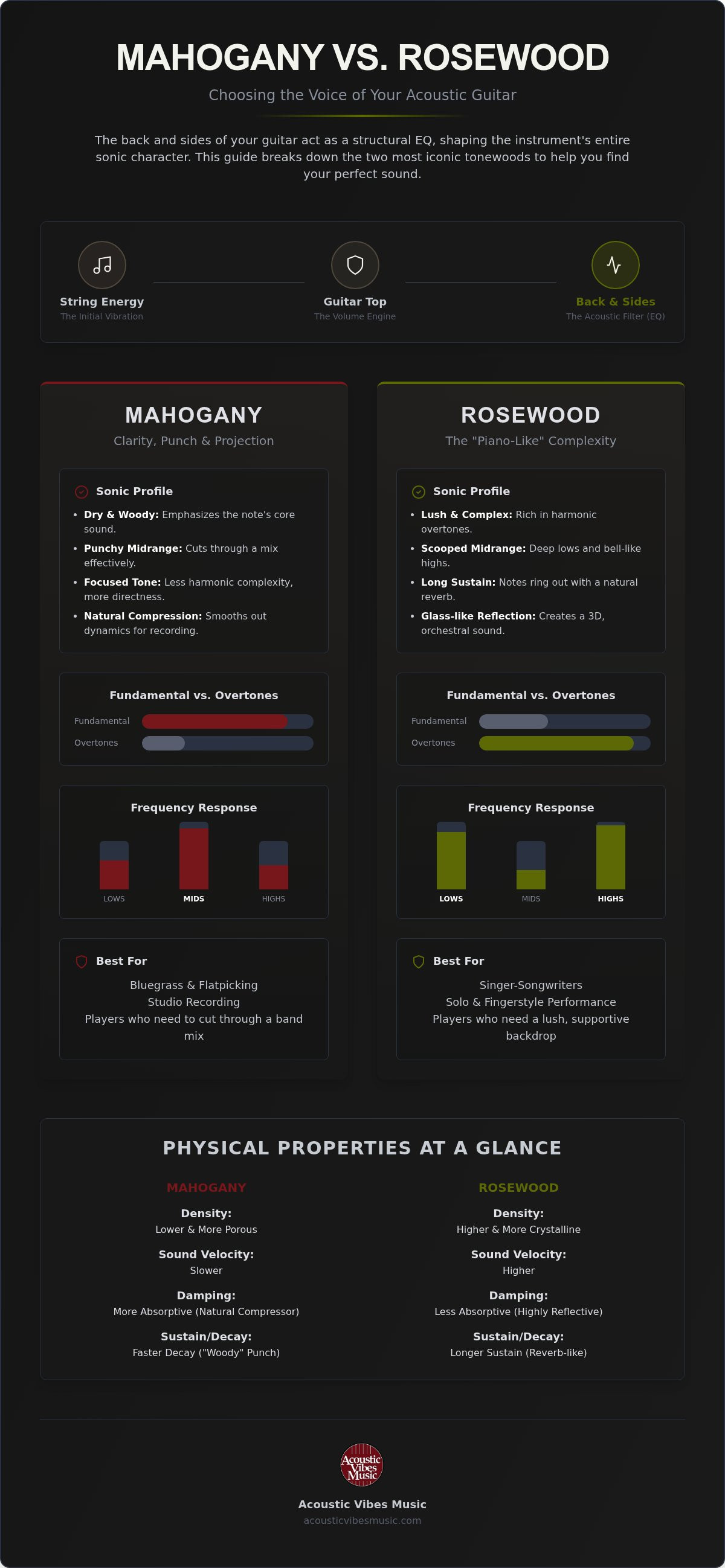
Think of your guitar's top as the engine that generates volume, while the back and sides act as the acoustic filter or "soundbox" EQ. This structural component dictates how the energy from the strings is shaped before it reaches your ears. To understand this, we first need to ask: What is Tonewood? In essence, it's the selection of timber based on its unique vibrational properties. Choosing between mahogany vs rosewood back and sides means you're selecting how that energy is managed. Rosewood is glass-like and highly reflective, bouncing sound waves back with minimal loss. Mahogany is more porous and slightly more absorptive, acting like a natural compressor that focuses the sound into a punchy midrange.
The "velocity of sound" refers to how quickly vibrations travel through the grain. Denser woods typically have a higher velocity, which translates to a more immediate projection and a broader frequency response. When you play a high-end instrument from builders like Collings Guitars or Boucher Guitars, you're hearing the result of how these specific densities interact with the air inside the body. It's a delicate dance of physics and artistry.
The fundamental is the primary, strongest frequency of the specific note you plucked. Overtones are the secondary, higher frequencies that ring out alongside that note, creating what we perceive as "shimmer" or "harmonic complexity." This distinction is the most vital factor in your decision. If you prefer a clean, direct sound where each note stands alone, you're looking for a wood that emphasizes the fundamental. If you want a lush, "reverb-soaked" soundscape where notes bleed into one another beautifully, you're chasing overtones. This choice defines your entire sonic identity as a player.
Wood density directly influences how long a note rings before it fades. Rosewood is significantly heavier and denser than mahogany, which gives it a higher velocity of sound and incredible sustain. It resists internal damping, meaning the wood doesn't "soak up" the vibration as quickly as softer materials. In contrast, mahogany’s lower density provides a faster decay. This creates the famous "woody" punch that recording engineers love. Master luthiers use "tap-tuning" to shave braces and thin these plates, finding the perfect balance between the wood's natural weight and its musical responsiveness. This ensures that even a dense rosewood guitar remains lively and resonant rather than tight or choked.
Rosewood has long been celebrated as the "piano-like" tonewood, offering a frequency response that feels vast and orchestral. The choice of mahogany vs rosewood back and sides is often the first major crossroad for a serious collector. While our previous section explored the physics of reflection, the emotional impact of this wood is where the magic happens. It delivers a deep, resonant low-end growl you can feel in your chest. Bell-like highs complement this, shimmering with a distinctive clarity. This creates a "scooped" midrange profile. By pulling back the middle frequencies, rosewood leaves a natural "pocket" for the human voice to sit. This makes it an exceptional choice for singer-songwriters who want their guitar to provide a lush, supportive backdrop.
The aesthetic beauty of these instruments is just as compelling as their voice. East Indian Rosewood is the industry standard, prized for its straight grain and reliable, dark chocolate hues. For the collector seeking the pinnacle of rarity, Brazilian Rosewood offers a wild, "spider-web" grain and a glass-like resonance that is increasingly difficult to source. Cocobolo provides a denser, heavier alternative with striking orange and red streaks, often producing an even more aggressive low-end response. When weighing mahogany vs rosewood back and sides, the sheer visual and sonic gravity of rosewood often tips the scales for those seeking an investment-grade masterpiece.
Playing a rosewood guitar feels like performing in a natural concert hall. Because the wood is so dense and reflective, it creates a three-dimensional soundstage where notes bloom and sustain far longer than other woods. This creates a natural reverb effect. Some enthusiasts describe the tone as "metallic" due to its high-frequency sparkle, while others find it deeply organic. It's a complex, sophisticated sound that reveals new layers of harmonic detail the more you play.
Solo performers and fingerstyle enthusiasts often consider rosewood the "Holy Grail." The extra sustain allows slow, melodic lines to hang in the air with a haunting quality. It provides a "fullness" that makes a single guitar sound like a small ensemble. However, this complexity requires careful management. In a dense recording mix or a loud bluegrass band, the heavy overtones can sometimes become "muddy." If you value harmonic richness and a wide, cinematic sound, browse our selection of rosewood Collings guitars to experience this legendary depth for yourself.
While rosewood is often celebrated for its lush complexity, mahogany is the wood of choice for those who value absolute clarity and mid-range authority. It's a common misconception that mahogany is merely a more affordable alternative to rosewood. In reality, many of the world's most discerning players choose it for its "dry," "woody," and "direct" character. When evaluating mahogany vs rosewood back and sides, you're choosing between the orchestral shimmer of the former and the focused, punchy honesty of the latter. Mahogany doesn't hide behind a wall of overtones. It presents the note exactly as you played it, making it a favorite for those who want their technique to shine through.
Recording engineers frequently refer to mahogany as the "king of the recording studio." This reputation comes from its natural compression and lack of harmonic clutter. Because it emphasizes the fundamental frequency of the note rather than a cloud of overtones, it sits perfectly in a track without needing heavy equalization. It provides a strong mid-range presence that cuts through a dense arrangement with ease. This "honesty" is why so many iconic records were tracked using mahogany instruments. They provide a solid foundation that never competes for space with other instruments or vocals.
The term "dry" in the guitar world refers to a sound with minimal harmonic sustain after the initial attack. This is tied to "decay," or how quickly a note fades. Mahogany's faster decay is a massive advantage for fast, technical playing. Bluegrass flatpickers rely on this "punch" to ensure every 16th note remains distinct and clear. If you're playing rapid-fire runs, you don't want the previous note's overtones washing over your current one. This fundamental focus is the hallmark of the "vintage" sound that defined American acoustic music throughout the mid-20th century. It offers a transparency that allows the character of the player to take center stage.
Singer-songwriters often find that mahogany is their most reliable stage companion. It provides a woody warmth that supports a vocal performance without overwhelming it. Unlike rosewood's "scooped" mids, mahogany fills that space with a supportive, earthy texture. No instrument embodies this legacy better than the Martin D-18. This legendary model has been a cornerstone of folk, country, and rock for decades, prized for its ability to project with power and precision. If you are looking for that classic, fundamental-driven voice, explore our curated Martin Guitars collection to find your own piece of history.
Selecting the right instrument requires looking at the sum of its parts rather than just a single spec sheet. The interaction between body shape and timber is where your personal sound is born. A rosewood Dreadnought provides a massive, cinematic low-end that can feel like a private orchestra. However, if you put that same rosewood on a smaller OM body, you get a focused, intimate instrument with shimmering harmonics. When comparing mahogany vs rosewood back and sides, remember that body volume acts as an amplifier for the wood’s natural EQ. Smaller bodies tend to balance out rosewood’s bass, while larger bodies maximize mahogany’s punch.
Your vocal range and playing technique should also guide your hand. Aggressive strummers often prefer the "honesty" of mahogany to prevent the sound from becoming a wash of overtones. Fingerstyle players, conversely, usually gravitate toward rosewood to fill the space between notes with natural resonance. Consider your own voice. If you have a deep, baritone range, the scooped mids of rosewood leave room for your vocals to breathe. If your voice is higher or thinner, the mid-range punch of mahogany provides a necessary foundation. In 2026, the performance gap is narrowing as builders get better at voicing. While rosewood still commands a higher price due to material scarcity, mahogany is no longer seen as a "budget" option but as a specific tonal preference for the connoisseur.
Bluegrass players need the "cut" of mahogany to be heard during a lead break without getting lost in the mix. Modern fingerstyle enthusiasts thrive on rosewood’s ability to sustain complex, harp-like harmonics. For the blues, the raw, mid-heavy bark of a mahogany small-body guitar is unmatched. Each genre demands a different response from the soundbox. When you evaluate mahogany vs rosewood back and sides, think about the "sonic space" you need to occupy. Do you need to fill the room alone, or do you need to pierce through a band?
The top wood is the engine. Pairing a stiff Adirondack spruce top with mahogany creates a high-headroom powerhouse. Using Sitka spruce tends to mellow the response. We see this masterfully executed in Boucher Guitars, where torrefied tops are paired with premium mahogany to create a "vintage-plus" tone. This torrefaction process mimics the cellular breakdown of aged wood, providing an immediate, broken-in feel. For a deeper dive into these combinations, read our Adirondack vs Sitka Spruce Guide.
Ready to hear the difference for yourself? Explore our curated gallery of world-class acoustics and find the wood profile that matches your musical soul.
The choice of mahogany vs rosewood back and sides often begins with the legendary rivalry between the Martin D-18 and the D-28. These two models defined the American acoustic voice for a century. The D-18, with its mahogany construction, offers a dry, fundamental-heavy punch that became the backbone of folk and bluegrass. In contrast, the D-28 provides the orchestral depth and lush overtones that rosewood is famous for. While Martin set the standard, modern boutique builders have taken these wood profiles to new heights through brand-specific voicing techniques. They don't just use the wood; they curate its response.
For example, Collings Guitars is renowned for bringing a surgical clarity to their instruments. Even their rosewood models, which are naturally rich in overtones, maintain a string-to-string definition that is rare in the industry. Similarly, the "Boucher sound" relies on pairing high-grade Adirondack spruce with these woods. By using master-grade tops, Boucher creates mahogany guitars with incredible headroom and rosewood models with a deep, resonant growl that never loses its focus. This brand-specific approach means a mahogany guitar from one builder can sound vastly different from another.
Selecting a boutique instrument means moving beyond standard factory specifications. Custom Shop wood selection involves hand-tapping sets to ensure they meet strict density and resonance requirements. In 2026, these instruments are increasingly viewed as investment-grade assets. They hold their value because of the rarity of the materials and the artisanal skill involved in their construction. If you're building a collection, understanding these nuances is essential for choosing a piece that will age beautifully. For more on this, explore our Collector's Guide to Heirloom Quality Acoustics.
Owning a premium tonewood guitar comes with a responsibility to maintain its environment. Rosewood, being particularly dense and oil-rich, can be sensitive to rapid humidity changes during national shipping. We take this seriously. Every instrument at Acoustic Vibes Music undergoes a rigorous inspection and a professional luthier setup before it leaves our shop. We use expert packing techniques to ensure your mahogany or rosewood masterpiece arrives in perfect playing condition. Whether you choose the woody punch of a mahogany dreadnought or the piano-like shimmer of a boutique rosewood OM, our national shipping process is designed to protect your investment from door to door.
Choosing your ideal instrument is a deeply personal milestone in any player's journey. Whether you're drawn to the woody punch of a mahogany flat-top or the orchestral shimmer of a rosewood masterpiece, understanding the nuances of mahogany vs rosewood back and sides ensures you make an investment that resonates for a lifetime. Remember that the right wood choice acts as a structural EQ, shaping your music to perfectly match your vocal range and playing style. At Acoustic Vibes Music, we curate only the finest examples of these tonewoods from legendary builders like Martin, Collings, and Boucher.
As an authorized dealer for the world's most prestigious brands, we provide more than just an instrument; we offer a gateway to premium craftsmanship. Every guitar in our collection includes a professional luthier setup to guarantee perfect playability the moment it arrives. We specialize in expert national shipping with climate-controlled considerations, so you can purchase with absolute confidence. Explore our curated collection of Mahogany and Rosewood masterpieces today and discover the voice you've been searching for. Your next heirloom-quality instrument is waiting to be discovered.
Neither is objectively better because they serve different musical roles. Rosewood offers a complex, lush sound with shimmering overtones, while Mahogany provides a punchy, fundamental-focused clarity. Your choice depends on whether you want an orchestral, reverb-like sustain or a dry, direct response that cuts through a mix. Both are premium choices used in world-class instruments from builders like Collings, Martin, and Boucher.
Price differences are primarily driven by scarcity and international trade regulations. Many rosewood species, such as Brazilian or Cocobolo, are protected or harder to harvest sustainably compared to mahogany. This rarity increases the cost of raw materials for luthiers. Additionally, rosewood's extreme density makes it more challenging to work with during the building process. These factors contribute to the higher investment value of rosewood instruments in today's market.
Both woods are incredibly durable and can last for generations when properly humidified. Rosewood is naturally denser and more resistant to physical wear, but it's also more prone to cracking if exposed to rapid humidity drops. Mahogany is slightly more stable but softer. As long as you maintain a consistent environment and utilize professional luthier services for regular setups, either tonewood will serve as a reliable, lifelong heirloom.
Mahogany is often called the king of the recording studio because of its natural compression and lack of harmonic clutter. Its focused midrange allows it to sit perfectly in a track without competing with vocals or other instruments. Rosewood can sound magnificent in solo recordings where its deep bass and shimmering highs provide a full, cinematic soundstage. Most engineers prefer mahogany's honesty for dense, multi-instrument arrangements.
Yes, the sonic signatures of mahogany vs rosewood back and sides are distinct enough for even an untrained ear to notice. You don't need years of experience to hear the difference between the woody punch of a Martin D-18 and the bell-like shimmer of a D-28. We encourage newcomers to listen for the sustain and the reverb effect in rosewood compared to the immediate, dry attack of mahogany.
The top wood acts as the engine, while the back and sides act as the EQ. A stiff Adirondack spruce top can add headroom and power to the dry clarity of mahogany, creating a bluegrass powerhouse. Conversely, a torrefied Sitka spruce top can mellow out the aggressive overtones of rosewood, making it more balanced. The interaction between these components is what defines the final character of a boutique instrument.
Brazilian Rosewood is widely considered the Holy Grail due to its glass-like resonance and unparalleled harmonic complexity. However, best is subjective. While its rarity and historical significance make it highly desirable for collectors, many modern players prefer the reliability of East Indian Rosewood or the punchy projection of Mahogany. Builders like Boucher and Collings achieve incredible results with various woods by masterfully voicing each specific set of timber.
Singer-songwriters often gravitate toward mahogany because its strong midrange supports the human voice without overwhelming it. It provides a warm, earthy foundation that stays out of the way of your lyrics. However, if you perform solo and want your guitar to sound like a full orchestra, rosewood's scooped mids and deep lows provide a lush backdrop. Your specific vocal range should ultimately guide your final selection of tonewood.