My shopping cart
Your cart is currently empty.
Continue ShoppingWhat if that "mint condition" 1954 Martin D-28 you're eyeing for $22,000 is actually a $500 counterfeit disguised with a masterfully aged finish? With the vintage market projected to reach $3.5 billion by 2035, the incentive for sophisticated "super-fakes" has never been higher. It's natural to feel a sense of anxiety when inspecting a high-stakes instrument, especially when the vintage acoustic guitar restoration process can sometimes blur the lines between an honest repair and a deceptive modification. You want to believe the seller's story, but the shifting specs across different manufacturing eras often feel like a moving target.
We've designed this expert-led checklist to help you master the art of high-end acoustic guitar authentication and protect your investment. You'll gain a clear set of physical markers to check, from internal bracing patterns to era-specific headstock logos. This guide provides the confidence you need to walk away from a suspicious deal and helps you recognize exactly when to seek a professional, in-depth appraisal for your next potential heirloom.
High-end authentication is a meticulous forensic exercise. It involves verifying every component, from the specific grain of the Sitka spruce to the chemical composition of the nitrocellulose lacquer. For a collector, this means ensuring the brand, era-correct specifications, and original parts all align perfectly. When these elements are misrepresented with the intent to deceive, it falls under the legal definition of forgery. Knowledge of the vintage acoustic guitar restoration process helps an expert distinguish between a well-loved heirloom and a modern deception.
Iconic brands like Martin and Gibson remain the primary targets for counterfeiters. Their instruments are more than just tools; they are appreciating assets. The "Chibson" phenomenon, once limited to cheap electric knockoffs, has aggressively moved into the acoustic market. These "super-fakes" often replicate the outward appearance of a pre-war flat-top with startling accuracy. However, they lack the structural integrity and tonal magic found in a genuine build.
The financial impact of a mistake is devastating. A counterfeit has zero resale value in the collector market. Buying one doesn't just result in a poor-sounding guitar; it represents a total loss of your investment capital. Authenticators look for the vintage acoustic guitar restoration process markers, such as hide glue residue or specific chisel marks, to confirm an instrument's lineage and justify its market price.
Legality hinges on intent and branding. A fake uses a stolen logo to trick a buyer. A replica or "tribute" model, however, celebrates a classic design without deceptive labeling. Boutique builders like Collings create instruments inspired by pre-war blueprints, but they proudly display their own name. These are high-performance machines with their own market value. High-end replicas can hold significant worth, provided they are disclosed as non-original from the start.
Market data is your best defense. In 2026, a 1954 Martin D-28 typically commands between $18,000 and $26,000. If you find one listed for $4,000, alarm bells should ring immediately. Unrealistic pricing is the most common indicator of a potential scam. Always compare a potential purchase against a curated guitar collection from a reputable dealer. Real-world benchmarks provide the grounding you need to spot a deal that is simply impossible.
The first glance at a high-end acoustic should be an experience of absolute precision. When Counterfeit guitars flood global markets, the exterior features are your first line of defense. Start with the headstock. On a genuine Martin, the headstock isn't a uniform block. It features a subtle taper, becoming thinner as it moves toward the top. Many counterfeiters miss this three-dimensional nuance. They produce flat, blocky profiles that lack the elegance of the original craftsmanship.
Next, look at the finish. High-end instruments use nitrocellulose lacquer. This material is thin and porous; it breathes with the wood. Over decades, it develops "checking," which is a series of fine, spider-web lines. Modern polyester finishes used on fakes are thick and glass-like. They don't check; they shatter or peel. If you're looking at an "old" guitar with a mirror-perfect, thick plastic coating, you're likely looking at a fake. This distinction is vital when evaluating the vintage acoustic guitar restoration process, as a true restoration respects the original finish chemistry.
Check the bridge material. It should be solid ebony or rosewood, never painted or dyed. You can often see the natural, tight grain of the wood. If the black color looks "painted on" or perfectly uniform without grain, it's a major red flag. Real quality is felt as much as it's seen.
Logo execution is a common "font fail" for counterfeiters. Vintage logos transitioned from simple decals to complex mother-of-pearl inlays. Examine the edges of the inlay carefully. On a premium Gibson, the logo is crisp. Fakes often show "ghosting," which is a hazy outline or visible filler around the inlay. Premium builders also spray the final lacquer over the logo, creating a seamless, integrated look that cheap knockoffs rarely replicate.
The tactile details often reveal the truth. High-end guitars use genuine bone or specialized composites like Tusq for the nut and saddle. Plastic is a sign of a budget build. Check the tuners. Are they period-correct Waverly or Grover units? Understanding the vintage acoustic guitar restoration process is key here; a replaced tuner should still match the footprint and style of the original era. Finally, try the smell test. Nitrocellulose has a distinct, sweet, almost vanilla-like scent that lingers for years. If the guitar smells like industrial chemicals or nothing at all, proceed with caution. If you want to see how these details look on verified instruments, take a look at our curated guitar collection for a gold-standard comparison.
While the exterior might fool a casual observer, the interior of a guitar tells the unvarnished truth. Grab a luthier's mirror and a high-intensity light. You're looking for the soul of the instrument. The vintage acoustic guitar restoration process often leaves breadcrumbs inside the body; a professional, high-end repair will be tidy and surgical, but a counterfeit usually shows sloppy glue squeeze-out and rough-sawn wood. Every surface should feel intentional.
Inspect the kerfing, the notched wood lining that joins the sides to the top and back. In a premium instrument, this should be perfectly uniform and free of excess adhesive. Look for the brand-specific stamps. A genuine Martin, for instance, features a crisp "C.F. Martin & Co, Nazareth, PA" impression burned into the wood. Counterfeiters often use ink stamps or poorly engraved plates that lack the depth and character of a traditional steel-die strike. If the internal markings look like they were applied as an afterthought, they probably were.
The neck block is the structural heart of acoustic authentication. It's the solid piece of mahogany where the neck meets the body, and it carries the instrument's identity. Always cross-reference the serial number with official manufacturer databases to ensure the age matches the build specs. Be wary of "re-stamped" blocks. If the wood grain around the serial number looks sanded or the font appears inconsistent with other models from that year, the instrument may have undergone an undisclosed neck reset or a major structural overhaul during a vintage acoustic guitar restoration process that was intended to deceive.
Bracing is the secret architecture of a master luthier. Forward-shifted bracing, where the X-brace intersects closer to the soundhole, provides a different tonal response than rear-shifted patterns. Counterfeiters rarely invest the time to hand-scallop these braces or use premium materials like Adirondack spruce. They rely on machine-cut, heavy wood that kills the vibration. A true high-end build displays an internal cleanliness that mirrors its external beauty. Every shave of the brace and every drop of glue is intentional, reflecting a deep respect for the heritage of the craft.
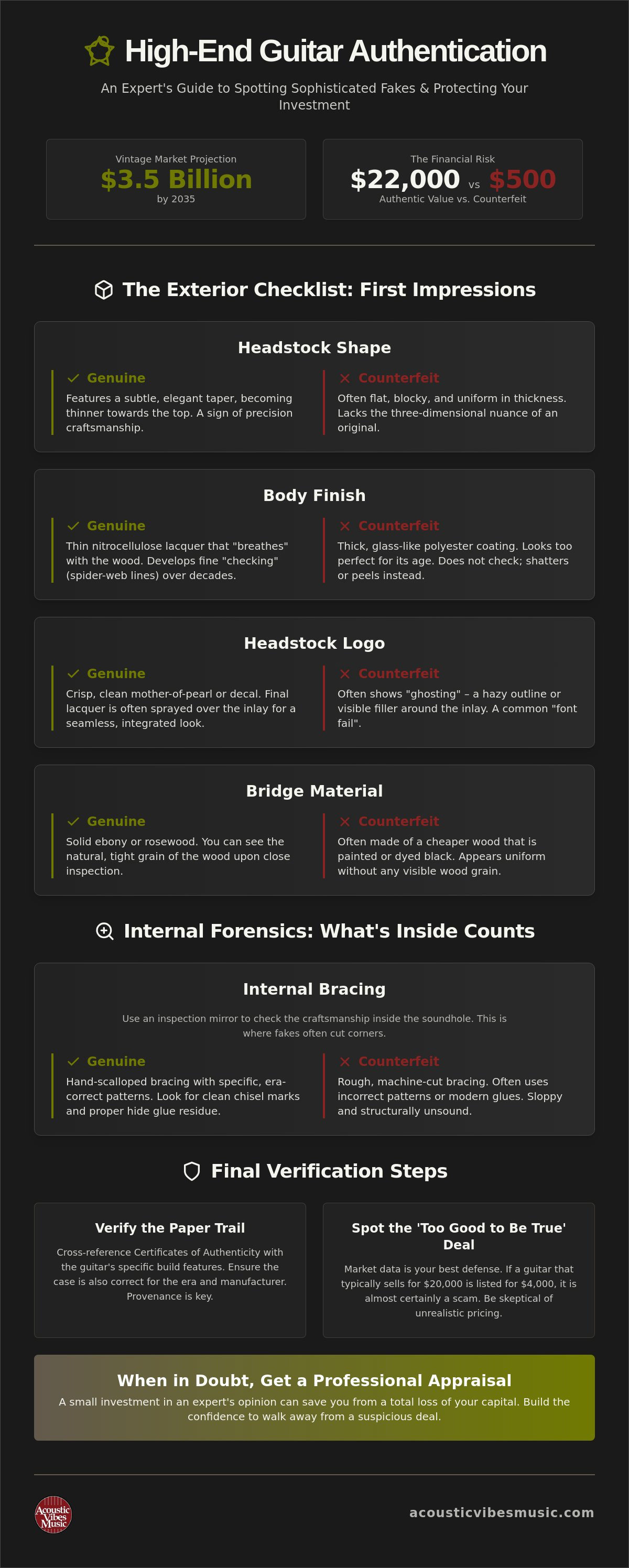
Physical evidence is only half the story. To truly validate an investment-grade instrument, you must follow the paper trail. Provenance, the documented history of ownership, provides the logical timeline that connects a 1930s workshop to the present day. Without it, even a beautiful guitar remains a mystery. High-end brands don't just ship instruments; they provide an ecosystem of quality that includes specific hard shell cases from manufacturers like TKL or Calton. If a "vintage" Martin arrives in a modern, generic plastic case with no explanation, your internal alarm should sound.
Documentation acts as a bridge between the instrument's past and its future value. A professional appraisal isn't just a piece of paper; it's an essential tool for insurance and resale. It confirms that any previous vintage acoustic guitar restoration process was performed to archival standards rather than as a quick, value-diminishing fix. A detailed history of maintenance can actually enhance the value of a player-grade vintage piece by proving it has been cared for by experts.
Case candy, the collection of hangtags, manuals, and original receipts, adds significant market value. These artifacts are often harder to fake convincingly than the guitar itself. Forgers frequently slip up on paper quality or the aging of ink signatures on a Certificate of Authenticity (COA). Always cross-reference the COA with the specific features of the build. For those looking to acquire instruments from afar, our guide on Buying a Guitar Sight Unseen offers deeper insights into remote verification and building trust with sellers.
DIY inspection has its limits. Even an experienced collector can miss a masterfully hidden crack or a non-original bridge plate. A professional luthier’s "eyes-on" evaluation is indispensable for high-value acquisitions. They understand the nuances of the vintage acoustic guitar restoration process and can tell if a neck reset was done correctly or if the finish is truly original. Always ensure your purchase includes a clear return policy. If a guitar fails a professional authentication, you must have a pre-arranged path to a full refund without hesitation.
Ready to find your next verified heirloom with total peace of mind? Explore our curated selection of authentic high-end acoustic guitars and discover instruments with proven lineage.
Purchasing a premium instrument is both a financial milestone and a deeply personal journey. While private marketplaces might offer the allure of a bargain, reputable dealers provide the only true safeguard against the sophisticated "super-fakes" currently circulating. A specialist shop acts as a curated gallery where every instrument has already passed a rigorous multi-point inspection. Our experts analyze the vintage acoustic guitar restoration process on every incoming piece, ensuring that any historical work enhances the instrument's longevity rather than hiding structural secrets.
When you explore our Gibson Acoustic or Taylor selections, you're looking at instruments vetted for era-correct authenticity. High-end dealers stake their reputation on every sale. This means we've already done the forensic work of checking serial numbers, inspecting internal bracing, and verifying provenance so you don't have to. Consignment verification adds another layer of protection. It ensures that both buyers and sellers are operating on a foundation of verified market value and physical integrity, removing the guesswork from the acquisition.
A specialist shop is your firewall. We understand the nuances of build quality and material rarity that counterfeiters simply cannot replicate. Beyond the initial authentication, we offer a crucial return period. This window allows you to live with the instrument and have it inspected by your own trusted luthier. If you're looking to move an existing piece, our consignment services provide a professional platform where your guitar's true history is celebrated and verified for its next owner.
Before you finalize your next acquisition, run through this definitive authentication summary:
Trust your intuition. If a deal feels suspicious or the price is disconnected from current market data, it's okay to walk away. The right instrument is out there, waiting to be discovered. If you have questions about a specific model or need help navigating the nuances of a potential heirloom purchase, reach out to our team. We're here to guide you toward an instrument you'll cherish for a lifetime.
Your journey into high-end guitar collecting should be defined by the joy of discovery, not the fear of deception. By mastering the physical markers of the headstock and the internal forensic clues of the bracing, you've gained the tools to protect your musical investment. Remember that a legitimate vintage acoustic guitar restoration process can preserve an instrument's soul, while a counterfeit only mimics its surface. True peace of mind comes from a combination of your own sharp eye and the backing of a trusted specialist who lives and breathes these instruments daily.
At Acoustic Vibes Music, we serve as your ultimate safe haven. As an Authorized Martin Custom Shop Expert Dealer, we subject every instrument to a rigorous professional luthier inspection before it enters our gallery. We handle the technical vetting so you can focus on the tone and feel. When you're ready to add a verified heirloom to your collection, we provide national shipping with full insurance and tracking for total security.
Explore our collection of verified high-end acoustic guitars and find the instrument that speaks to you. Your next great musical chapter is just one confident decision away.
A missing serial number is not always a sign of a fake, though it certainly demands closer scrutiny. Labels can peel over decades, and some historical neck blocks were modified during a legitimate repair. In these cases, an expert looks for other markers like wood grain matching and internal bracing styles to confirm the instrument's identity. It's about the total package of evidence rather than a single missing digit.
A 'Made in USA' stamp is not a guarantee of authenticity. This is actually one of the most common features found on modern "super-fakes" trying to look legitimate. Authenticators look at the specific typeface, the depth of the impression, and whether that specific brand even used such a stamp during the year the guitar was supposedly built. Many counterfeiters use the wrong font for the era they're trying to mimic.
Distinguishing a vintage model from a modern reissue requires looking for modern conveniences that didn't exist decades ago. Reissues often feature adjustable truss rods accessible through the soundhole or modern neck joints. Genuine vintage pieces will have fixed T-bars or ebony neck reinforcements and traditional dovetail joints. These structural details are much harder for a counterfeiter to replicate than a simple logo or decal.
Most counterfeits use low-grade laminates or cheap mystery woods stained to mimic premium materials like Brazilian rosewood. While some "high-tier" fakes might use solid spruce tops, they lack the tight grain and expert seasoning found in a true boutique build. You can often spot the difference by looking at the edge of the soundhole to see if the grain passes all the way through the wood.
If you've purchased a counterfeit, your first step should be to secure a professional appraisal that details why the instrument is fake. Use this documentation to demand a full refund from the seller or through your credit card provider. Selling forgeries is a crime, and having a written expert opinion is your strongest leverage for recovering your funds. Don't wait; take action immediately to protect your investment.
Counterfeiters heavily target serial numbers from highly desirable years, such as the 1930s for Martin or the late 1950s for Gibson. They often "borrow" a real serial number from a known authentic instrument found in an online registry. This is why a serial number alone is never enough to prove authenticity. The physical construction must match the specific database entry's specifications for that exact year.
A luthier authenticates an instrument by analyzing manufacturing fingerprints like wood oxidation levels and specific glue residue. This forensic deep-dive is a standard part of a professional vintage acoustic guitar restoration process where an expert can see tool marks hidden inside the body. They compare these physical traits against known factory standards from that specific era to verify the lineage of the instrument with absolute certainty.
A refinished guitar is still authentic, but its collector value is significantly diminished. While a fresh coat of lacquer might be part of an extensive vintage acoustic guitar restoration process to save a damaged instrument, collectors prioritize originality above all else. A refinish can drop the market price by 50 percent or more compared to an instrument with its original, checked nitrocellulose finish intact. It's a vital distinction for any serious investor.