My shopping cart
Your cart is currently empty.
Continue ShoppingSelling a masterpiece isn't just a transaction; it's a transfer of stewardship. When you're ready to learn how to sell a high end guitar, you quickly realize that the open marketplace can feel like a minefield of low-ball offers and shipping anxieties. You've spent years caring for the Adirondack spruce and hand-carved bracing of your Martin or Collings. Entrusting that heritage to a random algorithm or an unverified buyer feels inherently wrong. It's natural to worry about a $10,000 instrument arriving in pieces or falling victim to a sophisticated payment scam.
We understand that your goal is to find a buyer who truly values the artisanal skill behind your instrument while maximizing your financial return. This guide provides the professional roadmap you need to navigate these high-stakes waters with confidence. You'll discover how to accurately price rare custom-spec models, prepare your guitar for a flawless presentation, and choose the most secure selling channels. From professional luthier evaluations to the strategic benefits of expert consignment, we'll show you how to ensure your instrument finds its next home safely and profitably.
Selling an entry-level instrument is a simple transaction. Selling a boutique acoustic is a high-stakes endeavor. You aren't just offloading gear; you're curating a legacy. In the current Vintage Guitar Market, the distinction between a "commodity" instrument and an investment-grade piece has never been sharper. A mass-produced guitar might sell quickly on a local classified site, but a premium instrument requires a global stage and a level of authority that anonymous listings simply cannot provide.
Serious collectors are discerning. They look for more than just a brand name. They seek structural perfection, documented provenance, and the security of a professional intermediary. Understanding how to sell a high end guitar in 2026 means recognizing that the market has shifted toward expert-led transactions. Buyers are willing to pay a premium for peace of mind, especially when dealing with five-figure price tags and delicate tonewoods that are sensitive to climate and handling.
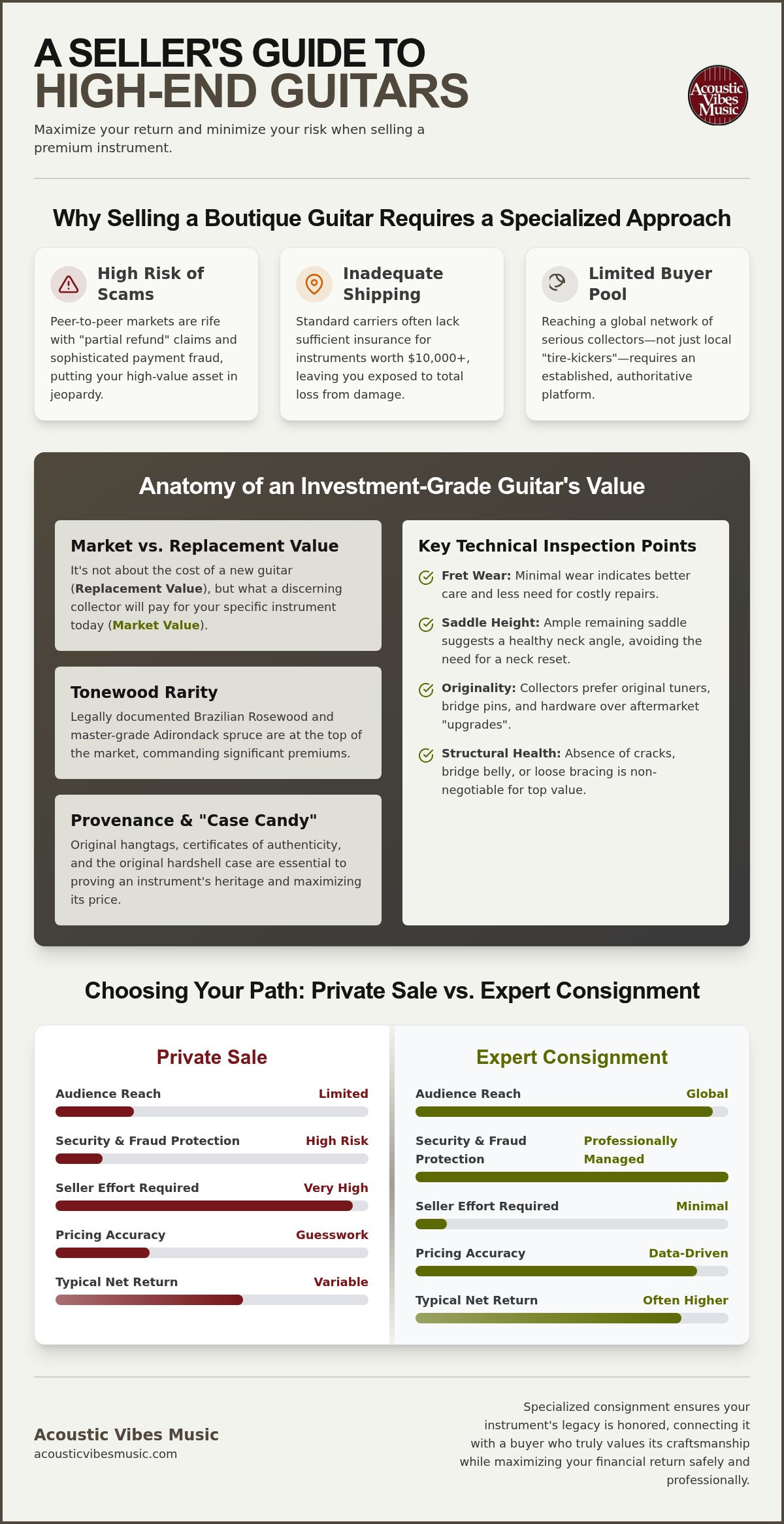
Listing a $10,000 instrument on a standard marketplace often invites more headache than profit. Sellers frequently face "partial refund" scams, where a buyer claims a non-existent defect after delivery to force a price reduction. If you refuse, you're stuck with the anxiety of a return shipment that might not be handled with care. Shipping is another major hurdle. Most standard carriers don't offer industrial-grade insurance for high-value instruments, leaving you exposed if the guitar arrives damaged. Managing dozens of "tire-kickers" and low-ball offers can also turn a rewarding sale into a full-time job of filtering noise.
Not every expensive guitar holds its value equally. True investment-grade instruments from legendary names like Martin and Collings are prized for their artisanal skill and material excellence. Limited runs, discontinued tonewoods, and custom shop specifications significantly influence long-term desirability. Boutique brands like Boucher guitars have also seen a surge in interest from collectors who appreciate master-grade Adirondack spruce and hand-voiced tops. To maximize your return, you must preserve the "case candy." Original hangtags, certificates of authenticity, and even the original hardshell case are essential components that prove the instrument's heritage to a serious buyer.
Pricing a premium instrument requires a nuanced understanding of "Market Value" versus "Replacement Value." Your replacement value is the cost to buy a brand-new equivalent today. Market value, however, is what a collector will actually pay for your specific instrument right now. When you're researching how to sell a high end guitar, looking at historical sales for boutique brands like Boucher guitars is more effective than checking generic price guides. Standard "Blue Book" values often fail to capture the premium commanded by custom shop specs or small-batch luthier pedigree.
Tonewood rarity continues to dictate 2026 pricing trends. Instruments featuring legally documented Brazilian Rosewood or master-grade Adirondack spruce are currently at the top of the market. For those handling high-value estate sales or donations, adhering to IRS Appraisal Standards ensures your valuation is defensible and accurate. This level of precision is exactly what separates a successful sale from a listing that sits stagnant for months.
Physical health is the primary driver of value. Fret wear and remaining saddle height are the first things a serious buyer will inspect. If the saddle is low and the action is high, a costly neck reset is on the horizon. This is particularly critical for vintage Martin guitars, where a professional appraisal is necessary to determine if the geometry is still sound. While modern pickups are convenient, they often detract from the value of a high-end acoustic. Collectors almost always prefer original tuners and bridge pins over aftermarket "upgrades" that alter the instrument's heritage.
Precision in grading is non-negotiable. A "Mint" instrument must be indistinguishable from a new arrival. "Excellent" condition allows for the softest pick swirls, while "Player Grade" pieces show honest wear but maintain structural integrity. "New Old Stock" (NOS) guitars represent the pinnacle of the used market, often commanding prices close to original retail because they've been perfectly preserved. Keeping your instrument in a humidity-controlled environment is the only way to protect these grades. A professional evaluation from Acoustic Vibes Music can help you document these details correctly before you list.
Deciding where to list your instrument is a critical strategic choice. Many owners focus solely on the final sticker price, but the truly savvy seller calculates the "Net Return." This is the actual cash that hits your bank account after subtracting marketplace fees, industrial-grade shipping insurance, and the significant value of your own time. When you research how to sell a high end guitar, you'll find that peer-to-peer platforms often emphasize low fees while ignoring the "authority premium" a specialized shop provides. Buyers are simply more comfortable paying top market value when a trusted curator stands behind the transaction.
A professional gallery environment elevates your instrument. Expert photography captures the subtle grain of a master-grade top, while an established reputation acts as a financial escrow. This security is vital for high-value sales. Using a third-party shop eliminates the risk of "chargeback" fraud or payment scams that plague anonymous marketplaces. You gain a partner who handles the vetting, the negotiation, and the legal paperwork, ensuring the transition is as refined as the instrument itself.
Consigning your instrument offers a "hands-off" experience with superior results. You gain immediate access to an established national database of serious collectors who are actively looking for elite acoustic guitars. Most reputable shops include a professional luthier setup as part of the service. This ensures the guitar plays perfectly the moment a potential buyer picks it up, removing any technical barriers to a sale. Perhaps most importantly, consignment eliminates your personal liability. If an instrument is damaged during shipping or a buyer requests a return, the shop manages the logistics and insurance claims on your behalf.
Private sales are occasionally the right path for specific scenarios. If you are selling to a local friend or a trusted member of your immediate musical community, you can avoid shipping costs entirely. This is often the best route for lower-value instruments where a consignment commission might eat too much of your narrow margin. However, this path requires you to be comfortable managing all logistics personally. You must be prepared to host strangers for auditions, handle potential fraud risks, and spend hours filtering through low-ball offers from "tire-kickers" who may not appreciate the instrument's true pedigree.
Presentation is the bridge between a simple listing and a successful sale. When you're mastering how to sell a high end guitar, you must treat the preparation phase with the same reverence the builder showed the tonewoods. Begin with a meticulous cleaning. Use only high-quality, silicone-free cleaners and a clean microfiber cloth to preserve the delicate nitrocellulose finish. Avoid heavy polishes that can build up over time. Instead, focus on removing oils and dust to let the natural luster of the wood shine through. A pristine instrument suggests a history of careful ownership, which is the first thing a collector looks for.
Documenting the finer points is where you build trust. Serious buyers want to know the nut width, the string spacing at the bridge, and the exact serial number to verify the production year. Don't just list these as dry specs. Tell the story of the instrument. Mention the specific luthier who voiced the top or the unique circumstances of its acquisition. This narrative approach transforms a piece of wood and wire into a piece of history. It helps the buyer connect with the instrument's heritage before they even pick it up.
Visuals are your most powerful marketing tool. Use soft, natural light to highlight the intricate grain patterns of an Adirondack or Sitka spruce top. Avoid direct sunlight or harsh flashes, which create distracting glares on high-gloss finishes. Take macro shots of the frets to show the remaining life and the end-pin area to document any wear from straps. Providing high-resolution images of the bridge and neck joint demonstrates transparency and confidence in the instrument's structural integrity. Clear, honest photos eliminate the need for dozens of back-and-forth questions.
A professional eye can find issues you might miss. Before listing, check the bridge for even the slightest lift and inspect the top for excessive bellying behind the bridge. Verify that the truss rod functions smoothly and the neck maintains its intended relief. A professional setup is a small investment that pays massive dividends. It ensures the first impression is one of effortless playability and tonal balance. If a buyer feels the instrument is ready to play immediately, they are far more likely to meet your asking price.
For shipping, only the gold standard suffices. Double-boxing with at least two inches of padding between the inner and outer containers is non-negotiable. Slacken the strings slightly and pad the headstock and end-pin area within the case. This level of care ensures your instrument arrives in the same pristine condition it left. If you prefer to skip the stress of logistics and technical prep, let our expert team at Acoustic Vibes Music handle the preparation and shipping for you.
Choosing the right partner transforms the stress of a high-value transaction into a celebratory experience. At Acoustic Vibes Music, we've designed our national consignment program specifically for those who care about where their instrument goes next. When you're determining how to sell a high end guitar, the most significant advantage is our reputation. As an authorized dealer for Martin and Taylor, we attract the world's most serious collectors. They trust our curation; it's a level of authority that anonymous marketplaces simply cannot replicate.
Our professional luthier team provides a comprehensive structural check for every consignment. This verification removes any technical doubt for the buyer. It's the ultimate peace of mind. We handle every detail, from the initial valuation to the complexities of global shipping, ensuring your instrument is protected every step of the way. You don't have to worry about the logistics of industrial-grade insurance or the risks of unverified buyers. We manage the entire lifecycle of the sale so you can focus on your next acquisition.
We treat every guitar as a work of art. The process begins with a precise appraisal that respects the instrument's heritage and current market demand. Once accepted, we produce high-fidelity video demos that capture the unique tonal profile of your build. This allows potential buyers to hear the nuanced resonance of the wood before they ever step foot in a showroom. We target a specific database of enthusiasts looking for heirloom-quality pieces. You'll receive transparent reporting and secure, prompt payment once the sale is finalized.
Your instrument deserves more than a local listing. Our showroom, both physical and digital, serves as a beacon for acoustic aficionados nationwide. One of the most powerful tools we offer is "In-Store" financing. High-end gear is a significant investment; our ability to offer flexible payment options helps qualified buyers say "yes" to premium instruments they might otherwise hesitate to purchase. This increased accessibility often leads to faster sales and higher net returns for our consignors. We don't just list guitars; we find them the right stewards.
Contact us today for a professional evaluation of your instrument and discover the most secure way to transition your guitar to its next home.
Transitioning from owner to seller requires a shift in perspective. You've seen that accurate valuation and meticulous preparation are the cornerstones of a successful transaction. By focusing on technical health and artisanal pedigree, you ensure your instrument stands out in a crowded market. Truly understanding how to sell a high end guitar means prioritizing trust through professional documentation and secure, expert logistics. It's about finding a buyer who doesn't just see a price tag, but appreciates the heritage of the tonewoods and the skill of the luthier.
Our team at Acoustic Vibes Music acts as your expert guide throughout this journey. As an authorized dealer for world-renowned brands like Martin, Collings, and Lowden, we provide the authority needed to attract serious collectors. Our professional in-house luthier repair services ensure every instrument is in peak condition before it reaches its next home. We've built a national reputation for curated acoustic excellence, providing the security and reach you deserve. Let our experts help you sell your high-end guitar for top market value. Your instrument’s next chapter starts with a partner who respects its artistry as much as you do.
Consigning is often the superior choice for high-value instruments. While selling directly might seem to save on fees, a professional shop provides the authority and marketing reach to command a higher final price. Buyers feel more secure purchasing a $10,000 instrument from a trusted dealer than an anonymous seller. This path also removes the burden of managing dozens of inquiries and the liability associated with high-stakes shipping.
Industry standard consignment fees for premium acoustic instruments typically range between 15% and 25% of the final sale price. When you are researching how to sell a high end guitar, understanding this structure is vital. The fee covers professional photography, expert marketing, and the security of a global audience. It also includes the value of having a professional luthier verify the instrument's condition, which often secures a higher final price.
Safe national shipping requires a double-boxing strategy. Place the guitar in its hardshell case with the strings slightly slackened. Use crumpled kraft paper to support the headstock and pad any gaps inside the case. Place the case inside a heavy-duty guitar box, then place that box inside a larger outer container with at least two inches of padding on all sides. Always secure industrial-grade insurance for the full market value before dispatching.
A headstock repair doesn't necessarily ruin the instrument, but it does significantly impact the resale value. In the collector's market, a clean, professionally executed repair typically results in a 40% to 50% reduction in market price. Structural integrity is often perfectly sound, but purists prioritize original condition. If you are learning how to sell a high end guitar with a repair, transparency and high-resolution documentation of the work are essential.
Obtaining a professional appraisal before selling is highly recommended for high-value items. It provides a documented baseline that justifies your asking price to potential buyers. More importantly, it serves as vital evidence for insurance claims if the instrument is lost or damaged during transit. Formal appraisals are especially critical for custom-spec models or rare vintage pieces where standard price guides are frequently outdated or inaccurate.
In 2026, the demand for rare and legally documented tonewoods remains at an all-time high. Brazilian Rosewood continues to be the "holy grail" for collectors, often commanding massive premiums. Master-grade Adirondack Spruce and highly figured Hawaiian Koa are also exceptionally desirable due to their tonal complexity and visual artistry. Instruments featuring these materials hold their value best, especially when accompanied by certificates of authenticity or original documentation from the builder.
To verify a pre-war Martin, look for the serial number stamped into the mahogany neck block inside the soundhole. You'll need a flashlight and perhaps a small mirror to see it clearly. Once you have the number, cross-reference it with official Martin archives to confirm the exact production year. For instruments of this era, it's also wise to have a professional luthier verify that the stamp is original and hasn't been tampered with.
You can certainly sell a guitar with modified electronics, though it may change your target audience. Purists and high-end collectors generally prefer instruments in their original, factory-spec condition. Adding modern pickups can sometimes decrease the value of a vintage or boutique acoustic. If you've made modifications, keeping the original components to include in the sale can help preserve the instrument's appeal and its overall market value.