My shopping cart
Your cart is currently empty.
Continue ShoppingWhat if a precise string-height reading starts with measuring from the wrong surface? If you’re learning how to measure guitar string height, measure from the top of the fret to the underside of the string, not from the fretboard. It’s an easy detail to mix up, and choosing the right tool and units can make the reading feel more confusing than it needs to be. A consistent method gives you a useful first check without turning one number into a verdict on your guitar’s setup.
This guide explains where to measure, how to position a ruler or string-action gauge, and how to record the result in inches or millimetres. You’ll learn how to interpret the reading as a starting point, why playing feel and other setup factors matter, and when a professional luthier setup may be the sensible next step. Take your time, keep the measurement repeatable, and you’ll have clearer information about what your instrument needs.
Before taking a reading, get clear on what the number represents. Guitar string height, commonly called action, is the clearance between a string and a fret. The key distinction is this: action measures string-to-fret clearance at a chosen fret; neck relief describes the neck’s slight forward or backward curvature. They’re related parts of a guitar’s setup, but they aren’t the same measurement.
Action affects how the instrument feels under your fingers. Lower clearance can make strings easier to press down, while too little space may leave a string rattling against a fret. More clearance can reduce that risk in some playing situations, but it may take more finger pressure to fret notes comfortably. The best balance depends on the instrument, the player’s touch, and relevant manufacturer guidance, so one reading can’t define a universal ideal.
For a foundational overview of the term and its playability trade-offs, see What Guitar String Height Measures. Keep the distinction in mind as you check your guitar: action is a measurement at a specific fret, while relief describes the neck’s curve along its length. A high or low action reading alone doesn’t explain the whole setup.
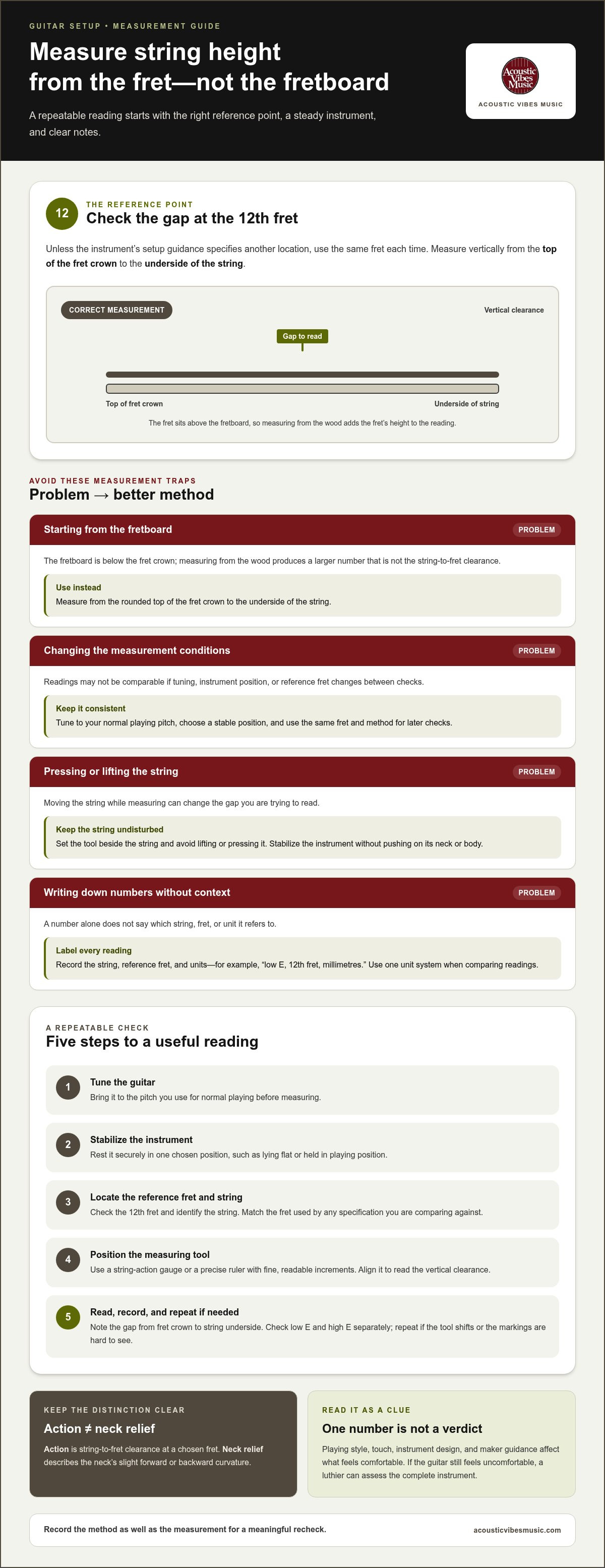
The 12th fret is a common reference point for checking action. Unless the instrument’s setup guidance specifies another location, use the same fret each time so your readings can be compared. Some specifications use a different fret, so record exactly where you measured rather than treating readings from different points as interchangeable.
At the chosen fret, measure the vertical gap from the top of the fret crown, the rounded metal surface that contacts the string, to the underside of the string. Don’t start at the fretboard. The fret sits above the board, so measuring from the wood includes the fret’s height and produces a larger number that doesn’t represent the string-to-fret clearance.
For a meaningful comparison, tune the guitar consistently and keep its position and measurement conditions similar from one check to the next. A reading taken with the instrument tuned differently may not match one taken at its usual pitch. Consistency makes how to measure guitar string height a repeatable check, not a hunt for a number that applies to every guitar.
A repeatable reading comes from controlling a few simple details: tuning, instrument position, reference fret, and tool alignment. Use this method to check your guitar without pressing on the string or mistaking a rough estimate for a precise measurement.
Use a dedicated string-action gauge if you have one, or a precise ruler with fine, clearly readable increments. The markings need to be small enough to distinguish the narrow space between string and fret. A general-purpose ruler with broad or hard-to-read marks can make the result difficult to judge accurately.
Tune the guitar to the pitch you use for normal playing. Set it on a stable surface and choose one position, such as lying flat or held in playing position, then use that same convention for later checks. Consistency makes readings easier to compare. Fender’s guide to Interpreting Guitar String Height also offers context on measurement references and why preferred action can differ between players.
Measure at the 12th fret, from the top of the fret crown to the underside of the string.
For example, label the results “low E, 12th fret, millimetres” and “high E, 12th fret, millimetres.” That’s clearer than recording two numbers without saying which strings or units they refer to. If the gauge provides both inches and millimetres, choose one system and stick with it for comparisons.
Repeat a reading if the tool shifts or the markings are difficult to see. Keep notes on tuning and instrument position too, so a later measurement reflects a meaningful comparison rather than a change in method. If the numbers are consistent but the guitar still feels uncomfortable, a luthier setup can help assess the complete instrument. Explore professional guitar repair and maintenance as a next step.
A measurement is a useful clue, not a verdict. The same string height can feel comfortable to one player and demanding to another, depending on playing style, picking attack, instrument design, and the maker’s setup guidance. Use your reading to understand the guitar you have, rather than chasing a single number that’s supposed to suit everyone.
Action can vary from string to string, so record individual readings rather than treating the low E and high E as a single result. Players may prefer a different feel across the strings, and a strong picking attack can make a setup that feels fine with a light touch sound or feel less comfortable. A difference between the outer strings doesn’t automatically mean something is wrong. Consider the readings alongside how the guitar plays.
Comparing instruments can also help you identify the feel you enjoy. The acoustic guitar collection offers a chance to explore how different instruments feel in your hands, rather than relying on a measurement alone.
Neck relief is the slight curvature of the neck, and it can influence how strings feel along the fretboard. A 12th-fret action reading doesn’t reveal relief by itself, nor does it explain every factor affecting playability. Nut-slot height matters especially near the first frets: if fretting feels unusually stiff or notes behave differently in that area, the nut may be part of the picture, even if the 12th-fret reading seems reasonable.
Use symptoms to guide what you check next, not to diagnose a cause from one measurement:
Before comparing your numbers with a published target, match the measurement convention: reference fret, string, tuning, and whether the distance is read from the fret crown to the string underside. Manufacturer guidance can be a useful point of reference, but it isn’t a universal prescription. If a reading and the playing feel don’t seem to make sense together, a luthier can assess the complete setup rather than relying on action alone.
An unexpected reading can point to a setup concern, but it can also come from a small measuring error. Before adjusting anything, repeat the check. A single 12th-fret number doesn’t identify the cause or tell you which part of the guitar needs attention.
Retune the guitar to your normal playing pitch, then measure again at the same fret with the same tool and method. Confirm the string rests normally and hasn’t been lifted or pressed as you position the gauge. Align the ruler so you’re reading from the fret crown to the underside of the string, not from the fretboard. If you change the reference point or instrument position, you may create a different result rather than clarify the first one.
Write down the repeat reading before making changes. Include the string, fret, units, tuning, and instrument position. If the two readings differ noticeably, check tool alignment and repeat once more. This is a practical first step in how to measure guitar string height, and it helps separate an inconsistent measurement from a playing issue worth investigating.
If the reading is repeatable but the guitar still feels wrong, several parts of the setup could be involved. Neck relief affects the string’s path along the frets; nut-slot height can influence feel near the first frets; and saddle height can affect clearance farther up the neck. Neck geometry may also shape how those factors work together. These are possibilities to assess, not causes a single measurement can confirm.
Don’t turn the truss rod simply to change a 12th-fret action reading. The truss rod adjusts neck relief, which is related to playability but is not the same as action. Changing it without assessing the neck and the complete setup may create new problems instead of solving the original concern.
If buzzing continues, the action remains uncomfortable, or you notice a structural concern, a luthier can evaluate the relief, nut, saddle, and neck geometry together. Acoustic Vibes Music provides professional instrument repair and maintenance by appointment. Book an appointment for a professional guitar assessment to get help interpreting the reading and identifying a sensible next step.
A measurement becomes more useful when you can compare it with a later check. Keep a brief record rather than relying on memory, especially if the guitar’s feel changes or you’ve had setup work done. The goal isn’t to adjust the instrument every time a number shifts. First, establish what changed and whether it affects how the guitar plays.
For a fair comparison, use the same tuning, reference fret, instrument position, measuring tool, and technique each time. Note the date and include:
Compare readings with the guitar maker’s published guidance when it’s available, taking care to match its measurement point and method. A number measured at a different fret or from a different reference won’t provide a like-for-like comparison. Recheck after setup work, a string change, or a meaningful shift in comfort or sound. If your method is consistent, your notes can help show whether the reading has changed or the guitar simply feels different.
Separate the measurement from the decision to make an adjustment. A reading that surprises you doesn’t, by itself, mean the instrument needs a change. Avoid making several adjustments at once; doing so can make it harder to understand what helped or caused a new issue.
If the reading or playing issue remains unclear, Acoustic Vibes Music provides professional instrument repair and maintenance by appointment. Bring your notes along; they can help guide the assessment. Book an appointment for professional guitar repair or maintenance.
A reliable string-height reading starts with consistency: measure from the fret crown to the string underside, use the same fret and conditions each time, and record the result with its units. Learning how to measure guitar string height gives you a practical first check, but the number alone can’t explain every change in feel. Your playing style and the guitar’s complete setup matter too.
If your guitar feels comfortable and plays cleanly, keep your notes and enjoy it. If buzzing, discomfort, or uncertainty persists, avoid adjusting parts by guesswork. A professional assessment can help make sense of the reading and the instrument as a whole. Acoustic Vibes Music offers professional luthier repair and maintenance by appointment, alongside a curated selection of acoustic instruments for players who enjoy discovering a guitar that feels right in their hands.
Book an appointment for professional guitar care and take your next step with confidence. A little clarity can make it easier to get back to the playing you love.
Measure the gap from the top of the fret crown to the underside of the string, commonly at the 12th fret. Don’t measure from the fretboard, because that includes the fret’s height and gives a different reading. For a useful comparison, record the fret and string you measured, and follow the instrument maker’s specified reference point if it differs.
A dedicated string-action gauge is designed to show small clearances clearly, making it a convenient choice. A precise ruler with fine, readable increments can also work. Whichever tool you use, keep it aligned at the fret and avoid lifting or pressing the string. Consistency matters: use the same tool and method when you repeat a measurement.
There isn’t one ideal height for every guitar and player. As acoustic-guitar starting points, Stringjoy’s March 2026 recommendations list 2.4 mm (0.093 in) for the low E and 1.6 mm (0.062 in) for the high E at the 12th fret. Treat these as reference values, not rules. Playing style, instrument, and maker guidance all matter.
Yes. Tune the guitar to the pitch you normally play before taking a reading. Tuning affects string tension, so measuring at a different pitch can make comparisons less meaningful. Keep the guitar’s position and measurement method consistent too. If you’re tracking a change over time, note the tuning alongside the fret, string, reading, and units.
Yes, provided the ruler has fine, clear increments that let you read the small gap accurately. A ruler with broad or difficult-to-see markings may only give you a rough estimate. Place it beside the string at the reference fret and read from the fret crown to the string underside. A dedicated action gauge can make the reading easier to see.
No. A high 12th-fret reading alone isn’t a reason to adjust the truss rod. The rod changes neck relief, which is related to playability but isn’t the same as action. Relief, nut-slot height, saddle height, and neck geometry can all influence how the guitar feels. If you’re unsure what’s causing the issue, have a luthier assess the complete setup.
There’s no fixed schedule that suits every player or instrument. Recheck after setup work, a string change, or a noticeable shift in playing feel, such as new buzzing or uncomfortable fretting. Keep the tuning, reference fret, instrument position, and tool consistent so you can compare readings. If the concern persists, professional repair and maintenance can help clarify what the guitar needs.