My shopping cart
Your cart is currently empty.
Continue ShoppingThe quickest capo to clamp on isn’t necessarily the one that will keep your guitar sounding its best. If you’ve wondered how to choose a capo that fits your instrument and holds every string cleanly, start by matching its shape and pressure to your guitar, rather than choosing by mechanism alone.
Convenience matters, but so does tuning stability. Uneven pressure can leave notes buzzing or pull them sharp, and neck shape, fretboard radius, and placement all affect the result. A capo that works well on one acoustic guitar may not sit evenly on another.
This guide compares common capo styles and their trade-offs in speed and adjustability. You’ll also learn how to check the fit, place the capo just behind the fret, and test the notes and tuning afterward. These simple checks help you find a secure grip without interrupting the music.
A capo is a movable clamp that holds the strings against a fret, shortening their vibrating length and raising their sounding pitch. It lets you play familiar chord shapes in a higher key, match a singer’s range, or find a comfortable key without changing your tuning. For a foundational overview of its purpose and mechanical designs, see Capo (musical device).
Think of a capo as a practical tool for transposition, not a substitute for understanding keys. For example, placing one at the second fret and playing a G chord shape produces an A chord. Knowing how the capo changes the pitch helps you choose a fret deliberately, follow a song’s chord progression, and communicate clearly with other musicians.
To learn how to choose a capo, begin with the guitar you’ll use and the way you play. Its appearance and mechanism matter less than whether it fits the neck and applies even pressure. The capo should hold each string cleanly without pressing so hard that notes pull sharp. Fit is specific to the instrument: the same capo may feel secure on one guitar and uneven on another.
A capo should press all the strings firmly enough against a fret to produce clear notes. Too little pressure can leave strings buzzing; too much may stretch them and make the notes sound sharp. Placement matters, too. Set the capo close behind the fret, then play each string individually to check for clarity.
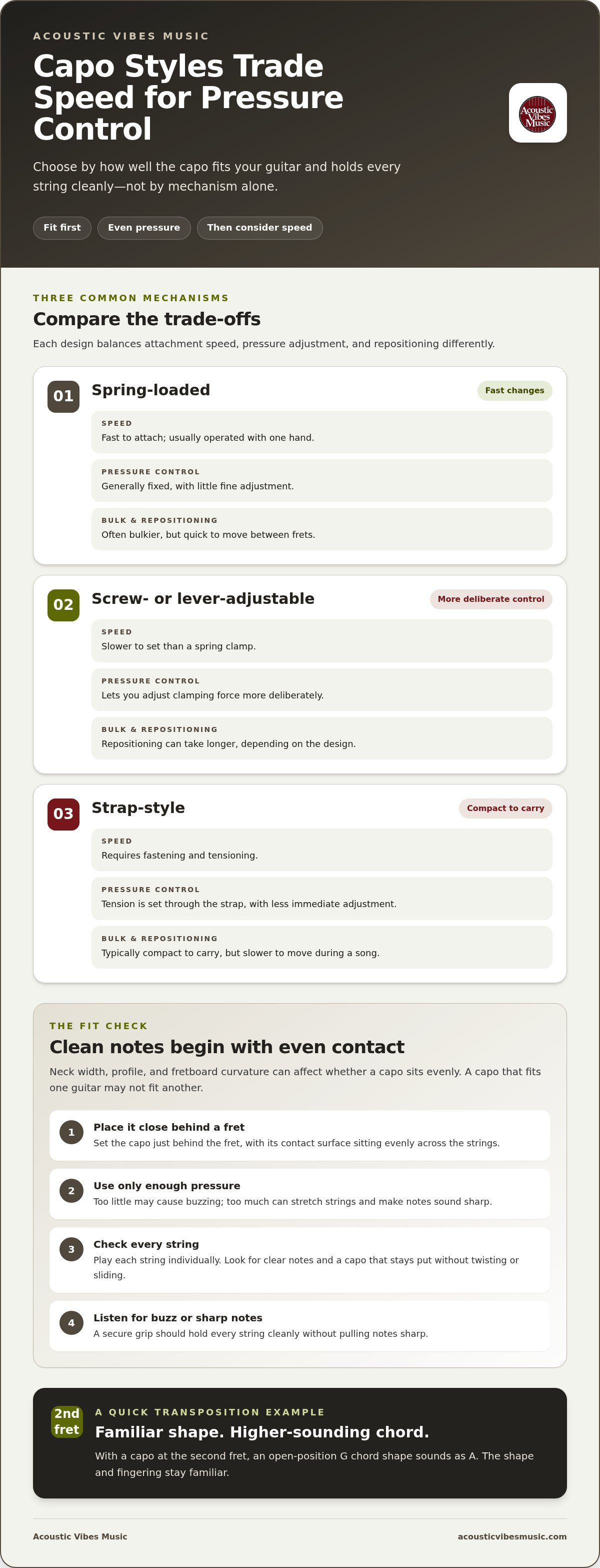
Try a familiar chord shape higher up the neck. With a capo at the second fret, an open-position G shape sounds as A, while the shape and fingering remain familiar. This can make a song easier to sing or play while preserving the bright quality of open-string voicings.
First identify whether you’re fitting a steel-string acoustic or a classical guitar. Their necks can differ in width, profile, and fretboard curvature, so a capo designed around one shape may not sit evenly on the other. Consider the width of the fretboard and how much it curves across its width. The capo’s contact surface should reach every string consistently.
Use your actual instrument as the reference rather than relying on assumptions about guitar types. A capo that tilts, shifts, or leaves an outer string buzzing may not match the neck’s shape. If playability problems continue when the capo is off, persistent buzzing or tuning concerns may point to a setup issue instead.
Capo mechanisms differ in how quickly they attach and how much control they give you over clamping pressure. The right choice depends on your guitar and playing habits, not on how many features a design offers. Fender’s guide to different types of capos also outlines common designs and their uses.
| Style | Speed | Pressure control | Bulk and repositioning |
|---|---|---|---|
| Spring-loaded | Fast; usually operated with one hand | Generally fixed, with little fine adjustment | Often bulkier, but quick to move between frets |
| Screw- or lever-adjustable | Slower to set than a spring clamp | Allows more deliberate pressure adjustment | Can take longer to reposition, depending on the design |
| Strap-style | Requires fastening and tensioning | Set through the strap’s tension, with less immediate adjustment | Typically compact to carry, but slower to move during a song |
A spring-loaded capo is convenient if you change positions between songs or need to attach it with one hand. Squeeze the handle, place the capo, and release. The trade-off is that the spring typically applies a set tension, leaving less room to fine-tune pressure for a particular neck. Check that it sits evenly across the strings. A quick clamp is only useful if it holds every string cleanly without pulling notes sharp.
A screw or lever mechanism lets you set the clamping force more deliberately. This control can help you find enough pressure for clear notes without pressing harder than necessary, which may reduce tuning shifts. It suits players who prioritize a precise fit over an instant change. Strap-style capos are compact, but fastening them takes time, and their tension still needs to suit the guitar neck.
These categories are starting points, not guarantees of fit. A spring clamp may work well on one guitar and feel uneven on another; an adjustable design still needs the right shape and pressure. Test a capo on your instrument before settling on a mechanism. If you’re comparing acoustic necks as part of your decision, explore the range of acoustic guitars and consider how each feels in your hands.
A capo needs to press each string evenly, but guitar necks aren’t all shaped alike. Fretboard radius describes how much the board curves across its width, while neck profile refers to the shape and depth of the neck in your hand. Both can affect how a capo sits and whether its pad reaches the strings consistently. Steel-string acoustics and classical guitars can differ in neck width and shape, so don’t assume one capo will fit both.
As you consider how to choose a capo, look for a stable fit rather than the strongest clamp. Too little pressure can leave notes buzzing or muted; excessive force can stretch strings and push their pitch sharp. The goal is clear notes with only enough pressure to hold the strings securely.
Place the capo just behind a fret, with its contact surface sitting evenly across the strings. It should stay in place without twisting, sliding, or pressing awkwardly against the neck. Then test it methodically:
If one string buzzes while the others ring clearly, the capo may not be contacting the fretboard evenly. A different fit or a small position adjustment may help.
Excessive clamping pressure can push a string down toward the fretboard and stretch it slightly, raising its pitch. A capo placed too far from the fret may also require more force to fret the strings cleanly. Move it close behind the fret and apply only enough pressure for clear notes. If the design allows pressure adjustment, ease the tension gradually and retest.
Separate capo-related changes from the guitar’s baseline. Tune the instrument first, attach the capo, then check the strings again. If a note sounds sharp only with the capo, review its placement, fit, and pressure. If buzzing or tuning trouble persists with the capo removed, the instrument’s setup may also be a factor. Persistent playability issues may benefit from professional instrument care, since action, neck relief, or other setup details may need attention.
The right capo should suit the way you use it. A player who changes keys between songs has different priorities from someone who keeps a capo in one position while fingerpicking. As you decide how to choose a capo, weigh how quickly you need to move it, how much pressure control you want, and which guitar it needs to fit.
For quick changes during a live set, prioritize a design you can place and remove smoothly, with a secure grip that doesn’t shift as you play. Rehearse the changes with the capo you’re considering. You’ll find out whether it’s easy to handle between songs, gets in the way, or is difficult to position consistently while playing.
Check your tuning after moving the capo, since changing its position can affect how the strings sound. Adjustable pressure may be useful if you want to fine-tune the grip and pay close attention to tuning stability. But adjustability can’t make up for a poor fit: the capo still needs to suit your guitar’s neck and fretboard.
Classical guitars commonly have wider, flatter necks than steel-string acoustics. That difference can affect whether a capo reaches all the strings evenly. Match the capo’s width and contact shape to the instrument rather than assuming a design that works on a steel-string guitar will also suit a classical one.
Don’t force a narrow or strongly curved capo onto a neck it doesn’t fit. If you play both classical and steel-string guitars, assess each neck separately. A capo that sits securely and produces clear notes on one instrument may press unevenly on the other.
Try before you settle. Test the capo on your guitar, ideally at the fret positions you use most. Apply it, play the strings, and check that it feels secure without obstructing your hand or creating unwanted tuning changes. If you use more than one guitar, repeat the test on each; one capo may not suit every neck equally well.
If you’re comparing instruments as well as capo fit, browsing acoustic and classical guitars can help you notice differences in neck width and profile. Let your playing feel guide the choice, then check the sound and tuning in the situations where you’ll rely on the capo.
A reliable capo should make a song easier to play, not add buzzing or repeated tuning corrections. Testing it on your guitar makes the choice practical: listen to the notes, check the tuner, and notice how securely the capo sits.
Use this quick sequence at the fret where you expect to play:
Pay attention to when the problem occurs. A buzz that appears only with the capo may point to its position, pressure, or fit. If the same string buzzes in open position without the capo, the cause may lie elsewhere in the instrument. Avoid tightening the capo immediately when a note sounds unclear; extra pressure can make sharpness worse.
Remove the capo and play the open strings and familiar chords again. If tuning instability, fret buzz, or other playability concerns remain, the issue may involve the guitar’s setup rather than the capo. Persistent problems are a reason to consider instrument maintenance. Acoustic Vibes Music offers repair and maintenance services by appointment, including care for stringed instruments.
Once the capo passes the test, try it at the positions and in the songs you actually play. A secure fit and clear notes matter more than a clamp that simply feels strong. If you’re exploring an instrument with a neck that suits your playing, browse our acoustic guitar selection.
The right capo suits your guitar’s neck and your playing habits. As you consider how to choose a capo, weigh the speed of its mechanism against the pressure control you need, then test for even contact, clear notes, and stable tuning. A capo should support your playing, not make you fight the instrument.
If buzzing or tuning problems continue when the capo is off, your guitar may need attention beyond a simple adjustment. Acoustic Vibes Music offers professional repair and maintenance by appointment, alongside a curated selection of acoustic and classical guitars.
Explore acoustic guitars and find the right instrument for your playing. With a well-fitting capo and an instrument that feels right in your hands, you’re ready to explore new keys and make familiar shapes your own.
Choose a capo that matches your guitar’s neck width, profile, and fretboard radius, then consider how you’ll use it. A spring-loaded design is quick to move, while an adjustable model offers more control over pressure. To decide how to choose a capo, test it on your guitar: it should sit securely, press the strings evenly, and produce clear notes without pulling them sharp.
Neither is automatically better; the right choice depends on your playing habits and how well the capo fits. Spring-loaded capos are convenient for quick changes, such as moving between songs, but usually offer less control over clamping pressure. Screw- or lever-adjustable designs let you fine-tune the grip, which can help achieve a precise fit and stable tuning. Whichever style you choose, check that it contacts every string evenly on your guitar.
Sometimes, but don’t assume a capo that fits one guitar will fit the other. Classical guitars commonly have wider, flatter necks than steel-string acoustics, so a capo shaped for a narrower or more curved fretboard may not reach the strings evenly. Test it on each instrument separately. If it tilts, shifts, or leaves strings buzzing, its width or contact shape may not suit that neck.
A guitar may sound sharp if the capo presses too hard and stretches the strings, or if it sits too far from the fret. Place it just behind the fret and use only enough pressure for clear notes. If a string still sounds sharp, release and reposition the capo, then check the tuning again. Test the guitar without the capo, too, to see whether the issue persists.
Position the capo just behind the fret, on the side toward the headstock, rather than in the middle of the space between frets. This placement helps the strings contact the fret cleanly without requiring excessive clamping force. Keep the capo aligned across the fretboard, then play each string individually. If notes buzz or sound muted, adjust its position and test again.
A properly fitted capo used with appropriate pressure should hold the strings without needing to be forced onto the neck. Avoid over-tightening adjustable designs or leaving a clamp pressed hard against the instrument when it isn’t needed. Keep the capo’s contact surfaces clean, and make sure the clamp isn’t twisting or shifting as you play. If it feels awkward or unstable, remove it and reassess the fit.
Check the tuning after you place a capo, even if the guitar was in tune beforehand. Clamping pressure and placement can shift a string’s pitch, so use a tuner and listen for strings that sound sharp. If the change is noticeable, try moving the capo closer behind the fret or reducing its pressure before retuning. Check again after moving the capo to another fret.