My shopping cart
Your cart is currently empty.
Continue ShoppingThe safest fretboard treatment may be no oil at all. Before guitar fretboard cleaning and conditioning, identify whether the wood is sealed or unfinished: a product that suits one surface may be unnecessary or risky on another. If advice about lemon oil, household cleaners, and “just a little polish” has left you unsure, that caution is well placed. A valued instrument deserves more than guesswork.
This guide explains how to recognize clues to a finished or unfinished board, remove ordinary grime gently, and decide whether conditioning is appropriate. You’ll also learn which products and techniques to avoid, how to protect the frets and surrounding finish, and when to stop rather than risk making a small concern worse. The key is matching care to the actual surface, not following a one-size-fits-all routine.
We’ll start by identifying the fretboard, then cover careful cleaning and conditioning where appropriate. If you find lifting finish, deep staining, cracks, or another persistent issue, a qualified luthier can assess it before you try further treatment. With a measured approach, fretboard care can be straightforward.
Before choosing a cleaner or conditioner, identify the fretboard’s surface. A guitar’s board may be bare wood or protected by a sealed finish, and the same treatment isn’t suitable for both. Rosewood and ebony boards are often unfinished, while maple boards are often sealed. These are common patterns, not guarantees, so check the specific instrument rather than relying on the wood’s name alone.
Cleaning removes dust, sweat, and residue from the surface. Conditioning is a separate step intended to replenish or protect suitable unfinished wood. Conditioning is not routine cleaning: it’s an occasional treatment for an appropriate unfinished board, not a required finishing step after every wipe-down. This distinction is central to safe guitar fretboard cleaning and conditioning.
A sealed board may look glossier or feel smoother than the surrounding wood, while an unfinished board often has a more natural, open appearance. These clues can be subtle, and wear or lighting can make them misleading. For background on fretboard materials and construction, see this overview of identifying the board. Appearance alone can’t confirm the finish.
Check the instrument maker’s care guidance or ask a qualified repair professional if you’re unsure. Don’t scratch or scrape the surface, or apply solvents to test it. Those methods can mark the wood or damage a finish without giving you a reliable answer.
A sealed finish acts as a surface barrier, so routine care generally means cleaning the finish rather than applying oil for the wood to absorb. Oil on a sealed board may sit on the surface or leave residue. Follow the manufacturer’s instructions, especially if you don’t know what finish is present.
Unfinished boards may benefit from occasional conditioning, but only when the instrument’s guidance and the board’s condition make it appropriate. More product isn’t better: excess conditioner can leave a film or cause other problems. If you can’t confidently identify the surface, pause before applying anything beyond gentle dry cleaning.
If the material, finish, or care instructions remain uncertain, choose caution over experimentation. Manufacturer guidance takes priority over generic advice. A qualified luthier can assess persistent grime, finish concerns, or visible damage before you proceed.
Once you know what surface you’re working with, keep the routine simple. For guitar fretboard cleaning and conditioning, start with the least aggressive option: a clean, soft, lint-free cloth. Check the instrument maker’s care instructions before adding moisture, and don’t use a household cleaner or solvent as a shortcut.
Gather a clean cloth, good lighting, and the maker’s care guidance. Place the guitar on a stable, padded surface and protect the body from dust or debris loosened during cleaning. Removing the strings can make it easier to reach the full fretboard, but do so only if you’re comfortable with the process and it suits your setup needs. If you’re unsure, clean accessible areas with the strings in place.
Minimal moisture and gentle pressure reduce avoidable risk. Don’t soak the fretboard. Forceful rubbing can put the finish or wood at risk. If color transfers to the cloth, the finish feels tacky, or the surface changes, stop and seek a qualified luthier’s assessment instead of applying another cleaner.
If cleaning reveals damage or a concern you can’t resolve, consider professional instrument repair and maintenance before attempting further treatment.
Choose care by purpose, not habit. A dry cloth lifts ordinary dust and fingerprints; a barely damp cloth can help with stubborn surface grime if the maker’s instructions allow it. Conditioner has a different role: it may be appropriate for some unfinished boards, but it isn’t a required final step after every cleaning or string change. For safe guitar fretboard cleaning and conditioning, confirm the board’s surface and follow the instrument maker’s guidance before applying a product.
| Method | Suitable surface | Purpose | Caution |
|---|---|---|---|
| Dry, soft cloth | Most fretboards, including finished and unfinished surfaces | Remove light dust, sweat, and residue | Use a clean, lint-free cloth and gentle pressure. |
| Barely damp cloth | Only where the maker’s guidance permits | Lift grime that a dry wipe doesn’t remove | Control moisture carefully; don’t soak the board or let water reach openings. |
| Fretboard conditioner | Only unfinished wood the maker says is suitable | Occasional care for an appropriate board | Use sparingly and wipe away excess; don’t assume every board needs it. |
| Household oils, furniture polish, abrasives, or solvent cleaners | Not recommended without explicit maker approval | Not a default fretboard-care method | They may leave buildup, scratch the surface, or affect the finish. |
A board that looks dry is a reason to check the manufacturer’s care instructions, not an automatic signal to apply oil. If the maker approves a conditioner for that specific wood, follow its directions and use only a small amount. Wipe away any excess rather than leaving a film. More product doesn’t mean better protection; overapplication can create residue and make the surface feel unpleasant.
A sealed fretboard is a finished surface, not exposed wood waiting to absorb oil. Clean it as directed for its finish instead of applying penetrating oil. Unapproved oils or polishes may build up or affect the coating, and even products marketed for guitar care aren’t automatically right for every instrument. Check the maker’s recommendations before use. If the finish is uncertain, stick to the least aggressive method the manufacturer permits or ask a qualified repair professional.
Keep the distinction clear: cleaning removes surface dirt; conditioning is a separate, occasional treatment for suitable unfinished wood. If you’re unsure whether a product matches your fretboard, don’t experiment on a valued instrument.
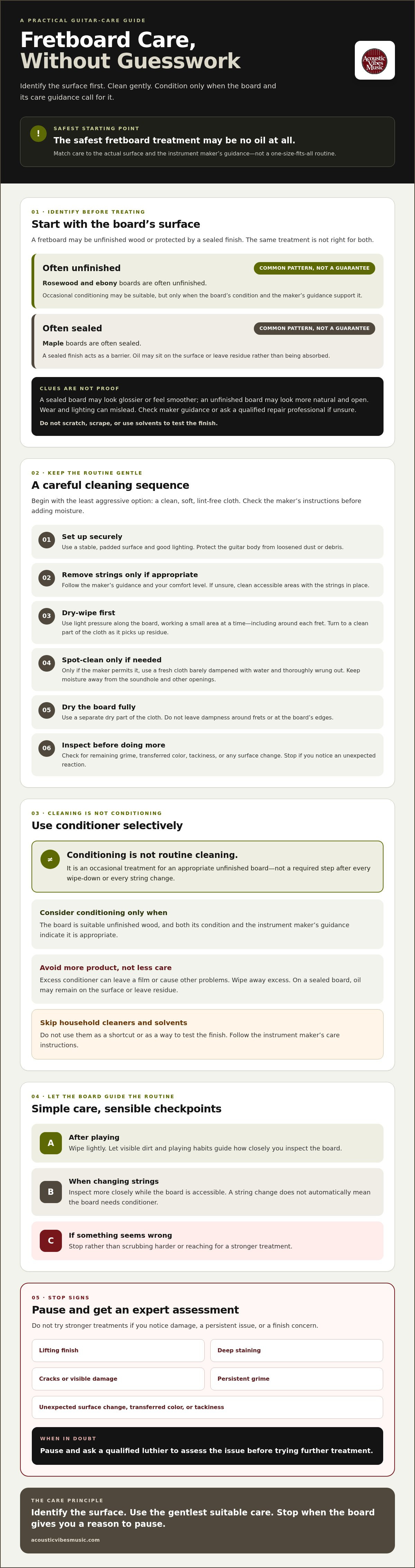
Let the board’s condition and your playing habits set the pace. A light dry wipe after playing can remove fresh fingerprints and sweat before residue builds up. Take a closer look during routine string changes, when the frets and spaces between them are easier to inspect. This keeps guitar fretboard cleaning and conditioning responsive to the instrument rather than tied to an arbitrary calendar.
Wipe when you see residue or after a playing session if the board feels marked by sweat or grime. A deeper clean depends on the amount of buildup, the fretboard’s surface, and the manufacturer’s care instructions. Don’t make conditioning part of every string change: it’s an occasional option for suitable unfinished wood, not an automatic maintenance step. A clean-looking board may need no more than a dry wipe.
Loose dust or a removable smudge is different from a physical change in the instrument. Pause if you find a crack, a lifting fret, persistent sticky residue, finish damage, or an unexplained change in color. These signs may need assessment, not more cleaning. Avoid sanding, scraping, or forcing debris from around a fret; those actions can worsen damage or alter the surface.
For a valued instrument, restraint is part of good care. If the surface changes during cleaning or a mark won’t lift with a gentle method approved by the maker, stop and have the concern assessed by a qualified luthier. Don’t try a stronger product simply to make the board look uniform.
Repair concerns deserve careful evaluation. If you’re unsure whether what you’re seeing is ordinary grime or damage, Acoustic Vibes Music offers professional instrument repair and maintenance by appointment. Ask about a luthier assessment before attempting further treatment.
Good care follows a simple sequence: identify the fretboard surface, clean gently, and condition only if the wood and maker’s instructions call for it. Stop if the instrument shows damage or reacts unexpectedly. This measured approach to guitar fretboard cleaning and conditioning is safer than relying on generic product claims that may not account for your guitar’s particular wood or finish.
A product described as suitable for guitars isn’t necessarily right for every fretboard. The maker’s instructions take priority over broad claims. If you’re uncertain, pause rather than test a treatment on the instrument.
Don’t treat structural or finish concerns as ordinary dirt. Cracks, lifted frets, a finish reaction, unexplained discoloration, or residue that persists after gentle cleaning may need expert assessment. Avoid trying to sand, scrape, or force material from around frets. These signs don’t automatically mean a major repair is needed, but they do make further DIY treatment a risk.
A luthier can assess the instrument and advise on appropriate next steps. Repair needs vary, and not every fretboard concern can be resolved at home with cleaning or conditioner. Acoustic Vibes Music offers professional instrument repair and maintenance by appointment. Contact the shop to ask whether your concern warrants an assessment, without assuming a specific fretboard treatment is available.
Ask about professional instrument repair if you’re unsure how to proceed. A careful pause can help protect the instrument while you get clearer guidance.
Safe guitar fretboard cleaning and conditioning starts with identifying the surface, then choosing the gentlest care that suits it. A soft dry wipe is often enough for routine upkeep; conditioner is appropriate only for some unfinished boards and should never be an automatic step. Follow the instrument maker’s guidance, and stop if you find damage, a finish reaction, or grime that won’t lift gently.
If you’re unsure what your fretboard needs, expert eyes can help you avoid turning a small concern into a larger one. Acoustic Vibes Music specializes in acoustic instruments and offers professional instrument repair and maintenance by appointment. Customers can explore the shop’s collection online or ask about repair and maintenance for a stringed instrument.
Ask about professional instrument repair if you need guidance on what to do next.
No, lemon oil isn’t suitable for every guitar fretboard. The right care depends on the wood, finish, and manufacturer’s instructions. A sealed board may not absorb oil, and an unapproved product could leave residue or affect the finish. Martin, for example, advises against lemon oil because it could break down the nitrocellulose finish on its necks. Check guidance for your specific instrument before applying any oil.
There’s no fixed schedule that suits every fretboard. Conditioning isn’t automatically needed after each string change or cleaning. First confirm that the board is unfinished and that its manufacturer recommends conditioning. If it is, follow the maker’s directions and let the board’s condition guide you. A dry-looking surface is a reason to check the care guidance, not to apply oil without checking.
Usually, a maple fretboard has a sealed finish, so it needs appropriate surface cleaning rather than oil intended to soak into exposed wood. However, maple boards aren’t all finished identically, so verify the specific instrument instead of relying on the wood name alone. Follow the guitar maker’s instructions, and don’t apply conditioner unless the manufacturer confirms it’s suitable for that board and finish.
Yes. You can wipe the accessible parts of the board with a clean, soft, lint-free cloth while the strings are in place. Removing strings can make it easier to reach the full surface and clean between frets, but it isn’t essential for a light wipe. If you remove them, follow the maker’s guidance and your comfort level. Don’t force access by pushing or pulling strings against the board.
A clean, soft, lint-free cloth is the safest starting point for guitar fretboard cleaning and conditioning. For stubborn grime, use a barely damp cloth only if the manufacturer permits it, then dry the board fully. Avoid household cleaners, silicone-containing waxes, abrasives, and harsh solvents unless the instrument maker explicitly approves them. Check the fretboard’s finish first, since care suitable for unfinished wood may not suit a sealed surface.
Too much conditioner can leave residue and may create problems, so more product doesn’t mean better protection. Apply only a small amount if the fretboard is unfinished and the manufacturer approves that conditioner. Follow its instructions and wipe away excess instead of leaving a film on the wood. If the surface becomes tacky, changes appearance, or reacts unexpectedly, stop applying product and seek guidance before trying another treatment.
Ask a qualified luthier to assess cracks, lifting frets, finish damage, unexplained color changes, or grime that persists after gentle cleaning. Stop if the surface feels tacky or changes during care. Don’t sand, scrape, or force debris from around frets, since that can worsen the problem. A professional can evaluate the instrument and recommend next steps; repair needs are individual, and not every concern is suitable for home treatment.