My shopping cart
Your cart is currently empty.
Continue ShoppingThe loudest guitar in the room isn't always the best one, but the right dreadnought is often the only instrument you'll ever truly need. It's easy to feel overwhelmed by the sea of similar-looking dreadnought guitars, especially when you're trying to understand why one model costs a few hundred dollars while another requires a serious investment. You want that legendary projection without the muddy, unbalanced low-end that often plagues lesser builds. We understand that pursuit of tonal perfection. It's the difference between a tool that just makes noise and a curated piece of artistry that responds to every nuance of your touch.
In this guide, you'll discover how to navigate the world of high-end acoustics, from the heritage of the Martin D-28 to the modern innovations of boutique builders like Boucher. We'll break down the science of tonewoods, including the rise of torrefied materials that offer aged resonance from day one. You'll learn exactly what to look for to secure a guitar that doesn't just sound incredible now, but also holds its value as a significant investment. From understanding current CITES regulations on rosewood to evaluating the new 2026 body sizes, we're providing the expert roadmap you need to find your forever guitar.
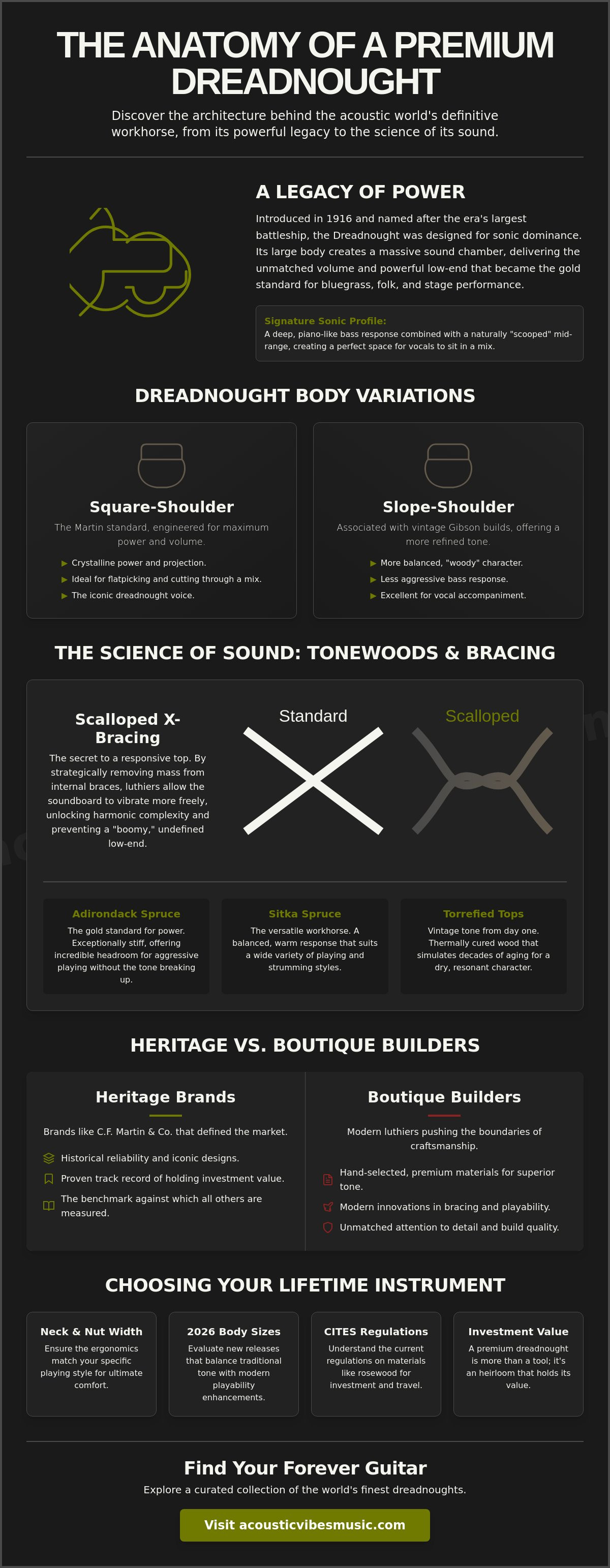
The dreadnought isn't just a guitar; it's an architectural triumph. In 1916, C.F. Martin & Co. looked at the small, polite parlor guitars of the day and decided the world needed something more powerful. They named it after the HMS Dreadnought, the largest battleship of its time. This wasn't marketing hyperbole. It was a literal description of the instrument's sonic dominance. By expanding the waist and deepening the body, they created a chamber capable of moving massive amounts of air. This Dreadnought guitar history reveals a design that didn't just join the market; it conquered it.
The anatomy of the shape is unmistakable. Square shoulders, a wide waist, and a deep body provide the physical foundation for its signature voice. Early iterations were often 12-fret designs, where the neck joined the body at the twelfth fret. This pushed the bridge further into the center of the lower bout, creating a warmer, more resonant tone. The evolution to the 14-fret design in the 1930s changed everything. It offered players better upper-fret access and a punchier, more focused projection. Today, dreadnought guitars remain the primary choice for bluegrass flatpickers who need to cut through a mix of banjos and fiddles, yet they are equally at home in the hands of modern folk strummers seeking a lush, orchestral backdrop.
Unmatched low-end response is the hallmark of this shape. While smaller guitars might struggle to provide a satisfying "thump," the dreadnought delivers a rich, piano-like bass that anchors any performance. This power is balanced by a naturally "scooped" mid-range. This tonal dip isn't a flaw; it's a feature that leaves a perfect pocket for a vocalist's frequency range to sit comfortably without competition. The dreadnought stands as the definitive workhorse of the acoustic world, prized for its ability to handle aggressive flatpicking and delicate accompaniment with equal poise.
Not all dreadnoughts are created equal. The distinction between slope-shoulder and square-shoulder designs is a point of passion for collectors. Slope-shoulder models, famously associated with vintage Gibson builds, often provide a more balanced, "woody" character with less aggressive bass. Square-shoulder designs, the Martin standard, lean into that crystalline power and maximum volume. Body depth also plays a critical role. A deeper body increases sustain and provides a sense of "airiness" as the notes decay, while a slightly shallower build can offer quicker note response. For those seeking the pinnacle of these designs, exploring High End Acoustic Guitars for Sale: The Collector’s Guide to Heirloom Quality can provide deeper insight into how these variations impact long-term value and playability. Whether you prefer the raw power of a traditional build or the refined balance of a boutique variation, dreadnought guitars continue to set the pace for the industry.
If the body shape is the hull of the battleship, the internal bracing and tonewood selection are its engine. A common frustration for many players is an overwhelming, "boomy" low-end that lacks definition. Premium dreadnought guitars solve this through precision-engineered internal architecture. Scalloped X-bracing is the secret. By strategically removing mass from the wooden struts under the top, luthiers allow the soundboard to vibrate more freely. This unlocks a level of responsiveness and harmonic complexity that standard production models simply can't match.
The choice of spruce defines your dynamic ceiling. Adirondack (Red) Spruce is the gold standard for serious players. It's exceptionally stiff, offering incredible headroom for aggressive flatpicking without the tone "breaking up" under a heavy hand. Sitka Spruce provides a versatile, warm response that suits a wider variety of strumming styles. For those seeking immediate vintage character, torrefaction—a process of thermally curing the wood in an oxygen-free oven—simulates the cellular breakdown of a seventy-year-old instrument. This results in a dry, resonant "aged tone" right out of the case. While rare, western red cedar tops sometimes appear on boutique builds, offering a lush, sensitive response for players who prefer a lighter touch.
Forward-shifted bracing moves the "X" intersection closer to the soundhole. This increases the vibrating area of the lower bout, significantly enhancing the bass response and overall volume. The true mark of a premium instrument, however, is hand-scalloping. A master luthier tunes the top by ear, shaving the braces to achieve a perfect balance between structural integrity and tonal clarity. This prevents the muddy sound often found in over-built instruments. Many high-end builders also utilize animal hide glue. Unlike modern synthetic glues, hide glue dries into a glass-like state, facilitating a more efficient harmonic transfer between the wooden components.
The back and side woods act as the instrument's natural equalizer. East Indian Rosewood is prized for its "scooped" mids and shimmering overtones, creating a complex, cathedral-like sound. Conversely, Mahogany offers a punchy, fundamental clarity with a focused mid-range that's ideal for recording and cutting through a live mix. Even the smallest details, like a genuine bone nut and saddle, play a critical role. These high-density materials ensure that string energy is transferred directly to the wood with minimal loss. If you're ready to experience these nuances firsthand, you can explore our curated collection of professional-grade instruments to find your perfect match.
Choosing a high-end instrument is more than a purchase. It's a milestone. For many serious players, the decision often boils down to a fundamental question: do you lean into the storied history of a heritage brand, or do you seek the hyper-focused precision of a boutique builder? Both paths lead to exceptional dreadnought guitars, yet the tonal destination and ownership experience differ significantly. Heritage brands offer a connection to the very foundations of the genre. Boutique builders, meanwhile, push the limits of material excellence through small-batch craftsmanship and individual attention to detail.
C.F. Martin & Co. remains the undisputed benchmark. If you're chasing that iconic "thump" and a vintage-inspired warmth that has defined recorded music for a century, Martin is the gold standard. Their instruments possess a complex, smoky resonance that only deepens with age. Explore our curated C.F. Martin & Co. collection to see how they continue to honor these traditional specifications. Gibson Acoustic provides a different but equally vital flavor. Their slope-shoulder designs are famous for a "dry" and percussive character. This shorter sustain and focused fundamental make them a favorite for singer-songwriters who need a guitar that supports, rather than competes with, a vocal performance. Taylor rounds out the "Big Three" by offering modern consistency and a brighter, more "shimmering" top-end that appeals to contemporary players.
Boutique builders operate with a different philosophy. Instead of high-volume production lines, these workshops focus on "hand-voicing" every top. Collings Guitars is a prime example of this obsession with perfection. Their instruments are known for "hi-fi" clarity across the entire frequency spectrum, offering a level of note separation that is rare in large-bodied guitars. For those who prioritize the finest materials, browse boutique masterpieces from Boucher Guitars. Based in Canada, Boucher has unparalleled access to the highest grades of Adirondack Spruce, resulting in instruments with massive headroom and explosive projection. Atkin Guitars takes a different approach, specializing in a pre-war "relic" feel. They capture the played-in soul of a 1930s instrument while maintaining the reliability of a modern build.
The choice between heritage and boutique often comes down to consistency versus character. A production-line guitar from a major brand offers a predictable, high-quality experience. A hand-voiced boutique instrument offers a unique tonal fingerprint. Beyond the sound, consider the investment. Heritage brands typically enjoy broader name recognition, which can lead to faster resale in the general market. However, boutique dreadnought guitars often hold their value exceptionally well among collectors who recognize the rarity and artisanal skill involved in their creation. Whether you seek a piece of history or a modern masterpiece, the current market is richer than it has ever been.
Finding the right instrument in 2026 requires looking at both established legends and high-performance newcomers. The landscape for dreadnought guitars has never been more competitive. We've curated a selection of standout models that represent the pinnacle of current craftsmanship, ranging from time-tested classics to boutique marvels that push the boundaries of acoustic projection.
The Martin D-28 remains the quintessential choice for those seeking rich overtones and deep bass. It's the "Traditionalist's Choice" for a reason. Its mahogany-backed sibling, the D-18, offers a drier, more fundamental punch that many players find indispensable. For those who prioritize ergonomics and modern feel, the Taylor 810 and 700 series serve as the ultimate workhorses. These professional-grade dreadnought guitars offer a level of playability and consistency that makes them favorites for touring musicians who need reliability on stage night after night.
If you need raw power, the Collings D2H is widely regarded as a "bluegrass cannon." Its precision engineering ensures that every note remains articulate, even when played with maximum force. For the spruce enthusiast, the Boucher BG-151 is a revelation. As a specialist in Adirondack materials, Boucher provides these instruments with explosive headroom and a complex harmonic profile that responds beautifully to a heavy pick attack.
The Martin Custom Shop allows for tailored specifications, creating a unique piece of history for the discerning player. These instruments often feature hand-selected woods and vintage-correct appointments. If your tastes lean toward the golden era of slope-shoulder designs, look no further than the M. Atkin "The Forty Three." It's a stunning tribute to the dry, percussive soul of 1940s builds. You can view our exclusive M. Atkin inventory to see these hand-crafted beauties for yourself.
In the studio, massive volume can sometimes be a liability. Mahogany-backed dreadnoughts, such as the Martin D-18, are often preferred by engineers because their focused fundamental tone doesn't clutter a recording with excessive overtones. They provide a clear, woody character that takes a microphone beautifully. The Collings D1 series is another studio favorite, prized for its exceptional balance across the frequency spectrum. This balance ensures that your tracks require less equalization in post-production. Ready to find your own studio companion? You can shop the full Dreadnought Collection at Acoustic Vibes Music today.
A lifetime guitar isn't defined solely by its label or the grain of its top. It's defined by the connection between the player and the instrument. When you're investing in premium dreadnought guitars, the physical interface, specifically the neck and the nut, becomes just as critical as the tonal output. A guitar that feels like an extension of your body will always be the one you reach for first. These ergonomic details are what separate a temporary tool from a forever companion.
Neck profiles vary wildly between manufacturers. The "Modified Low Oval" favored by many modern builders offers a slim, fast feel that reduces hand fatigue during long sessions. Conversely, a "Vintage V" profile provides a substantial, historical grip that many traditionalists find ideal for thumb-over playing styles. Nut width is another pivotal factor. While the 1 11/16" width is a classic choice for rapid flatpicking and strumming, a wider 1 3/4" nut width provides the essential string spacing required for complex fingerstyle passages on such a large-bodied guitar.
Scale length and action height also dictate the playing experience. Standard scale dreadnought guitars provide maximum tension and volume, but a "short scale" variation can significantly reduce string tension, making the instrument feel "slinkier" and more forgiving. If you're chasing the legendary "bluegrass growl," you'll want a slightly higher action that allows the strings to vibrate aggressively without buzzing against the frets. Every instrument we handle undergoes a professional luthier setup to ensure these specifications are dialed in perfectly before it ever leaves our care.
Buying an heirloom-quality instrument online can feel daunting. To bridge the gap, prioritize dealers who offer high-resolution, actual-instrument photography and professional video demos. You need to see every grain line and hear the specific resonance of the exact guitar you're considering. This level of transparency is vital when you can't physically walk into a gallery. Working with an authorized Expert Dealer provides an extra layer of security, ensuring your solid-wood investment is authentic and backed by full manufacturer support. Just as outdoor enthusiasts might check out Bass Online to secure a professional guide for an iconic freshwater adventure, guitarists benefit from specialized expertise when navigating the complexities of high-end acoustic builds.
Once your guitar arrives, long-term maintenance is your primary responsibility. Solid wood is a living material that reacts to its environment. Protecting your instrument from drastic humidity shifts is the only way to prevent cracks or structural movement over the decades. Invest in a high-quality humidification system and keep the instrument in its case when not in use. Treat your guitar with the reverence it deserves, and it will reward you with a lifetime of evolving tone. Ready to see what's currently in the vault? You can explore 100+ premium dreadnoughts in our online gallery and find the one that speaks to you.
Your forever guitar is more than a purchase. It's a milestone. You now understand how the intersection of heritage bracing and boutique wood selection determines the true utility of dreadnought guitars. Whether you crave the dry, percussive punch of mahogany or the lush, cathedral-like resonance of rosewood, the right instrument is waiting to be discovered. It's about more than just volume. It's about securing a tool that responds to your unique touch and grows with you over decades of play.
At Acoustic Vibes Music, we act as your expert guide through this curated landscape. As a Martin Custom Shop Expert Dealer and authorized representative for legendary names like Collings, Lowden, and Boucher, we've hand-selected every piece in our gallery. We ensure your investment is protected from the start by including a professional luthier setup with every purchase. Take the next step in your musical story and browse our curated collection of 118+ premium Dreadnought Guitars today. We're excited to help you find the voice you've been searching for.
While the large body can be a challenge, it's not strictly off-limits for smaller players. Many find comfort by adjusting their seated posture or choosing a slope-shoulder design, which features narrower upper bouts. If the body depth feels cumbersome, some boutique builders offer slightly thinner variations that maintain the classic footprint without the excessive bulk of a traditional build.
The primary difference lies in the back and side tonewoods. A D-18 utilizes mahogany, resulting in a punchy, fundamental tone with clear mid-range and a "woody" character. A D-28 features rosewood, which offers a more complex sound with rich overtones and a shimmering high-end. It's a choice between the direct clarity of mahogany and the lush, cathedral-like resonance of rosewood.
Bluegrass requires an instrument that can cut through a dense acoustic mix of banjos, fiddles, and mandolins. The massive internal volume of the dreadnought provides the necessary projection and low-end "thump" to hold its own in a jam. This shape offers the massive headroom required for aggressive flatpicking, making it the undisputed industry standard for the genre.
Absolutely. A high-quality hardshell case is essential for protecting your solid-wood investment from physical impact and environmental shifts. Beyond structural protection, a case provides a controlled micro-climate. This makes it much easier to maintain the consistent humidity levels required to prevent the wood from cracking or warping, especially during the dry winter months.
Most professional-grade dreadnought guitars are designed for medium gauge phosphor bronze strings. These strings provide the necessary tension to drive a large spruce top efficiently, maximizing volume and bass response. If you prefer a softer feel, light-medium sets offer a fine compromise, but medium strings remain the traditional choice for unlocking the instrument's full sonic potential.
Yes, though it's traditionally viewed as a flatpicking instrument. Many modern fingerstyle players appreciate the deep resonance and "air" that a large body provides for solo arrangements. To make this work comfortably, look for a model with a 1 3/4" nut width. This wider spacing gives your fingers the necessary room to navigate complex patterns without feeling cramped.
Investing in a professional instrument means looking for specific quality markers rather than a specific price tag. You should prioritize all-solid tonewoods, bone nuts and saddles, and hand-scalloped bracing. These features ensure the instrument will age gracefully and retain high resale value. Instruments at this level are curated for their artisanal skill and material excellence, representing a true lifetime investment.
A slope-shoulder dreadnought features rounded, less aggressive upper bouts compared to the traditional square-shoulder style. This design often incorporates a shorter scale length, which reduces string tension and creates a warmer, more percussive tone. It's a favorite for singer-songwriters who want the power of a large guitar with a slightly more intimate and "woody" character during performances.