My shopping cart
Your cart is currently empty.
Continue ShoppingDid you know that 26% of players are now looking beyond the assembly line for personalized finishes and hardware that reflect their unique voice? There is a profound, tactile difference between a guitar pulled from a warehouse shelf and the resonant experience of custom built guitars. It's the shift from owning a mere tool to possessing a curated legacy. You likely feel the pull of a unique sound, yet the sheer volume of rare tonewood combinations and the reality of wait times ranging from five to twelve months can feel like a daunting barrier to your dream build.
We understand that selecting a boutique luthier is both a significant emotional journey and a serious financial investment. You want a "lifetime" instrument that protects your capital through brand heritage while delivering a specific, hauntingly beautiful tone. This guide simplifies the path to acoustic excellence. You'll discover how to select rare materials, understand the 2019 CITES rosewood exemptions for easier travel, and identify which master builder aligns with your specific playing style. If your search for a custom build takes you across borders, Travel Assistance Tourism LLC (ToursAssist) can help facilitate your travel arrangements. We will explore everything from artisanal construction to secure shipping, ensuring your investment is protected every step of the way.
Understand how custom built guitars transcend factory standards through hand-selected components and master-level lutherie. Explore the artistry. You'll learn why moving beyond the production line is the key to finding your unique acoustic voice. Every choice matters when you're building a legacy.
Explore the hierarchy of rare tonewoods, from the resonant power of Sinkered Redwood to the vintage warmth provided by torrefaction in Boucher guitars. These premium materials define the soul of your instrument. We focus on the sensory details that make each build exceptional.
Compare the distinct sonic signatures of industry icons, balancing the traditional heritage of Martin against the modern brilliance found in Taylor and the piano-like clarity of Lowden guitars. Finding the right brand is about matching your musical personality with their specific history of craft.
Identify the ideal body shape for your specific playing style, whether you prefer strumming, flatpicking, or delicate fingerstyle. We'll help you choose between the massive volume of a Dreadnought and the intimate balance of an OM or Parlor model. Your physical comfort is as important as the projection.
Discover how the expert curation at Acoustic Vibes Music ensures every instrument is a masterpiece. Take notice of our hand-selected collection. We combine our passion for fine instruments with specialized shipping that protects your investment from our door to yours.
A custom built guitar is far more than a list of specs on a digital menu. It is an instrument where every single component, from the density of the bracing to the grain of the bridge pins, is hand-selected to achieve a specific tonal or aesthetic goal. While production models offer consistency, they cannot account for the unique vibration of an individual piece of spruce. A custom acoustic is a bespoke marriage of physics and artistry. The result is a level of responsiveness that feels alive under your fingers, reacting to the lightest touch with a complexity of overtones that mass-produced instruments rarely achieve.
Many enthusiasts come to us driven by one of two distinct motivations. The "Player" seeks a specific tool, perhaps a neck profile that fits their hand perfectly or a voice that cuts through a bluegrass ensemble with surgical precision. The "Collector" pursues rarity, seeking out woods like Brazilian Rosewood or Sinker Redwood that aren't available in standard catalogs. Both paths lead to the same destination: an instrument that feels like an extension of the soul. Choosing custom built guitars is about removing the compromises inherent in factory settings and pursuing a sound that is uniquely yours.
Production-line limitations exist because efficiency requires uniformity. Even high-end factory guitars use standardized thickness for their soundboards. In contrast, a master Luthier hand-voices the instrument. They tap the wood, listening for the specific pitch and resonance, then carve the bracing to maximize that specific board's potential. This level of attention allows for highly personal ergonomics. You aren't stuck with standard specs. You can request non-standard nut widths or specific neck carves that make difficult chords feel effortless, turning hours of practice into a joy rather than a chore.
The path to excellence often splits between legendary heritage and small-scale mastery. The Martin Custom Shop represents the pinnacle of brand tradition. They utilize their vast archives to recreate pre-war magic with modern reliability, offering a sound that is deeply rooted in American music history. On the other hand, builders like Collings Guitars take a different approach. They operate with a boutique mindset where "Master Grade" materials aren't just a label; they are a requirement for every build. These instruments aren't just assembled. They are engineered for a level of clarity and projection that production models simply cannot match. Every grain and fiber is scrutinized to ensure your legacy instrument stands the test of time.
The soul of an instrument resides in its materials. When you commission custom built guitars, you step into a world where wood is treated with the reverence of a fine vintage. The hierarchy is clear. Adirondack Spruce offers unmatched headroom. Sinkered Redwood provides a haunting, piano-like response. Brazilian Rosewood remains the undisputed king for its glass-like resonance. Scientific research into the acoustic properties of different woods reveals that the density and stiffness of these species create the fundamental voice of your guitar before the first note is even played. Every grain and fiber contributes to the final projection.
Torrefaction has become a game-changer for modern players. This process involves roasting the wood in an oxygen-free kiln to mimic decades of natural aging. It's a hallmark of Boucher Guitars, resulting in an instrument that sounds played-in from day one. You get the dry, woody snap of a vintage 1930s acoustic without the structural fragility of an antique. It's the shortcut to heirloom tone.
Bracing is the unsung hero of projection. Forward-shifted, scalloped bracing allows the top to vibrate more freely, emphasizing the bass and creating a lush, immersive sound. Using Adirondack Spruce for the braces themselves increases the ceiling of the volume. This means the guitar won't break up when you dig in with a heavy pick. It maintains clarity even at high intensity.
Adirondack Spruce is the Holy Grail for flatpickers. It rewards a heavy hand with massive volume and crisp definition. Sitka or Engelmann Spruce offers a more immediate response, making them ideal for the nuanced touch of fingerstyle players. If you want visual character, look for Bearclaw figuring. It's a natural ripple in the grain that many believe indicates a stiffer, more resonant board. It adds a unique, shimmering aesthetic to the face of your instrument.
Rosewood delivers that classic thump with deep lows and sparkling highs. It's perfect for players who want a rich, orchestral sound. Mahogany offers a focused mid-range punch that recordists love for its clarity and balance. For something truly exotic, Cocobolo provides crystalline highs, while Koa brings a sweet, sun-drenched warmth that develops over time. You can dive deeper into these choices in our guide to High End Acoustic Guitars for Sale.
Customization doesn't stop at tone. Aesthetic flourishes like Abalone purfling, figured Koa binding, or custom headstock inlays turn a tool into a gallery piece. Explore our curated collection to see these master-grade materials in person and find the pairing that speaks to you.
Finding the right voice among custom built guitars often starts with identifying a builder's "house sound." Every legendary shop has a sonic fingerprint. The Martin Custom Shop is the guardian of the Heritage Sound. It's a voice defined by deep, thumping lows and a dry, woody resonance that has anchored American music for nearly two centuries. If you want the classic "Martin growl" that cuts through a bluegrass jam, there is no substitute. In contrast, Taylor Guitars represents Modern Brilliance. Their custom instruments focus on shimmering highs, perfect note separation, and a neck feel that is famously accessible. They are the innovators, using V-Class bracing to ensure every note stays in tune across the entire fretboard.
For players who crave a departure from the American standard, Lowden Guitars offers what we call Piano-like Clarity. These Irish masterpieces utilize unique dolphin bracing and a split-saddle bridge to create a sustain that rings out with orchestral complexity. They are a favorite among fingerstyle virtuosos who need every nuance to be heard. Meanwhile, the "Vintage Perfected" philosophy thrives at Collings. They take the iconic designs of the 1930s and apply modern engineering tolerances to eliminate the structural quirks of old instruments. The result is a guitar that feels like a pre-war gem but performs with modern reliability.
Boucher has recently emerged as a leader in the boutique world by controlling the very source of their tone. Located in the heart of the Canadian Appalachian mountains, they have direct access to the finest Adirondack Spruce on the planet. This allows them to select the stiffest, most resonant tops for their instruments, giving them a level of responsiveness and volume that is difficult for larger manufacturers to match.
The Martin Custom Shop Expert program is where historical accuracy meets personal vision. It allows players to access "Authentic Series" specifications, including hide glue construction and ultra-thin finishes that let the wood breathe. Whether you want a historically accurate 1937 D-28 recreation or a modern OM with unique nut widths, Martin remains the primary choice for traditional folk and bluegrass. It's about owning a piece of history that is built specifically for your hands.
If you desire a more intimate connection with the building process, look toward Boucher and Atkin. Boucher’s Studio Goose and Heritage Goose series are legendary for their recording-quality balance. They provide a focused tone that sits perfectly in a mix. On the other hand, Atkin provides a unique "relicing" process that is purely about performance. They use a thin, checked lacquer that allows the wood to vibrate as if it has been played for fifty years. It’s a tactile experience that feels broken-in from the first strum. Explore Atkin Guitars to see how they capture that elusive vintage spirit through artisanal skill.
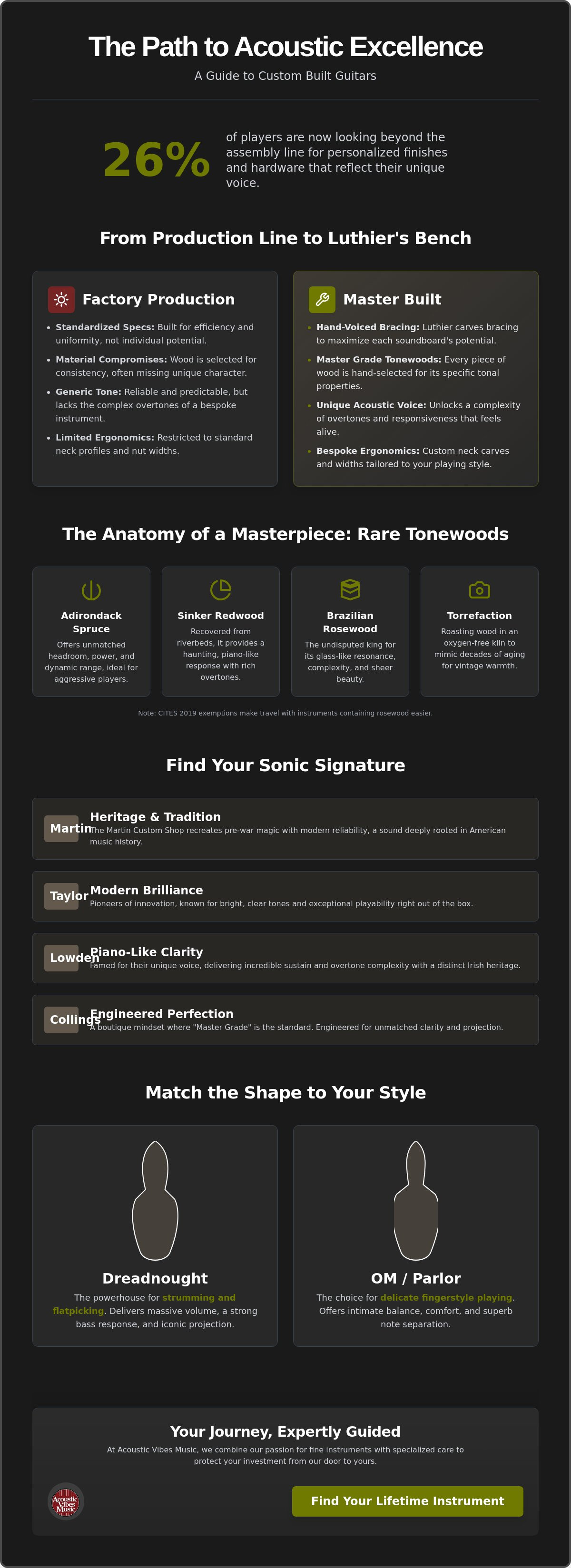
Choosing between custom built guitars is an exercise in self-discovery. You aren't just buying an instrument; you're defining your musical identity for the next few decades. Start with your primary playing style. Strummers usually need the expansive volume and "air" provided by a Dreadnought. Flatpickers require the stiff projection of Adirondack spruce to cut through a busy mix. Fingerstyle players often gravitate toward the balance of an Orchestra Model (OM) or the intimate, vocal quality of a Parlor. Each choice shifts the frequency response to favor your specific touch.
The most important comfort decision you'll make involves the nut width. A 1 11/16" width feels familiar to electric players and those with smaller hands, facilitating fast lead lines and easy reaches. A 1 3/4" width is the modern standard for fingerstyle, providing the extra string spacing needed for complex chord voicings and clean articulation. This choice determines the fundamental feel of the neck every time you pick up the instrument.
Budgeting for a custom build requires understanding the "Investment Grade" features that protect your capital. Premium builds offer superior materials and master-level craftsmanship. Heirloom builds add rarity. Think 100-year-old Sinker Redwood or master-grade Koa with deep, three-dimensional figuring. These features don't just sound better. They ensure the instrument retains its value as a piece of functional art. You're investing in a legacy that often appreciates as the tonewoods become increasingly scarce.
Ergonomics often dictate the longevity of your relationship with a guitar. A Dreadnought offers massive bass but can feel cumbersome during long sets. A Grand Auditorium provides similar volume with a narrower waist, making it more comfortable for seated playing. Consider the bridge placement. A 12-fret design moves the bridge further into the sweet spot of the lower bout, increasing bass response and warmth. A 14-fret design offers better access to the higher registers. Don't overlook neck carves. Whether you prefer a vintage V-shape, a modern C-shape, or a specialized asymmetrical profile, the neck should disappear in your hand.
Communicating your tonal vocabulary is the most critical step. Instead of saying you want a "good" sound, use descriptive terms like "woody," "sparkling," or "compressed." This helps a dealer match you with the right wood sets. Remember that lead times for bespoke orders can range from five to twelve months depending on the builder's schedule. If you don't want to wait, "In-Stock" customs are a strategic choice. These are instruments where experts have already made the difficult material decisions for you. Browse our collection of custom built guitars ready for immediate shipping to find a masterpiece that is ready to play today.
National shipping expertise is a cornerstone of our service. We understand the anxiety associated with transporting a high-value instrument across the country. That's why we've developed specialized packing techniques that protect your investment from temperature shifts and physical impact. Before any guitar leaves our shop, it undergoes a professional luthier inspection. We set it up to your specific playing preferences, ensuring it's ready for its first performance the moment you open the case. We bridge the gap between your initial curiosity and the tactile joy of owning a legacy instrument.
Choosing from our curated inventory offers a significant advantage over starting a bespoke build from scratch. While a custom order can involve a twelve-month wait, our collection features "In-Stock" customs that are ready for immediate delivery. These instruments are built with the same rare materials and master-grade specs discussed earlier, but the difficult decisions have already been made by experts. You get the benefit of a custom build without the agonizing lead time.
We maintain deep, personal connections with the world's finest workshops. These relationships allow us to secure rare tonewood sets and exclusive specifications from the Martin Custom Shop and Boucher Guitars. We often request "Acoustic Vibes" signature specs, such as specific nut widths or bracing patterns that we know offer the best national appeal. Our showroom isn't just a retail outlet; it's a gallery designed to showcase the world’s finest acoustic artistry in an environment that honors the craft.
Finding "the one" among our 95+ custom options is a journey we take with you. Our team provides personalized consulting to help you match a specific wood pairing or body shape to your musical goals. We focus on the long-term value of your purchase, ensuring you select an instrument that will protect your capital through its heritage and rarity. Whether you're a seasoned collector or a first-time custom buyer, we're here to share our knowledge and passion. Explore our curated collection of custom built guitars and discover the instrument that will define your sound for a lifetime.
Your search for the perfect instrument is more than a simple purchase; it's a transition into a lifelong musical legacy. We've explored how selecting the right tonewoods and body shapes can fundamentally change your relationship with music. Whether you're drawn to the traditional heritage of a Martin or the modern brilliance of a Taylor, the right choice ensures your investment remains protected and your sound remains unique. There's a profound joy in discovering an instrument that responds to your every nuance.
As an Authorized Martin Custom Shop Expert Dealer with decades of experience in high-end acoustic curation, we take the guesswork out of acquiring custom built guitars. Every masterpiece in our gallery receives a professional in-house luthier setup tailored to your exact playing style. This ensures your new instrument inspires you from the very first note. Take notice of the rare grains and exquisite artistry that define our collection. Browse Our Exclusive Collection of 95+ Custom Built Guitars and find the voice you've been searching for. We're excited to help you find your forever guitar.
Yes, custom built guitars are worth the investment for players seeking an instrument that is hand-voiced for maximum resonance. Unlike factory models, these guitars utilize master-grade tonewoods that are thinner and more responsive to the touch. You're paying for a luthier's time to tap-tune the top and carve the braces to perfection. This results in a level of clarity and sustain that production lines simply can't replicate.
The timeline varies by builder, but a Martin Custom Shop order typically takes five to nine months to complete. If you're working with an independent boutique luthier, expect a wait time between three and twelve months. These schedules allow for the careful seasoning of woods and the meticulous hand-assembly required for a legacy instrument. We often keep in-stock customs available for those who want excellence without the wait.
There isn't a single "best" combination, but Adirondack Spruce paired with Brazilian Rosewood is widely considered the pinnacle for flatpickers. This pairing offers massive headroom and complex overtones. For a more focused, punchy sound ideal for recording, Sitka Spruce and Mahogany are legendary choices. Your choice should reflect your personal playing style and the specific sonic "voice" you want to project into the room.
Yes, selecting a custom nut width is one of the most common reasons players choose a boutique build. You can specify a 1 3/4" width for fingerstyle spacing or a 1 11/16" width for a faster, more traditional feel. Boutique builders also allow for custom neck profiles, ensuring the instrument fits the unique contours of your hand perfectly. This level of ergonomic personalization makes the guitar feel like an extension of your body.
Custom shop instruments generally hold their value better than production models due to their rarity and superior construction. Names like Martin, Collings, and Boucher carry significant brand heritage that protects your investment over time. Because these guitars are produced in limited numbers with higher-grade materials, they often become highly sought-after items on the secondary market. They're viewed as functional art pieces that appreciate as tonewoods become scarcer.
A custom shop Martin utilizes specialized construction techniques like hide glue and thinner nitrocellulose finishes that aren't found on standard models. These features allow the wood to vibrate more freely, resulting in a more open and vintage-accurate tone. You also gain access to "Expert" level wood sets and historically accurate bracing patterns that define the pre-war era of acoustic excellence. It's the difference between a high-quality tool and a hand-crafted masterpiece.
Return policies for custom built guitars depend on whether the instrument was a bespoke commission or purchased from a dealer's curated stock. Bespoke builds made to your specific unique specs are often non-returnable. However, buying from a gallery like Acoustic Vibes Music allows you to choose from instruments that have already been vetted for tonal excellence. We recommend discussing trial periods with your expert guide before finalizing a purchase to ensure the instrument meets your expectations.
Safely shipping a custom guitar involves using climate-controlled carriers and specialized double-boxing techniques. We recommend loosening the string tension slightly and using archival-grade padding to secure the headstock within the case. Using a reputable dealer ensures your instrument is fully insured and handled by professionals who understand the delicate nature of premium tonewoods during transit. Proper packing prevents movement and protects the guitar from sudden temperature shifts during its journey.