My shopping cart
Your cart is currently empty.
Continue ShoppingWhat if the most iconic guitar in history isn't actually the best fit for your specific flatpicking style? Choosing between the Collings D1 vs Martin D-18 often feels like a choice between a beloved vintage heirloom and a high-performance racing machine. You likely already appreciate the warm, woody thump that has defined the Martin sound for nearly a century. Yet, there's a lingering curiosity about whether the meticulous, hand-voiced precision of a boutique build offers the clarity you've been missing in a loud bluegrass jam.
We understand the hesitation that comes with comparing "standard" versus "boutique" labels. It's difficult to know if a neck profile will suit your hand or if a guitar will truly cut through a dense mix. This guide provides a deep dive into the nuanced differences in resonance, build philosophy, and the 2026 playability updates that set these mahogany legends apart. You'll gain a technical understanding of Martin's refreshed Standard Series neck and the signature "hi-fi" sparkle of the Collings. We'll give you the confidence to select the dreadnought that perfectly complements your technique and your touch.
The mahogany dreadnought is the undisputed workhorse of the acoustic world. It provides the rhythmic heartbeat for bluegrass, the punch for flatpicking, and a reliable foundation for singer-songwriters. While rosewood offers lush overtones, the pairing of mahogany and Sitka spruce is celebrated for its fundamental honesty and dry, woody character. Comparing the Collings D1 vs Martin D-18 isn't just a look at two instruments; it is a study in how a legendary blueprint can be interpreted through two distinct lenses: heritage production and boutique refinement.
For many, the D-18 represents the very soul of the American acoustic guitar. It set the standard for what a professional dreadnought should be. On the other side, Bill Collings launched his workshop with a singular obsession: to take that classic pre-war formula and elevate it through uncompromising engineering. This comparison serves as the ultimate test of "Standard vs. Boutique," challenging players to decide between the warmth of tradition and the crystalline precision of modern lutherie.
The D-18 has undergone a fascinating evolution since its inception. While its 12-fret ancestors were formidable, the 14-fret "Golden Era" models of the 1930s cemented its place in music history. You can trace this journey through the C.F. Martin & Company history, which highlights how the brand adapted to the needs of louder, ensemble-driven performances. A pivotal moment for the modern player was the 2012 redesign. This update reintroduced forward-shifted, scalloped X-bracing to the standard line, a feature previously reserved for more expensive vintage reissues. This change brought back the "Martin Growl," characterized by a powerful bass response and a slightly scooped midrange that allows a vocalist to sit perfectly in the mix. Explore our current selection of Martin Guitars to hear this legacy for yourself.
If Martin is the sound of history, Collings is the sound of absolute clarity. Bill Collings' philosophy was rooted in the idea that every piece of wood is unique. Unlike a high-volume production line, the Austin-based team focuses on hand-voicing every single top. They thickness the wood and carve the braces based on the specific stiffness and density of that individual spruce plate. This ensures maximum resonance and a balanced response across the entire fretboard. While the Collings D1 vs Martin D-18 debate often starts with the D1 being seen as a "refined" Martin, Collings has carved out its own tonal identity. It is famous for "hi-fi" note separation and a brilliant high-end sparkle that never sounds thin. The fit and finish are legendary; every joint and finish pass is executed with a level of detail that borders on the fanatical. View the artistry behind these instruments in our Collings Guitars collection.
The physical construction of these two instruments reveals the fundamental divide between industrial excellence and artisanal obsession. When evaluating the Collings D1 vs Martin D-18, you're looking at two different ways of grading wood and assembling components. Martin operates a sophisticated production facility in Nazareth, Pennsylvania, where consistency is the primary goal. Collings, by contrast, maintains a boutique environment where the goal is to maximize the potential of every individual set of tonewood. It's the difference between a masterfully crafted tool and a custom-tuned instrument.
Materials selection is where the journey starts. Martin uses high-quality Sitka spruce and genuine mahogany, but the sheer volume of their production means they must rely on standardized grading systems. Collings luthiers spend significantly more time sorting through "stacks" to find the stiffest, most resonant pieces for the D1. This selectivity extends to the bracing. Both use scalloped X-bracing, but while Martin uses a forward-shifted pattern to enhance bass response, Collings employs a modified pre-war design that focuses on balance and structural longevity. The result is a guitar that feels incredibly light yet exceptionally strong.
The finish also plays a silent but critical role in the final voice. Both brands use nitrocellulose lacquer, but the application differs. A thinner finish allows the wood to vibrate more freely. Collings is famous for an ultra-thin finish that looks like glass but feels almost non-existent; Martin’s finish is slightly more robust to withstand the rigors of a lifetime on the road. If you're eager to feel these differences in your own hands, we invite you to explore our curated selection of dreadnoughts and find the one that speaks to your technique.
Martin’s modern production is a marvel of efficiency. Every D-18 coming off the line benefits from the PLEK system, a computer-controlled machine that levels frets to within a micron. This ensures that every guitar has a professional-grade setup right out of the box. While some purists prefer manual fretwork, the industry-standard status of the Martin D-28 history and its mahogany sibling proves that Martin’s "factory" build still commands immense respect. It’s a reliable, road-ready instrument that professionals trust for its predictable, classic response.
The defining difference in the Collings D1 vs Martin D-18 comparison is the voicing process. Collings luthiers tap-tune each top, removing tiny shavings of wood from the braces until the plate reaches a specific resonant frequency. This level of individual attention is impossible in a high-volume setting. You’ll also notice the bolt-on neck joint. While traditionalists might prefer Martin’s dovetail, Collings chooses the bolt-on for its incredible stability and the ease of future neck resets. It’s a modern engineering solution that doesn't compromise the "hi-fi" tone they’re known for. Visual perfection is the final touch, with mitred purfling and flawless woodwork that makes the D1 feel like a piece of fine furniture.
The physical foundation of any great dreadnought begins with its dimensions. While both instruments adhere to the industry-standard 25.4" scale length, the way they translate that tension to your fingertips is distinct. This scale length provides the necessary string tension to drive a large spruce top, ensuring the powerful projection expected from a professional instrument. When comparing the Collings D1 vs Martin D-18, the specifications on paper tell only half the story; the real magic lies in the tactile execution of those numbers.
A common misconception is that because both guitars feature a 1 3/4" nut width, they feel identical. In reality, the string spacing at the bridge and the taper of the neck create two very different playing experiences. Martin’s current D-18 utilizes a 2 5/32" string spacing at the bridge, while the standard Collings D1 offers a slightly wider 2 3/16". This extra fraction of an inch on the Collings provides a bit more "air" between the strings, which many fingerstyle players find advantageous. Conversely, the tighter spacing on the Martin often feels more natural for aggressive flatpicking and rapid-fire rhythm work.
The "feel" factor also extends to the finish. Martin’s modern Standard Series features a satin-finished neck that feels broken-in and fast from day one. Collings takes a different path, applying a high-gloss nitrocellulose lacquer to the entire instrument. While this glass-like finish is stunning to behold, some players find it requires a brief "buffing" period to reach that same level of effortless glide. You can explore these tactile differences in person by browsing our Collings Guitars and Martin Guitars inventory.
Martin’s High Performance Taper on their Modified Low Oval neck is designed for the modern professional. It is slim, consistent, and exceptionally easy on the fretting hand during long sets. Collings, however, leans into a vintage-inspired Modified V profile. It offers a more substantial "handful" that tapers beautifully as you move up the fretboard. This design choice is a direct reflection of Bill Collings' quest for perfection, aiming to capture the ergonomic soul of the most coveted pre-war instruments. For players who struggle with hand fatigue, the Martin's slimmer profile is often the safer bet, while those who prefer a traditional grip will gravitate toward the Collings.
The hardware choices highlight the "Standard vs. Boutique" divide. Martin equips the D-18 with reliable, open-gear nickel tuners that perform flawlessly. Collings steps up to Waverly tuners, widely considered the gold standard for precision and vintage aesthetics. Both guitars feature high-grade ebony for the fingerboard and bridge, though the Collings often showcases a higher degree of jet-black uniformity. Even the protection differs; while the Martin hardshell case is a industry staple, the Collings TKL case is legendary for its custom-fit stability and tank-like durability.
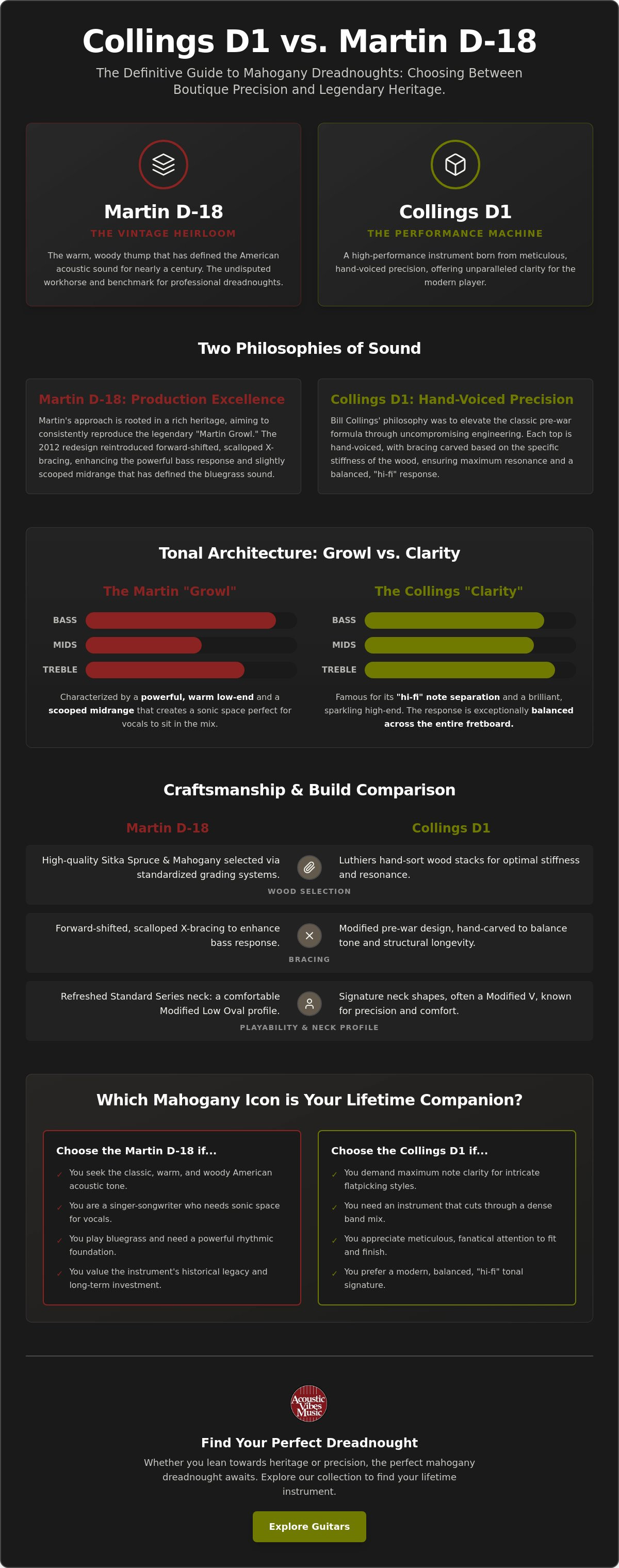
While the physical build defines the feel, the tonal architecture determines the musical soul of these instruments. The Collings D1 vs Martin D-18 debate is essentially a choice between "vintage warmth" and "modern hi-fi." Both guitars utilize the mahogany and spruce pairing to produce a dry, punchy sound, yet they distribute those frequencies in radically different ways. Understanding these harmonic nuances is the key to finding an instrument that complements your specific vocal range or ensemble role. It is a visceral experience that goes beyond simple "brightness" or "warmth."
The fundamental note strength of mahogany is present in both, but the harmonic overtones vary significantly. Martin focuses on a blended sound where the notes bleed into one another to create a lush, supportive cushion. Collings emphasizes note separation, ensuring that every string in a complex jazz chord or a rapid flatpicking run remains distinct. Experience these tonal profiles for yourself by exploring our full collection of professional acoustic guitars today and find the voice that matches your technique.
The D-18 is celebrated for its "scooped" mid-range. This sonic dip creates a natural pocket for a human voice or a lead fiddle to occupy without clashing. Its low-end response is legendary; the famous Martin "thump" provides a percussive, woody foundation for the "boom-chuck" rhythm style essential to bluegrass and folk. Over decades of play, the D-18 matures beautifully. The spruce top loses its initial stiffness, and the mahogany "opens up," resulting in a deeper, more resonant growl that feels like a piece of living history. It is a sound that rewards the patient player.
In a loud jam session, the Collings D1 is often the only guitar that truly cuts through the mix. This projection is a direct result of the hand-voicing mentioned in previous sections. The D1 offers crystalline highs and unrivaled note separation. Even when played with a heavy pick attack, the guitar maintains immense dynamic headroom without compressing or "breaking up." Unlike many production guitars that require years to find their voice, Collings instruments have an immediate, "played-in" response. They feel energetic and responsive from the very first strum, offering a level of clarity that acts as a magnifying glass for your playing style.
Deciding between the Collings D1 vs Martin D-18 is a significant milestone for any serious player. It is a choice that moves beyond simple specifications and into the territory of musical identity. In 2026, the value proposition for both remains exceptionally strong, though they serve different corners of the market. The Martin D-18 continues to be the most accessible entry point into professional-grade, American-made mahogany dreadnoughts. Collings, meanwhile, represents a pinnacle of small-shop engineering where every detail is scrutinized to achieve a specific, high-performance result. Your choice ultimately depends on whether you seek the comforting embrace of tradition or the surgical precision of a boutique build.
Investment value is a common concern for collectors. Martin guitars are the "blue chips" of the acoustic world; their resale market is vast and incredibly stable because the brand name carries a century of trust. Collings instruments hold their value differently. Due to lower production numbers and a reputation for "flawless" quality, they often command a higher percentage of their original price on the used market. When you buy a Collings, you are paying for the labor-intensive hand-voicing that ensures the guitar sounds "mature" from the moment you open the case. Both are heirloom-quality assets that will likely outlive their owners if properly humidified and maintained.
For those who find the standard models don't quite hit the mark, there are specialized paths to explore. You might consider the Martin Custom Shop if you want to pair the classic D-18 chassis with specific vintage appointments like an Adirondack spruce top or a unique neck carve. On the boutique side, the Collings D1 Julian Lage signature model offers a lighter build and a specialized neck profile designed to mimic the feel of a well-loved 1939 specimen. These elevated options provide a bridge between production standards and one-of-a-kind luthier creations.
The final recommendation comes down to the relationship between the player and the tool. The Martin D-18 has a soul that feels lived-in and familiar; it is the sound of the records we grew up with. The Collings D1 is an instrument of pure potential, offering a "hi-fi" response that challenges you to play with more accuracy and intent. Whether you choose the Collings D1 vs Martin D-18, you are securing a world-class mahogany dreadnought that will define your sound for decades to come.
Finding the perfect mahogany dreadnought is a personal journey that balances historical reverence with modern performance. The Collings D1 vs Martin D-18 comparison highlights two distinct paths to tonal excellence. Whether you crave the warm, percussive thump of a Martin or the crystalline note separation of a Collings, you're investing in an instrument that will grow with you for a lifetime. The right choice ultimately mirrors your technique. It's about whether you need a supportive rhythm partner or a precision lead machine that cuts through the densest acoustic mix.
We invite you to experience these masterpieces in person. As an Authorized Martin Custom Shop Expert Dealer, we take pride in our hand-selected inventory of premium Collings models. Professional in-house luthier setups are included with every purchase to ensure your new guitar plays perfectly from the moment it arrives. Explore our curated collection of Martin and Collings Dreadnoughts and discover the artistry that awaits. Your next great musical chapter starts with the right strings in your hands.
The value of a Collings D1 lies in the hundreds of additional hours of artisanal labor required for hand-voicing every top and individual material selection. While the Martin D-18 is a world-class production instrument, the Collings offers a level of refinement and tonal consistency that justifies the premium for professional players seeking a bespoke instrument. It's the difference between a masterfully made tool and a custom-tuned work of art.
Yes, the 2026 Martin D-18 continues to feature Genuine Mahogany (Swietenia macrophylla) for its back and sides. Martin remains committed to sourcing high-quality, sustainable tonewoods for their Standard Series. This ensures the classic, dry, and woody character that has defined the model for nearly a century remains intact for modern collectors.
Both guitars excel in the studio, but they serve different roles. The Collings D1 vs Martin D-18 choice for engineers often depends on the track density. The D1 offers incredible note separation that's easy to mic for lead parts that need to stand out. The D-18 provides a warm, supportive bed that blends perfectly with vocals without requiring heavy EQ adjustments.
You can absolutely order a Collings D1 with a custom nut width. While 1 3/4" is the standard, Collings offers 1 11/16" and 1 13/16" options through their custom ordering process. This flexibility allows you to tailor the playability to your specific hand size or fingerstyle preferences without compromising the guitar's structural integrity.
The Collings Traditional (T) Series is designed to bridge the gap between modern precision and vintage warmth. These models use animal protein glue and a unique bracing voicing to produce a more "rounded" tone. It trades some of the standard D1's hi-fi sparkle for a feel and sound that more closely resembles the "Golden Era" Martin instruments from the 1930s.
The "Martin Growl" refers to the powerful low-end resonance and slightly scooped midrange characteristic of the D-18. It creates a percussive "thump" when you strike the bass strings, providing a rich, woody foundation. This sonic profile is what makes the guitar so effective at driving the rhythm section in a bluegrass or folk ensemble.
Both brands are exceptional investments that hold their value better than almost any other acoustic guitars on the market. Martin benefits from massive name recognition and a high volume of collectors. Collings maintains its value through rarity and a reputation for impeccable construction. A well-maintained instrument from either maker remains a stable asset in the 2026 market.
The Martin D-18 is generally more comfortable for players with smaller hands. Its High Performance Taper and Modified Low Oval neck profile are slimmer than the more substantial Modified V found on the Collings D1. This reduced mass makes it easier to navigate the fretboard and reach complex chord shapes without straining the palm or thumb during long sessions.