My shopping cart
Your cart is currently empty.
Continue ShoppingWhat if the Brazilian rosewood on a guitar isn’t enough to justify its asking price? The wood’s rarity and reputation can draw attention, but brazilian rosewood guitar value depends on more than tonewood alone. If the species or origin is uncertain, or the instrument has repairs, replaced parts, or gaps in its history, the estimate is harder to support.
That doesn’t make a Brazilian rosewood guitar any less compelling. It means a realistic estimate starts with evidence: the maker and model, the guitar’s condition and originality, its provenance, and relevant legal documentation. Just as important, a listing price isn’t proof of what a comparable guitar actually sold for.
This guide explains what affects value, which records and condition details to gather, and how to research comparable instruments without mistaking asking prices for completed sales. It also explains how knowledge of acoustic guitar construction can put a premium instrument in context. Build a clearer picture of what your guitar may be worth and what evidence supports the estimate.
Brazilian rosewood guitar value is the market worth of the complete, documented instrument, not a price assigned to its back and sides alone. It reflects how confidently the wood is identified, as well as the maker, model, age, craftsmanship, condition, originality, provenance, and demand for that particular guitar. These factors work together, so no single detail guarantees a premium.
This distinction separates material prestige from a defensible estimate. Brazilian rosewood, or Dalbergia nigra, has a long history in guitar making and collector culture. Its trade is also tightly regulated: it is listed in CITES Appendix I, so documentation can matter to ownership and international movement. The Dalbergia nigra (Brazilian Rosewood) on Wikipedia overview provides background on its history and conservation listing. For a specific instrument, however, appearance or a seller’s description can’t replace reliable records.
Scarcity, historical associations, and distinctive figure make Brazilian rosewood compelling to many players and collectors. A visually striking set may catch the eye, and the wood’s reputation can lend an instrument a sense of heritage. These qualities can influence buyer interest, but they don’t establish the species, the wood’s origin, or whether its paperwork supports its history. Treat visual appeal as a reason to investigate, not as proof.
Maker and model provide important context. A sought-after design can attract different interest from a less collectible model, even if both use Brazilian rosewood. Year and craftsmanship matter too, as do original finish, hardware, and other components. Repairs may be appropriate and well executed, yet still affect originality or buyer confidence. Two guitars with the same wood can therefore occupy very different places in the market.
Material comparisons also need care. Rosewood and mahogany have distinct histories, visual character, and construction uses; the wood label alone doesn’t rank the quality or worth of a finished guitar. Consider the instrument as a whole: how its materials serve the design, how well it was built, and how it has held up. That broader view is more useful than assuming one tonewood automatically sounds or sells better.
Finally, distinguish asking price from completed-sale evidence. A listing shows what a seller hopes to receive, not what a buyer paid. A documented sale of a closely comparable guitar offers stronger market evidence, though differences in condition, originality, provenance, and sale circumstances still matter. Build an estimate from verifiable details and relevant market evidence, not just the rosewood name or one ambitious listing.
No single checklist ranks every instrument the same way. A model with strong collector interest may still be affected by major repairs, while an unusual custom specification may matter greatly to one buyer and less to another. Use the factors below to assess how each detail supports, complicates, or limits a value estimate.
Maker and model: Collector recognition can shape demand, but the exact model and its documented specifications matter more than a name alone.
Age: The production period may be relevant to a model’s history, but age by itself doesn’t establish rarity or desirability.
Condition: Structural stability, wear, and repair quality affect confidence in the instrument and its appeal to buyers.
Originality: Original finish and components can matter to collectors; modifications may change that appeal even if the guitar remains playable.
Documentation: Records may support the maker, model, date, wood identification, ownership history, and applicable legal paperwork.
Market evidence: Completed sales of closely comparable instruments are more informative than asking prices, though differences still need weighing.
These details interact. Confirming the wood’s identity may strengthen an instrument’s story, but it can’t erase condition concerns or make a less sought-after model equivalent to a more collectible one. Visible Brazilian rosewood grain is not the same as verified species identification. Grain and colour may prompt further investigation, but they don’t establish species, source, or chain of ownership. Treat these as separate questions, supported by different evidence.
Start with the instrument’s precise identity, then compare its construction with documented examples of that model. A respected maker may build instruments across different eras and specifications, which can attract different buyers. Age provides context, not a shortcut to value. Custom features may add interest when records confirm what they are and comparable instruments show that relevant buyers value them.
For a practical comparison, record the model name, serial or other identifying marks, stated year, body style, and any non-standard specifications. Separate what you can verify from what a seller or previous owner has reported. A listing’s description of Brazilian rosewood is a claim to investigate, not proof by itself.
A guitar’s overall condition can outweigh a single prestigious material detail. Assess structural soundness and repair history separately from cosmetic wear. A documented, stable repair differs from an unexplained crack; a finish change differs from ordinary checking. Replaced parts may reduce originality without making the guitar unpleasant to play or unsuitable for a musician.
Playability deserves its own consideration. Setup affects how comfortably an instrument performs, but it doesn’t establish originality or market demand. Keep observations distinct: note visible wear, known repairs, finish changes, replaced components, and current playability. Avoid automatic percentage deductions; the effect depends on the instrument and evidence from relevant sales. A clear record makes your view of brazilian rosewood guitar value more transparent. For context on how makers and specifications vary across acoustic instruments, explore our acoustic guitar selection.
Strong comparisons start with evidence of a transaction, not a striking number in a current listing. Look first for recent completed sales of the same maker and model, then narrow by production period, specifications, and condition. If exact matches are scarce, broaden the search carefully to similar instruments and explain what differs. A useful comparison makes those limits clear instead of treating every guitar described as Brazilian rosewood as interchangeable.
Start with the same maker and model. For each example, record its year, stated wood, specifications, condition, repairs, modifications, provenance, included case, sale date, and sale status. The table below shows how to classify evidence, including real asking-listing examples identified in the available market research. The named listings are not completed-sale results; their asking prices alone can’t establish what buyers paid.
| Example | Evidence status | How to use it |
|---|---|---|
| Closely matched guitar with a verifiable transaction record | Completed sale | Use as a core comparison, then account for differences in condition, originality, and specification. |
| A listing page marked sold, without a confirmed transaction amount | Sold listing | It indicates the item is no longer offered, but doesn’t by itself confirm the final sale price. |
| 1954 Martin D-28, converted to 1937 specifications, listed in November 2024 | Asking price | Use only as a historical seller-price reference; the conversion makes originality and specification especially relevant. |
| Bourgeois OM Vintage with Brazilian rosewood and an Adirondack top, listed in October 2026 | Asking price | Useful for current asking-price context, not as proof of a completed sale. |
Leave out records too thin to match confidently. A title that says “Brazilian rosewood” without a clear model, year, condition, or sale status may help you discover search terms, but it’s weak valuation evidence. Note the source and date, and distinguish a confirmed transaction from a page that was simply removed from sale.
A refinished instrument, replaced components, or substantial repairs may attract different buyers from an otherwise similar, original guitar. Documentation can also affect confidence in the wood claim and history. Record an included case rather than assuming it is equivalent to the case in another sale. These differences are reasons to qualify a comparison, not apply a fixed deduction.
Group the strongest matches and describe a reasoned range only when several credible transactions support one. If your evidence is limited to listings, say so. If results are old or specifications differ, lower your confidence. For a realistic brazilian rosewood guitar value, separate confirmed sale evidence from asking-price context and identify the differences that could move the estimate. One ambitious listing is a clue, not a market average.
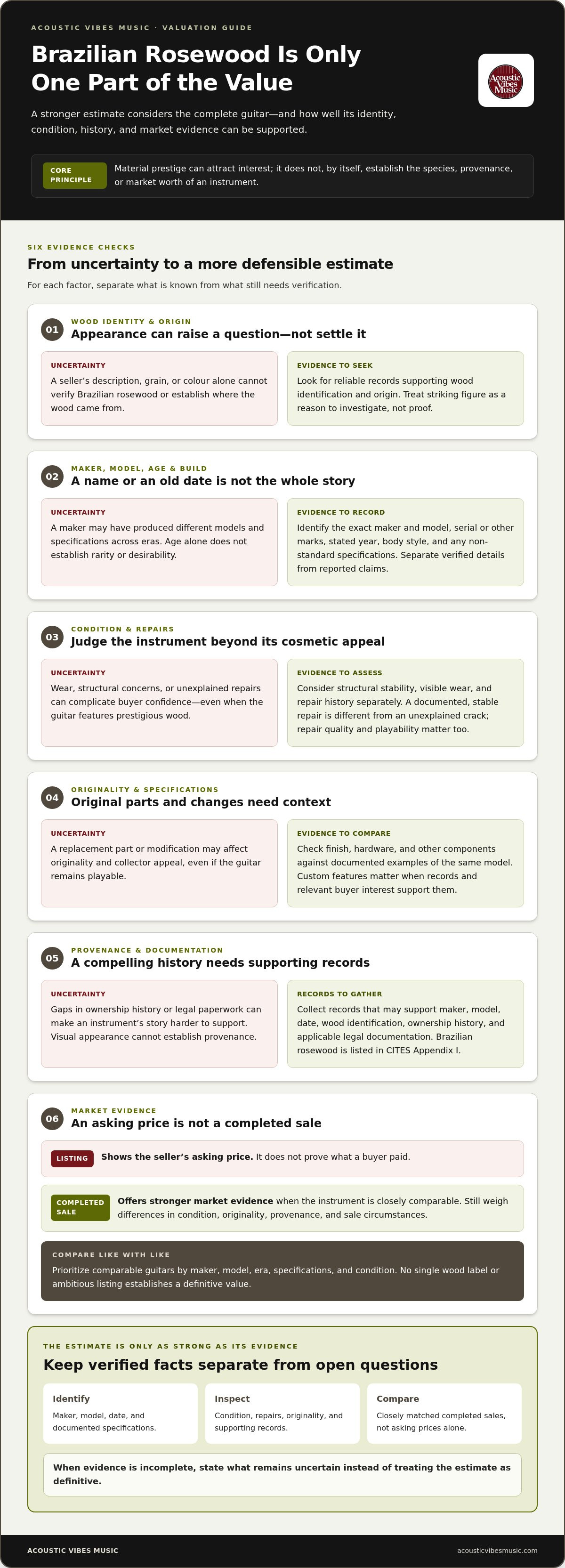
Build an evidence file before forming a view of the instrument. Separate what you can observe from what documents establish, and note gaps rather than filling them with assumptions. This makes it easier to assess the guitar’s identity, condition, history, and potential documentation needs.
Collect original sales paperwork, maker records, repair invoices, and ownership history where available. Record the maker, model, serial number, stated year, and stated wood specifications. A serial number can help you research an instrument’s history, but it can’t prove the back and sides are Brazilian rosewood. Check that records refer to this specific guitar, not simply a similar model or a set of wood.
Keep condition notes factual. Describe what you see, where it appears, and whether repair records support it; don’t diagnose a structural issue from photographs alone. Legal paperwork answers a different question from a maker record: one may support identity or history, while trade eligibility depends on applicable rules and evidence recognized by the relevant authorities.
Appearance can suggest a wood type, but it can’t prove species, source, ownership history, or trade eligibility. Grain and colour are not substitutes for documentation. If species identification or provenance remains uncertain, say so plainly. That uncertainty can affect how confidently you assess Brazilian rosewood guitar value. Keep records and condition notes together as you research the instrument. For context on acoustic guitar construction and materials, explore the acoustic guitar selection.
Bring the evidence together before settling on a number. A useful estimate connects comparable completed sales to the guitar’s specific maker, model, period, condition, originality, and supporting records. It also makes uncertainty visible. If the wood identification, ownership history, or sale evidence is incomplete, say so. Don’t let a confident seller description turn an open question into a verified fact.
Summarize the closest completed sales and explain why each one is relevant. Note meaningful differences, such as a different production period, refinishing, repairs, replaced parts, missing documentation, or sale context. Keep seller claims and your own assumptions separate from details backed by records or a confirmed transaction.
This is a research-based estimate, not a formal appraisal or a promise of what the guitar will sell for. The eventual result depends on the specific instrument, buyer interest, sale conditions, and the quality of the evidence presented. A carefully explained estimate is more useful than a precise-looking figure built on an uncertain wood claim or one asking price.
If you’re considering a sale, organize the records and condition notes so a prospective buyer can follow the instrument’s story. Clear photographs and repair documentation make details easier to assess, while identifying unknowns candidly helps set realistic expectations. Acoustic Vibes Music offers used and consignment instruments as one route for selling a guitar, though research alone can’t guarantee a particular sale price or outcome.
For broader perspective on craftsmanship, collectibility, and premium acoustic instruments, explore our high-end acoustic guitar collector’s guide. When you’re ready to compare instruments through their construction and maker details, take a look at our curated acoustic guitar selection. The same disciplined approach brings clarity to brazilian rosewood guitar value: match the evidence to the instrument and keep unknowns visible.
A guitar’s value can be a useful starting point, not the whole story. Decide what matters most for your next move: preserving the instrument’s originality, preparing it for sale, or finding a guitar whose craftsmanship and voice suit your playing. Keep your research notes with the instrument’s records, and revisit your estimate if new documentation or stronger comparable sales come to light. That way, your understanding of brazilian rosewood guitar value can develop with the evidence instead of resting on a fixed assumption.
For a closer look at the details that distinguish acoustic instruments, explore a specialist selection of new and pre-owned guitars. Acoustic Vibes Music also provides professional luthier repair and maintenance services by appointment. Explore the curated acoustic guitar selection to compare instruments and take your next step with confidence.
No. Brazilian rosewood may attract collectors, but the wood alone doesn’t guarantee a higher price. For example, an instrument with uncertain identity or extensive alterations may interest buyers less than a well-preserved guitar with a sought-after model and clear records. To assess brazilian rosewood guitar value, compare the whole instrument with relevant completed sales, not just another guitar described as having the same tonewood.
No. Colour, grain, and figuring can look distinctive, but visual inspection alone can’t conclusively establish Brazilian rosewood species or source. Lighting, finish, aging, and individual wood variation can also affect appearance. Treat a striking grain pattern as a reason to investigate, not proof for an insurance record or sale description. Seek reliable supporting documentation before presenting the wood identification as verified.
No. A serial number can help establish a guitar’s maker, approximate production details, or place in a model’s history, depending on the maker’s records. It doesn’t identify the actual wood used on an individual instrument. Custom orders and later repairs may also mean a guitar differs from standard specifications. Compare serial research with original build paperwork, repair records, and other instrument-specific evidence.
Yes. Brazilian rosewood, Dalbergia nigra, is listed in CITES Appendix I. The rules that apply can depend on the instrument, its history, and the proposed transaction or movement. Don’t assume that an old guitar is automatically exempt or that paperwork for one purpose covers another. Before buying, selling, shipping, or travelling with an instrument, consult current CITES guidance and the relevant national authorities.
No. Age can make a guitar historically interesting, but it doesn’t establish rarity, collector demand, or good condition. A later instrument from a sought-after model may attract more interest than an older guitar with substantial damage or undocumented changes. Check the production period against reliable maker records, then consider how the guitar’s specification and condition compare with instruments buyers have actually purchased.
Yes. A refinished guitar can remain collectible and playable, particularly if its model, craftsmanship, and history appeal to buyers. However, a changed finish may matter to collectors who prize originality. Keep any refinishing records and distinguish documented work from what can only be observed. The impact depends on the instrument and buyer, so compare it with sales of similarly altered guitars rather than applying a blanket deduction.
No. Tonewood can contribute to an instrument’s character, but it can’t guarantee that every player will prefer its sound. The top, body design, construction, setup, and playing style all shape the result. If you’re considering a guitar, listen to the instrument itself and assess whether its response suits your music. A prestigious wood label is no substitute for the sound and feel you enjoy.