My shopping cart
Your cart is currently empty.
Continue ShoppingA factory machine can cut a piece of spruce to a thousandth of an inch, but it can't hear the wood's soul. You know that finding a truly exceptional boutique mandolin for sale involves more than just comparing specs on a screen. It's about the luthier's intuition, that specific moment when hand-carving transforms a block of maple into a responsive, vibrating masterpiece. It's natural to feel a bit of hesitation when you're looking at high-value instruments online. You want to ensure the craftsmanship matches the prestige, especially with the current market seeing record demand and multi-year waitlists for top-tier builders.
Owning a handcrafted instrument is a journey into artistry and a smart long-term investment. We're going to help you distinguish between standard production and genuine luthier excellence. You'll learn how specific tonewoods like Adirondack spruce and figured maple interact in a small-body build, and why the hand-voiced process is the secret to that elusive lifetime tone. We'll also provide the clarity you need to navigate online procurement with total confidence. Let's explore the nuances of modern mandolin lutherie and find the instrument that will define your collection for decades.
A boutique mandolin isn't just a product. It's a hand-voiced sculpture. In 2026, the definition of boutique centers on luthier-led, small-batch production where individual attention isn't a marketing slogan but a structural necessity. When you look for a boutique mandolin for sale, you're stepping away from the assembly line and into a world where a master artisan's intuition guides every chisel stroke. These builders don't aim for "good enough" for the price point. They aim for the absolute peak of what four pairs of strings can achieve.
Scarcity is a core component of this market. Many of the most respected shops produce a mere handful of instruments each year. This limited output creates an environment of extreme quality control. By studying the history and styles of the mandolin, it becomes clear that the greatest instruments ever made were those where the builder had a personal relationship with the wood. This is why boutique builds remain the gold standard for professional recording and serious heirloom collecting.
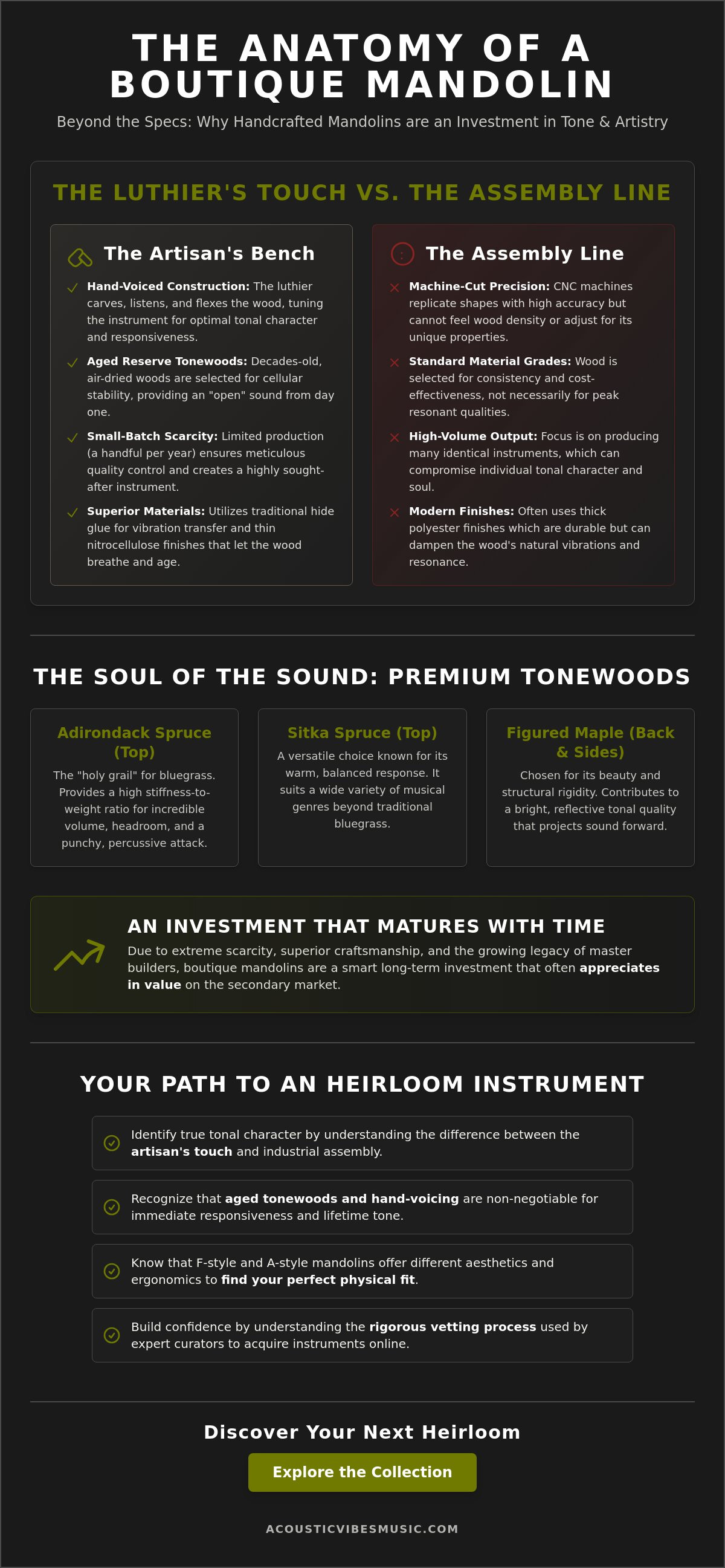
Factory production excels at mechanical precision, but it often lacks tonal soul. CNC machines can replicate a shape, but they can't feel the density of a spruce top. In a boutique "bench-built" environment, a luthier may oversee the entire process from the first join to the final setup. They select reserve-grade materials, often wood that has been air-drying for decades, specifically for its resonant properties. This results in a level of tonal complexity and overtone richness that mass-produced models simply can't match. Look for the tight grain of Adirondack spruce or the deep flame of premium maple. These aren't just for show; they're the engine of your sound.
Every builder has a signature sound. Some lean toward a modern, crystalline punch, while others chase a warm, woody thud reminiscent of the 1920s. Builders like Collings Guitars have refined this by bridging the gap between traditional techniques and modern structural reliability. They use ultra-thin nitrocellulose finishes that allow the wood to breathe and age naturally. Unlike thick polyester finishes that can dampen resonance, nitrocellulose ensures the instrument "opens up" as you play it.
Traditional hide glues are another staple of the boutique world. These glues create a glass-like bond that doesn't creep over time and facilitates superior vibration transfer across the instrument's body. This meticulous focus on construction is what makes a boutique mandolin for sale a lasting investment. It's a commitment to quality that ensures the instrument doesn't just play well today but sounds even better fifty years from now.
The physics of a mandolin are remarkably unforgiving. Because the instrument has such a small air chamber, every square millimeter of wood must work twice as hard as it would on a guitar. There's no room for "dead" weight or inconsistent density. When you browse a boutique mandolin for sale, you aren't just looking at a pretty object; you're looking at a high-tension acoustic engine. Master luthiers select aged tonewoods that have reached a state of cellular stability. This ensures the instrument offers immediate responsiveness and that coveted "open" sound that usually takes decades to develop in lesser builds.
While machines can mill a top to a specific shape, they can't feel the wood's resistance. A luthier uses tactile feedback, often carving the plates by hand with tiny finger planes. They listen. They flex the wood. This process, often supported by research shared through the Guild of American Luthiers, allows the builder to account for the unique character of every individual piece of spruce or maple. It's a level of precision that assembly lines simply can't replicate.
Adirondack Spruce, often called Red Spruce, remains the "holy grail" for players seeking the classic bluegrass "bark." It possesses a high stiffness-to-weight ratio, allowing for incredible headroom and a punchy, percussive attack. Sitka Spruce offers a warmer, more versatile response that suits various genres. For the back and sides, boutique builders prioritize highly figured European or Domestic Maples. These aren't just for aesthetics. The grain density and flame pattern contribute to the structural rigidity and the bright, reflective tonal quality necessary for a mandolin to cut through an ensemble. If you're curious about how these woods translate to performance, you can see these materials in action across our curated mandolin collection.
The real magic happens during graduation. This is the process of hand-thinning the soundboard and back plate, sometimes to a fraction of a millimeter. A boutique builder uses "tap-tuning" to listen to the resonant frequencies of the wood as they carve. They adjust the graduation to ensure the top vibrates with total freedom while remaining strong enough to withstand the bridge's downward pressure. By meticulously tuning the f-holes and the internal tone bars, the builder maximizes the instrument’s projection and balance. Ultimately, voicing is the luthier’s ability to manipulate wood to reach its peak resonance, ensuring that every note across the fretboard is clear, harmonically rich, and powerful. This level of detail is why a boutique mandolin for sale represents the pinnacle of acoustic engineering.
The most common question for any enthusiast looking at a boutique mandolin for sale is simple: is the scroll worth the price? It's a fair point of confusion. In the world of high-end builds, the iconic F-style scroll is a testament to a luthier's patience and technical precision. However, it's essential to demystify the ornamentation. Structurally, the internal air chamber of an F-style is virtually identical to its A-style counterpart. You're paying for a visual masterpiece, a sculpture that requires dozens of additional hours of meticulous hand-carving. For the performing musician, a boutique A-style will almost always outperform a factory-made F-style in terms of raw tone and projection.
Consider how you play. The points on an F-style body act as natural anchors, making it exceptionally comfortable for seated sessions. Conversely, the teardrop A-style is sleek and lightweight, often preferred by those who spend hours standing on stage. Both styles rely on the same fundamental physics of tonewoods where the density of the spruce top and maple back determines the final voice. If you prioritize "bang for your buck," the A-style is the collector's secret weapon, offering world-class luthier craftsmanship without the "scroll tax."
F-styles are the darlings of the bluegrass world for a reason. They offer a focused, percussive "chop" that cuts through a loud banjo or fiddle with ease. If your heart is in Celtic or Classical music, you might find the lyrical sweetness and sustain of an A-style more compelling. Boutique builders excel here; they ensure their A-style models maintain professional-grade volume and a complex harmonic range. This proves that you don't need a scroll to be heard in the back row of an auditorium. Choose the F-style for that legendary bluegrass punch, or opt for an A-style for a bell-like clarity that sings in more intimate settings.
Evaluating a boutique instrument requires a keen eye for detail. Look closely at the scroll. Is it perfectly graduated? Is the binding mitered with surgical precision? These are the hallmarks of a master luthier. Beyond the shape, consider the finish. Premium models often feature hand-rubbed oil varnish or ultra-thin nitrocellulose, which allows the wood to vibrate with total freedom. We invite you to explore our full mandolin and guitar collection to see these differences firsthand. From the complex geometry of a perfectly carved scroll to the understated elegance of a sunburst A-5, every instrument in a boutique mandolin for sale listing represents a distinct artistic philosophy.
Acquiring a high-tier instrument is a dual-purpose endeavor. It serves as a musical masterpiece and a tangible asset. Unlike mass-produced goods that depreciate the moment they leave the showroom, a boutique mandolin for sale from a legendary builder often moves in the opposite direction. The secondary market for names like Gilchrist, Monteleone, or "The Dude" (Lynn Dudenbostel) remains incredibly robust. These instruments frequently sell for significantly more than their original purchase price because the demand for world-class lutherie far outstrips the physical capacity of a single artisan's workshop.
Limited production runs create a natural supply-and-demand curve that favors the owner. When a builder produces only six to ten instruments a year, every existing piece becomes a rare commodity. There is also the "opening up" phenomenon to consider. As a boutique instrument is played, the wood fibers and resins settle into a state of harmonic maturity. A well-loved, five-year-old mandolin often possesses a complexity and resonance that a brand-new instrument hasn't yet achieved. This tonal evolution makes used boutique models highly sought after by professionals who want a "broken-in" sound without the decades-long wait.
A luthier's career trajectory directly impacts the value of your collection. When a renowned builder announces retirement or their waitlist stretches beyond five years, the market value of their available work can spike overnight. Identifying "rising star" luthiers before they reach this peak is the secret to a smart investment. Established brands like Collings Guitars and Boucher have already achieved a "modern vintage" status. Their consistency and heritage ensure that their instruments remain staples of the high-end market, providing a reliable baseline for collectors who value both performance and resale security.
Protecting your investment requires more than just careful playing. Humidity control is the most critical factor in maintaining the structural integrity of thin-carved boutique plates. Professional setups and minor adjustments should only be handled by specialists who understand the nuances of hand-voiced instruments. Provenance also plays a massive role in resale value. Always retain the original paperwork, hangtags, and the specialized cases provided by the builder. These elements verify the instrument's history and ensure it maintains its "gallery" condition. If you are ready to start or expand your collection, browse our current inventory of investment-grade mandolins to find a piece that resonates with your musical and financial goals.
At Acoustic Vibes Music, we view our collection as more than an inventory. It's a curated gallery of acoustic excellence. We operate as passionate curators who understand that a master-built instrument is a legacy. Finding a boutique mandolin for sale should feel like a milestone. We only carry instruments we would be proud to play ourselves. This rigor ensures that every scroll, fret, and finish meets our exacting standards before it ever reaches your hands. We invite you to experience the tactile difference of an instrument that has been handled with reverence from the moment it arrived in our shop.
We know that shipping a high-value instrument can be nerve-wracking. To solve this, we've perfected the art of national shipping. Every instrument leaves our shop in professional, climate-controlled packaging designed to withstand the journey across the country. You can trust that your new heirloom will arrive in the same pristine condition it left our gallery. Our logistics process is as meticulous as the luthiers who build these masterpieces. We handle the details so you can focus on the music.
Our expertise extends across the most respected names in the industry. We are proud specialists in brands like Taylor, Lowden, and the C.F. Martin & Co. collection. This deep knowledge allows us to bridge the gap between established legends and the most innovative new luthiers working today. Whether you seek the traditional "bark" of a heritage build or the modern crystalline clarity of a rising star, our selection reflects the highest quality standards in the acoustic world. We constantly update our inventory to ensure you have access to the finest craftsmanship available in 2026.
We don't just sell instruments; we act as your expert guide. Every player has a unique tonal "voice" they are chasing. We take the time to understand your style, your preferences, and your goals. Our professional in-house luthier repair services ensure that every instrument receives a tailored setup before it ships. We adjust the action and intonation to suit your specific touch. This personalized attention is what transforms a purchase into a partnership. Explore our boutique mandolins and guitars today and discover the instrument that speaks to you. Your next lifetime companion is waiting.
You've explored how the convergence of rare tonewoods and master-level voicing creates an instrument that transcends the ordinary. A boutique build is more than a simple acquisition. It's a commitment to a specific tonal vision that factory models simply can't replicate. Whether you've chosen the percussive punch of an F-style or the lyrical sustain of an A-style, you're investing in a piece of functional art that will only grow more resonant with time. These instruments aren't just tools; they're heritage pieces designed to be played and passed down.
Finding the right boutique mandolin for sale requires a partner who understands the nuances of the craft as deeply as the builders themselves. As an authorized dealer for world-renowned luthiers, we take pride in our role as expert guides. Every instrument in our collection receives a professional in-house luthier setup tailored to your playing style. Our expert national shipping uses climate-controlled packaging to ensure your new heirloom arrives in gallery condition. Take the next step in your musical journey and explore the pinnacle of handcrafted artistry today.
Browse Our Curated Collection of Boutique Mandolins
The pursuit of perfect tone is a rewarding path. We're excited to help you find the instrument that speaks your language and inspires your best work for decades to come.
The main difference lies in the hand-voicing process where a luthier adjusts the wood's thickness based on its unique resonance rather than a set factory spec. This meticulous attention results in a more complex, responsive instrument with superior sustain. While a production model offers consistency, a boutique instrument provides a distinct, "one-of-one" personality that matures beautifully over decades of play. It's the difference between a mass-produced tool and a bespoke work of art.
Whether the extra cost is worth it depends on your appreciation for the artisan's carving skill and the iconic bluegrass silhouette. An F-style requires significant additional labor to hand-carve the scroll and points, which is why it commands a higher price. Tonal differences are often negligible between the two styles in a boutique setting, so the investment primarily reflects the visual artistry and historical prestige of the F-5 design. It's a statement of craftsmanship.
Adirondack (Red) Spruce and highly figured Maple are the gold standards for professional-grade builds. Adirondack provides the stiffness needed for a powerful "bark" and high headroom, while Maple offers the bright, reflective qualities that allow the mandolin to cut through a mix. Boutique builders select these sets based on grain density and stiffness to weight ratios to ensure every square inch of the instrument vibrates with purpose. This combination is essential for that classic, punchy sound.
Builders voice a mandolin by meticulously tap-tuning the soundboard and back plate during the carving process. They remove wood in fractions of a millimeter while monitoring how the resonant frequency of the plate shifts. This ensures that the top and back work in harmonic sympathy with the air chamber. It's a delicate balance of structural integrity and acoustic freedom that a machine cannot replicate. This process is what gives a boutique instrument its characteristic "soul" and projection.
Instruments from world-renowned luthiers often appreciate because their annual output is extremely limited compared to global demand. When you find a boutique mandolin for sale from a builder with a long waitlist, you're looking at an asset that typically holds its value or increases as the builder's reputation grows. Provenance and original condition are the most critical factors in determining long-term investment returns. It's a smart way to enjoy a world-class instrument while protecting your capital.
Prioritize dealers who provide high-resolution photography, detailed tonal descriptions, and professional in-house setups. You should look for transparency regarding the instrument's history and a clear understanding of the luthier's specific building philosophy. A reputable dealer acts as an expert guide when you browse a boutique mandolin for sale, offering audio samples and answering technical questions about graduation and neck profile before the instrument ever ships. This ensures you make a confident, informed decision from afar.
You should maintain a consistent humidity level between 45% and 55% using a high-quality case humidifier and a digital hygrometer. Boutique instruments use thin-carved plates and traditional glues that are sensitive to rapid environmental changes. Keeping the mandolin in its case when not in play is the most effective way to prevent cracks, bridge sinking, or finish checking caused by dry air. It's a small effort that preserves the instrument's integrity for generations.
Varnish is preferred because it is thinner and more flexible than standard lacquer, allowing the wood to vibrate with less restriction. This organic finish takes months to cure properly but rewards the player with a warmer, more "woody" tone and a faster "opening up" period. It also ages gracefully, developing a rich patina that many collectors find more aesthetically pleasing than the high-gloss look of modern synthetics. It's the choice for those who prioritize pure acoustic resonance.