My shopping cart
Your cart is currently empty.
Continue ShoppingChoosing between a Boucher and a Collings isn't about finding the "better" guitar. It's about deciding whether you want an instrument that roars with raw, Adirondack-fueled power or one that sings with surgical, engineered precision. When you're diving into the Boucher vs Collings guitars debate, the technical specs can feel like a mountain of data. You've likely spent hours comparing torrefaction methods and bracing types, worried that a major investment might not actually suit your physical playing style.
We understand the pressure of choosing between these titans. You want an instrument that validates your passion every time you open the case. This comparison reveals the nuanced differences in tone, construction, and playability between these two world-class builders. We'll guide you through the 2026 updates, from Boucher's refined Bluegrass Goose series to the vintage-voiced Traditional models from Collings. By the end, you'll have a clear understanding of each brand's house sound and the confidence to select a model that perfectly matches your physical playing style and musical goals.
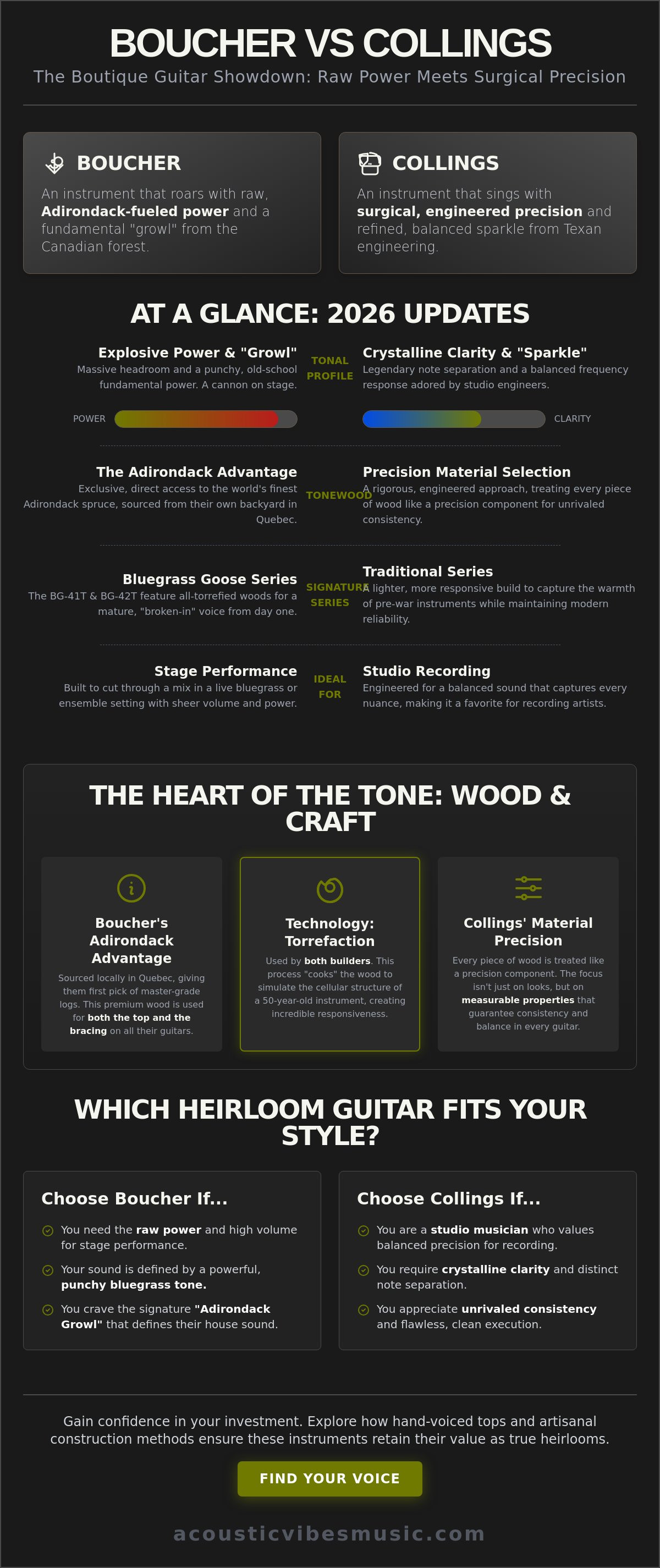
In 2026, the acoustic world is witnessing a fascinating clash between two philosophies of perfection. On one side, you have the raw, atmospheric power of Quebec's Boucher Guitars. On the other, the legendary, surgical precision of Austin's Collings Guitars. This isn't your standard factory comparison. We're looking at the "boutique" tier. These instruments surpass factory-standard builds by prioritizing hand-voiced tops and individual material selection over mass-market efficiency. The current market is hungry for authentic, vintage-inspired voices. Players are demanding high-performance materials like torrefied tops and premium Adirondack spruce. Choosing between Boucher vs Collings guitars often comes down to whether you prioritize the fundamental "growl" of a Canadian forest or the refined, balanced sparkle of Texan engineering.
Robin Boucher didn't just start a guitar company; he built a gateway to some of the finest tonewoods on the planet. Based in the heart of Quebec, Boucher has a unique logistical advantage. They sit at the source of the world's best Adirondack spruce. Their "Bluegrass Goose" series has earned a reputation for being a cannon on stage. It's built for the player who needs massive headroom and a punchy, old-school fundamental power. For 2026, they've pushed the envelope further with the all-torrefied BG-41T and BG-42T models. These instruments arrive with a "broken-in" maturity that usually takes decades to develop. Check out our latest Boucher Guitars to see how they've refined the 2026 line with new dart-style volutes, upgraded tuners, and a new bridge design with a long saddle.
If Boucher is about raw power, Collings is about unrivaled consistency. Bill Collings founded the company with an obsession for detail that bordered on the fanatical. That spirit lives on in their Austin workshop. Every instrument that leaves the bench is a masterclass in clean execution. A quick look at the Collings Guitars history shows a brand that never settles for "good enough." Their Traditional Series is a prime example of this evolution. It uses a lighter, more responsive build to capture the warmth of pre-war instruments while maintaining the legendary "Collings Sparkle." At the NAMM 2026 show, they introduced models like the C10 Traditional and the C-00, proving they can blend vintage character with modern reliability. Explore our curated selection of Collings Guitars to experience this level of precision firsthand. It's a different kind of excellence, one that focuses on note separation and a balanced frequency response that studio engineers adore.
Deciding between Boucher vs Collings guitars often involves understanding the material foundations of each builder. Both brands have embraced torrefaction as a cornerstone of their 2026 lineups. This thermal treatment "cooks" the wood in an oxygen-free environment, evaporating volatile oils and resins to simulate the cellular structure of a 50-year-old instrument. While both shops use this technology to create incredible responsiveness, they diverge when it comes to their primary top woods and finishing touches. Whether you prefer the lush overtones of East Indian Rosewood or the fundamental punch of Genuine Mahogany, the way these woods are selected and treated defines your final heirloom experience.
Boucher holds a unique trump card in the lutherie world. Based in the heart of Quebec, they source their Adirondack spruce directly from their own backyard. This isn't just a marketing story; it means they have first pick of the finest logs before they ever reach the open market. Because of this proximity, Boucher uses Adirondack spruce exclusively for both tops and bracing across their entire lineup. Their "Gold Touch" series categorizes these tops into specific grades, from AAA to the elusive Master Grade, ensuring each player gets the exact level of aesthetic and tonal perfection they desire. By sourcing these rare materials locally, Boucher can provide master-grade Adirondack tops on models that might otherwise be prohibitively expensive if the wood were imported.
Collings takes a different approach, treating every piece of wood like a precision-engineered component. They don't just look for pretty grain; they test every top for specific stiffness-to-weight ratios to ensure maximum vibration. While Adirondack is a staple for their high-headroom dreadnoughts, they often utilize Sitka spruce for its versatile, "all-around" character in smaller bodies. In their Traditional series, they've returned to using animal protein glue, a traditional hide glue that dries harder and more brittle than modern synthetics, allowing for superior energy transfer between the wood surfaces. This level of Collings craftsmanship and innovation ensures that every note is distinct and crystalline. The finishes also tell a story: Boucher’s high-gloss provides a shimmering, durable protection, while Collings’ ultra-thin nitrocellulose lacquer is designed to let the wood breathe and age naturally over time.
This distinction is vital when evaluating Boucher vs Collings guitars for your specific climate and aesthetic taste. If you're curious how these materials feel in your own hands, you can explore our latest arrivals of Collings guitars to see the precision for yourself.
The real magic happens when you strike that first chord. In the Boucher vs Collings guitars comparison, tone isn't just about frequency; it's about the emotional response of the wood. Boucher instruments are famous for their "growl." They possess a massive low end that feels like it’s vibrating through your ribs. Collings, however, offers a legendary "sparkle." It’s a crystalline high end where every note in a complex jazz chord is distinct. While both builders utilize premium materials, their internal voicing leads to two very different musical destinations. One roars while the other sings.
If you’ve ever sat in a crowded bluegrass circle, you know the struggle to be heard. The Bluegrass Goose was designed specifically to solve this. It cuts through the percussive chop of a mandolin and the piercing ring of a banjo with ease. This isn't just volume; it's a specific type of compressed power. When you dig in with a heavy right hand, the Adirondack top doesn't distort. It pushes back. It rewards aggressive flatpicking with a rich, overtone-heavy response that fills the room. It’s also a living instrument. While torrefaction provides a head start, these tops continue to "open up" significantly over the first 12 months. The sound becomes less tight and more resonant as the wood fibers settle into their new life as a guitar.
Precision is the hallmark of the Austin sound. For the studio professional, Collings Guitars are often the first choice because of their incredible string-to-string balance. Strike a low E and a high E simultaneously; they’ll ring at the exact same perceived volume. This consistency is a dream for recording engineers. You won't find "boomy" frequencies that muddy up a microphone’s signal. Instead, you get a focused midrange punch. This "honk" helps the guitar sit perfectly in a dense mix without needing excessive EQ. While Boucher leans into lush overtones, Collings focuses on the fundamental note. It’s a clean, honest sound that reveals every nuance of your technique. Whether you’re playing a delicate fingerstyle arrangement or a punchy rhythm track, the clarity remains unmatched.
Your choice often depends on your physical touch. Boucher guitars thrive under pressure. They have a ceiling that is remarkably high, making them ideal for stage performers who need to fill large spaces. Collings guitars, conversely, are incredibly responsive to a light touch. They don't require much energy to start the top moving. This makes them versatile for players who jump between styles. One offers a landscape of complex harmonics and swirling overtones. The other provides a focused, surgical strike of pure pitch. Both are masterpieces, but they serve different masters.
When you hold these instruments, the difference in philosophy becomes a physical sensation. In the Boucher vs Collings guitars debate, playability is where the luthier’s hand meets the player’s intent. Boucher focuses on an organic, hand-voiced resonance that makes the guitar feel alive against your chest. Collings, meanwhile, is often cited as the industry benchmark for "perfection," offering a level of fit and finish that feels almost impossibly clean. Whether you prefer the artisanal touch of tap-tuned tops or the surgical accuracy of Texan engineering, both brands deliver a world-class tactile experience that justifies their heirloom status.
Every Boucher top is hand-voiced by skilled luthiers who tap-tune the wood to find its maximum resonance. This results in an instrument that feels incredibly responsive. For the 2026 lineup, Boucher has introduced significant comfort updates. The Bluegrass Goose series now features a new dart-style volute and a more pronounced V-shaped neck, providing a secure, vintage-inspired grip for flatpickers. These models also include refined neck tapers that reduce fatigue during long performances. If you want a guitar that feels like it was grown in the forest specifically for your hands, explore our current Boucher Guitars collection.
Collings takes a mechanical approach to playability that is unrivaled. Their specialized bolt-on neck joint is a marvel of engineering, ensuring a rock-solid connection that maximizes energy transfer while allowing for easier maintenance decades down the road. The fretwork is legendary; every Collings is dressed to such a high standard that they are arguably the most "in-tune" guitars on the market. The internal bracing of a Collings guitar is flawlessly carved and sanded to a mirror-like smoothness, ensuring every cubic inch of the interior contributes to the instrument’s structural integrity. While Boucher leans into the V-shape for 2026, Collings offers a variety of profiles, from the sleek Modified V to the fuller Traditional neck.
Playability out of the box is where your investment truly shines. Both brands typically ship with 1 3/4" nut widths as a standard, though custom options abound for different hand sizes. The factory setups are meticulous, with string spacing designed for clean fingerstyle or aggressive flatpicking. If you’re ready to feel this level of craftsmanship for yourself, compare our boutique acoustic collection to find the neck profile and setup that perfectly matches your touch.
The journey to finding your perfect instrument eventually moves beyond technical specs and into the soul of your music. When settling the Boucher vs Collings guitars debate for your own collection, you must consider how the guitar supports your specific performance environment. Both builders represent the pinnacle of 2026 lutherie, yet they serve different masters. Your decision rests on whether you need a tool that dominates a room with sheer acoustic force or one that provides a perfectly balanced canvas for intricate arrangements. These aren't just guitars; they are legacy pieces that will grow with you for decades.
For the bluegrass specialist, Boucher is often the ultimate choice. The sheer volume and low-end "thump" discussed in our tonal analysis make it the deciding factor when you're competing with a banjo or fiddle. If you have an aggressive "attack" and want a guitar that won't top out, the Boucher is your stage companion. Conversely, the studio professional often leans toward Collings. The legendary balance across the strings saves precious time in the control room because the frequencies are already where they need to be. It’s a surgically clean sound that allows every nuance of a recording to shine without the need for heavy post-production EQ.
Solo performers and singer-songwriters face a different choice. A Collings provides a "piano-like" orchestral support, offering a wide, crystalline frequency range that complements a vocal without stepping on it. A Boucher provides a "wall of sound" that can make a solo performer sound like a full ensemble. From an investment perspective, both brands hold their value remarkably well. Collings remains the blue-chip standard for resale, while Boucher is the rising star of 2026, with collectors increasingly seeking out their master-grade Adirondack builds. For more on the investment side, see our guide on High End Acoustic Guitars for Sale.
We take our role as your expert guide seriously. Every Boucher and Collings in our shop is hand-selected to ensure it meets our rigorous standards for tone and beauty. We know that reading about these instruments is only the first step. You need to hear the "growl" and feel the "sparkle" for yourself. That is why we offer a national shipping and trial policy. It allows you to play these titans side-by-side in your own environment, ensuring your chosen heirloom is the one that truly speaks to your soul.
Ready to make a definitive choice? Schedule a private consultation with us for a deep-dive comparison. We’ll help you navigate the nuances of neck profiles and tonewood pairings to find your match. You can invest with total confidence knowing that every instrument receives a professional setup and long-term maintenance support from our luthier services. Explore our full collection of Acoustic Guitars today and discover the instrument that will define your sound for the next generation.
Choosing between the raw, Adirondack-fueled power of a Boucher and the surgical, engineered precision of a Collings is a milestone in any player’s journey. We’ve explored how Boucher dominates the stage with thunderous volume while Collings offers the crystalline clarity required for elite studio work. Ultimately, the Boucher vs Collings guitars debate is settled by your own touch and the musical stories you intend to tell. Both brands represent the pinnacle of modern lutherie. This ensures your choice is an investment in quality that will resonate for generations.
As an authorized dealer for Boucher, Collings, Martin, and Taylor, we’re dedicated to helping you find the perfect match. Every instrument in our gallery receives an expert-level luthier setup before it leaves our shop. We provide national shipping with professional, climate-controlled packaging. This means your new heirloom arrives in pristine condition regardless of your location. Don’t let the technical specs overwhelm you. Let the music guide your decision. Our team is here to act as your expert guide through every step of the process.
Experience the Artistry: Shop Our Curated Boucher and Collings Collection
Take the next step in your musical evolution. We’re excited to help you find the instrument that speaks to your soul and inspires your best work yet.
Boucher guitars are often preferred for bluegrass when raw volume and a thunderous low end are the primary requirements. Their Bluegrass Goose series is specifically voiced to cut through the mix of a loud acoustic jam. While Collings offers incredible clarity, the "Boucher growl" provides the massive headroom that many flatpickers need to compete with banjos and fiddles.
Boucher’s competitive pricing stems largely from their direct, local access to the world’s finest Adirondack spruce in Quebec. By sourcing their own materials, they eliminate the high costs of importing premium tonewoods. Collings’ price point reflects the intensive, multi-step engineering process and the higher overhead of their Austin based workshop where every component is precision tested for stiffness.
Collings guitars currently maintain a slight edge in resale value due to their decades of established reputation as a blue chip boutique brand. However, the 2026 market shows Boucher is rapidly closing this gap. As more collectors discover the rarity of Boucher’s master grade Adirondack builds, their status as a high value heirloom instrument continues to rise significantly.
The primary difference lies in the tonal philosophy; the Goose is an explosive cannon while the D2H is a precision tool. The Bluegrass Goose utilizes Adirondack spruce for all its bracing and tops to maximize power. The Collings D2H typically uses Sitka spruce to achieve a more balanced, "recording ready" sound that emphasizes note separation over raw acoustic volume.
You can certainly use light gauge strings on a Boucher, though you may notice a slight decrease in the instrument’s total volume. These guitars are braced to handle medium strings which fully drive the stiff Adirondack top. Switching to lights will increase playability and comfort, but it might soften the aggressive punch that defines the 2026 Boucher vs Collings guitars comparison.
Collings is the industry benchmark for ultra thin nitrocellulose lacquer finishes that allow the wood to breathe and age naturally. Their finish is applied with surgical precision to ensure it doesn't dampen the guitar's vibration. Boucher uses a high quality gloss finish that provides excellent protection and a shimmering aesthetic, though it feels slightly different under the hand than a traditional Texas nitro finish.
The Traditional series is worth the investment for players who demand a warmer, more responsive vintage character and a "broken in" feel. It utilizes animal protein glue and a lighter bracing structure to replicate the sound of pre-war instruments. If you prefer a more modern, crystalline sparkle, the standard series remains an exceptional choice that offers unrivaled clarity.
Both processes successfully simulate the cellular structure of aged wood, but Boucher has made torrefaction a core standard for much of their 2026 lineup. Boucher’s torrefied tops are known for their immediate, "old school" fundamental power right out of the case. Collings’ Aged Tone technology is a specialized upgrade that provides a similarly mature resonance while maintaining the brand’s signature refined sparkle.