My shopping cart
Your cart is currently empty.
Continue ShoppingWhy does a hand-carved scroll on an F-style mandolin often command a price tag thousands of dollars higher than its A-style counterpart when the internal air volume remains nearly identical? It's a question that frequently surfaces for players searching for the best mandolins for sale in a market where boutique craftsmanship is reaching new heights. You want an instrument that resonates with clarity and punch, yet the fear of investing in a high-priced instrument that doesn't live up to the cost or overpaying for purely aesthetic flourishes can feel paralyzing.
We understand that a truly exceptional mandolin is a feat of acoustic engineering where the smallest carving decisions yield the largest sonic rewards. This guide promises to demystify the complexities of mandolin construction, from the tactile response of different tonewoods to the structural differences that justify premium pricing. You'll gain a confident understanding of mandolin anatomy and learn which boutique brands offer the most enduring investment value. We are diving into the specific specs required for your musical genre, giving you the clarity needed to secure an heirloom instrument that defines your signature sound.
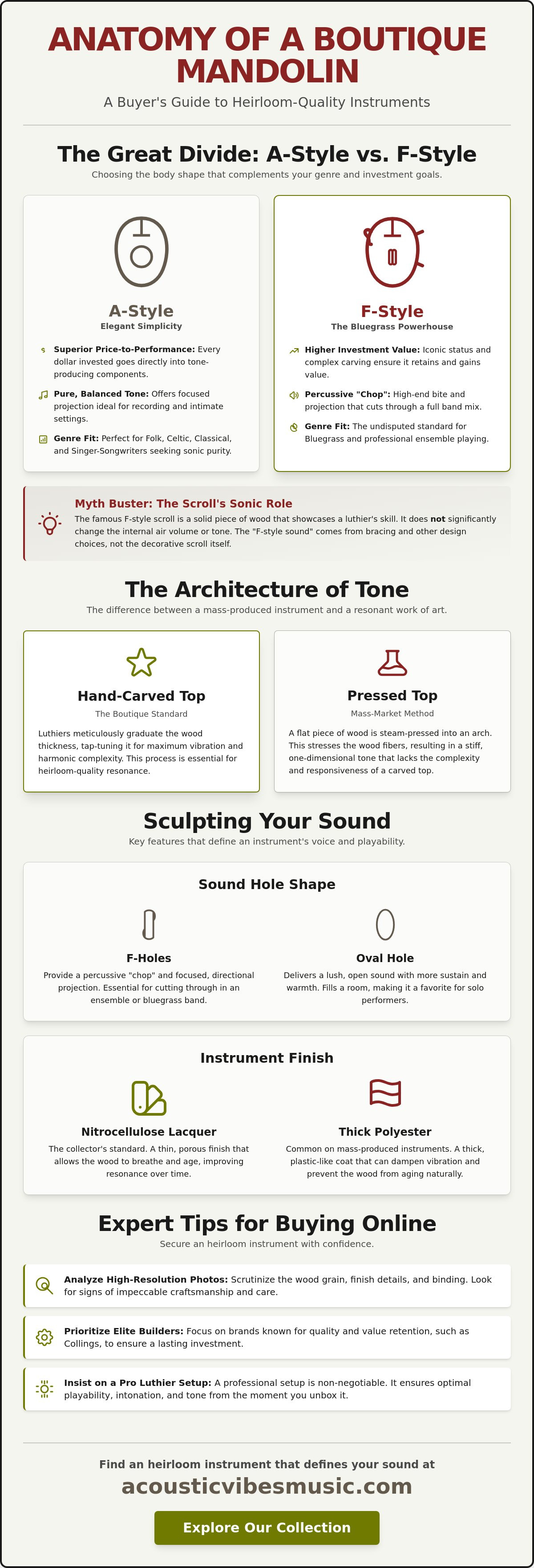
Choosing between an A-style and an F-style instrument is often the first major decision for anyone browsing the best mandolins for sale. While the visual differences are striking, the choice impacts more than just stage presence. It influences balance, price, and your standing within specific musical communities. Both styles share the same scale length and tuning, but their architectural paths diverge sharply when it comes to construction labor and historical prestige.
For those seeking a comprehensive overview of the mandolin and its evolution, it's clear that these two silhouettes have defined the modern era of the instrument. The F-style remains the gold standard for acoustic investments in 2026. Its complex geometry requires dozens of additional hours of artisanal carving, which naturally drives up the secondary market value. Collectors prize the F-style for its iconic status, ensuring these instruments retain their worth far better than mass-produced alternatives.
A-style mandolins are defined by their symmetrical, teardrop-shaped bodies. Because they lack the decorative scroll and points of the F-style, they often offer the superior price-to-performance ratio. You aren't paying for the labor-intensive carving of non-sonorous wood. Instead, every dollar goes toward the quality of the spruce top and the precision of the graduation. The teardrop shape provides a focused projection and a clean, balanced tone that appeals to folk players, Celtic traditionalists, and singer-songwriters. It's a streamlined tool for the pure musician who prioritizes sonic purity over ornate flourishes.
The F-style is the undisputed king of the bluegrass stage. Characterized by its Florentine scroll and sharp body points, this design was popularized by the legendary Bill Monroe. The architectural complexity of the scroll is a testament to a luthier's skill; it's a difficult feature to carve and bind correctly. Beyond the looks, the added mass of the points actually helps the instrument balance better when you're playing with a strap while standing. This "Bluegrass Powerhouse" provides a percussive "chop" and a high-end bite that cuts through the roar of a banjo and fiddle. Even when looking for the best mandolins for sale today, the F-style remains the most sought-after configuration for professional ensemble work.
Let's debunk the most persistent myth: the scroll does not significantly change the sound. It's a solid piece of wood that doesn't increase the internal air volume. The "F-style sound" is more about the parallel bracing and f-holes typically found on these models rather than the scroll itself. However, the psychological impact of playing an F-style is real. It carries a sense of tradition and authority that an A-style simply cannot replicate on a festival stage.
The body shape defines the silhouette, but the graduation of the top wood defines the soul. If you're scouring the market for the best mandolins for sale, you'll encounter two primary construction methods: pressed and hand-carved. Pressed tops are made by steam-forming a flat piece of wood into an arch. This method is efficient for mass production, yet it stresses the wood fibers and often results in a stiff, one-dimensional sound. Boutique luthiers instead utilize hand-carving to graduate the thickness of the top. They meticulously remove wood from specific areas, tap-tuning the plate to ensure maximum vibration and a complex harmonic response.
The finish on a high-end instrument is more than skin deep. A thin Nitrocellulose lacquer remains the industry standard for collectors. Unlike thick polyester finishes that act like plastic wrap, Nitrocellulose is porous. It allows the wood to age and open up over years of play, improving resonance as the organic materials settle. Your choice of sound holes further sculpts this output. F-holes provide the percussive chop and directional projection essential for ensemble play. Oval holes offer a lush, sustained warmth that fills a room, making them a favorite for solo performers. Discover the difference a master-built instrument makes by exploring our curated selection of boutique acoustic instruments.
Adirondack Spruce is the undisputed cannon of top woods, offering the high headroom required for aggressive flatpicking. When paired with Figured Maple, the result is a striking balance of stiffness and beauty. The flame and quilt patterns in the maple aren't just visual upgrades; they indicate a dense, stable wood that reflects sound with surgical precision. The exceptionally tight grain of 2026-sourced spruce provides a higher stiffness-to-weight ratio, which directly translates to superior note clarity and faster transient response.
Internal architecture dictates the mandolin's openness right out of the box. Parallel tone bars are the secret to that classic mid-range bluegrass bark, providing the structural support needed for a focused, punchy sound. X-bracing offers a more modern, balanced, and sweet tonal profile with increased sustain across the entire fretboard. This bracing choice determines whether your instrument will have a vintage-style compression or a wide-open, contemporary voice. Understanding these internal skeletons is vital when evaluating the best mandolins for sale, as they define the instrument's long-term sonic trajectory.
The transition from a standard factory instrument to a boutique build is a defining moment for any musician. In 2026, the market has shifted toward a "Modern Vintage" philosophy. Builders are no longer just copying old designs; they are refining them with modern precision and advanced spectral analysis to recreate the dry, woody response of pre-war instruments. This dedication to small-shop luthiery ensures that production numbers remain low, which in turn drives long-term investment value. When you search for the best mandolins for sale, you aren't just buying wood and wire. You're acquiring a piece of acoustic history that has been optimized for the contemporary stage.
When looking for the best mandolins for sale, the conversation inevitably centers on Collings. Their workshop in Austin, Texas, has become the benchmark for consistency and tonal excellence. The MT series offers a professional-grade A-style build with a simplified aesthetic, while the MF series provides the iconic F-style silhouette for those who demand the ultimate bluegrass look. Tone purists often gravitate toward their varnish finishes. This labor-intensive coating is thinner than standard lacquer, allowing the spruce top to vibrate with unparalleled freedom. For multi-instrumentalists, the same level of obsessive detail found in the Collings collection is also present in their world-class Collings Guitars, making them a favorite for players who value a unified tonal palette across their arsenal.
While Gibson defined the archtop mandolin, C.F. Martin & Co. carved out a unique niche with their flat-back designs. These instruments offer a different flavor of resonance, often sounding more "guitar-like" with a sweet, lingering sustain. Finding a Martin Custom Shop instrument allows you to bridge the gap between these two worlds, utilizing premium Adirondack spruce and mahogany for a distinctive folk voicing. Meanwhile, vintage Gibson A-models from the early 20th century are increasingly seen as the perfect "entry-level" vintage investment. They provide a gateway to the Gibson legacy without the five-figure price tag of a Loar-era F-5, offering a rich, historical tone that modern factory builds struggle to replicate.
Many collectors find that their passion for these small-bodied instruments naturally leads them toward other heirloom-quality strings. This is why mandolin players often transition to high-end acoustic guitars as they expand their collections. The same appreciation for hand-graduated tops and premium tonewoods applies across the board. This scarcity ensures that the best mandolins for sale from these workshops remain blue-chip assets, appreciating in both sonic character and market value as they age.
Selecting an instrument is about more than aesthetics; it's about matching a specific sonic fingerprint to your musical intent. When you're browsing the best mandolins for sale, you must consider how individual build specs will interact with your genre's demands. A bluegrass player needs an instrument that can fight through a dense acoustic mix, while a solo jazz performer might prioritize harmonic complexity and sustain. Understanding these nuances ensures you don't just buy a high-quality mandolin, but the right one for your hands.
In the world of bluegrass, the mandolin serves as both a melodic lead and a percussive snare. You need that legendary "chop." This requires an instrument with f-holes and parallel tone bars, which focus the energy into a sharp, mid-range bark. High-end bite is essential here. Without it, your solos will get lost behind the banjo's metallic ring. Conversely, classical and jazz players often seek out oval-hole models. These designs offer superior note separation and a lingering sustain that f-holes typically compress. For those playing Celtic or folk music, the A-style remains a versatile workhorse. Its balanced projection makes it an ideal companion for vocal accompaniment or intricate fiddle tunes.
If your primary goal is studio work, raw volume is actually a secondary concern. Microphones prefer a balanced frequency response over sheer decibels. An instrument that's too "boomy" or "shrill" can be a nightmare to mix. Look for a mandolin with even graduation across the top to ensure every string speaks with equal authority on the track. This balance allows the natural woodiness of the instrument to shine through without the need for heavy equalization.
Mandolin skills translate beautifully to other small-bodied strings. The precision required for a 13.875 inch scale length makes moving to a larger instrument feel effortless. While you explore the best mandolins for sale, consider the unique voice of our Orchestra Model collection. These guitars bridge the gap between the mandolin's punch and a full-sized acoustic's resonance, offering a sophisticated alternative for the player who refuses to be pigeonholed. Explore our Orchestra Models today.
Purchasing a high-end instrument from a digital gallery requires a discerning eye and a bit of technical intuition. While the best mandolins for sale often feature stunning grain patterns and flawless finishes, the true quality lies in the tactile details that a standard photograph might miss. You aren't just buying a product. You're entering a partnership with a curator who understands the fragility of a hand-carved spruce top. Trust your instincts, but verify the specs before you commit to an heirloom-quality investment.
When you're reviewing high-resolution images, focus your attention on the bridge and the nut. A well-seated bridge should follow the arch of the top perfectly with no visible gaps. This ensures maximum energy transfer from the strings to the soundboard. Look closely at the nut slots; they should be clean and not overly deep. If a seller can't provide these specific angles, it's a red flag. Secure shipping is also non-negotiable. Fragile, carved instruments require specialized packing materials and climate-controlled transit to arrive in pristine condition. High-end wood is a living material that reacts to its environment, so every stage of the journey must be managed with care.
A mandolin is a high-tension machine that requires surgical precision. Even the finest boutique builds need a final touch to reach their full potential in your hands. Adjusting the bridge height is a delicate balancing act between achieving a rich, woody tone and maintaining easy playability. We check every fret for levelness and verify nut slot depth to eliminate buzzing. This is why Acoustic Vibes Music performs a full luthier inspection on the best mandolins for sale in our collection. We don't just ship boxes. We deliver ready-to-play masterpieces that feel like they've been played for years.
Your new instrument needs a fortress. A high-quality hardshell case is essential for both travel and home storage, providing the structural support a carved top demands. However, the case alone won't save a mandolin from the dangers of dry air. Carved woods are highly susceptible to top-cracking if humidity levels drop too low. Invest in a reliable hygrometer and a dedicated humidification system to keep your instrument in the 45 percent to 50 percent range. This simple step preserves the structural integrity and the long-term resale value of your collection. Ready to find your signature sound? Browse our curated selection of premium acoustic instruments.
Your journey into the world of boutique mandolins is more than a simple acquisition. It's a commitment to preserving an art form where hand-graduated spruce and master-carved maple converge to create a singular voice. By understanding the architectural nuances between A-style and F-style builds, and prioritizing the resonance of a hand-carved top over mass-produced alternatives, you've equipped yourself with the knowledge to identify the best mandolins for sale today. The final luthier setup remains the critical bridge between a fine instrument and a true extension of your musical intent.
As an authorized dealer for Collings and the Martin Custom Shop, we act as both passionate curators and expert guides. Every instrument in our gallery undergoes a rigorous inspection and expert luthier setup before being shipped nationally in specialized, climate-secure packaging. Whether you're chasing the percussive bluegrass chop or a lush classical sustain, we are here to help you secure an heirloom that inspires you for decades. Explore our hand-selected Orchestra (OM) collection and premium acoustic instruments to discover your next great discovery. Your signature sound is just one chord away.
The primary distinction lies in the architectural silhouette and the labor required to build them. A-style mandolins feature a symmetrical, teardrop shape that offers a balanced, clean projection favored in folk and Celtic music. F-style models boast the iconic Florentine scroll and body points. While both share the same internal air volume, the F-style is the traditional choice for bluegrass due to its percussive bite and historical prestige.
The increased cost reflects the dozens of additional hours a master luthier spends hand-carving the decorative Florentine scroll and body points. These features are purely aesthetic and don't significantly alter the internal air volume, yet they require immense artisanal skill to bind and finish correctly. Collectors and professionals often view the F-style as a blue-chip investment because of its enduring demand and iconic status in the acoustic market.
Your choice depends on the specific tonal texture you want to achieve. F-holes produce a percussive, directional bark with a quick decay, which is essential for cutting through the mix in a bluegrass jam. Oval sound holes offer a lush, lingering sustain and a warmer bass response. This makes them the ideal choice for solo performers, jazz players, or anyone seeking a more intimate, room-filling sound.
A hand-carved top is superior for professional projection and tonal complexity. Luthiers graduate the thickness of the wood by hand to ensure the top vibrates with maximum efficiency. Flat top mandolins are simpler to construct and offer a thinner, more plunky sound that works well for certain folk styles. For a true heirloom-quality instrument, a carved top provides the structural integrity and resonance that serious collectors demand.
The premier tonewood combination for elite instruments is an Adirondack spruce top paired with figured maple back and sides. Adirondack provides the high headroom and cannon-like projection required for stage use. When searching for the best mandolins for sale, look for tight grain patterns in the spruce and deep flame in the maple. These materials ensure a complex harmonic response that only improves as the instrument ages.
Most modern players prefer a radiused fingerboard for its superior ergonomics. The subtle curve follows the natural arc of your fingers, making it much easier to bar chords and execute fast, melodic runs. Traditionalists sometimes stick with a flat fingerboard because it's what they've always played. If you want to reduce hand fatigue during long sets, the radiused option is a modern refinement that makes a noticeable difference in playability.
You should schedule a professional luthier inspection at least twice a year. High-tension instruments like mandolins are prone to shifting with seasonal changes in temperature and humidity. A regular setup ensures your bridge height is optimized and your intonation remains precise. This preventative maintenance keeps your instrument playing at its peak and allows a specialist to catch minor issues before they become expensive repairs.
The most effective method is using a dedicated in-case humidification system combined with a digital hygrometer. High-end carved instruments are incredibly sensitive to moisture levels. Aim to keep your storage environment between 45 percent and 50 percent relative humidity. This prevents the top from shrinking or cracking during dry winters. It is a small investment to protect the best mandolins for sale in your personal collection.