My shopping cart
Your cart is currently empty.
Continue ShoppingA fifth-string capo is small, but a misplaced spike can leave a lasting mark on your banjo. That’s why banjo fifth string capo installation starts with planning, not simply driving a spike into the fingerboard. The fifth string begins partway along the neck, commonly at the fifth fret, so a standard capo across the other strings won’t raise its pitch.
It’s reasonable to be unsure where a spike should sit, how much clearance the string needs, or whether drilling is right for your instrument. Each option has trade-offs: railroad spikes are discreet but may call for slight retuning, while a sliding capo makes key changes quick but adds a rail along the neck. Non-permanent capos can avoid alterations altogether.
This guide explains how the main fifth-string capo styles work, what spike installation involves, and how to check that the string clears the fretboard and sounds cleanly. You’ll also learn how to choose a safe next step for your banjo, including when professional luthier repair and maintenance can help.
A fifth-string capo raises the pitch of the banjo’s short drone string so it can sound in tune when you play in higher keys. On a five-string banjo, the string begins partway along the neck, commonly at the fifth fret, rather than running from the nut like the other strings. A standard capo across the lower frets therefore won’t catch it. The fifth string needs its own capoing method, such as individual railroad spikes or a sliding mechanism.
These systems hold the string down at a chosen fret position, shortening its vibrating length and raising its pitch. Each spike corresponds to a particular fret, so spikes at selected positions provide fixed capo points rather than a mechanism that moves freely between them. For a broader overview of capo styles and their use on five-string banjos, see this guide to the fifth-string capo.
A railroad spike is a small piece of hardware installed in the fingerboard near a chosen fret. The string slips beneath the spike head, which holds it down at that position. It should sit securely without being pinched, pulled out of alignment, or forced against neighboring frets. A spike can look close to the right spot and still affect tuning or playability if it doesn’t fit correctly.
Spikes create compact, discreet capo points. They suit players whose repertoire regularly calls for a few familiar positions, but changing position means moving the string beneath a different spike and may require a small retuning adjustment. A sliding capo uses a mounted rail and movable mechanism, allowing faster changes between positions. The trade-off is more visible hardware along the neck, which may feel intrusive to some players.
Both approaches involve fitting hardware to the banjo, and the instrument’s geometry affects how well a system sits and operates. Fingerboard width, neck shape, string height, and the existing setup can all influence placement, clearance, and the final result. That makes banjo fifth string capo installation more than a choice between two pieces of hardware. Consider which positions your music actually needs, how you prefer to change keys, and whether the instrument’s setup can accommodate the system cleanly. There’s no universal winner. The right choice is the one that works reliably with your playing and your banjo.
Pause before drilling or fitting hardware. A successful banjo fifth string capo installation depends on choosing useful positions and understanding how the instrument is built, not just on having a spike and a drill. If you’re uncertain about the fingerboard, string path, or your measurements, stop and get hands-on help from a luthier. A permanent hole is not the place to learn by trial and error.
Start with the music you play. Note the keys you regularly perform in, the capo positions you use on the other strings, and the fifth-string fret positions that would support those arrangements. A position that looks convenient on its own may be less useful if it doesn’t match your repertoire. Make a short list, then check each proposed location against the banjo.
Map each intended capo point to its fret, then inspect how the fifth string crosses that area. Look for nearby frets, binding, existing hardware, or other features that could affect the string’s path or your access. Before committing, use a temporary mock-up to visualize where the string would sit and whether you can reach the position comfortably. Don’t rely on a mark alone. Check the placement with the banjo in playing condition.
Consider whether you need several fixed points or a sliding mechanism. The answer depends on your usual keys, how often you change positions, and the hardware that fits your instrument. Keep the plan focused: install only the positions that serve a clear musical purpose.
Choose tools only after reading the instructions for the specific spike or capo system. The required drill bit, fitting method, and depth depend on the hardware and the fingerboard. If the instructions don’t clearly suit your instrument, don’t substitute a guessed measurement.
For spike work, preparation may include a controlled drilling tool, accurate measuring and marking tools, eye protection, and a depth-control method suited to both the spike and fingerboard thickness. Secure the banjo on a stable, padded surface and protect nearby areas from accidental contact. Work slowly, checking alignment and depth before making a hole. If you can’t control the tool precisely or identify the fingerboard construction, leave the installation to a specialist. Acoustic Vibes Music provides professional banjo repair and maintenance for players who want careful hands-on help.
A spike is small, but the hole that holds it is permanent. The correct position, angle, pilot-hole size, and depth depend on the banjo’s fingerboard and the spike being used, so there’s no universal measurement that’s safe for every instrument. Follow reliable instructions specific to the hardware and banjo. If you can’t verify those details or control the drilling precisely, have a luthier handle the work.
Use this sequence as a careful overview, not a substitute for fitting guidance specific to your instrument:
Mark the proposed spot while the fifth string’s route is clear, and check the mark from more than one angle. The pilot hole must suit the specific spike and stay within a safe depth for that fingerboard. Verify bit size, hole angle, and placement relative to the fret wire against reliable, instrument-specific guidance. Don’t estimate these details from a generic diagram. If they remain uncertain, stop before drilling.
Seat the spike in small, controlled increments. The string should slip beneath its head and remain secure without being crushed or pushed into contact that produces a buzz. Tune and play notes around the capo point, listening for clear sustain and checking that the string stays in tune. A spike that sits crooked, holds the string too tightly, or leaves it unstable needs attention before you install more.
Precision matters more than speed. A misplaced or overly deep hole can permanently damage the fingerboard, and extra force won’t correct poor alignment. If the fit doesn’t feel controlled, pause and leave the adjustment to professional banjo repair.
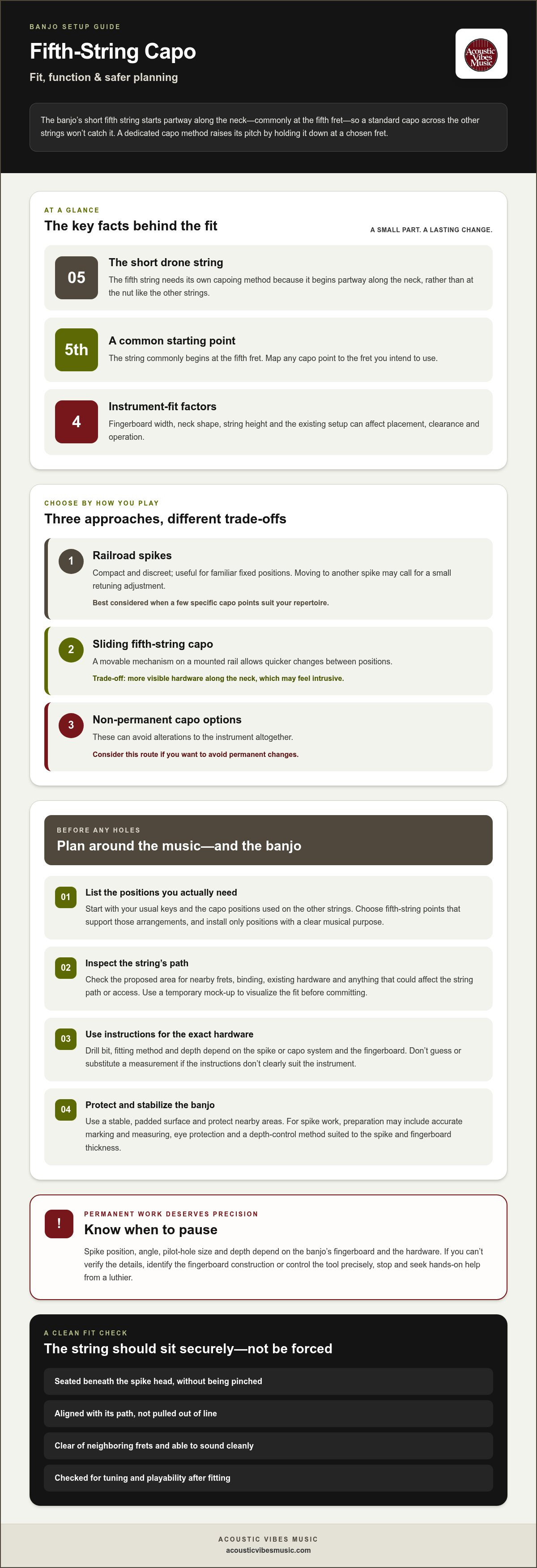
A clean installation should hold the fifth string securely, produce clear notes, and remain comfortable to play. Test every installed position before relying on it in a performance. If something sounds or feels wrong, compare how the string behaves open and capoed before changing the hardware. Symptoms can point to different issues, and a careful check helps narrow them down.
If a symptom appears only when the string is capoed, inspect its seating and the spike’s position without pushing or bending anything. If the open string also buzzes or sounds unstable, the string’s condition, fret contact, or broader banjo setup may be involved. A tuning change after capoing can have more than one cause. Compare the same string open and capoed, and note exactly when the problem begins. Don’t force the string beneath the spike or bend the hardware as a quick fix.
Different symptoms can overlap. A worn string, contact with a fret, or a setup issue elsewhere on the instrument may resemble a capo-placement problem. These checks can help describe what’s happening, but they won’t always identify the cause on their own.
Stop adjusting if a spike feels loose, the fingerboard or fret wire appears damaged, buzzing persists, or tuning remains unstable. Repeatedly removing and refitting a spike can enlarge the hole or worsen its alignment. Avoid further work if you can’t tell whether the problem is the capo, the string, or the banjo’s setup, especially on an instrument you value.
For a persistent problem or an installation that doesn’t feel secure, book professional banjo repair and maintenance with Acoustic Vibes Music. A luthier can assess the capo fit alongside the instrument’s overall playability.
Decide based on more than confidence with a drill. A spike hole is a permanent change, so control over its position and depth matters. Use this comparison to weigh your readiness before choosing what to do next.
| Consideration | DIY may suit you if… | Professional help makes sense if… |
|---|---|---|
| Readiness | You’ve completed precise instrument work and can follow instructions for the specific hardware and banjo. | You’re new to this work, unsure of the method, or hesitant about altering the fingerboard. |
| Tool control | You have suitable tools and can measure, align, and limit drilling depth accurately. | You lack depth control, or the bit, spike, or fitting instructions don’t clearly suit the instrument. |
| Instrument risk | The banjo’s construction is familiar, and the fingerboard and frets are in sound condition. | The instrument is valuable, has previous damage, or has an unusual fingerboard or setup. |
| Follow-up setup | You can assess string clearance, tuning, buzzing, and playability after fitting. | Problems persist or you can’t tell whether the cause is the spike, string, frets, or broader setup. |
DIY is best reserved for players with experience in precise work, appropriate tools, and a clear plan. Before making a hole, know which fret positions you need, how the string will pass beneath each spike, and how you’ll control hole depth according to the hardware’s instructions. If any part of the banjo’s construction or installation method is uncertain, stop. Don’t improvise a measurement on the fingerboard.
Professional assessment is a sensible choice for a valuable banjo, previous fingerboard damage, unusual construction, or playability issues that remain after installation. A luthier can consider spike placement alongside string clearance and the surrounding setup, rather than treating the hardware in isolation. Acoustic Vibes Music offers banjos and professional luthier repair and maintenance for players who want careful hands-on support.
If you’d rather leave the fitting or assessment to experienced hands, explore professional instrument repair. Choosing help isn’t a failure to DIY. It’s a considered way to protect an instrument you value.
A reliable fifth-string capo begins with a thoughtful choice of system and carefully planned placement. Railroad spikes offer discreet, fixed capo points, while sliding capos provide adjustability with different hardware and fit considerations. For any banjo fifth string capo installation, exact placement and depth must suit the instrument. Then check that the string sits securely, sounds clear, stays in tune, and feels comfortable to play.
DIY may suit you if you have precise tools, experience, and instructions specific to your instrument. If the banjo is valuable, its construction is unfamiliar, or the result feels or sounds wrong, professional assessment can help protect it. There’s no need to force a decision or risk a permanent mistake.
Acoustic Vibes Music offers banjos and professional luthier repair and maintenance by appointment. Explore professional instrument repair for hands-on help with your banjo. With a suitable plan and support, you can get back to playing with confidence.
The best method depends on how you play and whether you want fixed or adjustable capo positions. Railroad spikes are compact and provide set positions along the neck; a sliding capo moves between positions but adds mounted hardware. Non-permanent options avoid drilling. Consider your usual keys, how often you change positions, and how each system fits your banjo before choosing.
Yes, but DIY installation is best for someone with experience in precise work, suitable tools, and clear instructions for the specific spike and banjo. You need to control the hole’s position and depth, then check string clearance and playability. A misplaced or overly deep hole can damage the fingerboard. If the instrument’s construction or instructions are unclear, stop and book professional luthier repair with Acoustic Vibes Music.
Choose each spike position to suit the keys and tunes you regularly play, with the spike placed so the fifth string can sit securely beneath its head. Exact placement depends on the banjo’s geometry, fret wire, string path, and hardware. Don’t rely on a universal measurement or copy a location without checking it against your instrument and the spike maker’s fitting instructions.
There’s no set number. Install only the positions that support your repertoire and playing habits. Start by listing the keys you use and mapping the fifth-string capo points that help with those arrangements. Each spike adds another fixed position, so extra hardware isn’t automatically useful. A luthier can help assess suitable positions if you’re unsure how the string path or instrument setup affects placement.
They can contribute to buzzing if the string doesn’t sit properly, but a buzz may also relate to the string, fret contact, or broader setup. Compare the sound with the fifth string open and capoed, and check whether the string is seated consistently beneath the spike. Don’t force the string or bend the hardware to silence the noise. Stop if you see damage or the cause isn’t clear.
Neither is best for every player. Spikes are discreet fixed points and suit players who use familiar positions, though you may need to retune slightly after moving the string. A sliding capo allows quick position changes but adds a rail along the neck that may affect hand comfort. Consider your repertoire, preferred changing speed, and the hardware’s fit on your banjo.
Choose a luthier if the banjo is valuable, has previous damage or an unusual fingerboard, or you’re uncertain about drilling depth and placement. Professional help also makes sense if a spike feels loose, tuning is unstable, or buzzing persists after fitting. Acoustic Vibes Music offers banjos and professional luthier repair and maintenance by appointment, including hands-on help if you’d rather not risk a permanent alteration.