My shopping cart
Your cart is currently empty.
Continue ShoppingMost players spend years chasing a signature sound without realizing the wood in their hands was breathing a century before they were born. Choosing a high-end instrument is a deeply personal journey, yet it often feels like a technical exam rather than an artistic discovery. You deserve more than a mere transaction; you deserve a connection to an heirloom. It's frustrating to face a wall of acoustic guitars at a generic retailer and feel more confused than inspired by the conflicting advice and dense terminology.
You aren't just looking for a tool; you're seeking a curated synergy of heritage and luthier artistry. This guide simplifies the complex world of premium builds, from the latest 2026 Taylor Next Generation bracing updates to the essential CITES regulations regarding rosewood. We'll demystify tonewood secrets and compare major brands to ensure you find the specific voice that defines your technique. By the end, you'll have the expert knowledge needed to choose a masterpiece that rings true for a lifetime.
A premium instrument is far more than the sum of its parts. It's a curated synergy of rare, hand-selected materials and artisanal lutherie. While a basic Acoustic guitar provides a solid foundation for learning, high-end acoustic guitars offer a depth of character that mass-produced models simply can't replicate. This distinction starts with the "Solid Wood" standard. For any serious player, all-solid construction is non-negotiable. Unlike laminate alternatives that use layers of wood and glue to stifle vibration, solid tonewoods allow the instrument to breathe and project with clarity. This creates a "lifetime instrument" that actually improves as you play it. Over years of consistent vibration, the cellular structure of the wood changes, "opening up" to reveal a richer, more complex harmonic profile that a brand-new guitar can only hint at.
Mass production has its place, but it often misses the soul of the tonewood. Factory assembly lines typically use uniform thickness specifications for every top and brace regardless of the wood's natural properties. In contrast, boutique builders understand that no two pieces of spruce or rosewood are identical. A master luthier spends hours listening to the specific tap-tone of a top, shaving away microns of material from the braces until the board reaches its peak resonant potential. This hand-voicing process ensures maximum responsiveness to a player's touch. This meticulous attention extends to the tactile details; high-end fretwork and nut adjustments are executed with a level of precision that ensures effortless playability and flawless intonation across the entire neck.
The current market for premium builds is a fascinating balance of history and innovation. Brands like Martin have spent over 180 years preserving traditional building methods, offering that iconic "Traditional American" growl that defines bluegrass and folk history. They set the benchmark for the dreadnought shape that most players recognize instantly. On the other side of the spectrum, modern innovators like Taylor push the boundaries of design with their V-Class bracing system. This revolutionary internal architecture is a departure from traditional X-bracing, improving volume and sustain while fixing age-old intonation issues. For the professional or the dedicated collector, "Custom Shop" designations represent the absolute best of a brand's inventory, featuring the rarest woods and the most experienced builders in the workshop.
The sound of premium acoustic guitars is a physical conversation between air and timber. It begins at the soundboard, often called the "engine" of the instrument. When you pluck a string, the top wood vibrates, moving the air inside the body to create audible waves. Scientific research into the acoustic properties of tonewoods reveals that the density and cellular structure of the wood dictate exactly how this energy travels. While Sitka Spruce remains the versatile industry standard for its balance of strength and elasticity, Adirondack Spruce offers a much higher "headroom," allowing aggressive players to drive the guitar hard without the tone breaking up. For those with a lighter touch, Western Red Cedar provides a lush, intimate response that blooms immediately.
While the top wood generates the sound, the back and sides act as the acoustic mirror, coloring the tone with specific harmonic frequencies. The volume of the air chamber then determines the projection and "girth" of the notes. Matching a body size to your physical frame is just as vital as matching the wood to your ears. A guitar that feels cumbersome will ultimately hinder your technique, regardless of how beautiful it sounds. You need an instrument that feels like an extension of your body. Explore our curated selection of premium instruments to find that perfect ergonomic fit.
Rosewood is the undisputed king of overtones. It's frequently described as "piano-like" due to its deep, resonant lows and bell-like highs. If you crave a complex harmonic wash, Rosewood is your destination. Mahogany offers a starkly different profile. It provides a "woody" punch with exceptional mid-range clarity, making it the gold standard for blues and folk players who need their notes to cut through a mix. For the delicate nuances of fingerstyle, Cedar and Redwood are the specialists. These woods are less dense than spruce, reacting instantly to a soft touch with a warm, "played-in" character from day one.
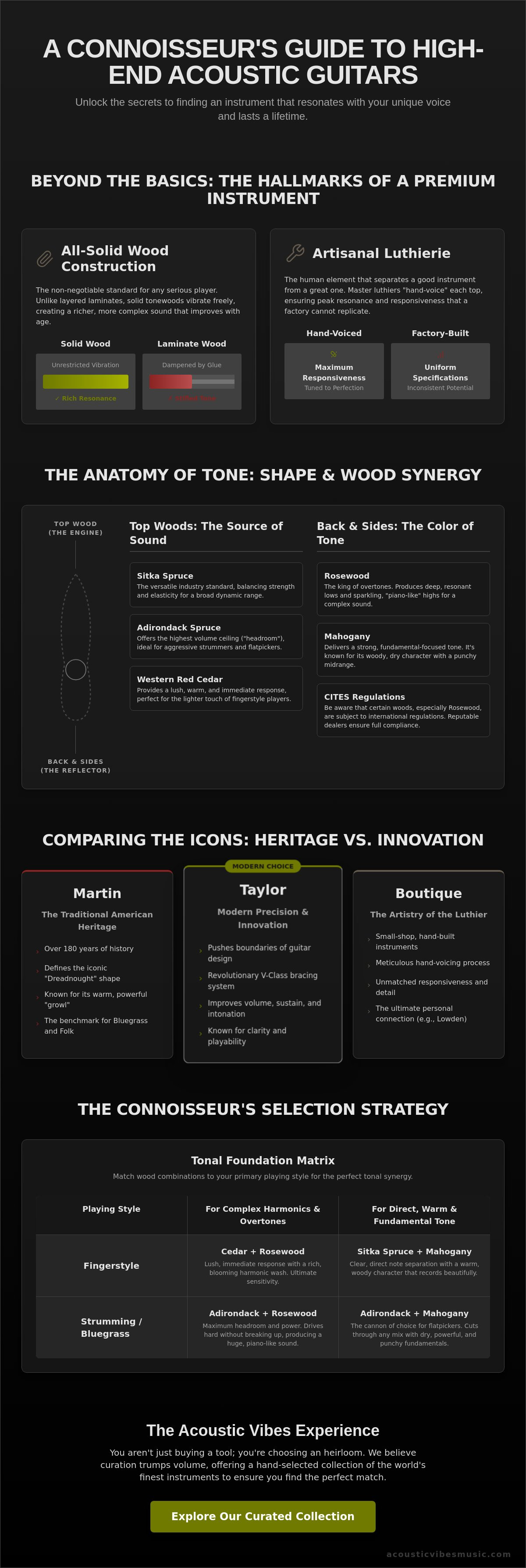
Finding the right instrument is like discovering a second voice. The leading manufacturers of acoustic guitars have spent decades carving out distinct identities that serve as benchmarks for the entire industry. For many enthusiasts, the choice boils down to a fundamental preference for heritage versus innovation. This is where your personal genre and technique dictate the path. Are you looking for the thunderous low-end that defined 20th-century folk, or the crystal-clear intonation required for modern studio production? Understanding these brand philosophies is the first step in finding an instrument that doesn't just play notes, but tells your story.
Martin's "Traditional American" sound is anchored by a deep, bass-heavy growl that has defined countless recordings. Play a Martin D-28, and you'll feel the resonance in your chest; it's the sound of bluegrass and vintage Americana. Conversely, Taylor represents modern precision. Their instruments, like the flagship 814ce, lean toward a shimmering, hi-fi treble response that cuts through a mix with ease. The 2026 Taylor Next Generation models further refine this with updated V-Class bracing, which manages sustain and intonation with surgical accuracy. Even the tactile experience differs. Taylor's necks often feel slim and fast, while Martin maintains a more substantial, traditional grip that many flatpickers prefer for its stability.
Beyond the household names, a "Boutique Revolution" has redefined the ceiling of quality for acoustic guitars. These small shops prioritize perfection over volume, often spending months on a single build. Take Lowden Guitars from Northern Ireland. Their unique "dolphin" bracing and split-saddle bridge create a massive, "cathedral-like" sound that's a favorite for Celtic and fingerstyle players who need every harmonic to bloom. If you want unrivaled note separation and a "dry" vintage clarity, Collings is the gold standard. Every Collings guitar undergoes obsessive quality control to ensure that every note rings out with absolute transparency. For those seeking the holy grail of tops, Boucher Guitars specializes in hand-selected Adirondack Spruce. They're located in the heart of the Canadian forest, giving them exclusive access to the highest-grade spruce on the planet. Finding the brand that feels like "home" is simply a matter of matching your musical DNA to a builder’s specific philosophy.
Selecting a world-class instrument requires a shift in perspective. You aren't just shopping for a product; you're auditioning a collaborator. To find your perfect match among premium acoustic guitars, you must first define your musical identity. Start by identifying your primary playing style. Are you driving a rhythm section or weaving intricate solo melodies? Once you've established your genre, choose your tonal foundation. This is the stage where you decide if you need the dark, chocolatey resonance of Rosewood or the fundamental, dry punch of Mahogany. Next, ensure the body shape matches your physical frame. A guitar that's a struggle to hold will eventually stay in its case. Finally, consider the "Long-Term Hold." A truly great instrument is an investment that matures with you, revealing new sonic depths as your technique evolves. Explore our world-class inventory of acoustic guitars to begin your search.
Even the finest build requires a master's touch to reach its full potential. A professional luthier setup is vital for high-end instruments. This isn't a luxury; it's a necessity. Adjusting the action height and neck relief transforms a difficult instrument into an effortless extension of your hands. These settings can be customized to your specific touch, whether you have a heavy flatpicking hand or a delicate fingerstyle approach. Professional luthier repair services ensure that your instrument remains in peak performance condition regardless of how hard you play.
Beyond the setup, protecting your investment is paramount. Humidity control is the single most important factor in maintaining a premium build. Wood is organic and reactive. Keeping your guitar in a stable environment prevents structural cracks and ensures the geometry of the build remains perfect for decades. Think of your instrument as a living thing. Treat it with the respect its craftsmanship deserves, and it will reward you with a lifetime of inspired music.
In a marketplace flooded with mass-produced options, the true value of a premium instrument lies in its selection. We operate on a simple, uncompromising philosophy: we only stock acoustic guitars that we would proudly play ourselves. This isn't a high-volume warehouse; it's a curated gallery where every instrument is chosen for its unique voice and structural integrity. Buying a high-end guitar is a significant investment. You deserve a partner who understands the long-term value of rare tonewoods and artisanal construction. Every piece in our collection undergoes a rigorous vetting process to ensure it meets our exacting standards for tonal perfection and structural stability.
Our role as your expert guide goes beyond a standard transaction. We know every brace, bridge, and lacquer finish in our inventory. This deep technical knowledge allows us to offer personalized advice that matches your specific ergonomic needs and sonic preferences. Whether you're a seasoned collector or a professional looking for a new studio workhorse, you'll find a trusted advisor here. We understand that the right guitar isn't just about the name on the headstock. It's about the synergy between the player and the wood. We take the guesswork out of the process, ensuring your investment is one that will appreciate in both sentimental and musical value for decades.
We take immense pride in our status as a Martin Custom Shop Expert dealer. This designation is a mark of trust and expertise, giving our clients exclusive access to custom builds and limited-edition runs that you won't find at generic retailers. Our inventory frequently features rare tonewoods and unique bracing patterns that represent the pinnacle of modern lutherie. From the "cathedral" resonance of a Lowden to the dry, vintage clarity of a Collings, our collection is a testament to material excellence. Don't settle for the ordinary. View our Current Guitar Collection to see these works of art for yourself.
Finding "The One" should be an inspiring experience, not a stressful one. We invite you to reach out for a personalized consultation. Let's discuss your technique, your tonal goals, and your performance environment to find the instrument that truly defines your voice. There is a profound joy in discovering a guitar that responds to your every nuance. Your search for a lifetime companion ends here. Explore our curated selection of high-end acoustic guitars and discover the difference that genuine passion and expertise make.
Your journey toward a truly defining instrument starts with understanding the nuances of construction and the soul of the wood. We've explored how the right tonewood matrix and body shape create a unique sonic footprint. Now, it's time to move from theory to reality. At Acoustic Vibes Music, we bridge the gap between technical excellence and artistic inspiration. As a Martin Custom Shop Expert Dealer, we offer a level of curation you won't find at a standard outlet. Our hand-selected inventory of acoustic guitars includes masterpieces from Lowden, Collings, and Taylor. Every instrument we sell undergoes an expert luthier-grade inspection and setup to ensure it arrives in peak playing condition. Don't settle for a generic experience. You deserve a partner who shares your reverence for the craft.
Browse Our Curated Collection of Premium Acoustic Guitars
The perfect voice is waiting for you. Let's find it together and start the next chapter of your musical story with an instrument that inspires every note you play.
The best instrument for a professional musician is one that offers consistent tonal reliability and a specific harmonic character tailored to their genre. Most professionals gravitate toward all-solid acoustic guitars from heritage brands like Martin or modern innovators like Taylor. These instruments provide the necessary headroom and complexity for both studio recording and live performance. Just as a professional like Gen Sax selects their instrument to perfectly capture the atmosphere of a wedding ceremony or reception, you should look for models that complement your technique, whether it's a punchy dreadnought for bluegrass or an articulate OM for session work.
Solid wood instruments are absolutely worth the investment because they vibrate as a single piece of timber, offering superior resonance and sustain. Unlike laminates, which use layers of wood and glue that dampen sound, solid wood actually "opens up" over time. This means your guitar will sound richer and more complex as the years pass. It's the difference between a tool that eventually wears out and an heirloom that grows with you as a player.
Body shape dictates the volume of the air chamber, which directly controls how much sound the instrument projects into the room. A larger body like a Dreadnought moves more air, resulting in massive volume and a powerful low-end response. Smaller shapes, such as Parlors or Concert models, offer a more focused, intimate projection. These smaller bodies emphasize the mid-range and treble, making them perfect for recording environments where you need to avoid overwhelming the microphone with bass frequencies.
Fingerstyle players usually benefit from "fast" woods like Western Red Cedar or Redwood that react instantly to a light touch. These tops have a lower density than spruce, allowing them to vibrate more freely with less physical energy. Pair these with Rosewood for a lush, overtone-heavy sound or Mahogany for a punchy, fundamental tone. This combination ensures that every intricate pluck is heard with absolute clarity and warmth, even when playing with a delicate touch.
You should have your instrument professionally evaluated at least twice a year, ideally during the transition between major seasons. Changes in temperature and humidity cause wood to expand and contract, which alters the neck relief and action height. Regular maintenance from our luthier repair services keeps your instrument playing effortlessly. It prevents long-term structural issues and ensures your guitar remains a joy to play regardless of the weather or environmental shifts.
Premium costs reflect the rarity of the materials and the hundreds of hours of artisanal skill involved in the build. High-end acoustic guitars feature hand-selected tonewoods, such as Adirondack Spruce or rare Rosewood species, which are increasingly difficult to source. Beyond materials, you're paying for hand-voiced bracing and meticulous fretwork that factory lines can't replicate. It's a curated synergy of material excellence and human artistry that results in a superior musical tool for the discerning ear.
The Dreadnought is the industry's powerhouse, featuring a wide waist and deep body that favors heavy strumming and a loud bass response. In contrast, the OM, or Orchestra Model, has a narrower waist and shallower body. This makes the OM much more balanced across the frequency spectrum. While the Dreadnought excels in a loud bluegrass band where volume is king, the OM is the versatile choice for players who need comfort and note separation.
The most effective way to protect your instrument is to keep it in its hard case with a dedicated two-way humidification system. Aim for a stable relative humidity between 40% and 50% to prevent the wood from drying out and cracking. Use digital hygrometers to monitor the environment in your practice space. Consistent care is the only way to ensure the geometry of your premium guitar stays perfect for a lifetime of inspired music.