My shopping cart
Your cart is currently empty.
Continue ShoppingMost players spend years chasing the perfect tonewoods while ignoring the six small pegs that anchor their sound. These components are the final filter for your resonance. If they're soft plastic or poorly fitted, they're dampening the very shimmer you've been searching for. It's time to consider an acoustic guitar bridge pin replacement to unlock the hidden potential of your instrument. We understand the hesitation. The fear of cracking a bridge or the confusion over 3-degree versus 5-degree tapers can stop any enthusiast in their tracks. Precision matters when it comes to your pride and joy.
You deserve an instrument that sings with clarity and sustains with authority. You'll learn exactly how to select and fit the perfect set of pins to enhance your guitar's voice. We'll explore the technical nuances of tapers and the rich tonal signatures of artisanal materials like bone and buffalo horn. This guide provides the expert knowledge needed to achieve a snug, professional fit. Protect your bridge plate. Elevate your aesthetic. Discover the joy of a perfectly calibrated instrument.
The bridge pin is far more than a simple plastic peg. It serves as the critical anchor for string tension, acting as the final conduit in the vibrational chain between the string and the soundboard. To understand its role, one must look at the overall function of the Bridge (instrument), which acts as the heart of your guitar's acoustic projection. Over time, constant pressure from high-tension strings takes a toll. If you notice your pins are bent, chewed, or "mushroomed" at the bottom, it's time for an acoustic guitar bridge pin replacement. These physical deformities prevent the pin from seating correctly, which often leads to mysterious buzzing or a frustrating loss of sustain. When a pin fails to seat, the energy transfer is interrupted. The result is a guitar that sounds smaller and less vibrant than the day you bought it.
Before you commit to a full setup, inspect your hardware for these specific physical warnings:
A loose or ill-fitting pin is a silent threat to your instrument's longevity. When a pin doesn't fit snugly, the string's ball end can migrate, slowly chewing into the hardwood bridge plate underneath the top. This is particularly common with softer plastic pins that deform under heat and pressure. Look closely at the bridge surface during your next string change. Is there a visible gap between the pin head and the wood? If the pins sit unevenly or "pop" up during tuning, they aren't doing their job. This misalignment puts uneven stress on the bridge itself. Ignoring these signs can lead to significant structural damage to the top wood, potentially requiring a costly luthier intervention to repair the bridge plate. A perfect, flush fit is non-negotiable for a healthy instrument.
Even if your pins look intact, they might be robbing your guitar of its voice. Many factory-standard acoustic guitars come with inexpensive plastic pins that absorb vibration rather than reflecting it. If your premium instrument feels like it has lost its "sparkle" or the treble notes sound muffled, the pins are likely the culprit. This "dead string" syndrome is often just a symptom of poor energy transfer. Upgrading to heirloom-quality materials like ebony, bone, or even buffalo horn can restore that lost resonance. Collectors and discerning players prioritize these materials because they provide a denser, more responsive connection to the soundboard. While plastic is functional, it lacks the material excellence found in artisanal alternatives. It's a simple change that yields a sophisticated, custom result, turning a standard instrument into a curated masterpiece of sound.
Material selection is the ultimate refinement in the vibrational chain. While the body of your instrument provides the character, the bridge pins act as the gatekeepers of energy. Selecting the right material for your acoustic guitar bridge pin replacement is a decision that balances physics with artistry. Density is destiny here. A heavier, denser pin will typically increase sustain and brightness, while a lighter, organic material can provide a softer, more traditional attack. As experts often discuss how to Enhance Your Acoustic Guitar's Tone, the mass of these small components dictates how much energy actually reaches the soundboard versus how much is absorbed by the bridge itself.
Ebony remains the gold standard for many high-end builds. Its dense, tight grain provides a focused and mellow response that tames aggressive trebles. For those seeking a darker aesthetic with the tonal properties of bone, buffalo horn is an exceptional choice. At approximately $10.99 for a set, buffalo horn offers a sophisticated look and a clear, articulate voice. If you prefer the traditional "woody" snap of rosewood, you can rest easy knowing that since the November 2019 CITES revision, finished accessories like rosewood bridge pins are exempt from international documentation requirements. For the truly discerning collector, snakewood or boxwood pins offer rare, evocative textures that turn the bridge into a curated gallery of natural beauty.
Modern innovation has introduced materials that challenge traditional lutherie. Martin LUXE Liquidmetal pins utilize a zirconium alloy that reflects energy back into the strings rather than absorbing it. This results in a measurable increase in volume and sustain without altering the fundamental voice of the wood. If your instrument sounds muddy or lacks "cut," brass or titanium pins can provide a dramatic brightening effect. These high-mass options are perfect for cutting through a dense mix. For the touring professional, synthetic materials like Tusq offer unparalleled consistency. Unlike natural bone, which can have hidden marrow pockets that dampen vibration, synthetics are engineered for uniform density. This ensures every string rings with the same authority. Whether you choose the heirloom quality of cattle bone, priced between $10.99 and $11.74, or the technological edge of alloys, the goal is a perfect marriage of material and music.
Discover the difference that premium craftsmanship makes by exploring our current selection of boutique acoustic guitars and seeing how world-class luthiers select their hardware.
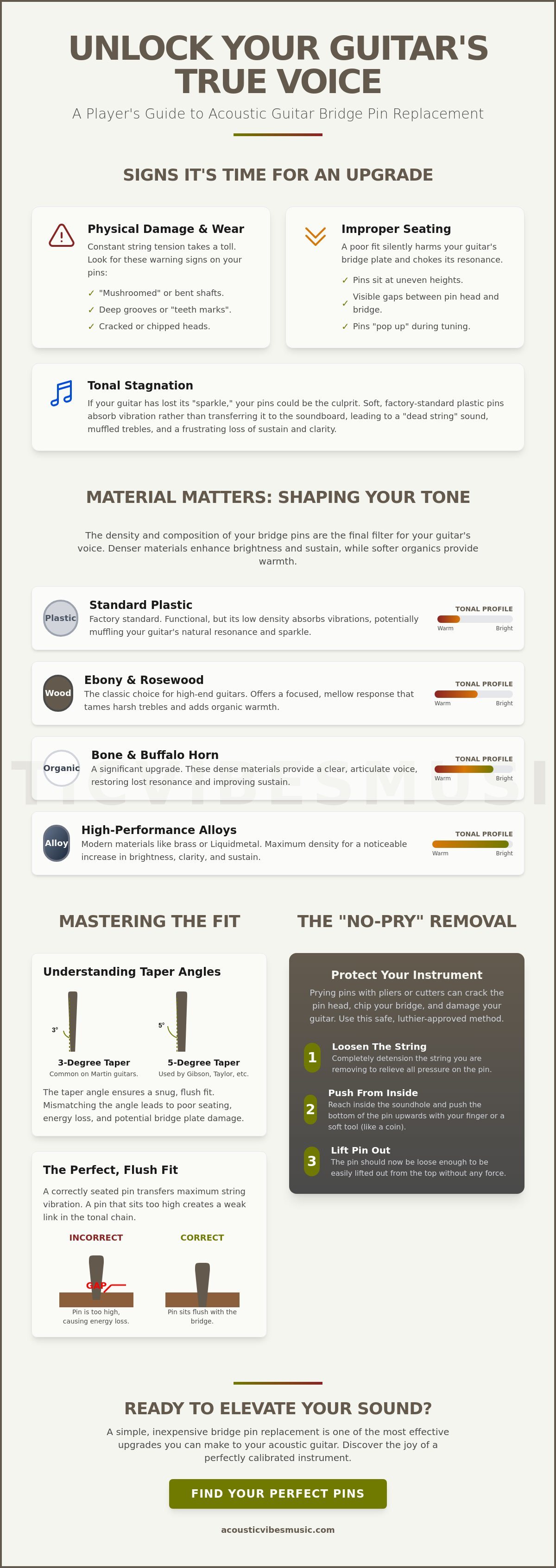
Precision is the silent partner of great tone. While material density dictates the color of your sound, the physical geometry of the pin determines the efficiency of energy transfer. An ill-fitting pin is more than a nuisance. It's a mechanical failure. If the taper doesn't match the bridge hole exactly, the string's ball end will eventually climb the pin, chewing into your bridge plate and deadening your sustain. Achieving a perfect acoustic guitar bridge pin replacement requires a deep understanding of angles and slots. You aren't just looking for a peg that stays in place. You're looking for a total mechanical lock that preserves the vibrational integrity of your instrument.
The world of high-end acoustics is not standardized, and "one size fits all" is a dangerous myth. Martin Guitars provides a classic example of these technical nuances, having navigated historical shifts from traditional 3-degree tapers to the modern 5-degree standard. Modern 5-degree pins are generally wider at the top, designed for a snug fit in contemporary bridges. Conversely, brands like Taylor and Collings utilize specific factory dimensions that demand exact replacements to maintain their signature clarity. Gibson models often vary by era, sometimes requiring slight hand-fitting by a specialist. Using an oversized pin can wedge the bridge and cause a catastrophic crack, while an undersized pin will simply pop out under tension. Always measure your existing pins with a digital caliper before committing to a new set.
The choice between slotted and unslotted pins is a hallmark of the true enthusiast's journey. Most modern players are familiar with slotted pins, where a groove in the pin allows the string to pass through the bridge. It's a convenient, reliable system. However, many master luthiers and collectors prefer unslotted pins used in "ramped" bridges. In this setup, the slot is carved directly into the bridge wood itself. This allows the pin to be a solid, uninterrupted cylinder of material, which often increases the mass and energy transfer to the soundboard. If you look at your bridge and see small channels carved toward the saddle, your guitar is already ramped. Choosing unslotted pins for a ramped bridge is a sophisticated upgrade that protects your bridge plate from the "sawing" effect of high-tension strings, ensuring your heirloom instrument remains structurally sound for generations.
Approach the physical task of acoustic guitar bridge pin replacement with the same reverence you'd give a full restoration. This isn't just maintenance; it's a ritual of precision that ensures your instrument's structural integrity remains uncompromised. Before you begin, gather your tools: a dedicated bridge pin puller, a clean microfibre cloth, and your chosen set of high-quality strings. Preparation is half the battle. Clear your workspace and ensure the guitar is supported on a neck rest to prevent any accidental slips that could mar the finish. A calm environment allows you to feel the subtle mechanical feedback of the wood.
The cardinal sin of bridge maintenance is the use of pliers. Pliers are strictly forbidden in this process because they inevitably crush the pin heads and leave unsightly gouges in the bridge wood. Instead, utilize a dedicated puller that applies even, vertical pressure. If you encounter a stubborn, stuck pin, don't force it from above. Reach inside the soundhole and gently push the pin upward from the bottom using a small, flat object like a coin. This "push from inside" method protects the bridge plate from unnecessary trauma. Always place a thin protective barrier, such as a piece of cardstock, over the delicate spruce top to catch any tool that might slip during the process.
Once the old pins are removed, take a moment to inspect the bridge holes and the plate underneath for any signs of wear or "sawing" from previous string ball ends. When fitting your new hardware, the most critical step is the "tug-and-set" technique. After inserting the string and the pin, give the string a firm upward tug while holding the pin down with your thumb. You should feel the ball end lock firmly against the bridge plate, not the bottom of the pin. If the pin sits too high, it's a "high-rider" and likely indicates an incorrect taper match from a previous section's guide. A perfect seat is defined as a pin that stays in place by friction, not force. If you're looking to pair your new hardware with a world-class instrument, explore our collection of premium acoustic guitars to find your next heirloom.
Finally, bring your guitar up to pitch slowly. Monitor the pins as you increase tension to ensure they don't "creep" upward. A successful replacement results in a flush, aesthetic look and a noticeable improvement in vibrational transfer. Your guitar is now ready to perform with its full, intended voice. Listen for the increased clarity in the treble and the renewed authority in the bass notes.
An acoustic guitar bridge pin replacement is often the catalyst for a more comprehensive tonal awakening. While the pins anchor the strings, they exist within a delicate ecosystem alongside the saddle and bridge plate. A change in pin material or fit can subtly shift the break angle of the string over the saddle. This shift influences both playability and the downward pressure required to drive the soundboard effectively. It's the ideal moment to assess your instrument's overall health. Matching the visual elegance of your pins to the guitar's existing appointments, such as abalone inlays or herringbone purfling, creates a cohesive, curated look. It reflects a deep respect for the artistry of the build and your own personal style.
While DIY upgrades are rewarding, certain refinements require the steady hand of a specialist. A professional luthier can use a bridge pin reamer to ensure a custom 5-degree fit that factory-standard holes might lack. This meticulous adjustment guarantees maximum surface contact, which is the secret to unlocking hidden sustain and preventing energy loss. For vintage instruments, an expert inspection of the bridge plate is essential. They can identify if years of string tension have compromised the wood before new hardware is installed. Integrating these upgrades into a seasonal maintenance schedule ensures your instrument adapts to humidity changes. It maintains peak resonance and structural integrity throughout the year.
Observing how world-class builders approach these details provides a blueprint for your own upgrades. Premium brands like Collings Guitars or Boucher Guitars are renowned for their specialized bridge components. Every gram of mass is calculated for performance. Even the custom shop models from Martin frequently arrive factory-equipped with upgraded pins. This acknowledges that these small parts are vital to the "heirloom" experience. There is a profound joy in playing an instrument where every component has been selected with intention. It transforms a simple practice session into a moment of discovery. Your guitar becomes more than a tool. It becomes a partner in your creative journey. Trust your ears. Honor the craft. Let your guitar reach its full potential through expert care and thoughtful modification.
The journey to a more articulate sound begins with the smallest details. By mastering the nuances of an acoustic guitar bridge pin replacement, you've taken a significant step toward preserving your instrument's heritage and enhancing its natural shimmer. You now understand how material density dictates tone and why a precise taper fit is the ultimate safeguard for your bridge plate. These refinements transform a standard guitar into a highly calibrated tool for expression. Every vibration counts when you're pursuing perfection.
As an Authorized Martin Custom Shop Expert Dealer specializing in heirloom-quality brands like Lowden and Collings, we're dedicated to the pursuit of tonal excellence. Our team is here to guide you through every artisanal choice. If your instrument requires a more technical touch, our professional luthier services are available by appointment to ensure every component is flawlessly fitted. We believe that every player deserves an instrument that responds with authority and grace.
Explore our curated collection of premium acoustic guitars and accessories to find the perfect match for your musical journey. Your instrument has a unique voice waiting to be heard. Trust your ears and enjoy the joy of discovery.
Bridge pins absolutely influence your tonal output by functioning as a vibrational gatekeeper. Denser materials like bone or brass reflect more energy back into the string, which increases sustain and high-end clarity. Conversely, softer materials like plastic tend to absorb vibration, resulting in a warmer, more rounded attack. It is a subtle but distinct refinement for any discerning player.
The primary difference lies in the specific angle of the taper along the pin's shaft. A 3-degree taper is narrower and frequently found on vintage-style instruments or specific boutique builds. The 5-degree taper is the contemporary standard for many modern manufacturers. Using the incorrect angle prevents a flush seat and can eventually damage your bridge plate through uneven pressure.
You can use a dedicated puller, but a "no-pry" approach is always best for heirloom instruments. While a high-quality puller is far safer than pliers, seasoned collectors often prefer reaching inside the soundhole to push the pin out from below. This eliminates any risk of marring the bridge surface or putting unnecessary pressure on a fragile spruce top.
Your pins are the correct size if they slide into the bridge hole and seat firmly with only light thumb pressure. If the pin "high-rides" or feels loose, the taper is likely a mismatch. We recommend using a digital caliper to measure your existing hardware's diameter at the top of the taper to ensure a perfect mechanical lock before purchasing a replacement set.
Your choice depends entirely on whether your bridge has been ramped. Slotted pins are the standard for most modern instruments, as the groove provides a clear path for the string to bypass the pin. However, unslotted pins are the preferred choice for ramped bridges, as they offer more mass and a solid surface to reflect vibrational energy into the soundboard.
Brass pins will noticeably brighten an instrument's voice due to their high density and significant mass. This is an excellent solution for "darker" guitars that lack projection or high-end shimmer. If your guitar is already naturally bright, the added brilliance might feel overwhelming. It is a precision tool for balancing your instrument's natural frequency response.
The safest way to remove a stuck pin is to push it from the bottom. Reach through the soundhole and use a small, flat object to apply upward pressure directly to the tip of the pin inside the body. This method avoids the prying forces that often lead to cracked bridges or chipped finishes on the delicate spruce top.
An acoustic guitar bridge pin replacement from plastic to bone is one of the most effective upgrades for a high-end instrument. Bone is significantly denser and more durable than factory plastic, ensuring better energy transfer and a crisper treble response. It is a simple way to elevate a premium guitar to its full artisanal potential without invasive modifications.