My shopping cart
Your cart is currently empty.
Continue ShoppingIs that iconic, hand-carved scroll on an F-style mandolin actually worth the significant price jump over its teardrop-shaped sibling? It's a question every enthusiast asks when they first encounter a master-built instrument. When exploring the different types of mandolin A-style vs F-style, it's easy to get lost in the aesthetics. Most players feel the magnetic pull toward the ornate silhouette of the F-style, often equating its visual prestige with a superior acoustic voice. You're not alone if you find yourself torn between the elegant simplicity of an A-style body and the legendary status of the scroll and points.
Discover the structural, sonic, and cultural differences between these designs to find the perfect instrument for your playing style. Whether you're chasing the percussive bark required for a bluegrass jam or the sweet, lingering sustain of a Celtic air, understanding the artisanal nuances of bracing and soundhole design is essential. We will peel back the layers of tradition to examine how internal tone bars, X-bracing, and material choices like torrefied spruce or modern carbon fiber shape your musical identity. Feel the resonance; listen to the wood. Get ready to move beyond the aesthetics and make a confident investment in your next heirloom-quality mandolin.
Orville Gibson changed the course of musical history when he applied violin-making principles to the mandolin in the late 19th century. By replacing the fragile, round-backed "tater bug" design with a carved, arched top and back, he created an instrument with unprecedented volume and projection. This innovation birthed the two iconic silhouettes that continue to define the market in 2026. While modern boutique builders like Collings have refined these designs with contemporary precision, the fundamental choice between the primary types of mandolin A-style vs F-style remains the most significant decision for any enthusiast.
The A-style mandolin is a masterclass in understated elegance. Characterized by its symmetrical, teardrop or pear-shaped body, this design appeals to players who value clean lines and structural efficiency. Because it lacks the intricate, labor-intensive flourishes of its counterpart, the A-style allows the luthier to focus entirely on the graduation of the top and the quality of the tonewood. Many classical and Celtic musicians gravitate toward this silhouette for its refined, balanced appearance. It's also a practical choice; the lack of points and scrolls makes it lighter and easier to transport in compact cases. For the musician who travels frequently, the A-style is a reliable, streamlined workhorse that never compromises on build quality.
The F-style, or "Florentine" mandolin, represents the pinnacle of luthier artistry. Its most striking feature is the hand-carved scroll on the upper bout, paired with two sharp body points and an ornate, oversized headstock. While the scroll is a non-functional acoustic chamber, its presence is a powerful symbol of status and tradition. This silhouette became the definitive icon of bluegrass after Bill Monroe adopted the F-5 model as his signature instrument. Beyond the psychological impact of its stage presence, the F-style offers unique ergonomic benefits. The lower body points act as natural anchors when playing while seated, resting against the player's leg to provide a stable, secure foundation. It's an instrument designed for those who appreciate the marriage of visual drama and historical heritage.
Choosing between these A-style and F-style mandolins often comes down to the player's relationship with the instrument. A-style models offer a sense of modern versatility and a focused aesthetic, while F-style models provide the tactile satisfaction of intricate carving and a deep connection to bluegrass history. Both designs share the same scale length and neck dimensions, meaning the transition between them is seamless for your hands, even if the visual experience is worlds apart. Whether you're drawn to the simple curve of the teardrop or the complex architecture of the scroll, each style offers a unique gateway into the world of premium craftsmanship.
While the silhouette captures the eye, the internal architecture dictates the voice. Many players assume the scroll on an F-style adds resonance, but in reality, the air volume inside the body remains remarkably consistent across both types of mandolin A-style vs F-style. The true variance in tone comes from the specific pairing of soundhole shape and internal bracing. These elements act as the engine of the instrument, converting string vibration into the visceral acoustic energy that fills a room.
Tone Bars are the traditional internal bracing system designed to maximize the percussive projection and mid-range bark required for bluegrass. This setup has been the preferred choice for professionals since the era of the father of bluegrass, Bill Monroe. If you are looking to refine your own sound, our team can help you navigate the nuances of these builds with a professional setup tailored to your playing style.
The combination of F-holes and tone bars is the gold standard for ensemble playing. F-holes act like directional speakers, focusing the sound and pushing it forward with immense clarity. This allows the mandolin to cut through the dense textures of a banjo or fiddle. Inside, two longitudinal tone bars run nearly parallel to the grain of the spruce top. This configuration provides the structural integrity needed to withstand high string tension while emphasizing a quick, percussive "bark" that defines the bluegrass chop. It is a focused, disciplined sound that rewards a heavy right hand.
For those seeking a warmer, more resonant harmonic profile, the oval hole paired with X-bracing offers a compelling alternative. Oval holes allow for a larger volume of air to move in and out of the body, resulting in what players often call a "tubby" sustain. This setup provides a more guitar-like response, with lush overtones and a balanced frequency range. X-bracing supports the top by crossing two bars directly under the bridge, allowing the entire soundboard to vibrate with more openness. This architecture excels in Celtic, Folk, and Classical music, where solo resonance and sweetness are often prioritized over raw cutting power.
Whether you prefer the laser-like focus of a Collings mandolin with F-holes or the ethereal sustain of an oval-hole A-style, the internal build is what transforms a beautiful object into a world-class tool. Every luthier graduates these braces with artisanal precision to ensure the instrument remains stable for decades while vibrating with maximum efficiency. Understanding these hidden details is the first step toward finding a voice that truly mirrors your musical intent.
The cultural identity of the mandolin is as much about the community you play in as it is about the music itself. While we've explored how internal architecture dictates the voice, the visual silhouette often acts as a passport into specific musical neighborhoods. For decades, a subtle hierarchy existed within the community, but the modern landscape of types of mandolin A-style vs F-style is becoming increasingly inclusive as players prioritize personal tone over rigid tradition.
The pivotal moment in the development of the archtop mandolin occurred when Bill Monroe stepped onto the Grand Ole Opry stage with his Gibson F-5. That single choice cemented the F-style as the definitive icon of bluegrass. It transformed the instrument from a Victorian parlor curiosity into a high-octane lead voice capable of driving a full string band.
In traditional bluegrass jams, the F-style scroll is often treated as a visual requirement. It signals a commitment to the genre's heritage. Beyond the look, the F-style is prized for the "chop," that percussive, rhythmic bark that provides the heartbeat of the ensemble. Professional players often invest in heirloom-quality F-styles from builders like Collings because they offer the headroom and cutting power necessary to compete with a banjo. The F-style isn't just an instrument; it's a piece of stage presence that commands respect in a circle of pickers.
While the F-style dominates the bluegrass stage, the A-style has long been the secret weapon of the studio and the folk festival. Its symmetrical body often provides a melodic clarity and a "woody" resonance that's perfect for the intricate lead lines of Celtic music or the soulful drones of Old-Time styles. Many multi-instrumentalists prefer the A-style for its versatility; it sits beautifully in a mix without the aggressive mid-range bite of a bluegrass-tuned F-style. It captures a vintage, earthy sound that feels right at home in intimate acoustic settings.
The "A-style stigma" that once relegated these instruments to beginner status is rapidly disappearing. Modern innovators like Sarah Jarosz and Tim O’Brien have proven that an A-style can hold its own on any stage. These artists choose their tools based on a specific sonic preference rather than a rigid set of cultural rules. When you choose between these two styles, consider your "musical neighborhood." If you're spending every weekend at a bluegrass festival, the F-style heritage might be your best fit. However, if your journey takes you through folk, jazz, or classical landscapes, the elegant A-style offers a professional-grade alternative that focuses entirely on the purity of the note.
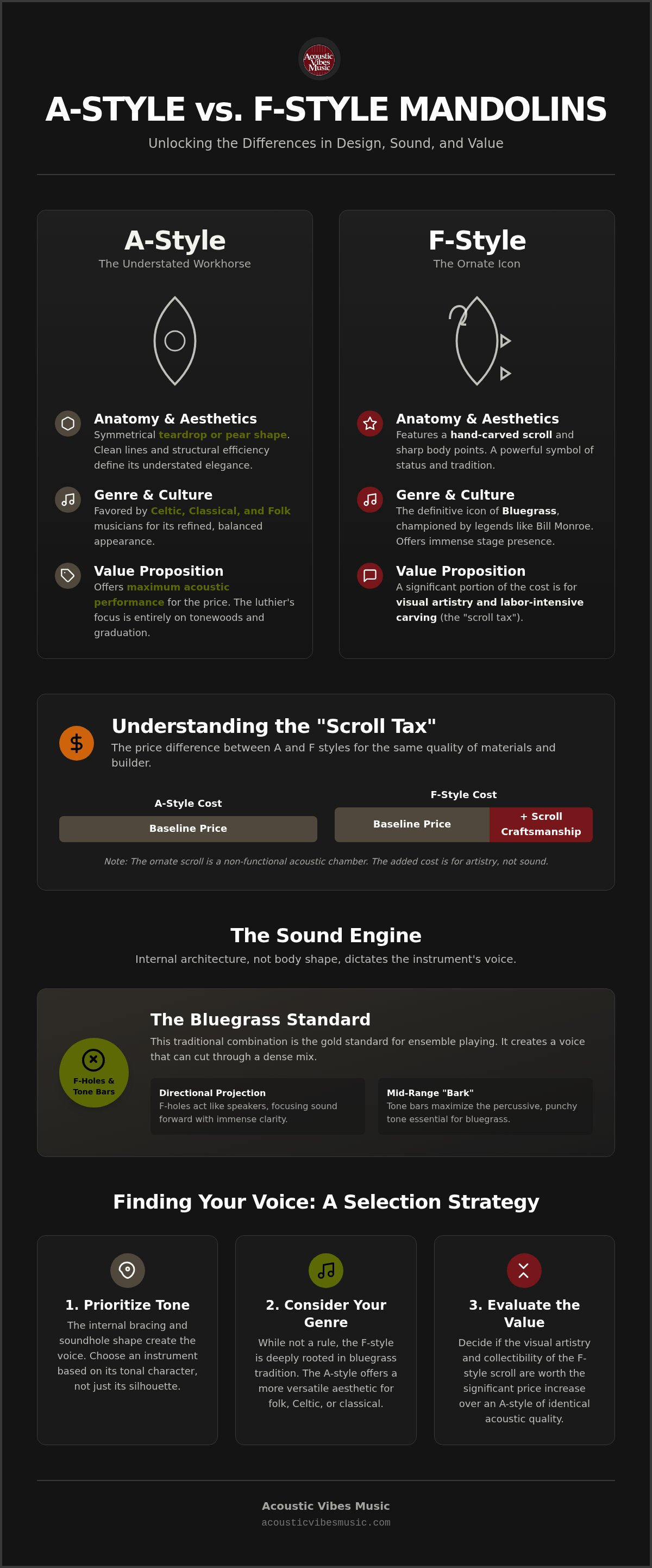
Every enthusiast eventually confronts the reality of the "Scroll Tax." When comparing two instruments built with the exact same tonewoods and internal bracing, the F-style model will typically cost 30% to 50% more than its teardrop counterpart. This price gap isn't a marketing gimmick. It's a direct reflection of the intense manual labor required to execute the Florentine design. While both types of mandolin A-style vs F-style can be world-class tools, an A-style mandolin often provides more tone per dollar for the player who prioritizes acoustic performance over visual tradition.
The difficulty of building an F-style instrument lies in the details that the eye often skims over. Binding a smooth, teardrop edge on an A-style is a relatively straightforward process. Conversely, wrapping plastic, celluloid, or wood binding around the tight, internal curves of a hand-carved scroll is a luthier's ultimate test. It requires specialized heat-bending techniques and hours of painstaking scraping to achieve a seamless finish. Elite builders like Collings Mandolins spend weeks perfecting these graduations to ensure the top vibrates freely despite the added mass of the scroll and points. Every flourish is a testament to artisanal skill, making the F-style as much a piece of sculpture as it is a musical instrument.
If you are considering the long-term journey of your collection, style significantly impacts resale value and collectibility. Historically, F-style mandolins hold their value better in the used market, largely due to the evergreen demand from bluegrass players. Collectors often hunt for limited runs or custom builds that feature unique appointments or rare figure in the maple. If you are just starting your upgrade journey, reading our guide on the Best Intermediate Mandolin can help you decide if the extra investment in a scroll aligns with your current goals. A high-end A-style from a boutique builder will always outperform a budget F-style, making it the savvy choice for the discerning ear.
Choosing an instrument is a deeply personal investment in your creative future. Whether you are drawn to the streamlined efficiency of the teardrop or the legendary architecture of the scroll, your mandolin should inspire you to pick it up every single day. Explore our curated collection of premium mandolins to find the instrument that speaks to your soul and your budget.
The journey toward your next instrument should always begin with your ears. While the visual allure of a Florentine scroll is undeniable, the most seasoned players often rely on the "Blind Fold" test. By listening to the instrument before looking at its silhouette, you can objectively evaluate its projection, tonal balance, and harmonic complexity. When exploring the different types of mandolin A-style vs F-style, you may find that the sonic differences are far more subtle than the price tags suggest. Your goal is to find a voice that mirrors your musical intent, regardless of the ornamentation on the headstock.
Budgeting for tone is a strategic art. If your investment is capped, a professional-grade A-style mandolin will almost always outplay an entry-level F-style. By choosing the teardrop shape, more of your capital goes toward premium tonewoods and master-level graduation of the top. Remember that custom options, such as the choice between the punchy headroom of Adirondack spruce and the warm, immediate response of Sitka spruce, often have a more profound impact on your sound than the body style itself. A well-built instrument with a high-quality top is a tool that grows with you over decades.
We view our inventory as a curated gallery of elite craftsmanship. Our selection process focuses on "best-in-class" tone, ensuring that every instrument we house meets a rigorous standard of acoustic excellence. To maintain this performance over time, we offer Professional Luthier Services to handle everything from seasonal setups to intricate repairs. We understand the anxiety of shipping a high-end instrument. That is why we take extraordinary care in preparing every mandolin for national shipping, ensuring it arrives at your door in performance-ready condition, perfectly humidified and expertly packed.
As you narrow down your search, use this simple framework to guide your investment:
There is no "wrong" choice in the world of premium mandolins. There is only the choice that resonates with your soul. Whether you are drawn to the timeless elegance of the teardrop or the legendary architecture of the scroll, the right instrument is the one you cannot put down. Explore our curated collection of premium mandolins today and find the companion for your next musical chapter.
Selecting between the primary types of mandolin A-style vs F-style is a milestone for any dedicated player. Whether you're chasing the percussive bark of a bluegrass icon or the sweet, woody sustain of a folk workhorse, the right choice is the one that fuels your creativity. As an authorized dealer for elite builders like Collings and Martin, we ensure every instrument in our collection meets a professional standard. Every purchase includes an expert luthier setup to guarantee elite playability right out of the case.
We take pride in our national shipping with professional packing, bringing the world's finest craftsmanship directly to your door. Your musical journey deserves an instrument that resonates with your personal style and technical needs. Trust your ears, honor the heritage of these arched-top masterpieces, and invest in a tool that will inspire you for a lifetime.
Browse Our Curated Collection of High-End Mandolins and discover the voice you've been searching for.
Not necessarily. While the F-style is iconic, the tonal quality depends more on internal bracing than the specific types of mandolin A-style vs F-style. Many professionals find that an A-style mandolin with identical specs produces the same projection and clarity. You're often choosing between the aesthetic of a scroll and the streamlined elegance of a teardrop. Both can deliver world-class resonance when crafted by master builders.
The price difference is primarily due to the intense manual labor required to carve the Florentine scroll and body points. Binding these intricate curves takes significantly more time and precision than finishing a symmetrical A-style body. When comparing different types of mandolin A-style vs F-style, you're paying for the luthier's additional bench hours. It's an investment in functional art and historical bluegrass tradition.
Absolutely. While the F-style is the visual standard for bluegrass, an A-style mandolin with F-holes and tone bar bracing provides the exact percussive bark needed for the genre. Artists like Tim O'Brien have famously used A-style instruments to drive traditional ensembles. It's the internal architecture and your playing technique that define the chop, not the presence of a decorative scroll on the body.
F-holes act like directional speakers, offering a focused, percussive sound that cuts through a loud band. This makes them ideal for bluegrass and jazz. Oval hole mandolins allow more air movement, resulting in a warmer, tubby sustain with rich overtones. These are often preferred for solo playing, Celtic melodies, or old-time music where a sweeter, more resonant harmonic profile is desired by the player.
The neck dimensions and scale length are typically identical between the two styles, so one isn't inherently easier to play. However, A-style models are often better for beginners because they offer higher quality for the same price. You can often secure a professional-grade A-style for the cost of an entry-level F-style. This ensures your first instrument has the superior setup and tonewoods needed to stay in tune.
F-style mandolins tend to hold their resale value slightly better because they're in higher demand within the bluegrass community. The Bill Monroe aesthetic remains the most sought-after look for collectors and performers alike. That said, a high-end A-style from a boutique builder like Collings will always maintain its value among enthusiasts who prioritize tonal purity and artisanal construction over purely decorative flourishes and scrolls.
Many Celtic and Folk musicians prefer the A-style mandolin, particularly those with an oval soundhole. This configuration provides a lush, open resonance that complements the intricate, melodic nature of these genres. The A-style's balanced voice sits beautifully in an acoustic mix alongside fiddles and guitars. It captures a woody, vintage character that feels authentic to the traditional roots of folk and old-time musical styles.
Usually, no. F-style mandolins require a specific case designed to accommodate the scroll and body points. An A-style mandolin will fit into an F-style case, though it may shift slightly due to the extra room. However, an F-style instrument won't fit into a standard A-style teardrop case. It's always best to use a case specifically contoured for your instrument's unique silhouette to ensure maximum protection during transport.